

Don’t Panic! Mastering the Korean Bank Transfer (Even if You Hate Math)
Hello! Daily Hangul Editor here. 👋
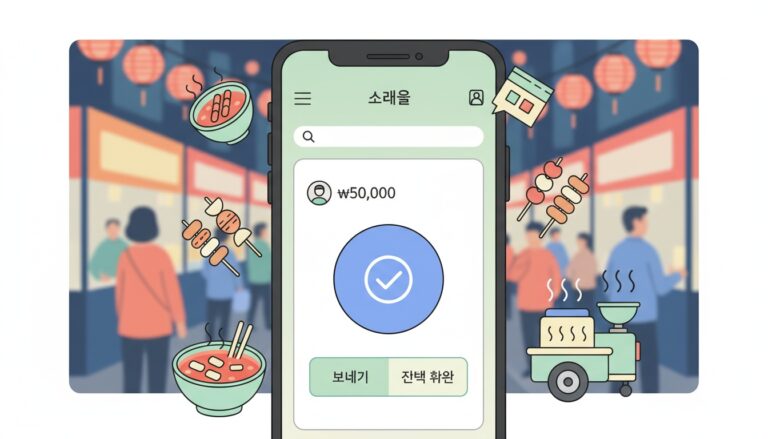
Picture this: You’re at a Pocha (street food tent) in Hongdae. You’ve just devoured some spicy Tteokbokki and Eomuk soup. You pull out your credit card, confident as ever.
The Ajumma (auntie/owner) looks at the card, then looks at you, and points to a small handwritten sign: “계좌 이체 (Bank Transfer Only).”
Panic sets in. You don’t have cash. The people behind you are waiting. You open your banking app, but everything is in Korean. 😱
Or maybe you’re at a K-BBQ joint with new Korean friends. The bill comes, and someone says, “Let’s Dutch pay.” Suddenly, everyone is looking at their phones, typing furiously.
In Korea, banking apps are social media. We send money as easily as we send text messages. If you master just three phrases, you won’t just survive—you’ll look like a total local.
Let’s get your digital wallet ready.
Phase 2: The “Magic Words” for Money 💸
We are focusing on the absolute essentials. Forget complex banking terms. You only need these to survive.
1. 계좌 번호 좀 알려주세요 (Gye-jwa beon-ho jom al-lyeo-ju-se-yo)
- Pronunciation: [Gyeh-jwa bun-ho jom al-lyuh-ju-seh-yo]
- Tip: “Gye-jwa” is the hardest part. It sounds a bit like “Get-cha” but with a softer ‘w’ sound in the middle.
- Meaning: “Please let me know your account number.”
- K-Culture Moment: You’ll hear this constantly in online second-hand markets (like Karrot Market) or when splitting bills after Bingsu (shaved ice).
- Editor’s Insight: This is your shield. If you can’t read the sign or the menu, just ask this. They will usually show you their phone screen or point to a sign.
- Situation Spectrum:
[🚫 Formal Boss] ———— [⚠️ Colleagues] ———— [✅ Shop Owners/Friends]
(It’s polite enough for shop owners, but with friends, we shorten it!)- 🤔 Think About It: Why do Koreans prefer transfers over cash? It’s about speed (Pali-pali culture) and not wanting to deal with heavy coins.
2. 얼마 보내면 돼요? (Eol-ma bo-nae-myeon dwae-yo?)
- Pronunciation: [Ol-ma bo-neh-myun dweh-yo?]
- Meaning: “How much should I send?”
- Literal: How much sending is okay?
- K-Culture Moment: The moment the bill arrives at a chicken & beer (Chimaek) place. One person pays first to save time, and everyone else asks this.
- Editor’s Insight: This saves you from doing the math. Let the Korean friend calculate the “N-bbang” (split).
- Situation Spectrum:
[✅ Perfect for almost any situation involving payment]3. 보냈어요! (Bo-naess-eo-yo!)
- Pronunciation: [Bo-ness-uh-yo!]
- Tip: Make the “ss” sound sharp, like a snake. 🐍
- Meaning: “I sent it!” / “Done!”
- K-Culture Moment: Watch any variety show where they play games for money or food. The winner often shouts this when claiming their prize.
- Editor’s Insight: Say this cheerfully while showing your phone screen to the shop owner. It confirms the transaction is finished.
Phase 3: Textbook vs. Real Life 🗣️
How does a Korean actually sound when sending money? Let’s look at the difference.
| Situation | 📖 Textbook Korean | 🗣️ Real Korean | 💡 Why the difference? |
|---|---|---|---|
| Checking if they got it | 입금 확인 부탁드립니다. (Please confirm the deposit.) |
들어갔나요? (Did it go in?) |
“Entering” (the account) is a visual, physical metaphor used in daily life. |
| Splitting the bill | 비용을 나눕시다. (Let’s divide the cost.) |
N빵 하자! / 정산해줘. (Let’s N-bbang! / Calculate it for me.) |
“N-bbang” is slang from math (dividing by N people). It’s efficient and fun. |
| Asking for account | 계좌번호가 무엇입니까? (What is your account number?) |
계좌 줘. / 카뱅이야? (Give me the account. / Is it KakaoBank?) |
Most Koreans use KakaoBank or Toss. Asking the specific bank is a shortcut. |
💡 Editor’s Note: For A1 learners, stick to “보냈어요” (Sent it). It works for the Queen of England (if she spoke Korean) and your best friend.
Phase 4: Cultural Context — The “Ding” of Trust 🔔
4-1. The Sound of Money
In Korea, silence is golden, but the sound of a banking app notification is platinum. When you send money to a shop owner, their phone will often go “Ding! 5,000 won has arrived.”
Non-verbal Tip: After you press send, hold your phone screen up to the owner for 1 second. You don’t need to shove it in their face; just a quick flash of the “Transfer Complete” checkmark. It’s the universal gesture of “I’m not a scammer.”
4-2. N-bbang (Dutch Pay) Culture
K-Dramas often show the rich protagonist paying for everyone. In reality? We split.
– Older Generation: Usually one person pays (the oldest or highest ranking). It’s a fight for the bill.
– Younger Generation (You): We do “N-bbang” (1/N). One person pays the restaurant, and everyone transfers to that person immediately.
Critical Insight: Why? It’s efficient. The restaurant owner hates swiping 5 different cards during a lunch rush. Paying once and transferring later is considered good manners towards the staff.
Phase 5: Roleplay — The Chicken Joint Crisis 🍗
Setting: Friday night, 9 PM. A noisy fried chicken restaurant in Busan. You are with Minji, a Korean friend you met at a language exchange. You just finished a plate of garlic soy chicken.
Characters:
– YOU: Hungry learner, card doesn’t work well overseas.
– MINJI: Quick-witted, loves using KakaoPay.
(Dialogue Start)
Minji: 잘 먹었다! 내가 먼저 계산할게.
(Jal meogeotda! Naega meonjeo gyesanhalge.)
[Translation: That was good! I’ll pay first.]
(🎭 Minji grabs the bill and walks to the counter)
YOU: (Following her) 아, 민지 씨! 고마워요.
(Ah, Minji-ssi! Gomawoyo.)
[Translation: Ah, Minji! Thank you.]
Minji: 나중에 보내줘. 만 오천 원이야.
(Najunge bonaejwo. Man-o-cheon won-iya.)
[Translation: Send it to me later. It’s 15,000 won.]
🔀 Decision Point: What do you say?
A) “계좌 번호 좀 알려주세요.” (Safe & Polite)
B) “현금 없어요.” (I don’t have cash – stating the obvious)
C) “내가 살게!” (I’ll buy! – Fighting for the bill)
✅ Best Choice: A
Minji already paid, so you need to pay her back. Asking for the account number is the next logical step.
(Continuing with Choice A…)
YOU: 계좌 번호 좀 알려주세요.
(Gye-jwa beon-ho jom al-lyeo-ju-se-yo.)
Minji: 카톡으로 보낼게! 확인해봐.
(Katok-euro bonaelge! Hwaginhaebwa.)
[Translation: I’ll send it via KakaoTalk! Check it.]
YOU: (Pretending to type on phone) 네… 아! 보냈어요!
(Ne… Ah! Bo-naess-eo-yo!)
Minji: 오케이~ 땡큐! 2차 갈까?
(Okay~ Thank you! I-cha galkka?)
[Translation: Okay, thanks! Shall we go for round 2?]
Phase 6: 10-Second Shadowing Drill 🎤
Let’s practice the rhythm. Don’t sound like a robot!
- Polite Request:
😊 계좌 번호 / 좀 / 알려주세요?
(Gye-jwa beon-ho / jom / al-lyeo-ju-se-yo?) -
Cheerful Confirmation:
😤 사장님! / 지금 / 보냈어요!
(Sa-jang-nim! / ji-geum / bo-naess-eo-yo!)
Phase 7: K-Culture Mini Glossary 📘
| Korean | Romanization | Meaning | Context |
|---|---|---|---|
| N빵 | N-bbang | Dutch Pay / Split | Slang derived from math (1/n). Used casually. |
| 토스 | Toss | Toss (App) | A super popular Korean finance app. Blue logo. |
| 카뱅 | Ka-baeng | Kakao Bank | The yellow banking app linked to KakaoTalk. |
| 송금 | Song-geum | Remittance | The formal word for “Transfer” you see on buttons. |
| 먹튀 | Meok-twi | Eat and Run | Someone who eats/drinks and leaves without paying (or transferring). Don’t be a Meok-twi! |
Phase 8: Traveler’s Survival Kit 🎒
Going to a traditional market or a festival? You need this.
🆘 Survival Card: Banking
– 🇰🇷 “카드 안 돼요?” (Ka-deu an dwae-yo?)
– Translation: “Do you not accept cards?” (Use this first!)
– 🇰🇷 “현금영수증 필요 없어요.” (Hyeon-geum-yeong-su-jeung pil-yo eops-eo-yo.)
– Translation: “I don’t need a cash receipt.” (Saying this speeds things up and makes owners happy).
– 📍 Where to use: Street food stalls (Myeongdong), Underground shopping malls (Gangnam/Goto Mall), Flea markets.📌 Editor’s Travel Note:
If you are a tourist without a Korean Alien Registration Card (ARC), you cannot use most Korean banking apps to transfer money.
Pro Tip: Carry about 50,000 KRW in cash (10,000 won bills) just in case. If a friend pays for you, buy them coffee at the next stop instead of trying to transfer money internationally!
Phase 9: Think Deeper — Fast Money, Fast Life 🧠
Korea has one of the world’s most advanced real-time banking systems. Transfers happen instantly—literally in milliseconds—24/7, 365 days a year. There is no “wait 2-3 business days.”
Think about this: How does this instant speed reflect the Korean “Pali-pali” (Hurry, hurry) culture? Does this convenience make people trust each other more (because I can check immediately if you paid), or does it make relationships more transactional? In your country, is it rude to ask for money back immediately?
Phase 10: Troubleshooting & FAQ 🛠️
Q: Can I ask an elder for their account number?
A: Yes, but be careful. If an older person buys you a meal, it’s usually a treat. Offering to pay might be seen as polite, but insisting on transferring money can be seen as rejecting their kindness. Read the room (Nunchi)!
Q: I sent money to the wrong person!
A: This is a “Miguk (US) scale” disaster in Korea too. Call your bank immediately. There is a function called “착오송금 반환지원” (Mistaken Transfer Return Support), but it’s complicated. Double-check the name before you press send!
❌ Common Mistake: Asking for an “IBAN” or “SWIFT” code for a domestic transfer.
✅ Fix: Korean domestic transfers only need: Bank Name + Account Number + Account Holder Name. No complex codes needed!
Phase 11: Wrap-up & Missions 🎁
Summary: To survive cashless Korea, remember: “Gye-jwa” (Account) and “Bo-naess-eo-yo” (Sent).
🚀 Your Action Missions:
- 🥉 Bronze: Look at your own banking app. Find the “Transfer” or “Send” button. Say “Song-geum” (Transfer) out loud as you press it.
- 🥈 Silver: Next time you go to a Korean restaurant (in your country or Korea), ask the staff playfully, “Do you take transfers?” just to practice the word “Gye-jwa.”
- 🥇 Gold: If you have a Korean friend, offer to pay for coffee and ask them to “N-bbang” with you later using the phrase “Eol-ma bo-nae-myeon dwae-yo?”
K-Culture Mission: Watch a scene in a K-Drama where they are at a convenience store. Look at the payment screen. Is it a card? Or an app? Spot the difference!
💬 Talk to me: Does your country have an app like Venmo or Revolut? Is it rude to ask to split the bill on a first date? Let me know in the comments!
Frequently Asked Questions (FAQ)
Q: What does "계좌 번호 좀 알려주세요 (Gye-jwa beon-ho jom al-lyeo-ju-se-yo)" mean in Korean and how do you pronounce it?
A: In Korean, "계좌 번호 좀 알려주세요 (Gye-jwa beon-ho jom al-lyeo-ju-se-yo)" is pronounced [Gyeh-jwa bun-ho jom al-lyuh-ju-seh-yo] and means: a key conversational Korean expression covered in this lesson.
Q: What does "얼마 보내면 돼요? (Eol-ma bo-nae-myeon dwae-yo?)" mean in Korean and how do you pronounce it?
A: In Korean, "얼마 보내면 돼요? (Eol-ma bo-nae-myeon dwae-yo?)" is pronounced [Ol-ma bo-neh-myun dweh-yo?] and means: "How much should I send?"
Q: What does "보냈어요! (Bo-naess-eo-yo!)" mean in Korean and how do you pronounce it?
A: In Korean, "보냈어요! (Bo-naess-eo-yo!)" is pronounced [Bo-ness-uh-yo!] and means: a key conversational Korean expression covered in this lesson.







