

Phase 1: The ‘Airport Fashion’ Moment ✈️
Hello, Daily Hangul family! It’s your editor here.
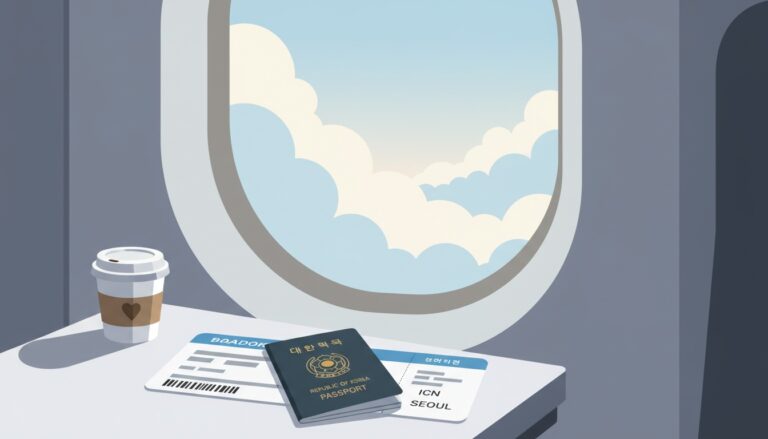
Imagine this: You’ve finally booked that ticket to Seoul. You’re at the check-in counter, heart pounding. You’re dreaming of that K-Pop idol moment—looking wistfully out the airplane window as you descend into Incheon Airport, spotting the islands below just like in the opening scene of a travel vlog.
But wait! If you don’t speak up now, you might end up in the dreaded middle seat, sandwiched between two strangers for 14 hours. No view, no easy bathroom access, just awkward elbows.
Don’t panic. Today, we are going to learn the magic phrase to secure your throne in the sky. Whether you want the view or the freedom of the aisle, I’ve got you covered.
Let’s unlock your first ‘Real Korean’ mission before you even board the plane!
Phase 2: Deep Dive — Key Expressions 🔍
Here are the only three phrases you really need at the check-in counter.
1. 창가 자리 주세요 (Window seat, please)
- Pronunciation: [Chang-ga ja-ri ju-se-yo]
- Sound Analogy:
- Chang: Sounds like ‘Chang’ in ‘Change’.
- Ga: Sounds like ‘Ga’ in ‘Garden’.
- Jari: Think of ‘Ja’ (Jar) + ‘Ri’ (Re-play).
- Meaning:
- Chang-ga: Window side/edge
- Jari: Seat
- Juseyo: Please give me
- K-Culture Moment: You know those aesthetic Instagram photos K-Pop idols post of clouds from the plane? That’s the Chang-ga vibe. If you want to see the Han River as you land, this is your phrase.
- Situation Spectrum:
[🚫 Rude] ———— [⚠️ Careful] ———— [✅ Perfect]- This is the standard polite form (해요체). Perfect for talking to staff! ✅
🤔 Think About It: In English, we say “Window seat.” In Korean, it’s “Window edge seat.” Korean often describes the location relative to something (side, edge, front) rather than just the object itself.
2. 통로 쪽 주세요 (Aisle side, please)
- Pronunciation: [Tong-no jjok ju-se-yo]
- Sound Analogy:
- Tong-no: This is tricky! Written as ‘Tong-ro’ but pronounced Tong-no. (Think ‘Tong’ + ‘No’).
- Jjok: Sounds like ‘Jo’ in ‘Joke’ but with a strong, tense click at the start.
- Meaning: Aisle side, please.
- Editor’s Insight: If you drink a lot of water or need to stretch your legs (hello, long-haul flights!), forget the view. Ask for Tong-no. It’s the practical choice.
3. 붙어 있는 자리 (Seats next to each other)
- Pronunciation: [Bu-teo it-neun ja-ri]
- Meaning: Attached seats (Seats together).
- Use Case: You are traveling with a friend or partner, and you don’t want to be separated like a tragic K-Drama couple.
Phase 3: Textbook vs. Real Life 🆚
| Situation | 📖 Textbook Korean | 🗣️ Real Korean (Incheon Airport) | 💡 Why the difference? |
|---|---|---|---|
| Asking for a window seat | 창가 쪽 좌석을 원합니다. (I desire a window-side seat.) |
창가 자리 있어요? (Do you have a window seat?) |
Real conversation is about speed and softness. “원합니다” sounds like a robot. |
| Asking for any seat | 어떤 자리든 상관없습니다. (It does not matter which seat.) |
아무 데나 괜첖아요. (Anywhere is fine.) |
Koreans love efficiency. Short, clear phrases help the staff process your ticket faster! |
Phase 4: Cultural Deep Dive — The Art of “Nunchi” 🌏
4-1. The Two-Hand Rule 👐
Even at an international airport, Korean culture applies. When you hand over your passport (여권, yeokwon) to the staff, try not to just toss it on the counter or hand it with one hand.
- The Pro Move: Support your right elbow with your left hand as you extend the passport. It’s a small gesture of respect that screams, “I know Korean culture.” The staff will likely smile warmer at you.
4-2. Airport Fashion (Gonghang Paesyeon)
Have you noticed how Korean celebrities treat the airport like a runway? This is called 공항 패션 (Airport Fashion). In Korea, the airport isn’t just a transit hub; it’s the start of the journey’s excitement. Asking for a nice seat isn’t just about comfort; it’s about setting the mood for your own personal “drama” to begin.
Phase 5: Immersive Roleplay 🎭
Scenario: You are at the check-in counter at the airport. It is busy. The ground staff, Minji, looks tired but professional. You want a good seat.
Characters:
* YOU: Excited traveler going to Korea.
* Minji: Airline Ground Staff.
(Dialogue Start)
Minji: 여권 주시겠어요? 📂
(Yeokwon jusigesseoyo?)
(English) May I have your passport?
YOU: 네, 요기요.
(Ne, yogiyo.)
(English) Yes, here it is.
Minji: 짐 부치실 거 있으세요?
(Jim buchisil geo isseuseyo?)
(English) Do you have any bags to check?
YOU: 아니요, 없어요. 저기… 🙋♂️
(Aniyo, eopseoyo. Jeogi…)
(English) No, I don’t. Excuse me…
🔀 Decision Point: Make your move!
- A) “창가 자리 있어요?” (Chang-ga jari isseoyo?) – Asking if it exists.
- B) “창가 자리 주세요.” (Chang-ga jari juseyo.) – Directly asking for it.
- C) “좋은 자리 주세요!” (Joeun jari juseyo!) – Asking for a ‘good’ seat.
✅ Editor’s Choice: B is the most standard and clear.
⚠️ About C: “Good seat” is subjective. To Minji, a “good seat” might be near the toilet! Be specific.
(Roleplay continues with Choice B)
YOU: 창가 자리 주세요. 🥺
(Chang-ga jari juseyo.)
(English) Please give me a window seat.
Minji: (Typing…) 네, 가능합니다. 창가 쪽으로 해드릴게요.
(Ne, ganeunghamnida. Chang-ga jjogeuro haedeurilgeyo.)
(English) Yes, it’s possible. I’ll assign you to the window side.
YOU: 감사합니다! 😊
(Gamsahamnida!)
(English) Thank you!
Phase 6: 10-Second Shadowing Drill 🎙️
Repeat after me. Focus on the intonation!
- 😊 (Polite & Soft) 창가 자리 / 주세요.
- (Chang-ga jari / juseyo.)
- 🤔 (Thinking/Checking) 통로 쪽 / 있어요?
- (Tong-no jjok / isseoyo?)
Phase 7: K-Culture Glossary 📚
| Korean | Romanization | English | Context |
|---|---|---|---|
| 여권 | Yeokwon | Passport | The most important item! |
| 탑승권 | Tapseung-gwon | Boarding Pass | “Show me your Tapseung-gwon.” |
| 만석 | Manseok | Full Flight | If you hear this, no seat changes allowed. |
| 공항 | Gonghang | Airport | Incheon Gonghang is world-class! |
Phase 8: Traveler’s Survival Kit 🆘
So you got your seat. Now what?
🆘 Survival Phrase #1
* 🇰🇷 게이트가 어디에요? (Ge-i-teu-ga eodi-eyo?)
* 🗣️ Meaning: Where is the gate?
* 💡 Pro Tip: ‘Gate’ is just ‘Ge-i-teu’ in Korean style English (Konglish). Easy, right?📌 Editor’s Travel Note:
Incheon Airport is HUGE. If you have time, look for the 편의점 (Convenience Store) to buy a T-Money card (transportation card) before you leave the airport. It will save you so much hassle later!
Phase 9: Think Deeper — “The Speed of Korea”
🧠 Think Deeper: Why is everything “Palli-Palli”?
You might notice that Korean airport staff work incredibly fast. This reflects the ‘Palli-Palli’ (Hurry-Hurry) culture. It’s not because they are impatient with you; it’s because they value efficiency as a form of good service. They don’t want to waste your time. So, having your passport and your question (“Chang-ga jari juseyo”) ready beforehand is considered good manners!
💬 Your Turn: Does your culture prefer slow, chatty service or fast, efficient service? Tell me in the comments!
Phase 10: FAQ & Troubleshooting ❓
- Q: Can I just say “Window?” in English?
- A: Yes, most staff speak English. But saying 창가 (Chang-ga) shows effort and earns you respect!
- Q: Is it rude to ask for a specific seat?
- A: Not at all! Koreans are very vocal about their preferences. Just add 주세요 (Juseyo – Please) to be polite.
❌ Common Mistake: Saying “창문 (Chang-mun)” instead of “창가 (Chang-ga)”.
* Chang-mun means the physical window (glass). Chang-ga means the window side/area. If you ask for a Changmun, they might look at you funny, like you want to buy a window pane!
Phase 11: Wrap-up & Mission 🏁
One-Liner: To get the view, say “Chang-ga jari juseyo”; to get the freedom, say ‘Tong-no jjok juseyo’.
🔥 Your Mission:
* 🥉 Bronze: Say “Chang-ga jari juseyo” 3 times while looking out your bedroom window.
* 🥈 Silver: Open a map of the plane (seat selection screen) and point to a seat saying the Korean phrase.
* 🥇 Gold: Use this phrase on your actual flight to Korea!
📝 K-Culture Mission: Watch a ‘Get Ready With Me: Flight to Korea’ vlog on YouTube. Count how many times they show the window view!
Phase 12: Interactive Quiz 🧩
1. You drank a large iced Americano before the flight. Which seat should you ask for?
* A) 창가 자리 (Chang-ga jari)
* B) 통로 쪽 (Tong-no jjok)
2. True or False?
* In Korea, handing your passport with one hand while looking away is considered cool and casual.
* (True / False)
3. Fill in the blank:
* “Please give me a window seat.” = 창가 자리 [ _______ ].
⬇️ Click to see the answers
- B) You need the aisle (Tong-no) for the restroom access!
- False! It is considered rude. Use two hands or support your arm.
- 주세요 (Juseyo)
Frequently Asked Questions (FAQ)
Q: What does "창가 자리 주세요 (Window seat, please)" mean in Korean and how do you pronounce it?
A: In Korean, "창가 자리 주세요 (Window seat, please)" is pronounced [Chang-ga ja-ri ju-se-yo] and means: a key conversational Korean expression covered in this lesson.
Q: What does "통로 쪽 주세요 (Aisle side, please)" mean in Korean and how do you pronounce it?
A: In Korean, "통로 쪽 주세요 (Aisle side, please)" is pronounced [Tong-no jjok ju-se-yo] and means: a key conversational Korean expression covered in this lesson.
Q: What does "붙어 있는 자리 (Seats next to each other)" mean in Korean and how do you pronounce it?
A: In Korean, "붙어 있는 자리 (Seats next to each other)" is pronounced [Bu-teo it-neun ja-ri] and means: Attached seats (Seats together).







