

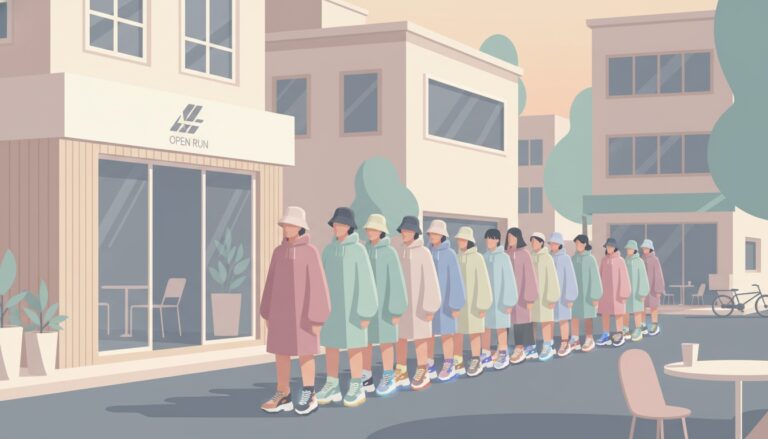
Phase 1: Immersive Hook — The 6 AM Line in Seongsu
Hello, Daily Hangul readers. It’s your editor here.
Picture this: It’s a crisp Saturday morning in Seongsu-dong, the Brooklyn of Seoul. You see a line of people wrapping around the block. They aren’t queuing for a famous bagel shop or a K-Pop fan meeting. They are waiting for a “Drop”—a limited edition collaboration between a luxury house and a street brand.
In K-Dramas, you see chaebols in pristine suits. But walk down the streets of Hannam-dong or Apgujeong today, and the real status symbols are hoodies, oversized sneakers, and beanies that cost more than a monthly paycheck. If you want to understand modern Korean aesthetics, you have to look beyond the traditional Hanbok or the corporate suit. You need to understand the “Hype.”
Today, we’re not just learning words; we’re decoding the psychology behind Korea’s obsession with high-end street fashion. Let’s get you sounding like a true Seoulite trendsetter.
Phase 2: Deep Dive into the “Hype”
1. 오픈런 (Open Run)
- Pronunciation: [O-peun-reon] + Sounds like ‘Open’ + ‘Run’
- Meaning: Literally running into a store the moment it opens to buy scarce items.
- K-Culture Moment: You’ve seen news clips of people camping out with tents in front of department stores. While originally used for Chanel bags, it’s now standard for limited edition sneakers or street brand pop-ups.
- Editor’s Insight: This word encapsulates the Korean “Pali-Pali” (hurry-hurry) culture mixed with extreme FOMO. It’s not just shopping; it’s a competitive sport. If you say, “나 오늘 오픈런 했어” (I did an open run today), you are asking for respect for your dedication.
- Situation Spectrum:
[🚫 Formal Biz] ———— [⚠️ Semi-Formal] ———— [✅ Casual] - 🤔 Think About It: Why is the process of acquiring the item almost as important as the item itself in Korean consumer culture?
2. 힙하다 (Hip-hada)
- Pronunciation: [Hip-ha-da] + Think ‘Hip’ + ‘Hada’ (to do/be)
- Meaning: To be trendy, cool, and stylish in a unique, non-mainstream way.
- K-Culture Moment: Watching a music video by NewJeans or wandering through a gritty alleyway cafe in Euljiro. If a place or person has a distinct, cool vibe, they are “Hip-hada.”
- Editor’s Insight: Do not confuse this with “멋있다” (Cool/Handsome). “멋있다” is classic (like a suit). “힙하다” implies a sense of street sensibility and uniqueness. It’s the highest compliment in the fashion world right now.
- Situation Spectrum:
[🚫 Formal Biz] ———— [✅ Casual]
3. 플미 (Peul-mi) / 리셀 (Ri-sel)
- Pronunciation: [Peul-mi] (Short for Premium) / [Ri-sel] (Resell)
- Meaning: The extra price attached to a sold-out item / The act of reselling.
- K-Culture Moment: Teenagers discussing sneakers on the subway. “와, 이거 플미 엄청 붙었어.” (Wow, the premium on this is insane.)
- Editor’s Insight: Korea has a massive “Resell-tech” (Resell + Investment technology) market. Platforms like KREAM are essential apps. Knowing this term shows you understand the economy of Korean fashion.
- Situation Spectrum:
[🚫 Formal Biz] ———— [✅ Casual]
Phase 3: Textbook vs. Real Life (Street Edition)
| Situation | 📖 Textbook Korean | 🗣️ Real Street Korean | 💡 Why the difference? |
|---|---|---|---|
| Copying a celebrity style | 유행을 따라하다 (Following the trend) | 손민수하다 (Son-min-su-hada) | Based on a Cheese in the Trap character who copied the protagonist. Used when you buy what your idol wore. |
| Asking if it’s popular | 이거 인기 많아요? (Is this popular?) | 이거 대세예요? / 폼 미쳤다 (Is this the trend? / Form is crazy) | “Form is crazy” is current slang for anything performing exceptionally well or looking amazing. |
| Wearing expensive clothes | 비싼 옷을 입었어요. (I wore expensive clothes.) | 플렉스(Flex) 해버렸지 뭐야. (I just Flexed.) | Adopted from Hip-hop culture, referring to showing off wealth/luxury casually. |
💡 Editor’s Note: “Son-min-su-hada” is high-level C2 slang. Use it like: “정국이 모자 손민수했어” (I bought the same hat Jungkook wore). It instantly signals you are deeply embedded in K-Culture.
Phase 4: Cultural Deep Dive — The “Nunchi” of Fashion
1. The “Monami Look” vs. Individualism
Walk into a university classroom, and you might see a sea of black and white (resembling the Monami ballpoint pen). This is the Korean pressure to conform. However, High-End Street Fashion is the rebellion against this. It is how Koreans express individuality within the boundaries of “acceptance.” Wearing a limited edition Supreme hoodie signals, “I know the trends, but I have the status/luck to own this.”
2. The K-Pop Airport Runway
The real fashion show isn’t Seoul Fashion Week; it’s Incheon Airport departure arrivals. What Blackpink or BTS wears to the airport sells out instantly. This phenomenon drives the “Sold Out” culture. The street fashion you see in Seoul is a direct reflection of these “Airport Looks.”
Phase 5: Immersive Roleplay — The “Drop” Day
Setting: Outside a pop-up store in Seongsu-dong. 10:00 AM. You are with your Korean friend, Min-jae, waiting for a limited sneaker release.
Characters:
– YOU: Fashion enthusiast, tired but excited.
– Min-jae (28): A “Sneakerhead” who knows all the resell prices.
Min-jae: 와, 줄 실화냐? 우리 순번 안에 들 수 있을지 모르겠다.
(Wa, jul silhwanya? Uri sunbeon ane deul su isseulji moreugetda.)
(English: Wow, is this line for real? I don’t know if we can get in within the cutoff.)
(🎭 Min-jae stands on his tiptoes looking ahead anxiously)
YOU (Select your response):
🔀 Your Turn!
– A) “그러게요. 사람이 정말 많네요.” (Standard, polite)
– B) “이거 못 사면 리셀가로 사야 하는데… 절대 안 돼!” (Desperate, Insider)
– C) “오픈런이 이렇게 힘든 건 줄 몰랐어.” (Empathetic, Experienced)✅ Best Choice: B — Mentioning “Resell price” (Resell-ga) shows you understand the stakes. Min-jae will immediately bond with you over the shared financial fear.
Min-jae: 그치? 지금 크림(KREAM) 보니까 벌써 플미 20만 원 붙었더라.
(Right? I checked KREAM and the premium is already up by 200,000 won.)
YOU:
“진짜? 와, 무조건 득템(Deuk-tem) 해야겠다.”
(Really? Wow, we strictly need to score this item.)
Phase 6: 10-Second Shadowing Drill
Let’s practice the envy and shock of seeing a rare item.
😲 Envious/Shocked Tone
와 / 이거 / 구하기 진짜 힘든 건데 / 어떻게 구했어?
(Wa / igeo / guhagi jinjja himdeun geonde / eotteoke guhaesseo?)
“Wow / this is / really hard to get / how did you get it?”
Phase 7: K-Culture Mini Glossary
| Korean | Romanization | Meaning | Context |
|---|---|---|---|
| 드로우 | Deu-ro-u | Draw/Raffle | Buying rights are given via lottery, not first-come-first-served. |
| 정가 | Jeong-ga | Retail Price | The original price before the premium is added. |
| 한정판 | Han-jeong-pan | Limited Edition | The magic word that opens wallets in Korea. |
| 무신사 | Musinsa | Musinsa | The Amazon of Korean fashion. If it’s ranked here, it’s the trend. |
Phase 8: Traveler’s Survival Kit (Shopping Edition)
Shopping in hip areas like Seongsu or Hongdae? Don’t be shy.
🆘 Survival Phrases
– 🇰🇷 “이거 재고 남아 있나요?” (Igeo jaego nama innayo?)
– “Is there any stock left of this?”
– 🇰🇷 “피팅 해봐도 될까요?” (Piting haebwado doelkkayo?)
– “Can I try this on?” (Note: Use ‘Fitting’ not ‘Wear’)
– 🇰🇷 “이거 새 상품으로 주시나요?” (Igeo sae sangpumeuro jusinayo?)
– “Do I get a new piece (from the back)?”📌 Editor’s Travel Note:
Many street brand showrooms in Seongsu (like Ader Error or Gentle Monster) are more like art galleries. It’s okay to just walk in, take photos, and leave without buying. That’s part of the culture!
Phase 9: Think Deeper — Conformity or Expression?
🧠 Think Deeper:
Korea is often described as a collective society, yet the obsession with unique, high-end street fashion seems to contradict this. However, is it true individuality, or just a more expensive form of conformity? When everyone wears the same “unique” limited-edition sneaker, does it cease to be unique? In Korea, fashion is a language of belonging. It says, “I am part of this era’s conversation.”
💬 Your Turn: In your country, does wearing expensive street brands signal “coolness” or just “wealth”? Is there a difference?
Phase 10: FAQ & Troubleshooting
- Q: Can I wear this street style to a Korean wedding?
- A: NO. Unless you are a hip-hop artist or extremely close family who allows it. Korean weddings are still semi-formal. Stick to “Neat” (단정한) clothes. A Supreme hoodie at a wedding might get you staring daggers from the elders.
- Q: Is it rude to ask someone how much their clothes cost?
- A: Maybe. Between close friends or young people discussing “deals,” it’s fine. But asking an older acquaintance or a colleague implies you are judging their spending habits. Use your nunchi!
- ❌ Common Mistake: Calling a trendy person “Trendy-hada.”
- ✅ Correct: Use “Hip-hada” (힙하다) or “Sensu itda” (센스 있다 – You have sense).
Phase 11: Wrap-up & Missions
Summary: Today we learned that Korean street fashion is fueled by Open Runs, Resell culture, and the desire to be Hip.
🚀 Action Missions:
– 🥉 Bronze: Practice saying “이거 완전 힙하다!” in front of a mirror.
– 🥈 Silver: Go to the KREAM website/app (Korean resell platform) and browse the ranking. See what items are trending in Seoul right now.
– 🥇 Gold: If you have a Korean friend, ask them, “Do you use KREAM?” or “Have you ever done an Open Run?” Watch their eyes light up (or fill with traumatic memories).
See you next time on Daily Hangul! Stay Hip! 😎
Frequently Asked Questions (FAQ)
Q: What does "오픈런 (Open Run)" mean in Korean and how do you pronounce it?
A: In Korean, "오픈런 (Open Run)" is pronounced [O-peun-reon] and means: Literally running into a store the moment it opens to buy scarce items.
Q: What does "힙하다 (Hip-hada)" mean in Korean and how do you pronounce it?
A: In Korean, "힙하다 (Hip-hada)" is pronounced [Hip-ha-da] and means: To be trendy, cool, and stylish in a unique, non-mainstream way.
Q: What does "플미 (Peul-mi) / 리셀 (Ri-sel)" mean in Korean and how do you pronounce it?
A: In Korean, "플미 (Peul-mi) / 리셀 (Ri-sel)" is pronounced [Peul-mi] and means: The extra price attached to a sold-out item / The act of reselling.







