

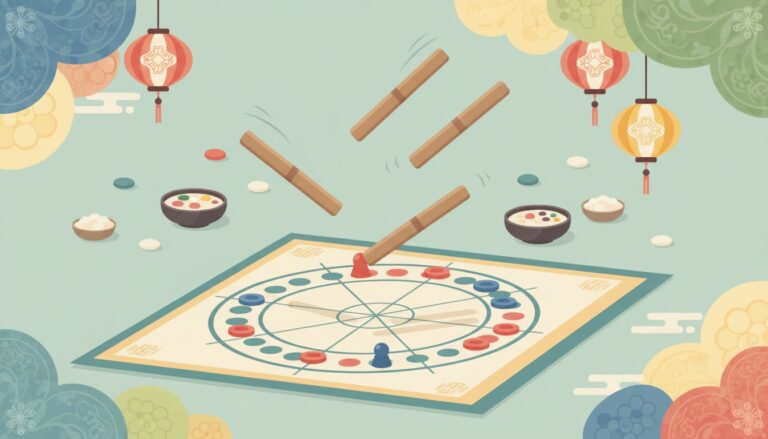
Don’t Just Roll the Dice! How to Survive Yutnori (Korea’s Uno) 🎲
Phase 1: The “Why is Everyone Screaming?” Moment
안녕하세요! Daily Hangul Editor here.
If you are a fan of BTS or SEVENTEEN, you have definitely seen this scene in their variety shows: The members are gathered around a blanket on the floor, throwing four wooden sticks into the air. Suddenly, RM screams, Jimin falls to the floor laughing, and chaos erupts.
What are they doing? They are playing Yutnori (윷놀이).
It looks like a simple board game, but don’t be fooled. In Korea, Yutnori is not just a game; it’s an emotional battlefield. It’s the Korean equivalent of Monopoly or Uno—friendships are tested here!
Today, I’m going to teach you the phrases you need to survive this game during Seollal (Lunar New Year). Because if you just sit there quietly, you’re missing half the fun.
Phase 2: Essential Survival Phrases
To play Yutnori, you don’t need perfect grammar. You need energy.
1. 던지세요! (Deon-ji-se-yo!)
- Pronunciation: [Deon-ji-se-yo] — Sounds like “Dawn” + “G” + “Say-yo”
- Meaning: “Please throw it!” (Literal) vs. “Your turn, hurry up!” (Real nuance)
- K-Culture Moment: Imagine a game show host like Yoo Jae-suk shouting this to keep the game moving.
- Editor’s Insight: In the heat of the game, Koreans often drop the polite “yo” and just shout “던져!” (Deon-jyeo!) to friends. But stick to “던지세요” for now to be safe with elders.
- Situation Spectrum:
[🚫 Formal Boss] ———— [⚠️ Elders/Polite] ———— [✅ Friends]
(Use “던지으시지요” for Boss / “던지세요” for Elders / “던져” for Friends)- 🤔 Think About It: Why is the verb “to throw” (던지다) used for dice, sticks, and even “throwing a party” in some languages? What action starts the game in your culture?
2. 잡았다! (Ja-bat-da!)
- Pronunciation: [Ja-bat-da] — Sounds like “Jab-at-da”
- Meaning: “I caught it!” (Literal) vs. “Gotcha! You’re dead!” (Real nuance)
- K-Culture Moment: This is the climax. In K-Dramas, when the protagonist finally catches the villain (or catches the opponent’s game piece), this is the word.
- Editor’s Insight: In Yutnori, if your piece lands on the opponent’s piece, you “catch” them, and they have to start over. This is the most satisfying moment. Say it with power!
- Situation Spectrum:
[🚫 Boss] ———— [⚠️ Elders] ———— [✅ Everyone]
(Actually, everyone screams this in excitement, even in front of elders!)- 🤔 Think About It: Korean culture values harmony, but games like Yutnori are fiercely competitive. Why do you think “catching” (eliminating) someone is allowed to be so aggressive during a holiday?
3. 빽도! (Bbaek-do!)
- Pronunciation: [Bbaek-do] — Sounds like “Back” + “Dough”
- Meaning: “Back Do” (One step back)
- K-Culture Moment: The “Uno Reverse Card” of Korea. One of the sticks usually has a special mark (X or writing). If you get this, you must go back. It can save you or ruin you.
- Editor’s Insight: This is technically Konglish (Korean + English “Back”). It’s a modern rule that makes the game unpredictable.
- Situation Spectrum:
[✅ Universal Term]- 🤔 Think About It: This rule was added later in history. How does language evolve to make games more exciting?
Phase 3: Textbook vs. Real Life
| Situation | 📖 Textbook Korean | 🗣️ Real Korean (Yutnori Vibe) | 💡 Why different? |
|---|---|---|---|
| Urging someone | 순서입니다. (It is your turn.) | 빨리 해! (Do it quickly!) | Speed is crucial in Korean games (Pali-pali culture). |
| Losing a piece | 아, 안타깝네요. (Oh, that is unfortunate.) | 아!! 망했다… (Ah!! I’m doomed…) | “Mang-haet-da” is the honest feeling of ruin. |
| Winning | 제가 이겼습니다. (I have won.) | 대박! 이겼다! (Daebak! I won!) | Emotions override formality in games. |
Bottom Note for A1: If you are playing with your friend’s parents, smile and use the Textbook version, but add a little clap! 👏
Phase 4: Cultural Context — The “Nunchi” Game
4-1. Non-verbal Communication (Body Language)
Playing Yutnori isn’t just about the sticks. It’s about the theater.
– The Shake: Don’t just drop the sticks. Shake them in your hands loudly near your ear. It builds tension.
– The High Throw: Throw them high! If they roll off the mat (blanket), it’s a “Nak” (Foul/Out).
4-2. K-Culture Connection: The “Team Dinner” (Hoesik) Vibe
Yutnori during Seollal is very similar to a Korean company Hoesik (team dinner).
– Hierarchy exists but softens: Even the youngest can tease the grandfather if they catch his piece. It’s a rare moment where ranks are blurred by fun.
– Food is fuel: You are likely eating Tteokguk (Rice Cake Soup) or Jeon (Pancakes) while playing. If you win, you get the first bite of the fresh fruit.
Phase 5: Immersive Roleplay
Setting: Seollal morning. The living room floor is covered with a mat. Your team (You + Minji) is losing against Uncle Min-su.
Characters:
– YOU: A foreign guest, eager to win.
– Uncle Min-su: Competitive, loud, loves to tease.
Start Dialogue:
Min-su: (Shaking sticks) 자, 삼촌이 간다! 잡으러 간다!
(Ja, samchon-i ganda! Jabeureo ganda!)
[Right, Uncle is coming! I’m coming to catch you!]
Min-su: (Throws sticks) 윷이다!! (Yut-i-da!! – Move 4 spaces)
YOU: (Min-su’s piece lands on yours… Oh no!)
Min-su: 하하하! 잡았다! 너 집에 가!
(Hahaha! Ja-bat-da! Neo jibe ga!)
[Hahaha! Caught you! Go home (back to start)!]
🔀 Decision Point: How do you react?
- A) “아, 괜찮아요.” (Ah, it’s okay.) – Cool and calm.
- B) “아, 진짜!!” (Ah, really/seriously!!) – Passionate and funny.
- C) “다음에 두고 보세요.” (Wait and see next time.) – Determine.
✅ Best Choice: B) In a game, showing frustration makes the winner feel better. It makes the atmosphere fun. A is too robotic!
YOU: 아, 진짜!! 한번 더 해요!
(Ah, jin-jja!! Han-beon deo haeyo!)
[Ah, seriously!! Let’s do it one more time!]
Phase 6: 10-Second Shadowing Drill
Let’s practice the energy. Repeat after me with emotion!
- 😤 Determined: 제발 / 윷 / 나와라!
(Je-bal / Yut / Na-wa-ra!)
[Please, let “Yut” come out!] -
😲 Surprised: 우와 / 모다! / 모!
(U-wa / Mo-da! / Mo!)
[Wow, it’s “Mo”! (Move 5 spaces)] -
😩 Despairing: 아… / 낙이다…
(Ah… / Nag-i-da…)
[Ah… it’s a foul (off the board)…]
Phase 7: K-Culture Mini Glossary
| Korean | Romanization | English | Context |
|---|---|---|---|
| 말 | Mal | Game Piece (Horse) | Literally means “Horse.” You move your “Mal” around the board. |
| 업다 | Eop-da | Piggyback | When two pieces land on the same spot, they travel together. Efficient but risky! |
| 윷판 | Yut-pan | Game Board | The square or round board you play on. |
| 낙 | Nak | Foul / Out | When a stick goes off the mat. You lose your turn. Don’t do this! |
Phase 8: Traveler’s Survival Kit (Social Edition)
Even if you aren’t playing Yutnori, these phrases save you in any social game or competition in Korea.
🆘 Survival Expression #1: Accepting Defeat
– 🇰🇷 “제가 졌어요.” (Je-ga jyeo-sseo-yo.)
– 🗣️ Sounds like: [Jay-ga Juh-sso-yo]
– 📍 Use when: You lose a game or a bet.
– 💡 Pro Tip: Say this with a smile. Koreans love a “good loser.”📌 Editor’s Note: Betting Culture
– Koreans often bet on small things. “loser buys coffee” (Coffee naegi) or “loser cleans up” (Seol-geo-ji naegi). If someone suggests a “Naegi” (Bet), play hard!
Phase 9: Think Deeper — “Winning Together”
Topic: Community over Individual
In Yutnori, you usually play in teams. Notice the rule called “Eop-da” (Piggyback). If your piece lands on your teammate’s piece, you can stack them and move together. It’s faster, but if you get caught, everyone dies together.
This reflects the Korean value of “Uri” (Us/We). We rise together, and we fall together. High risk, high return, but always shared. In your culture, do board games focus more on individual winning or team strategy?
💬 Your Turn: Have you ever played a game where you can carry your teammate? Tell me in the comments!
Phase 10: FAQ & Troubleshooting
Q: Can I use these loud expressions with my boss?
A: Only if the atmosphere is very wild and alcohol is involved. Otherwise, keep the volume down and add “-yo” at the end. (e.g., “잡았어요!” instead of “잡았다!”).
Q: Is Yutnori only for kids?
A: No! It is one of the few games enjoyed by ages 5 to 90 equally. Adults actually get more competitive because money is often involved.
❌ Common Mistake: Throwing the sticks at someone.
✅ Fix: Throw them straight up into the air. Safety first!
Phase 11: Wrap-up & Mission
One-Liner: Yutnori is about loud energy—shout “Jab-at-da” when you win!
Action Missions:
– 🥉 Bronze: Look in the mirror and practice the “Shake and Throw” motion while saying “Deon-ji-se-yo!”
– 🥈 Silver: Watch a “Run BTS!” Yutnori episode (Ep 22 or 43) and try to catch the word “Nak” or “Back-do.”
– 🥇 Gold: If you have 4 popsicle sticks, mark X on one, and play a mini-game with a friend using coins as pieces!
Phase 12: Quiz — What would you do?
Situation: You threw the sticks. One stick has an ‘X’ on it (Back-do), and three are face down.
- Move forward 1 step.
- Move backward 1 step.
- Move forward 3 steps.
Answer: 2. Move backward 1 step. (The ‘X’ usually means Back-do, which overrides other rules in most house rules!)
True or False:
“It is rude to beat an elder in Yutnori.”
Answer: False! While you should be polite in language, holding back in the game is considered boring. The elders want a real fight! Play to win!
Frequently Asked Questions (FAQ)
Q: What does "던지세요! (Deon-ji-se-yo!)" mean in Korean and how do you pronounce it?
A: In Korean, "던지세요! (Deon-ji-se-yo!)" is pronounced [Deon-ji-se-yo] and means: "Please throw it!" (Literal) vs. "Your turn, hurry up!" (Real nuance)
Q: What does "잡았다! (Ja-bat-da!)" mean in Korean and how do you pronounce it?
A: In Korean, "잡았다! (Ja-bat-da!)" is pronounced [Ja-bat-da] and means: "I caught it!" (Literal) vs. "Gotcha! You're dead!" (Real nuance)
Q: What does "빽도! (Bbaek-do!)" mean in Korean and how do you pronounce it?
A: In Korean, "빽도! (Bbaek-do!)" is pronounced [Bbaek-do] and means: "Back Do" (One step back)







