

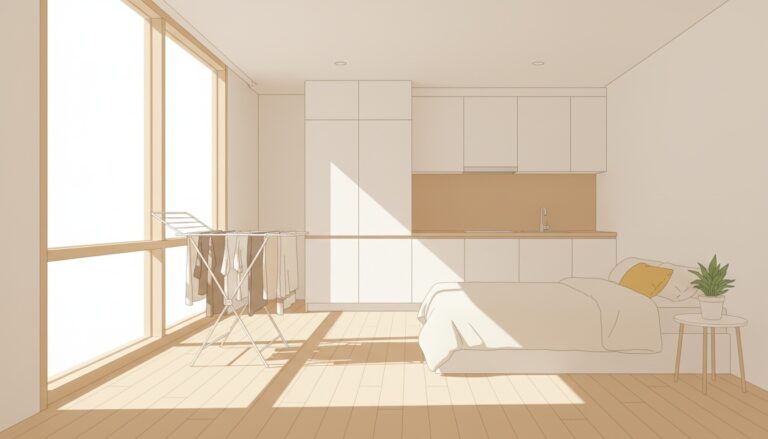
Don’t Live in a Cave! How to Check for Sunlight in Korean Homes ☀️
Phase 1: The Hook — More Than Just a View
Hello! Your Daily Hangul editor here.
Do you remember the movie ‘Parasite’? The family lives in a Banjiha (semi-basement). One of the most striking things about their home isn’t just the smell—it’s the darkness. In that movie, sunlight represents wealth.
In Korea, checking for sunlight isn’t just about aesthetics; it’s a survival skill. Korea has four very distinct seasons. A house without sun is freezing in winter (hello, insane heating bills!) and moldy in summer.
I once rented a studio in Mapo-gu because it was cheap. I didn’t check the sunlight. Three months later, my favorite leather jacket was covered in green mold. Don’t be like past-me. Today, we’re going to learn how to make sure your future Korean home is bright and dry.
Phase 2: Core Expressions (Deep Dive)
Here are the three phrases you need to save your clothes from mold and your wallet from heating costs.
1. 해가 잘 들어요?
(Haega jal deureoyo?)
- Pronunciation: Hae-ga jal deu-ru-yo? (Think of ‘Hae’ like ‘Hey’ but shorter).
- Meaning: Does the sun come in well? (Lit: Does the sun enter well?)
- K-Culture Moment: In reality TV shows like Home Alone (I Live Alone), celebrities always open their curtains dramatically in the morning. If they say “Wah~”, the answer is yes.
- Editor’s Insight: This is the softest, most natural way to ask. You aren’t asking about physics; you’re asking about the feeling of the room.
- Situation Spectrum:
[🚫 Boss] ———— [⚠️ Agent/Landlord] ———— [✅ Friend]
(Actually, this is ✅ Safe for everyone. Even with a strict landlord, this is a polite inquiry.)- 🤔 Think About It: Why do Koreans use the verb “enter” (들다) for sunlight? It treats the sun like a welcome guest coming into your home.
2. 남향이에요?
(Namhyang-ieyo?)
- Pronunciation: Nam-hyang-ee-eh-yo?
- Meaning: Is it South-facing?
- Real Nuance: “Is this a top-tier house?”
- K-Culture Moment: In family dramas, mothers often brag, “Our daughter’s new apartment is Namhyang!” It’s a status symbol.
- Editor’s Insight: South-facing houses get sunlight all day long. West is hot in the afternoon, East is bright only in the morning, and North… well, bring a sweater.
- Situation Spectrum:
[🚫 Casual Chat] ———— [⚠️ Asking Direction] ———— [✅ Real Estate]
(Use this specifically when looking for houses.)3. 낮에 불 켜야 돼요?
(Naje bul kyeoya dwaeyo?)
- Pronunciation: Na-jay bool kyu-ya dway-yo?
- Meaning: Do I have to turn on the light during the day?
- Real Nuance: “Is this place a dungeon?”
- Editor’s Insight: This is a power move. It’s a direct, practical question that cuts through the agent’s sales pitch. If they hesitate, run.
- Situation Spectrum:
[🚫 Polite Dinner] ———— [⚠️ Inspection] ———— [✅ Viewing a Room]
Phase 3: Textbook vs. Real Life
| Situation | 📖 Textbook Korean | 🗣️ Real Korean | 💡 Why the difference? |
|---|---|---|---|
| Asking about light | 채광이 좋습니까? (Is the lighting good?) | 여기 밝네요! (It’s bright here!) | “Chaegwang” is a technical term. “Bright” is how we actually feel. |
| Checking orientation | 집의 방향이 어디입니까? (What is the direction of the house?) | 혹시 남향이에요? (By chance, is it South-facing?) | Being specific shows you know the market value. |
| Asking about dampness | 습기가 많습니까? (Is there a lot of humidity?) | 곰팡이 나온 적 있어요? (Has mold ever appeared?) | Humidity is vague; mold is the scary reality we want to avoid. |
Bottom Note: In A2 level, don’t worry about complex real estate terms. Just focus on “Bright” (Bar-ga-yo) and “Dark” (Eo-doo-wo-yo).
Phase 4: Cultural Deep Dive
4-1. The Eyes Have It (Nunchi)
When viewing a room, the agent might say, “Oh, the tenant is just sleeping, so we can’t open the curtains.” Major Red Flag.
Use your Nunchi. Look at the corners of the ceiling and the wallpaper near the windows. If the wallpaper looks bubbly or discolored, it means there was water or condensation due to lack of sunlight and ventilation. You don’t need to ask; the walls tell the truth.
4-2. K-Drama Connection: The Rooftop Room (Oktapbang)
You’ve seen it a hundred times. The poor but cheerful heroine lives in a room on the roof (Oktapbang).
* Pros: Amazing sunlight, great view for drinking soju.
* Cons: It freezes in winter and boils in summer.
If you want the “K-Drama experience,” go for it. But get a good air conditioner first.
Phase 5: Immersive Roleplay
Setting: It’s 2:00 PM on a Saturday. You are with a generic real estate agent (let’s call her ‘Auntie’) looking at a ‘One-room’ (studio) in Sinchon.
Characters:
* YOU: Looking for a bright room for your studies.
* Auntie: Wants to sign the contract quickly. Friendly but pushy.
Dialogue:
Auntie: 여기 봐요. 방 진짜 크죠? 혼자 살기 딱 좋아.
(Yeogi bwayo. Bang jinjja keujo? Honja salgi ttak joa.)
(English) Look here. The room is huge, right? Perfect for living alone.
(🎭 She spreads her arms wide, distracting you from the small window.)
YOU: 네, 방은 크네요. 그런데 좀 어두운 것 같아요.
(Ne, bang-eun keuneyo. Geureonde jom eoduun geo gatayo.)
(English) Yes, the room is big. But it seems a bit dark.
Auntie: 에이~ 오늘 날씨가 흐려서 그래. 원래는 밝아요.
(Ey~ Oneul nalssiga heuryeoseo geurae. Wonraeneun balgayo.)
(English) Ey~ It’s just because it’s cloudy today. Usually, it’s bright.
🔀 Your Turn! How do you verify this?
– A) “아, 그렇군요! 알겠습니다.” (Trust her blindly)
– B) “남향이에요?” (Check the facts)
– C) “거짓말 하지 마세요!” (Too aggressive)✅ Best Choice: B
Why? Asking if it’s South-facing is objective. Even if it’s cloudy, the compass doesn’t lie.
Outcome: If she says “Actually, it’s North-facing,” you know why it’s dark.
Phase 6: 10-Second Shadowing Drill
Let’s practice the reaction when you find a good house.
Emotion: 😊 Happy & Relieved (You found a gem!)
“Wow, the sun comes in really well here!”
와, / 여기 / 해가 / 진짜 / 잘 드네요!
(Wa, / yeogi / haega / jinjja / jal deuneyo!)
Phase 7: K-Culture Mini Glossary
| Korean | Romanization | English | Context |
|---|---|---|---|
| 남향 | Namhyang | South-facing | The gold standard for Korean homes. Warmest and brightest. |
| 반지하 | Banjiha | Semi-basement | Made famous by Parasite. Cheap, but often damp and dark. |
| 곰팡이 | Gompangi | Mold | The enemy of Korean homes. Caused by humidity + no sun. |
| 월세 | Wolse | Monthly Rent | One of the two main rent systems (the other is Jeonse). |
Phase 8: Survival Kit (House Hunting Edition)
If you are looking for a room in Korea, stick these phrases on your phone.
🆘 Survival Phrases TOP 3
1. 🇰🇷 “남향이에요?” (Is it South-facing?)
– Why: Saves on heating bills.
2. 🇰🇷 “관리비는 얼마예요?” (How much is the maintenance fee?)
– Why: Rent might be cheap, but the fee could be $100+!
3. 🇰🇷 “옵션은 뭐 있어요?” (What options/furniture are included?)
– Why: In Korea, “Full Option” usually means fridge, washer, and AC are included.📌 Editor’s Pro Tip
Use apps like Zigbang (직방) or Dabang (다방) to check photos first. But remember, they use wide-angle lenses and brighten the photos. Always visit in person during the daytime (11 AM – 2 PM) to check the real sunlight.
Phase 9: Think Deeper — “Why the Obsession?”
Food & Identity: The Kimchi Connection
Why is sunlight (and drying clothes) so critical? Historically, Koreans dried peppers (for Gochugaru) and vegetables under the sun for winter. Even today, many Koreans prefer drying laundry on racks in the sun (using “Nature’s dryer”) rather than using electric dryers, which are seen as damaging to clothes or expensive to run. A house without sun means your clothes stay damp and smell like a wet dog. The obsession with Namhyang isn’t just about light; it’s about hygiene and the rhythm of daily life.
💬 Your Turn: In your country, is the direction of the house important? Or do you just care about the size? Tell me in the comments!
Phase 10: FAQ & Troubleshooting
Q: Can I trust the photos on real estate apps?
A: Trust, but verify. We call fake listings “Heo-wi-mae-mul” (허위매물). If a sunny, huge room is suspiciously cheap, it doesn’t exist.
Q: The agent keeps showing me rooms at night. Why?
A: Beware. They might be hiding the fact that the building next door blocks all the sunlight. Always demand to see the room when the sun is up.
❌ Common Mistake: Confusing “South” (Nam) and “North” (Buk).
✅ Fix: Just remember “Nam” like “Gangnam Style” (South of the river). We want Nam-hyang!
Phase 11: Wrap-up & Mission
Summary: Today we learned how to ask if a room is sunny (해가 잘 들어요?) and why South-facing (남향) is the king of Korean real estate.
🚀 Action Mission:
– 🥉 Bronze: Look at your own window right now. Say “Haega jal deureoyo” or “Eoduwoyo” (It’s dark).
– 🥈 Silver: Go to a Korean real estate app (Zigbang), find a room, and look for the word ‘남향’ in the description.
– 🥇 Gold: Next time you enter a brightly lit cafe or shop in Korea, say to your friend: “Wow, yeogi haega jal deuneyo!”
K-Culture Mission: Watch a clip of the movie Parasite (the Banjiha scenes) and compare the lighting to the rich family’s house. You will never forget the importance of sunlight again.
Phase 12: Quiz — House Hunter Challenge
1. Situation Check:
The agent shows you a room. It is very dark, but she says, “It’s cozy!” What is the polite but sharp question to ask?
– A) 이모, 밥 먹었어요? (Auntie, did you eat?)
– B) 낮에 불 켜야 돼요? (Do I have to turn on lights during the day?)
– C) 사랑해요. (I love you.)
2. True or False:
– “Oktapbang” (Rooftop room) is famous for being cool in summer and warm in winter. (True/False)
3. Fill in the Blank:
– Koreans love
______-facing houses because they are the warmest.
Answers:
1. B) This cuts through the marketing fluff.
2. False. It is the opposite! Hot in summer, cold in winter.
3. South (Namhyang)







