

Phase 1: The ‘8282’ Instinct
Hello! Daily Hangul editor here.
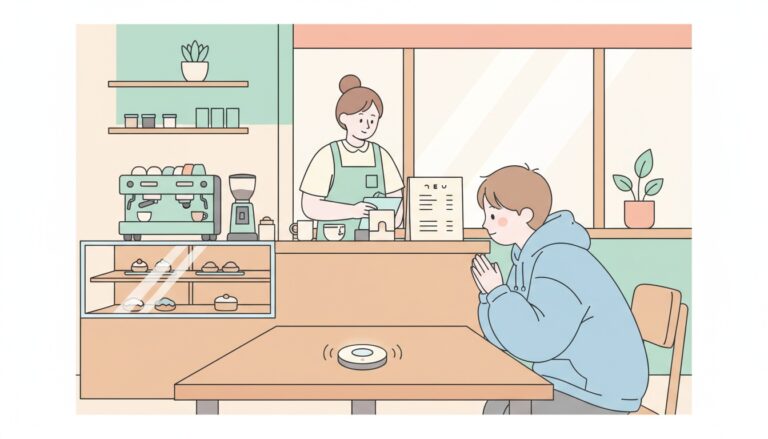
Picture this: You are in a packed café in Hongdae. You just ordered an Iced Americano. The cashier hands you a round, buzzing disc—the Jindongbel (vibration bell). Logically, you should go sit down and wait for it to buzz, right?
But look around. Do you see people hovering near the pickup counter like hawks circling prey? Or someone grabbing the bell the second the barista turns around, even before the machine makes a sound?
Welcome to the world of ‘Pballi-Pballi’ (Hurry-Hurry) service culture. In K-Dramas, the romantic lead waits hours in the rain. In a Korean café, we get anxious if the coffee takes more than 3 minutes. Today, we’re learning how to survive the lunch-rush battlefield without losing your cool.
This guide isn’t just about ordering; it’s about understanding the rhythm of Korea.
Phase 2: Deep Dive — The “Is It Ready?” Spectrum
Here are the phrases you’ll hear (and use) when the waiting game gets intense.
1. 나왔어요? (Nawasseoyo?)
- Pronunciation: [Na-wat-seo-yo?]
(Think of ‘Na’ like ‘Nah’, ‘wat’ like ‘what’, ‘seo’ like ‘saw’, ‘yo’ like ‘yo-yo’)- Meaning: Literal: “Did it come out?” → Real Nuance: “Is my order ready?”
- K-Culture Moment: You’ll see this in reality TV shows like Youn’s Kitchen when the servers are checking if the food is ready to serve. It’s the universal phrase for “status update.”
- Editor’s Insight: This is the most common phrase. You use it when you think you saw your drink on the counter, but the bell hasn’t buzzed yet. It’s not rude if said with a soft tone, but say it too sharply and you sound demanding.
- Situation Spectrum:
[🚫 Formal Meeting] ———— [⚠️ Café/Restaurant] ———— [✅ Friends]
(Usage Note: In a café, it is perfectly standard.)- 🤔 Think About It: In English, we might say, “Excuse me, could you check on my order?” Korean skips the “check” part and asks about the result. Why is the result more important than the process here?
2. 진동롤로 알려드릴게요. (Jindongbello allyeodeurilgeyo.)
- Pronunciation: [Jin-dong-bel-lo al-ryeo-deu-ril-ge-yo]
- Meaning: “I will let you know via the vibration bell.”
- Editor’s Insight: This is the staff’s polite way of saying, “Please go sit down and stop staring at me.” If you hear this, you are hovering too close!
- Key Word: 진동롤 (Jindongbel) = Vibration Bell. This little device is the holy grail of Korean café culture.
3. 금방 나와요. (Geumbang nawayo.)
- Pronunciation: [Geum-bang na-wa-yo]
- Meaning: “It’s coming out right away / very soon.”
- K-Culture Moment: This is the classic “Korean Time” phrase. “Geumbang” can mean 30 seconds, or it can mean 5 minutes. It’s meant to reassure you so you don’t cancel the order.
Phase 3: Textbook vs. Real Life
| Situation | 📖 Textbook Korean | 🗣️ Real Street Korean | 💡 Why the difference? |
|---|---|---|---|
| Asking if coffee is ready | 주문한 커피 준비됐습니까? (Is the ordered coffee prepared?) | 저기요, 제 거 나왔어요? (Excuse me, is mine out?) | Efficiency. “Prepared” is too formal for a $4 coffee. |
| Reacting to the bell | 진동롤이 울립니다. (The bell is ringing.) | 어! 울렸다! (Oh! It rung!) | Instant reaction vs. descriptive statement. |
Bottom Note: In a busy lunch hour (12:00-1:00 PM), long sentences are luxury items. Keep it short.
Phase 4: Cultural Deep Dive — The ‘Nunchi’ Game
4-1. The ‘Hovering’ Phenomenon
In many Western countries, standing near the counter might seem pushy. In Korea, it’s often seen as ‘readiness’. We want to pick up the tray the millisecond it hits the counter to clear the space for the next person. It’s a form of consideration born from high population density.
4-2. K-Drama Connection: The ‘Ah-Ah’ Addiction
Why the rush? Because Koreans run on caffeine. Specifically, ‘Ah-Ah’ (아아 – Iced Americano). Even in -10°C winter, you’ll see people clutching iced coffees. It’s the fuel for the ‘Pballi-Pballi’ lifestyle. If you see a character in a drama chugging a dark drink through a straw aggressively, that’s the ‘Ah-Ah’ survival mode.
Phase 5: Roleplay Scenario — The Lunch Rush
Setting: A Starbucks in Gangnam at 12:45 PM. It is chaotic. People in suits are everywhere. You are holding a buzzing buzzer.
Characters:
– YOU: A caffeine-deprived foreign employee.
– Barista: Exhausted but moving at the speed of light.
(Dialogue Start)
YOU: (Staring at the counter) …
Barista: (Puts a drink down) 아이스 아메리카노 나왔습니다! ☕
(Ice Americano na-wat-seum-ni-da!)
(Ice Americano is ready!)
YOU: (Checking your buzzer… it’s not vibrating yet)
🔀 Decision Point: What do you do?
A) Grab the coffee immediately.
B) Ask: “이거 제 거예요?” (Is this mine?)
C) Wait until your specific buzzer vibrates.
✅ Best Choice: B
Checking is crucial! “Is this mine?” (Igeo je geoyeyo?) prevents you from stealing someone else’s lifeline. There are probably 10 other Americanos waiting.
⚠️ Choice A Analysis: Dangerous. If you take someone else’s coffee in Korea during rush hour, you might create a silent enemy for life.
(Dialogue Continue)
YOU: 🙋♂️ 저기요, 이거 제 거예요?
(Jeogiyo, igeo je geoyeyo?)
(Excuse me, is this mine?)
Barista: 영수증 번호 확인해 주세요. 102번 고객님이세요?
(Yeongsujeung beonho hwaginhae juseyo. 102-beon gogaengnimiseyo?)
(Please check the receipt number. Are you customer 102?)
YOU: 아, 맞아요! 감사합니다.
(Ah, majayo! Gamsahamnida.)
(Ah, that’s right! Thank you.)
Phase 6: 10-Second Shadowing Drill
Practice saying this while walking fast to simulate the Korean experience.
- 🤔 Excuse me, is mine ready?
저기요 / 제 거 / 나왔어요?
(Jeogiyo / je geo / na-was-seo-yo?) -
⏳ How long does it take?
얼마나 / 걸려요?
(Eolmana / geollyeoyo?)
Phase 7: K-Culture Glossary
| Word | Romanization | Meaning | Context |
|---|---|---|---|
| 진동롤 | Jindongbel | Vibration Bell | The buzzer given at cafes. Don’t throw it away! |
| 영수증 | Yeongsujeung | Receipt | Often contains the Wi-Fi password or restroom code. |
| 대기 | Daegi | Waiting | You might see this on a screen. ‘대기 5명’ means 5 people waiting. |
| 테이크아웃 | Teikeu-aut | Take-out | Koreans use this English loanword more than ‘to-go’. |
Phase 8: Traveler’s Survival Kit ☕
If you are visiting a trendy cafe in Seoul (like Onion or Nudake), you need these.
🆘 Survival Phrases
– “Where do I return this?” (Tray/Cup)
➡️ 이거 어디에 두면 돼요? (Igeo eodie dumyeon dwaeyo?)
– “Is the Wi-Fi password on the receipt?”
➡️ 와이파이 비번 영수증에 있어요? (Wifi bibeon yeongsujeunge isseoyo?)📌 Editor’s Note: Most Korean cafes are self-service for returning trays. Look for a counter marked ‘Return’ or ‘반납’ (Bannap). Leaving your mess on the table is a major faux pas!
Phase 9: Think Deeper — Efficiency vs. Relaxation
Why is Korean service so fast?
It’s easy to think Koreans are just impatient. But historically, the rapid industrialization of Korea required speed to survive and succeed. This ‘Pballi-Pballi’ spirit built the internet infrastructure and the subways we love. However, in a café, a place meant for rest, this speed can feel ironic. We rush to relax.
🧠 Think About It: Does the speed of service change how you taste the coffee? In your culture, is slow service a sign of luxury or incompetence?
Phase 10: FAQ & Troubleshooting
Q: Can I take the vibration bell (Jindongbel) to the bathroom?
A: Maybe. The range is usually good inside the store, but if you go too far, it might disconnect (or start beeping loudly like an alarm). Best to leave it with a friend.
Q: The staff shouted something, but I didn’t catch it.
A: They likely shouted the order number (e.g., “102-beon gogaengnim!”). Check your receipt for your number.
❌ Common Mistake: Trying to order while the staff is making drinks.
✅ Fix: Wait at the register (POS) until they make eye contact or say “주문 도와드릴게요” (I’ll help you with your order).
Phase 11: Wrap-up & Mission
Today’s Summary: Don’t just wait; anticipate. Use “나왔어요?” sparingly, and always check if that Americano is actually yours.
🎯 Action Mission:
– 🥉 Bronze: Practice saying “Igeo je geoyeyo?” (Is this mine?) three times.
– 🥈 Silver: Next time you are at a cafe (anywhere), try to spot the pick-up area before you order.
– 🥇 Gold: Go to a Korean cafe, get a buzzer, and when you pick up your drink, say “Gamsahamnida” with a slight bow.
Phase 12: Quiz
Situation: You are standing at the counter. The staff looks busy. You want to know if your order is done.
- Which phrase is too direct/rude for a stranger?
a) 제 거 나왔어요? (Is mine out?)
b) 야! 줄 셔! (Hey! Stand in line!) – Wait, this is definitely wrong.
c) 어이, 커피! (Hey, Coffee!) -
True or False: You should leave your empty cup on the table when you leave a Korean cafe.
(Answer: False. Always return it to the return bar!)
(Scroll down for answers…)
.
.
.
Answers: 1. (c) is extremely rude. (a) is acceptable. 2. False.
Frequently Asked Questions (FAQ)
Q: What does "나왔어요? (Nawasseoyo?)" mean in Korean and how do you pronounce it?
A: In Korean, "나왔어요? (Nawasseoyo?)" is pronounced [Na-wat-seo-yo?] and means: Literal: “Did it come out?” → Real Nuance: “Is my order ready?”
Q: What does "진동롤로 알려드릴게요. (Jindongbello allyeodeurilgeyo.)" mean in Korean and how do you pronounce it?
A: In Korean, "진동롤로 알려드릴게요. (Jindongbello allyeodeurilgeyo.)" is pronounced [Jin-dong-bel-lo al-ryeo-deu-ril-ge-yo] and means: “I will let you know via the vibration bell.”
Q: What does "금방 나와요. (Geumbang nawayo.)" mean in Korean and how do you pronounce it?
A: In Korean, "금방 나와요. (Geumbang nawayo.)" is pronounced [Geum-bang na-wa-yo] and means: “It’s coming out right away / very soon.”







