

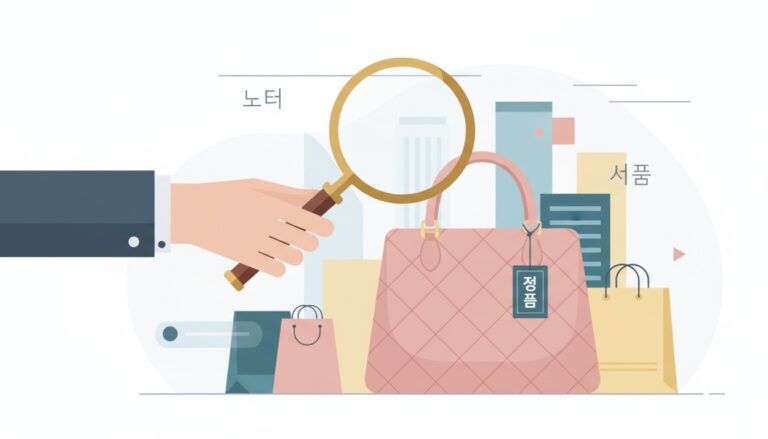
Phase 1: The “Real” Deal in Seoul
Hello! It’s your Daily Hangul editor here. 👋
Picture this: You are wandering through the trendy alleys of Hannam-dong or browsing a glistening vintage shop in Cheongdam. You spot the bag. It’s vintage Chanel, the leather is worn just right, and the price is… suspicious. Or maybe you’re at a street market where a vendor swears those sunglasses are “same factory, different label.”
In Korea, we have a massive market for both high-end vintage luxury and, let’s be honest, very convincing fakes. K-Dramas show chaebol heiresses smashing vases worth millions, but in reality, smart Korean shoppers are obsessed with “Shatech” (Chanel + Investment Technology)—buying luxury goods because they hold value better than stocks.
But if you don’t know how to ask “Is this real?” without sounding rude, or how to check for a warranty card, you might end up paying a premium price for a souvenir.
Today, we aren’t just learning words; we’re learning how to protect your wallet.
Phase 2: Essential Expressions (The Detective Kit)
Here are the three heavy-hitters you need when money is on the table.
1. 정품인가요? (Jeongpumingayo?)
- Pronunciation: [Jeong-pum-in-ga-yo?] (Sounds like “JUNG-poom” + “in-ga-yo”)
- Meaning: Is this genuine/authentic?
- K-Culture Moment: You’ll hear this in every second-hand luxury shop review on YouTube. It is the first question asked.
- Editor’s Insight: Jeongpum (정품) means “correct product” (genuine). The opposite is Gapum (가품 – fake) or the slang Jjaktung (짝퉁).
- Situation Spectrum:
[🚫 Boss] ———— [✅ Shop Owner] ———— [✅ Online Seller]- 🤔 Think About It: Why does Korea have a specific word for “genuine product” rather than just asking “Is it real?” It reflects a society that values certification and official status.
2. 보증서 있어요? (Bojeungseo isseoyo?)
- Pronunciation: [Bo-jeung-seo i-sseo-yo?] (“Bo-jeung” sounds like ‘boating’ without the ‘t’.)
- Meaning: Do you have the warranty/certificate of authenticity?
- K-Culture Moment: In crime thrillers, a detective might ask for a Bojeungseo to prove an alibi or ownership. In shopping, it’s your safety net.
- Editor’s Insight: In Korea, the “Full Set” (Box, Dust bag, Card) is crucial for resale value. No card? The price should drop drastically.
- Situation Spectrum:
[🚫 Casual friend] ———— [⚠️ Colleague] ———— [✅ Seller]3. S급 / A급 (S-geup / A-geup)
- Pronunciation: [S-geup / A-geup] (The ‘geup’ sounds like the ‘g’ in ‘go’ + a short ‘up’)
- Meaning: S-Grade (Mint condition) / A-Grade (Good condition)
- K-Culture Moment: Used in everything from grading beef (Hanwoo) to K-Pop idol visuals. “She is S-class!”
- Editor’s Insight: Don’t say “Good condition.” Say “It looks like S-geup.” You sound like an insider.
Phase 3: Textbook vs. Real Life
How do actual Seoulites talk in vintage shops?
| Situation | 📖 Textbook Korean | 🗣️ Real Korean | 💡 Why different? |
|---|---|---|---|
| Asking if it’s real | 이거 진짜예요? (Is this real?) | 혹시… 정품 맞나요? (By chance… is this correct/genuine?) | “Jeongpum” sounds more professional and less accusatory than “Real.” |
| Asking about condition | 상태가 좋아요? (Is the condition good?) | 이거 사용감 많아요? (Does this have a lot of “feeling of use”?) | We focus on “signs of use” (Sayeong-gam) to negotiate price. |
| Asking for a discount | 깎아 주세요. (Please cut the price.) | 현금으로 하면 좀 더 되나요? (If I pay cash, is a bit more [discount] possible?) | Direct bargaining is rare in stores; suggesting cash is the polite workaround. |
Bottom Note: In a high-end boutique (department store), asking for a discount is a no-go. In a vintage shop in Hongdae? Totally fine.
Phase 4: Cultural Deep Dive — “The Open Run”
K-Culture Connection: The “Open Run” (오픈런)
You might see lines of people in sleeping bags outside a Department Store at 5 AM. Are they waiting for a K-Pop concert? No. They are waiting for Chanel or Rolex to open.
This is called “Open Run.”
Because buying Jeongpum (authentic goods) is so difficult due to high demand, people queue for hours. This scarcity fuels the second-hand market where you, the learner, might be shopping. If a shop owner says a bag is “Open Run level” (오픈런급), it means it’s a hot item that people usually camp out for.
Non-verbal Tip: When examining a luxury bag, handle it with two hands, or ask the staff to show it to you. Treating the object with respect shows you are a serious buyer, not just a tourist looking for Jjaktung (fakes).
Phase 5: Roleplay — The Vintage Shop Showdown
Setting: A stylish, dimly lit vintage shop in Apgujeong. Jazz music is playing. You are eyeing a Gucci wallet.
Characters:
* YOU: A sharp shopper looking for a deal.
* Manager Park: Stylish, 30s, wearing glasses, very polite but firm.
Dialogue:
Manager Park: 고객님, 안목이 좋으시네요. 그거 S급이에요. ✨
(Gogaek-nim, anmogi joseusi-neyo. Geugeo S-geubieyo.)
[Customer, you have a good eye. That is S-Grade.]
YOU: 아, 상태가 진짜 좋네요. 그런데…
(Ah, sangtaega jinjja jonneyo. Geureonde…)
[Ah, the condition is really good. But…]
Manager Park: 네, 궁금한 거 있으세요?
(Ne, gunggeumhan geo isseuseyo?)
[Yes, do you have any questions?]
🔀 Your Turn! How do you verify authenticity?
A) 이거 짝퉁 아니죠? (This isn’t a fake, right?)
B) 혹시 보증서랑 박스도 다 있나요? (By chance, do you have the warranty and box, all of it?)
C) 이거 진짜 비싸네요. (This is really expensive.)
✅ Best Choice: B
* Why: Asking for the “components” (box/card) is the polite, indirect way to verify authenticity. If they have the full set, it’s likely real.
* ⚠️ Choice A Analysis: using the word “Jjaktung” (slang for fake) in a nice shop can be offensive to the owner. Save that word for the street markets.
Phase 6: 10-Second Shadowing Drill
Practice this before you walk into the store. Sound confident!
Emotion: 🤔 Polite skepticism (Curious but cautious)
“혹시 / 보증서도 / 같이 / 주시나요?”
(Hoksi / bojeung-seodo / gachi / jusinayo?)
(By any chance / the warranty card too / together / do you give?)
Phase 7: K-Culture Mini Glossary
| Korean | Romanization | English | Context |
|---|---|---|---|
| 짝퉁 | Jjaktung | Knockoff / Fake | Slang. Fun to say, but use carefully. |
| 신상 | Sinsang | New Product | Short for ‘Sin-sang-pum’. Everyone wants the Sinsang. |
| 당근 | Danggeun | Karrot Market | Korea’s #1 app for local second-hand trading. |
| 네고 | Nego | Negotiate | “Nego ganung?” (Is negotiation possible?) |
| 득템 | Deuk-tem | Rare find / Score | Obtaining (Deuk) + Item (Tem). Used when you find a bargain. |
Phase 8: Traveler’s Survival Kit
📍 Scenario: Using “Karrot Market” (Danggeun) App
Even travelers use this app to buy gear or souvenirs from locals. But be careful of scams!
🆘 Survival Phrases
1. 🇰🇷 “현장에서 계좌이체 해드릴게요.”
* (Hyeonjang-eseo gyejwah-iche haedu-ril-geyo.)
* English: I will wire the money on the spot (when we meet).
* Why: Never send money before meeting the seller.
2. 🇰🇷 “직거래 원해요.”
* (Jik-georae wonhaeyo.)
* English: I want a direct (in-person) trade.
* Why: Avoids shipping scams.📌 Editor’s Note:
If a price is too good to be true on a street cart in Myeongdong or Namdaemun, it is 100% a Jjaktung. Enjoy it for what it is, but don’t expect Jeongpum quality!
Phase 9: Think Deeper — Appearance & Status
“Why is everyone wearing the same coat?”
In Korea, fashion is often about belonging to the group rather than standing out. Luxury goods act as a membership card to a certain social status. This is tied to the concept of Che-myeon (Face/Reputation). Carrying a Gapum (Fake) when your friends have the Jeongpum (Real) can cause a loss of face.
🧠 Think Deeper:
Does your culture value “standing out” or “fitting in” more? How does that change how people shop for luxury brands?
Phase 10: Troubleshooting & FAQ
Q: Can I take a picture of the item to check online before buying?
A: ASK FIRST. “사진 찍어도 돼요?” (Sajin jjigeodo dwaeyo?). Some vintage shops protect their inventory fiercely. In a department store? Usually okay. In a street market? They might get angry.
❌ Common Mistake:
Assuming all “Vintage” shops sell authentic goods.
✅ Fix: Look for the “명품 감정” (Luxury Authentication) sign in the window. Reputable shops always have an in-house authenticator.
Phase 11: Wrap-up & Mission
Summary:
Use “Jeongpum” for real, “Gapum” for fake, and always ask for the “Bojeungseo” (Warranty) to protect yourself.
🚀 Action Mission:
* 🥉 Bronze: Say “Jeongpum-ingayo?” out loud 3 times looking at your own bag.
* 🥈 Silver: Go to a Korean online store (like Musinsa or Kream) and look for the word “정품” on listings.
* 🥇 Gold: Visit a vintage shop (or a market) and ask “Is this S-class?” (Igeo S-geubieyo?) just to see their reaction!
💬 Comment below:
Have you ever bought a “Jjaktung” by mistake? Tell me your story!
Frequently Asked Questions (FAQ)
Q: What does "정품인가요? (Jeongpumingayo?)" mean in Korean and how do you pronounce it?
A: In Korean, "정품인가요? (Jeongpumingayo?)" is pronounced [Jeong-pum-in-ga-yo?] and means: Is this genuine/authentic?
Q: What does "보증서 있어요? (Bojeungseo isseoyo?)" mean in Korean and how do you pronounce it?
A: In Korean, "보증서 있어요? (Bojeungseo isseoyo?)" is pronounced [Bo-jeung-seo i-sseo-yo?] and means: Do you have the warranty/certificate of authenticity?
Q: What does "S급 / A급 (S-geup / A-geup)" mean in Korean and how do you pronounce it?
A: In Korean, "S급 / A급 (S-geup / A-geup)" is pronounced [S-geup / A-geup] and means: S-Grade (Mint condition) / A-Grade (Good condition)







