

Phase 1: The Immersive Hook
Hello! This is your Daily Hangul Editor.
Picture this: You are watching a popular K-Drama—let’s say something like The Glory or My Mister. You notice a scene where characters aren’t just praying in a church or temple; they are eating rice cakes, gossiping in the parking lot, or holding intense political debates in the courtyard. Suddenly, the subtitles translate a complex sentence simply as “Let’s eat.” But the vibe suggests something much deeper.
In Korea, religious facilities—whether it’s a neon-cross-topped church in Seoul or a quiet temple in the Jirisan mountains—are rarely just about spirituality. They are community centers, free cafeterias, social safety nets, and sometimes, the fiercest political arenas.
If you treat these places solely as houses of worship, you miss half the story. Today, we’re stepping into the blurred line between the sacred and the social in Korea. I’ll show you how to navigate these spaces like a local, so you don’t accidentally offend a monk or stand awkwardly during a church lunch.
Phase 2: Deep Dive into Core Expressions
Here are three expressions that capture the social weight of religious spaces. These are C1-level concepts because they bridge the gap between ancient tradition and modern slang.
1. 성지순례 (Seongji-sullye)
- Pronunciation:
[seong-ji-sul-lye](Sounds like: Song-jee-sool-yeh) - Meaning:
- Literal: Pilgrimage to the Holy Land.
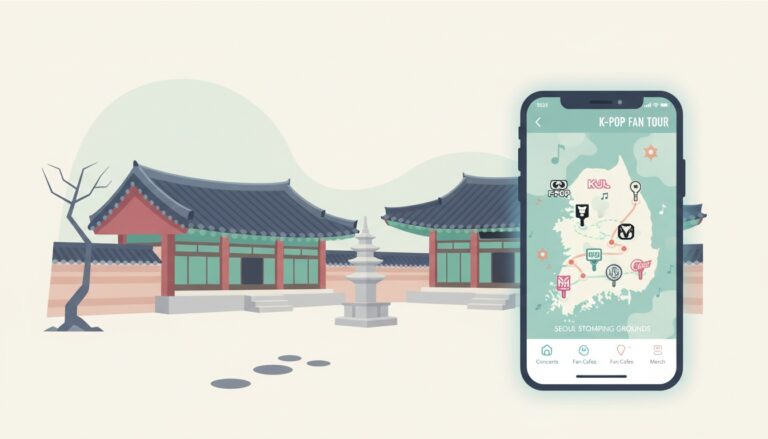
- Real Nuance: While Catholics use this for visiting martyr sites, 90% of young Koreans use this to mean “Visiting a filming location” or “Going to a restaurant your bias loves.”
- K-Culture Moment: If you comment on a YouTube video from 10 years ago because the algorithm suddenly brought you there, you type: “성지순례 왔습니다” (I have come on a pilgrimage). It means paying respect to a legendary internet moment.
- Editor’s Insight: This word is the perfect example of how secular Korean culture borrows from religious gravity to express fandom loyalty. It turns a K-Pop tour into a spiritual journey.
- Situation Spectrum:
[🚫 Formal Prayer] ———— [⚠️ Religious Context] ———— [✅ Internet/Fandom]- (Note: Use carefully with strict religious elders, but freely online.)
- 🤔 Think About It: Why does modern fandom culture borrow such heavy religious terminology? Does it suggest that K-Pop or K-Drama has become a form of modern “religion” for the younger generation?
2. 공양 (Gongyang)
- Pronunciation:
[gong-yang](Sounds like: Gong-yah-ng) - Meaning:
- Literal: Offering (usually food) to Buddha or monks.
- Real Nuance: In a temple stay context, it simply means “meal.” But it implies a meal eaten with gratitude, silence, and zero waste.
- K-Culture Moment: In variety shows like I Live Alone (Na Honja Sanda), when a celebrity goes on a temple stay to “clear their mind,” the monk will tell them, “It is time for Gongyang.” It sets a tone of discipline immediately.
- Editor’s Insight: You don’t “eat” (먹다) at a temple; you “do Gongyang” (공양하다). If you leave even a single grain of rice in your bowl, the intense stare from the head monk (Sunim) will burn a hole in you. It’s about respecting the labor behind the food.
3. 나눔 (Nanum)
- Pronunciation:
[na-num] - Meaning: Sharing / Charity.
- Editor’s Insight: While basic, this is the core social function of Korean religion. Churches are famous for their “free lunch” culture. You’ll often see elderly people lining up at churches not for the sermon, but for the Nanum (lunch/gifts). It’s a keyword that legitimizes the facility’s existence in the neighborhood.
Phase 3: Textbook vs. Real Life
How we talk about religion changes drastically depending on who is listening.
| Situation | 📖 Textbook Korean | 🗣️ Real Korean | 💡 The “Why” |
|---|---|---|---|
| Going to church | 교회에 갑니다. (I go to church.) | 예배 드리러 가 / 주일 지키러 가 (I go to give worship / keep the Lord’s Day.) | “Going” is physical; “Worship” explains the purpose. Christian speak is very specific. |
| Eating at a temple | 밥을 먹습니다. (I eat rice.) | 공양 드립니다. (I partake in an offering.) | Using secular verbs in a sacred space can sound crude or uneducated. |
| Giving money | 기부합니다. (I donate.) | 헌금 냅니다 (Christian) / 불전 놓습니다 (Buddhist) | Money in religion is never just “donation”; it’s an offering with specific rituals. |
Note: Even if you aren’t religious, using the specific verb (e.g., 헌금 vs. 기부) shows high cultural IQ.
Phase 4: Cultural Deep Dive
4-1. The Art of “No Eye Contact” (Non-verbal)
When visiting a Korean temple, or even a solemn cathedral, the rule is lowered eyes. Unlike Western interactions where eye contact equals respect, in these spiritual (and highly hierarchical) spaces, staring directly at a Monk or a Priest can be seen as challenging their authority. Keep your gaze at their chest level. Also, silence is not empty here; it’s a form of communication. If a monk pours you tea in silence, do not break it with “So, how long have you lived here?” Just drink.
4-2. The “Reply 1988” Effect (Community)
In K-Dramas like Reply 1988, you often see the “Church Oppa” (교회 오빠). This isn’t just a religious term. In Korean society, a “Church Oppa” represents a boy who is kind, plays guitar, sings well, and is innocent—a distinct archetype. Religious facilities function as dating pools and talent shows for the youth. Understanding this helps you see why so many K-Pop idols started their careers singing in church choirs.
Phase 5: Immersive Roleplay
Scenario: You are doing a Temple Stay in the mountains. It is lunch time (Gongyang). The atmosphere is dead silent. You are an expat looking for peace. Sunim (Monk) is observing the room.
Sunim: (Softly but firmly) 밥알 하나도 농부의 땀입니다. 남기지 마세요.
(Babal hanado nongbu-ui ttam-imnida. Namgiji maseyo.)
(Translation: Even a single grain of rice is the farmer’s sweat. Do not leave any.)
YOU (Select your response):
- Option A: “네, 죄송합니다. 배가 너무 불러서요.” (Sorry, I’m too full.)
- Option B: (Silently pours water into the bowl to rinse the remaining sauce and drinks it.)
- Option C: “김치가 너무 매워요!” (The kimchi is too spicy!)
🔀 Decision Point:
* Option A: 🚫 Fail. In a temple, “I’m full” is not a valid excuse for waste. It breaks the principle of Gongyang.
* Option B: ✅ Perfect Choice. This is called “Balwoo Gongyang.” You clean the bowl with water and drink it to ensure zero waste. The Monk will respect you immensely.
* Option C: ⚠️ Risk. Complaining about the food is considered bad form in a spiritual setting.
Phase 6: 10-Second Shadowing Drill
Let’s practice the “Seongji-sullye” phrase, useful for your next Instagram post at a BTS filming location.
😊 (Excited & Proud)
드디어 / 방탄 뮤비 촬영지에 / 성지순례 왔습니다!
(Deu-di-eo / Bangtan myubi chwal-yeong-ji-e / seong-ji-sul-lye wat-seumnida!)
Finally, I have come on a pilgrimage to the BTS music video location!
Phase 7: K-Culture Mini Glossary
| Korean | Romanization | Meaning | Context |
|---|---|---|---|
| 눈치 | Nunchi | Social sensing | Crucial in church cafeterias to know where not to sit (e.g., the Elders’ table). |
| 합장 | Hapjang | Palms together | The Buddhist greeting. Do this instead of shaking hands at a temple. |
| 템플스테이 | Temple Stay | Temple Stay | A popular cultural program. It’s 50% meditation, 50% recovering from corporate burnout. |
| 무속신앙 | Musok-sinang | Shamanism | Often seen in dramas (The Moon Embracing the Sun). It’s the root of many Korean superstitions. |
Phase 8: Traveler’s Survival Kit (Religious Sites)
Visiting Myeongdong Cathedral or Bongeunsa Temple? Keep these in mind.
🆘 Survival Phrases
1. “사진 찍어도 되나요?” (Sajin jjigeodo doenayo?) – Can I take a photo? (Many interiors prohibit this.)
2. “신발 벗어야 하나요?” (Sinbal beoseoya hanayo?) – Do I need to take off my shoes? (Almost always YES for indoors.)
3. “조용히 하겠습니다.” (Joyonghi hagetseumnida.) – I will be quiet. (Useful if you are warned by staff.)📌 Editor’s Pro Tip:
Never step on the threshold (moon-ji-bang) of a temple door. Step over it. Stepping on it is considered bad luck and disrespectful to the spirits/structure. It marks you instantly as a tourist who doesn’t know the rules.
Phase 9: Critical Thinking — “Think Deeper”
Topic: The Secularization of Sacred Language
Words like Seongji-sullye (Pilgrimage) shifting from strictly religious use to K-Pop fandom slang is a fascinating phenomenon. It reflects how modern Korea elevates entertainment to a “sacred” status. Fans invest time, money, and emotional devotion similar to religious worship.
🧠 Think Deeper: Does using religious terminology for pop culture trivialize the religion, or does it elevate the art form? In your native language, do you use religious words (like “Icon” or “Idol”) for celebrities? How does that compare to the Korean context?
Phase 10: FAQ & Troubleshooting
- Q: Can I eat the free food at a church/temple if I’m not a believer?
- A: Generally, Yes. Especially at temples during lunch or big churches with cafeterias. However, the polite thing to do is to follow the queue, eat quickly, and perhaps leave a small donation (offering) if there’s a box. Don’t treat it like a restaurant.
- Q: A grandmother approached me on the street asking “Do you know the Tao?” (도를 아십니까?). Is this a religious invite?
- A: NO. This is a common cult-like scam. They often target foreigners. Just say “No” firmly and keep walking. Do not engage.
- ❌ Common Mistake: Wearing sleeveless tops or short shorts to a temple.
- ✅ Fix: Even in summer, carry a light scarf or cardigan to cover your shoulders. It’s a sign of respect.
Phase 11: Wrap-up
Today, we explored how Korean religious facilities are social hubs, not just prayer halls. We learned that “Pilgrimage” applies to BTS as much as Buddha, and that finishing your rice bowl is a spiritual act.
🏆 Your Action Missions:
* 🥉 Bronze: Practice the Seongji-sullye shadowing sentence.
* 🥈 Silver: Watch an episode of The Glory or Reply 1988 and spot the church scenes. Notice the social dynamics.
* 🥇 Gold: Visit a local temple in Korea (or a Korean church in your country) and try the Hapjang bow or eat a meal there observing the silence.
Phase 12: Interactive Quiz
1. You are visiting a famous K-Drama filming location. You post a photo. Which caption is the most culturally witty?
* A) I am here. (여기에 왔어요.)
* B) Seongji-sullye! (성지순례!)
* C) I am praying. (기도 중입니다.)
2. True or False?
* “At a temple stay, if you are full, it is polite to leave a little bit of food to show the host provided plenty.”
3. Situation: You enter the main hall of a temple. Where should you step?
* A) On the wooden threshold.
* B) Over the wooden threshold.
Answer Key:
1. B. It shows you understand internet culture.
2. False. In Buddhist culture (Gongyang), leaving food is disrespectful to the effort that produced it.
3. B. Never step on the threshold!
Frequently Asked Questions (FAQ)
Q: What does "성지순례 (Seongji-sullye)" mean in Korean and how do you pronounce it?
A: In Korean, "성지순례 (Seongji-sullye)" is pronounced [seong-ji-sul-lye] and means: Literal: Pilgrimage to the Holy Land.
Q: What does "공양 (Gongyang)" mean in Korean and how do you pronounce it?
A: In Korean, "공양 (Gongyang)" is pronounced [gong-yang] and means: Literal: Offering (usually food) to Buddha or monks.
Q: What does "나눔 (Nanum)" mean in Korean and how do you pronounce it?
A: In Korean, "나눔 (Nanum)" is pronounced [na-num] and means: Sharing / Charity.







