

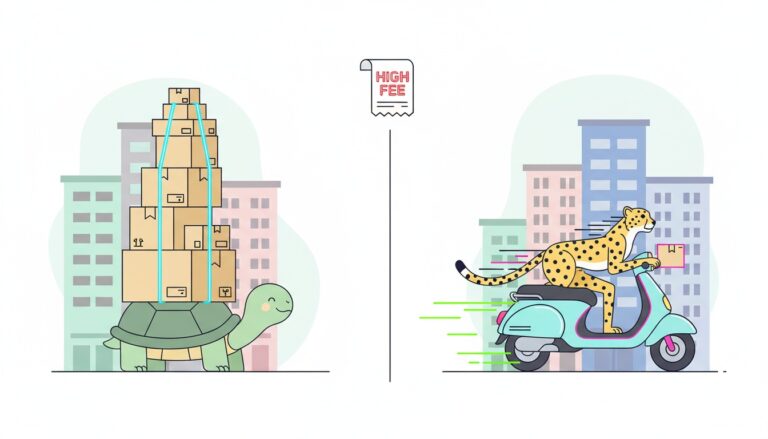
Why Is My Delivery Fee Higher Than My Coffee? 🛵
Phase 1: The Sticker Shock
Hello, fellow learners! It’s your editor at Daily Hangul, writing to you from a rainy Seoul evening. 🌧️
I just opened a delivery app to order pajeon (green onion pancake) because, well, it’s raining (and if you’ve been in Korea for a while, you know rain = pajeon + makgeolli). But here’s the kicker: the pancake is 15,000 KRW, but the delivery fee is 6,000 KRW. Ouch.
Welcome to the paradox of the “Nation of Delivery” (배달의 민족). We can get anything delivered—from a single iced Americano to a full course sashimi dinner—at 3 AM. But recently, a fierce war has erupted over speed. It’s no longer just about getting the food; it’s about getting it now. This is the era of “Single Delivery” (단건 배달), or what some apps call “Cheetah Delivery.”
If you don’t understand the nuance of these delivery options, you might end up paying double for a cold burger, or worse, waiting an hour while your driver visits three other houses. Let’s decode the economics and emotions behind that daunting delivery receipt.
Phase 2: Deep Dive into the “Delivery War”
1. 배달비 (Baedal-bi)
- Pronunciation: [Bae-dal-bee] (Think of ‘Bae’ as in ‘baby’ + ‘dal’ like ‘Dahl’ + ‘bee’)
- Meaning: Delivery Fee (Literal) / The Price of Laziness (Real Nuance)
- K-Culture Moment: You’ll see this discussed heatedly on Korean variety shows or YouTube comments. A comedian might joke, “I was going to order a diet salad, but the baedal-bi was so high I got angry and ordered fried chicken instead.”
- Editor’s Insight: Until a few years ago, delivery was often free if you ordered enough. Now, 배달비 is separate. It’s a source of collective national sighing. When you see a delivery fee of 0 won, it feels like winning the lottery.
- Situation Spectrum:
[🚫 Formal Report] ———— [✅ Everyday Life] ———— [✅ Complaint] - 🤔 Think About It: In many Western countries, a delivery fee + service fee + tip is standard. In Korea, there is no tipping. So, is the baedal-bi actually expensive, or are we just paying the true cost of labor that was previously hidden?
2. 단건 배달 (Dangeon Baedal)
- Pronunciation: [Dan-geon Bae-dal]
- Meaning: Single-order Delivery / One-shot Delivery
- K-Culture Moment: The app interface usually highlights this in flashy colors (Blue for Baemin 1, Orange for Coupang Eats). It promises that the driver comes only to your house, not stopping for others.
- Editor’s Insight: This is the premium service. Standard delivery is called ‘알뜰 배달’ (Al-ddeul: thrifty/saving) or ‘묶음 배달’ (Bundled), where the driver picks up 3-4 orders and drops them off sequentially. If you are ‘Stop #4’, your noodles will be soggy. Dangeon Baedal is the solution, but you pay for the privilege.
- Situation Spectrum:
[🚫 To your boss (too detailed)] ———— [✅ Ordering with friends]
3. 최소 주문 금액 (Choeso Jumun Geumaek)
- Pronunciation: [Choe-so Ju-mun Geu-maek]
- Meaning: Minimum Order Amount
- Editor’s Insight: The ultimate enemy of the solo diner (Hon-bap-jeok). You want a burger (8,000 KRW), but the minimum is 15,000 KRW. You are forced to add cheese sticks and a drink you didn’t want. This is often why delivery feels so expensive.
Phase 3: Textbook vs. Real Life
| Situation | 📖 Textbook Korean | 🗣️ Real Street Korean | 💡 Why the difference? |
|---|---|---|---|
| Complaining about fees | 배달 요금이 너무 비싸요. (The delivery fee is too expensive.) | 배달비 실화냐? (Is this delivery fee for real/a true story?) | Silhwa-nya? is a internet slang staple used when reality is absurdly disappointing. |
| Ordering just one item | 하나만 배달 되나요? (Is delivery available for just one?) | 1인분도 되나요? (Is a portion for one person okay?) | ‘1인분’ (One person portion) is the standard unit of measurement in Korean dining. |
| Asking to leave it at door | 문 앞에 놓아 주세요. (Please place it in front of the door.) | 문 앞에 두시고 문자 주세요. (Leave it at the door and text me.) | Efficiency & Safety. Koreans prefer non-contact delivery (especially post-pandemic). |
💡 Editor’s Note: “배달비가 밥값보다 비싸” (The delivery fee is more expensive than the meal) is a common hyperbolic phrase you can use to sound like a local.
Phase 4: Cultural Deep Dive — The “Pali-Pali” Tax
4-1. The Silence of the Doorstep (Non-verbal)
Unlike in the US or Europe, where handing the food over might involve a friendly “How are you?”, modern Korean delivery is extremely transactional and often invisible. The default setting is often “Leave at door” (문 앞에 놓고 가주세요). The driver drops the food, takes a photo as proof, rings the bell, and vanishes. Do not open the door immediately to greet them; it can actually be awkward! The photo verification is the “handshake” of this interaction.
4-2. K-Food Connection: The Death of “Service” (Seo-bi-su)?
In the old days, if you ordered a lot of Chinese food (Jajangmyeon), the owner might send free dumplings (Gun-mandu) as ‘Service’. With the rise of third-party delivery apps and high baedal-bi, margins are tight. That free ‘service’ is disappearing, or it’s now conditional: “Write a 5-star review, get a free soda.” It’s a transaction of digital reputation now.
Phase 5: Immersive Roleplay — The Friday Night Dilemma
Setting: It’s Friday night at a Han River Park (Yeouido). You are sitting on a picnic mat with two Korean friends, Min-ji and Jun-ho. You are designated as the “Order Master.”
Min-ji: 아, 배고파. 치킨 시키자! 근데 여기 배달존 어디야?
(Ah, baegopa. Chikin sikija! Geunde yeogi baedal-jon eodiya?)
Ah, I’m hungry. Let’s order chicken! But where is the delivery zone here?
YOU: (Looking at the app) 응, 여기 배달존 2번이랑 가까워. 근데…
(Eung, yeogi baedal-jon 2-beonirang gakkawo. Geunde…)
Yeah, we are close to Delivery Zone 2. But…
Jun-ho: 왜? 배달비 비싸?
(Wae? Baedal-bi bissa?)
Why? Is the delivery fee expensive?
YOU:
(Looking at the screen: Standard delivery is 3,000 KRW / 50 mins. Cheetah Delivery is 6,000 KRW / 20 mins.)
🔀 Decision Point: What do you choose?
- A) “배달비 6천 원이래. 그냥 알뜰 배달로 시키자.” (It says 6,000 won. Let’s just do the saver delivery.)
- B) “야, 식은 치킨 먹기 싫어. 내가 쏠게, 한 집 배달로 가자!” (Hey, I don’t want cold chicken. It’s on me, let’s go with single delivery!)
- C) “편의점 가서 라면이나 먹을까?” (Shall we just go to the convenience store and eat Ramen?)
✅ Best Choice: B — On a Friday night at the Han River, mood and speed are everything. Paying the extra $3 to ensure the chicken arrives hot and crispy while the beer is still cold? That makes you the hero. “내가 쏠게” (I’ll treat/shoot) regarding the delivery fee is a small flex that gains huge points.
Phase 6: 10-Second Shadowing Drill
Let’s practice the sigh of resignation we all feel.
😤 Emotion: Disbelief mixed with hunger
배달비가 / 무슨 / 국밥 한 그릇 값이야… / 그래도 먹어야지.
(Bae-dal-bi-ga / mu-seun / guk-bap han geu-reut gap-si-ya… / geu-rae-do meo-geo-ya-ji.)
“The delivery fee / is like / the price of a bowl of soup… / but I still have to eat.”
Phase 7: K-Culture Glossary (The Delivery Edition)
| Korean | Romanization | Meaning | Context |
|---|---|---|---|
| 역세권 | Yeok-se-kwon | Station Area | Usually refers to real estate, but in delivery, living near a station often means lower fees and faster times. |
| 배달존 | Baedal-jon | Delivery Zone | Specific pick-up spots in large public areas like Han River Parks or Universities. You must go there to meet the driver. |
| 리뷰 이벤트 | Ribyu Event | Review Event | “Promise to leave a 5-star photo review, and we’ll give you cheese balls.” A massive part of Korean delivery culture. |
| 피크타임 | Peak Time | Peak Time | Lunch (11:30-1:00) and Dinner (6:30-8:00) when fees spike and rain makes it impossible to find a driver. |
Phase 8: Traveler’s Survival Kit 🆘
If you are visiting Korea, you cannot order delivery to your hotel room door usually. You must meet them in the lobby.
🆘 Survival Expression #1
* 🇰🇷 “로비로 내려갈게요.” (Robi-ro naeryeo-gal-ge-yo.)
* 🗣️ Pronunciation: [Ro-bee-ro neh-ryeo-gal-geh-yo]
* Meaning: “I’ll come down to the lobby.”
* Use when: The driver calls you and sounds confused or asks for a password you don’t have.📌 Editor’s Pro Tip:
Most Korean delivery apps (Baemin, Yogiyo) require a Korean phone number and credit card to verify identity. If you are a short-term traveler without an ARC (Alien Registration Card), use Uber Eats (limited availability) or Shuttle Delivery (English friendly, higher fees) or ask your hotel concierge to order for you (The “Concierge Chance”).
Phase 9: Think Deeper — The Cost of “Pali-Pali”
Language & Society: The existence of “Single Delivery” (Cheetah Delivery) perfectly illustrates the Korean societal obsession with Pali-Pali (Hurry, Hurry). Time is commodified. In many cultures, delivery is a convenience you wait for patiently. In Korea, it is a race. We are willing to pay a premium (sometimes 30-40% of the food cost) just to save 15 minutes.
🧠 Think Deeper: Does this demand for hyper-speed create too much pressure on the delivery riders (Raiders)? The language we use—”Cheetah,” “Bullet,” “Lightning”—glamorizes dangerous driving. When you toggle that “Single Delivery” switch, you are participating in a system that values minutes over safety. Is it worth the extra 3,000 won?
Phase 10: FAQ & Troubleshooting
- Q: Do I need to tip the delivery driver in Korea?
- A: NO. Do not try to give cash. The baedal-bi you paid in the app covers everything. Handing cash can actually be awkward or refused. Just say “Gamsahamnida” (Thank you).
- Q: Can I order just one coffee?
- A: Yes, but be prepared for the “Belly Button is bigger than the Stomach” (배보다 배꼽이 더 크다) situation, where the delivery fee costs more than the coffee.
- Q: Why do riders sometimes wear full-face masks and sunglasses?
- A: To protect against dust/sun, but also for anonymity. Delivery work is tough, and some riders prefer to remain anonymous while working.
Phase 11: Wrap-up
Today we navigated the expensive but convenient world of Korean delivery wars. We learned that time is money, quite literally.
Action Missions:
* 🥉 Bronze: Open a Korean delivery app (even if you can’t order) and try to find the “Delivery Fee” (배달팁/배달비) on a menu.
* 🥈 Silver: Watch a “Mukbang” video and see if they mention delivery speed or service items.
* 🥇 Gold: If you are in Korea, order fried chicken to a Han River Delivery Zone and successfully meet the driver!
💬 Your Turn: In your country, how much is the average delivery fee? Do you have “express” options? Tell me in the comments!
Phase 12: Quiz — The Savvy Orderer
- True or False? Giving the delivery driver a 2,000 KRW tip in cash is considered polite and expected in Korea.
- Scenario: You want to save money. Which delivery option should you choose?
- A) 단건 배달 (Single Delivery)
- B) 알뜰 배달 (Thrifty/Bundled Delivery)
- Fill in the blank: When the delivery fee is more expensive than the food, Koreans say: “_____ is bigger than the stomach.” (Hint: Body part)
(Scroll down for answers)
.
.
.
Answers:
1. False. (No tipping!)
2. B) 알뜰 배달. (It takes longer but is cheaper.)
3. Belly Button (배꼽). (배보다 배꼽이 더 크다)
Frequently Asked Questions (FAQ)
Q: What does "배달비 (Baedal-bi)" mean in Korean and how do you pronounce it?
A: In Korean, "배달비 (Baedal-bi)" is pronounced [Bae-dal-bee] and means: Delivery Fee (Literal) / The Price of Laziness (Real Nuance)
Q: What does "단건 배달 (Dangeon Baedal)" mean in Korean and how do you pronounce it?
A: In Korean, "단건 배달 (Dangeon Baedal)" is pronounced [Dan-geon Bae-dal] and means: Single-order Delivery / One-shot Delivery
Q: What does "최소 주문 금액 (Choeso Jumun Geumaek)" mean in Korean and how do you pronounce it?
A: In Korean, "최소 주문 금액 (Choeso Jumun Geumaek)" is pronounced [Choe-so Ju-mun Geu-maek] and means: Minimum Order Amount







