

Phase 1: Immersive Hook
Hello! This is your Daily Hangul editor.
You know that specific moment in almost every K-Drama romance? The couple is bickering, the tension is high, and suddenly, the male lead drops the polite “-yo” ending and switches to casual speech (Banmal). The subtitles might just show a change in tone, but for a Korean audience, the air in the room just shifted. He didn’t just change his grammar; he just claimed intimacy. He just crossed a line.
Or consider the K-Pop idol on a variety show. They are laughing hysterically, falling over, but notice how they never, ever drop the honorifics when addressing the host, even in the heat of the moment? That isn’t just politeness; it’s survival.
If you’ve reached a C1 level, you know the grammar rules. You know how to conjugate Hasip-sio and Haeyo. But today, we aren’t talking about verb endings. We are talking about social strategy. We’re looking at why a 50-year-old manager might use honorifics to a 30-year-old client, and why getting this wrong doesn’t just make you sound like a foreigner—it makes you sound rude.
I’ve seen advanced learners get perfect scores on TOPIK exams but freeze at a company dinner because they didn’t know when to stop being polite. Let’s fix that.
Phase 2: Deep Dive into Nuance
Here are three expressions that define the subtle art of Korean hierarchy.
1. 말씀 편하게 하세요 (Malsseum pyeonhage haseyo)
- Pronunciation: [Mal-sseum pyeon-ha-ge ha-se-yo] / Sounds like: “Mal-sum pyun-ha-ge ha-se-yo”
- Meaning: (Lit.) Please speak your words comfortably. / (Real Nuance) “Please drop the honorifics and speak casually to me.”
- K-Culture Moment: You see this in business meetings when a younger client wants to show respect to an older vendor, or on blind dates in dramas when the couple decides to get closer. It is the green light for intimacy.
- Editor’s Insight: This is a power move wrapped in kindness. By allowing the other person to speak casually (lowering their language level), you are acknowledging their higher status (age or position) or trying to break the ice. If you are the older one, never assume you can just start speaking Banmal. You wait for this permission slip.
- Situation Spectrum:
[🚫 To a Boss] ———— [✅ To an older subordinate] ———— [✅ To a date]- 🤔 Think About It: In English, we say “Please, call me John.” How is “Call me by my first name” different from “Speak to me in casual grammatical forms”?
2. 말을 놓다 (Mareul nota)
- Pronunciation: [Ma-reul no-ta] / Sounds like: “Ma-rul no-ta”
- Meaning: (Lit.) To put down words. / (Real Nuance) To lower the speech level; to start speaking Banmal.
- K-Culture Moment: A tense scene where two rivals meet. One suddenly speaks casually. The other glares and says, “지금 말 놓으셨어요?” (Did you just ‘put down’ your words? / Did you just speak Banmal to me?).
- Editor’s Insight: Nota implies placing something down on a lower surface. It’s physical. When you speak Banmal without permission to a stranger, it feels like a physical shove. Conversely, suggesting “우리 말 놓을까?” (Shall we drop the honorifics?) is the Korean equivalent of becoming “official” friends.
- Situation Spectrum:
[🚫 First Meeting] ———— [⚠️ With Permission] ———— [✅ Childhood Friends]- 🤔 Think About It: Why does Korean visualize speech levels as physical elevation (putting up / putting down)?
3. 잘 부탁드립니다 (Jal butak deurimnida)
- Pronunciation: [Jal bu-tak deu-rim-ni-da] / Sounds like: “Jal boo-tak du-rim-ni-da”
- Meaning: (Lit.) I ask you for a favor well. / (Real Nuance) “I am in your care,” “Please look after me,” or “Let’s have a good working relationship.”
- K-Culture Moment: The very first thing any contestant says on Produce 101 or any audition show. The first thing a new employee says to the team.
- Editor’s Insight: There is no English equivalent. “Nice to meet you” is too weak. This phrase acknowledges a hierarchy: “You have the power to help me or hurt me, so please choose to help me.” It establishes humility immediately.
- Situation Spectrum:
[✅ Formal Intro] ———— [✅ Email Sign-off] ———— [🚫 To close friends]- 🤔 Think About It: This phrase places the speaker in a vulnerable position dependent on the listener. Does this reflect a collective reliance that Western individualism rejects?
Phase 3: Textbook vs. Real Life
Let’s be honest. Textbooks make you sound like a 19th-century scholar or a robot.
| Situation | 📖 Textbook Korean | 🗣️ Real Korean (C1 Level) | 💡 Why the difference? |
|---|---|---|---|
| Acknowledging a mistake | 죄송합니다. (Joesonghamnida) | 아, 제가 실수를 했네요. 죄송합니다. (Ah, I made a mistake. Sorry.) | Just saying “Sorry” can sound defensive or robotic. Admitting the specific error shows ownership and professional maturity. |
| Asking for a favor | 이것 좀 해주세요. (Please do this.) | 혹시 시간 되시면, 이것 좀 부탁드려도 될까요? (By any chance, if you have time, may I ask for this favor?) | Direct requests can sound like orders. “Hoxy” (By any chance) acts as a softener, giving the listener an ‘out’. |
| Leaving work | 안녕히 계세요. (Stay peacefully.) | 먼저 들어가 보겠습니다. (I will try going in first.) | Leaving before others (especially the boss) implies guilt. You announce your departure tentatively to show respect for their continued labor. |
Bottom Note: In a professional setting, being too grammatically correct without the proper “cushion words” (like hoxy, jwesonghande) can actually make you seem cold.
Phase 4: Cultural Deep Dive — The Art of Nunchi
Language isn’t just what comes out of your mouth. In Korea, Nunchi (눈치)—the ability to gauge the mood and read the room—dictates which honorifics you use.
4-1. The “Non-Verbal” Honorifics
Advanced etiquette isn’t just adding -yo. It’s about body mechanics:
– The Two-Hand Rule: Even if you are just passing a salt shaker or pouring a drink. One hand supports the wrist or elbow of the extending arm. Using one hand with an elder is aggressive.
– The Eye Contact Paradox: In the West, direct eye contact shows confidence. In Korea, staring too intensely at a superior while they are reprimanding you is seen as defiance (Daedeulda – talking back). You lower your gaze slightly.
4-2. The K-Drama Connection: The “Wrist Grab” Shift
We’ve all seen the trope. The chaebol heir grabs the poor girl’s wrist. But listen to the dialogue. Usually, this physical breach of boundaries coincides with a linguistic breach. He switches from polite language to Banmal. It signals, “I am taking control of this dynamic.” In real life? Don’t grab wrists. But do notice that shifting to Banmal unilaterally is an act of dominance.
Phase 5: Immersive Roleplay
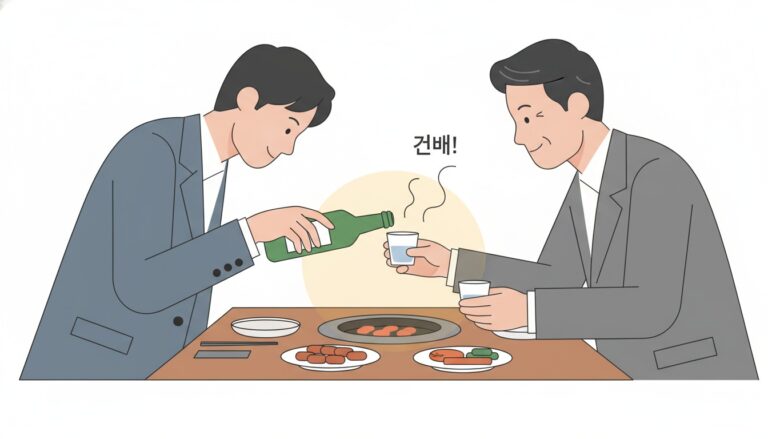
Scenario: It is a Hoesik (Company Dinner). You are the only non-Korean on the team. You are at a BBQ restaurant in Mapo-gu. The grill is sizzling. Manager Kim (50s, male) is slightly tipsy. You (30s) are sitting across from him.
Manager Kim: (Holding up an empty soju glass) 어이, [Your Name]! 여기 한 잔 받아!
(Hey, receive a glass here!)
YOU (Decision Point):
🔀 Your turn! How do you accept the drink?
– A) Hold the glass with one hand and say “Thanks!”
– B) Hold the glass with two hands, turn your head away as you drink, and say “Gamsahamnida.”
– C) Refuse politely because you don’t like soju.
✅ Best Choice: B
Why? The “Head Turn” is crucial C1-level etiquette. When drinking alcohol with an elder, you never face them directly while swallowing. You cover your mouth or turn your torso/head to the side. It shows you are not daring to show your “pleasure” directly to a superior.
(Dialogue Continues)
Manager Kim: (Smiling) 우리 [Your Name]은 한국말 진짜 잘해. 말 편하게 해! 이제 우리 친구잖아?
(You speak Korean so well. Speak comfortably! We are friends now, right?)
YOU:
🔀 Strategy Check: He gave you permission. Do you switch to Banmal?
– A) “Okay, thanks buddy!” (Geurae, gomawo!)
– B) “Ah, no, how could I?” (A-nio, eotteoke geuraeyo?)
– C) “Ah, thank you, but I am comfortable speaking politely.” (Gamsahamnida, hajiman joneun jondaetmari pyeonhaeyo.)
✅ Best Choice: B or C
Why? This is a trap! (Sort of). In a hierarchical business culture, even if a superior says “speak comfortably,” they usually mean “relax your posture,” not “speak to me like your childhood friend.” Option A would create a dead silence in the room. Stick to polite language, but perhaps with a warmer tone.
Phase 6: 10-Second Shadowing Drill
Let’s practice a phrase that perfectly balances politeness with assertiveness. Use this when you need to interrupt a senior to ask a question.
Emotion: 🥺 Apologetic but clear (Not weak!)
Sentence:
부장님, / 바쁘시겠지만 / 잠시 / 시간 괜찮으실까요?
(Bu-jang-nim, / ba-ppeu-si-get-ji-man / jam-si / si-gan gwaen-chan-eu-sil-kka-yo?)
Context: “Manager, I know you are busy, but would you have a moment?”
Phase 7: K-Culture Mini Glossary
| Korean | Rom. | Meaning | Context |
|---|---|---|---|
| 꼰대 | Kkondae | Old-school person / Boomer | A superior who enforces rigid hierarchy and says “Back in my day…” often demands excessive honorifics. |
| 존댓말 | Jondaetmal | Honorific speech | The default setting for strangers and seniors. |
| 반말 | Banmal | Casual speech | Reserved for friends and those younger than you. |
| 야자타임 | Yaja-time | Informal time | A drinking game where hierarchy is reversed for 5 minutes. The only time you can curse at your boss (at your own risk!). |
Phase 8: Traveler’s Survival Kit (Etiquette Edition)
Even if you are just traveling, getting the “addressing terms” right changes how you are treated.
🆘 Survival Expression: Calling a Stranger
– DO NOT USE: “Agassi” (Miss) or “Ajuma” (Ma’am) – These can be offensive depending on tone and age.
– USE THIS:
– To a server: “Sajang-nim!” (Boss – even if they are just an employee, it flatters them).
– To a stranger on the street: “Jeogiyo…” (Excuse me) or “Seonsaeng-nim” (Teacher – very respectful for older men).
– 💡 Pro Tip: If you bump into someone on the subway, don’t just say “Sorry” in English. A slight bow of the head is the universal “I’m sorry” in Korea. It works better than words.
Phase 9: Think Deeper — Language & Power
The Hierarchy Paradox:
Korean honorifics are often criticized for reinforcing vertical social structures. If you have to change your verb endings based on age, you are constantly reminded of your “place.” This makes horizontal discussion in meetings difficult—how can an intern debate a manager when the language itself requires submission?
However, there is a flip side. Honorifics also force a mandatory level of respect towards others. You cannot easily be rude to a stranger if you are forced to use polite grammar. It creates a “social safety distance.”
🧠 Think Deeper: Does your native language have a way to encode respect? Or does the lack of honorifics make your culture more egalitarian, or simply more rude? Which do you prefer?
Phase 10: FAQ & Troubleshooting
Q: Do foreigners get a “Free Pass” on honorifics?
A: Yes… and no. If you are a beginner (A1-A2), Koreans will think it’s cute or understandable if you mix up levels. But you are at C1 level now. If you speak fluent Korean but use Banmal to a store clerk, you won’t be seen as a “mistaken foreigner.” You will be seen as an “arrogant foreigner.” The better your Korean gets, the stricter the social rules apply to you.
Q: Can I use honorifics to myself?
A: Never. This is a common mistake. You cannot say “I am doing (Honored) work” (Jeo-neun il-ha-si-go isseoyo). You must always lower yourself. Jeo-neun il-ha-go isseoyo.
❌ Common Mistake Warning:
Don’t use “Dangsin” (You). In textbooks, it means “You.” In real life, it’s mostly used in two situations: poetic lyrics or road rage arguments. Avoid it. Use the person’s title or name.
Phase 11: Wrap-up & Mission
Summary: Korean honorifics are not just grammar; they are a tool to navigate social distance, showing respect, and reading the Nunchi of the room.
🚀 Action Missions:
– 🥉 Bronze: Stand in front of a mirror. Practice the “Two-Hand Receive” gesture while saying “Gamsahamnida.”
– 🥈 Silver: Watch a K-Drama episode. Count how many times characters switch from Jondaetmal to Banmal. What triggered it?
– 🥇 Gold: Go to a Korean restaurant. When the server brings water, say “Gamsahamnida” while making slight eye contact and a head bow. See if they smile back differently.
Phase 12: Interactive Quiz
Situation: You are meeting your Korean friend’s grandmother for the first time.
- She asks: “How old are you?” You answer:
- A) “I am 25.” (Naneun seumul-daseot-ya.)
- B) “I am 25.” (Jeo-neun seumul-daseot-sal-ieyo.)
- C) “I am 25.” (Jeo-neun seumul-daseot-sal-imnida.)
- True or False:
- Because you are a foreigner, it is okay to call the grandmother “You” (Dangsin).
Answers:
1. C is the safest. B is acceptable, but C shows higher respect for an elder. A is rude.
2. False. Never call an elder “Dangsin.” Call her “Hal-mo-ni” (Grandmother) or “Eo-reu-sin” (Elder).
Frequently Asked Questions (FAQ)
Q: What does "말씀 편하게 하세요 (Malsseum pyeonhage haseyo)" mean in Korean and how do you pronounce it?
A: In Korean, "말씀 편하게 하세요 (Malsseum pyeonhage haseyo)" is pronounced [Mal-sseum pyeon-ha-ge ha-se-yo] and means: (Lit.) Please speak your words comfortably. / (Real Nuance) "Please drop the honorifics and speak casually to me."
Q: What does "말을 놓다 (Mareul nota)" mean in Korean and how do you pronounce it?
A: In Korean, "말을 놓다 (Mareul nota)" is pronounced [Ma-reul no-ta] and means: (Lit.) To put down words. / (Real Nuance) To lower the speech level; to start speaking Banmal.
Q: What does "잘 부탁드립니다 (Jal butak deurimnida)" mean in Korean and how do you pronounce it?
A: In Korean, "잘 부탁드립니다 (Jal butak deurimnida)" is pronounced [Jal bu-tak deu-rim-ni-da] and means: (Lit.) I ask you for a favor well. / (Real Nuance) "I am in your care," "Please look after me," or "Let's have a good working relationship."







