

Phase 1: The Late-Night Saviour 🏪
Hello! Daily Hangul Editor here.
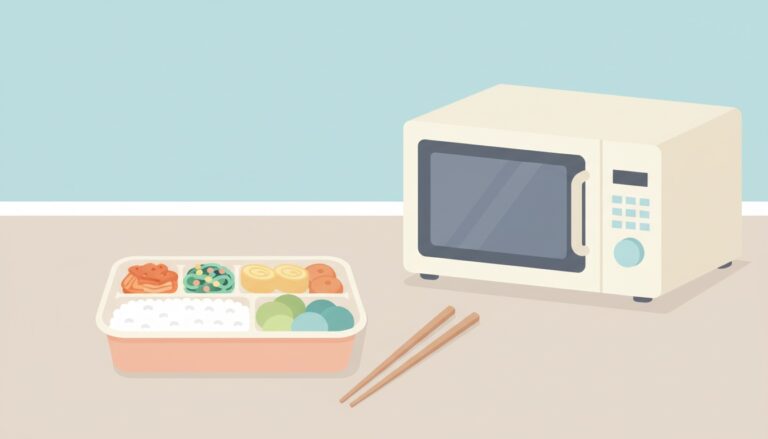
Imagine this: It’s 11 PM in Seoul. You’ve just finished exploring Hongdae, your feet hurt, and you are starving. Most restaurants are closing, but then you see it—the glowing blue or green sign of a convenience store (GS25, CU, 7-Eleven). You walk in, and there it is: a wall of colorful boxes filled with rice, bulgogi, kimchi, and eggs.
This is the Dosirak (도시락).
In K-Dramas, you often see the busy protagonist eating these alone while working late. It’s not just a cheap meal; it’s a symbol of the fierce “Pali-pali” (Hurry, hurry) culture of modern Korea. But here is the problem: If you don’t know how to eat it properly, you will end up eating cold, hard rice.
I have seen so many foreigners buy a Dosirak and try to eat it cold right at the counter. The part-timer looks at them with sad eyes. Don’t be that person. Today, I’ll teach you how to enjoy a hot, delicious Korean lunchbox like a local.
Phase 2: Essential Expressions (Deep Dive)
1. 전자레인지 있어요? (Jeonja-reinji isseoyo?)
- Pronunciation: [Jeon-ja-rain-ji i-sseo-yo?]
- Sound Analogy: Jeon (like ‘John’) + Ja (like ‘Ja’r) + Rain (like falling water) + G (like ‘G’ee) + E-saw-yo.
- Meaning: “Is there a microwave?”
- K-Culture Moment: In Korea, 99% of convenience stores have a microwave area (usually near the hot water dispensers for ramen). You usually heat it yourself. If you can’t find it, use this phrase.
- Editor’s Insight: You don’t ask the staff to do it for you (like in some other countries). You ask where it is or if they have one.
- Situation Spectrum:
[🚫 Boss] ———— [✅ Stranger/Staff] ———— [✅ Friend]🤔 Think About It: Why is it self-service in Korea? It reflects the “Un-tact” (Un-contact) culture that was growing even before the pandemic—speed and efficiency are king.
2. 젓가락 주세요. (Jeotgarak juseyo.)
- Pronunciation: [Jeot-ga-rak ju-se-yo]
- Sound Analogy: Jut (sounds like ‘Jut’ting out) + Ga + Rak (like ‘Rock’) + Ju-se-yo.
- Meaning: “Please give me chopsticks.”
- K-Culture Moment: You grab your Dosirak, pay, and walk out… only to realize you have no utensils. This happens to everyone. The staff sometimes forgets to put them in the bag.
- Editor’s Insight: Say this while you are paying. Don’t wait until everything is packed.
- Situation Spectrum:
[🚫 Formal Banquet] ———— [✅ CVS Staff] ———— [✅ Friend]3. 이거 매워요? (Igeo maewoyo?)
- Pronunciation: [Ee-geo mae-wo-yo?]
- Sound Analogy: E-go + Mae (like ‘May’) + Wo (like ‘Wa’r) + Yo.
- Meaning: “Is this spicy?”
- Editor’s Warning: Korean “mild” is often Western “spicy.” A red Dosirak usually means danger. If you see the word “불” (Fire) on the package, run away if you can’t handle heat.
Phase 3: Textbook vs. Real Life
| Situation | 📖 Textbook Korean | 🗣️ Real Korean | 💡 Why different? |
|---|---|---|---|
| Asking for chopsticks | 젓가락을 주시겠습니까? (Could you give me chopsticks?) | 젓가락 좀 주세요. (Chopsticks, please.) | The textbook version is too stiff for a 30-second transaction. |
| Asking about taste | 이 음식은 맛이 맵습니까? (Is the taste of this food spicy?) | 이거 매워요? (Is this spicy?) | Koreans value speed. Shorten the subject! |
💡 Note: In a busy CVS, making eye contact and nodding while saying “Gamsahamnida” (Thank you) is often enough interaction.
Phase 4: Cultural Deep Dive — Honbap (혼밥)
4-1. The Art of Eating Alone
Ten years ago, eating alone in Korea was seen as sad. Today, it’s a trend called Honbap (Honja = Alone, Bap = Rice). The convenience store is the sanctuary of Honbap. You will see students studying, office workers watching Netflix on their phones, and travelers like you.
4-2. The “Ding!” Etiquette
When using the store microwave:
1. Open the lid slightly! If you don’t, the Dosirak might explode. Seriously.
2. Check the time: The box usually says “1000W 1min 30sec / 700W 2min”. Most store microwaves are 1000W (industrial strength).
3. Clean up: If you spill soup, wipe it. It’s basic manners (Etiquette).
Phase 5: Roleplay Scenario 🎬
Setting: A small CU convenience store near your guesthouse. It’s late. You are hungry.
Characters:
* YOU: A hungry traveler holding a Buloggi Dosirak.
* Staff: A tired part-time student wearing a vest.
(You put the Dosirak on the counter)
Staff: (Beep) 4,500 won iseyo.
YOU: (Handing over card) …
Staff: Bongtu piryo haseyo? (Do you need a bag?)
🔀 Decision Point: What do you say?
- A) “Ne, juseyo.” (Yes, please.) – Cost: usually 20-50 won.
- B) “Aniyo, gwaenchannayo.” (No, it’s okay.) – You have a tote bag or will eat it right there.
(Let’s assume you chose B)
YOU: Aniyo. Ah, jeotgarak juseyo!
Staff: Ah, ne. (Tosses wooden chopsticks on the counter) Here.
YOU: Gamsahamnida. (Looking around confused) Jeonja-reinji… eodiyo? (Where is the microwave?)
Staff: (Points behind you) Dwi-e isseoyo. (It’s behind you.)
Phase 6: 10-Second Shadowing Drill 🗣️
Practice this before you enter the store!
- 🥺 Politely asking for chopsticks:
Jeotgarak / juseyo.
(Jut-ga-rak / ju-se-yo) -
🥵 Worried about spice:
Igeo / maewoyo?
(E-geo / mae-wo-yo?) -
🤔 Looking for the microwave:
Jeonja-reinji / eodiyo?
(Jeon-ja-rain-ji / oh-di-yo?)
Phase 7: K-Culture Mini Glossary
| Korean | Romanization | Meaning | Context |
|---|---|---|---|
| 편의점 | Pyeonuijeom | Convenience Store | The lifeline of modern Korea. Open 24/7. |
| 삼각김밥 | Samgak-gimbap | Triangle Kimbap | The cheaper, smaller cousin of the Dosirak. |
| 1+1 | One-plus-one | Buy 1 Get 1 Free | The magic words you must look for on price tags. |
| 알바 | Alba | Part-timer | Short for “Arbeit” (German). The staff member. |
Phase 8: Traveler’s Survival Kit 🆘
🆘 Survival Expression: The Microwave Code
– Look for: “700W” or “1000W” on the microwave door.
– Look for: The time on your Dosirak lid (e.g., 2분 = 2 minutes).
– Rule: If unsure, do 1 minute 30 seconds. Touch the rice. If cold, do 30 more seconds.📌 Editor’s Note:
Most CVS have a designated eating area (tables/chairs). You can eat there. Just remember to separate your trash (liquids, plastics, general waste) into the specific bins provided. Not doing this is a major foul!
Phase 9: Think Deeper — “The Speed of Hunger”
Food & Identity: Why are Dosiraks so popular in Korea? It’s not just price. It’s time. The Korean concept of “Pali-pali” (Hurry, hurry) means lunch breaks are often short. A Dosirak allows you to eat a “proper meal” (rice + soup + side dishes) in 15 minutes. In many Western cultures, a sandwich is the quick fix. In Korea, even a quick fix must include Rice (Bap). It shows how deeply the definition of a “meal” is tied to rice in the Korean psyche. What is the “quick fix” meal in your country?
Phase 10: FAQ & Troubleshooting
- Q: Can I eat the Dosirak inside the store?
- A: Yes! Look for the tables. But don’t stay for 2 hours. It’s for eating and leaving.
- Q: Is it rude to ask the staff to heat it for me?
- A: In Korea, yes. It is expected that you do it yourself unless you have a disability or the store is incredibly small and the microwave is behind the counter (very rare).
- Q: Can I bring outside food to the CVS to use their microwave?
- A: 🚫 No. That is considered rude. Only use it for items bought at that store.
Phase 11: Wrap-up & Mission
One-Liner: Don’t eat cold rice—find the microwave and ask for chopsticks!
🎯 Action Mission:
* 🥉 Bronze: Say “Jeotgarak juseyo” out loud three times right now.
* 🥈 Silver: Go to a Korean CVS (or an Asian market in your country) and find a package that says “매운” (Spicy) or “불” (Fire).
* 🥇 Gold: Visit a GS25 or CU in Korea, buy a Dosirak, heat it up yourself, and eat it at the window seat while watching the city go by.
Phase 12: Quick Quiz
Situation: You bought a Dosirak, but you didn’t get any chopsticks. The staff is busy on their phone. What is the most natural thing to say?
- “Excuse me, utensil please.” (English)
- “Jeotgarak juseyo.” (Korean)
- “Jeonja-reinji isseoyo?” (Korean)
Correct Answer: 2. Number 3 asks for a microwave, which won’t help you eat the rice! Number 2 is direct and polite enough.
Frequently Asked Questions (FAQ)
Q: What does "전자레인지 있어요? (Jeonja-reinji isseoyo?)" mean in Korean and how do you pronounce it?
A: In Korean, "전자레인지 있어요? (Jeonja-reinji isseoyo?)" is pronounced [Jeon-ja-rain-ji i-sseo-yo?] and means: "Is there a microwave?"
Q: What does "젓가락 주세요. (Jeotgarak juseyo.)" mean in Korean and how do you pronounce it?
A: In Korean, "젓가락 주세요. (Jeotgarak juseyo.)" is pronounced [Jeot-ga-rak ju-se-yo] and means: "Please give me chopsticks."
Q: What does "이거 매워요? (Igeo maewoyo?)" mean in Korean and how do you pronounce it?
A: In Korean, "이거 매워요? (Igeo maewoyo?)" is pronounced [Ee-geo mae-wo-yo?] and means: "Is this spicy?"







