

Phase 1: The ‘Merch Has Arrived’ Moment (Immersive Hook)
Greeting: Hello! Your Daily Hangul editor here.
The Scene: Picture this. You ordered that limited-edition K-Pop album or those viral Korean skincare products three days ago. Your phone buzzes. It’s a notification from CJ Logistics or Coupang: “Delivery Complete to Convenience Store.”
Your heart races. It feels like the scene in a K-Drama where the protagonist runs to meet their long-lost love—except your love is a cardboard box waiting at GS25 or CU. You dash to the store, burst through the door, and meet the clerk’s eyes.
Now, what? If you freeze and just point at the storage room, it gets awkward fast. You need the magic phrase to unlock your treasure.
The ‘Why’: Picking up a package (Taekbae) is a daily ritual in Korea. Knowing how to do this smoothly prevents that “silent staring contest” with the busy part-timer and makes you look like a total local.
Phase 2: Deep Dive into the Magic Words
Here are the phrases you actually need. Forget the stiff textbook stuff.
1. 택배 찾으러 왔어요 (Taekbae chajeureo wasseoyo)
- Pronunciation: [Taek-bae cha-jeu-reo wa-sseo-yo]
- Sound Analogy: Taek (like ‘tech’) + bae (like ‘bay’) / cha (like ‘cha-cha’) + jeu (like ‘juice’ without ‘ice’) + reo (like a soft ‘run’)
- Meaning: Literal: “I came to find a package.” / Real Nuance: “I’m here to pick up my delivery.”
- K-Culture Moment: Think of a variety show mission where the cast has to retrieve an item to win. They don’t ask “May I receive it?” They say, “I came to find it!” It implies an active mission.
- Editor’s Insight: This is your opening line. Say it confidently as you walk to the counter. It signals to the clerk, “I am not here to buy gum; I have business.”
- Situation Spectrum:
[🚫 Boss at work] ———— [⚠️ Stranger (Polite)] ———— [✅ Convenience Store Clerk]
- Note: This is standard polite language (yo-form). Perfect for service interactions.
- 🤔 Think About It: We use the verb ‘찾다’ (to find/look for) instead of ‘receive’. Why? Because in the old days, you physically had to look for your item? Or because it implies effort on your part?
2. 제 이름으로 된 거요 (Je ireumeuro doen geoyo)
- Pronunciation: [Je i-reum-eu-ro doen geo-yo]
- Meaning: “The one under my name.”
- K-Culture Moment: In medical dramas, when family members rush to the reception desk asking for a patient, the structure is similar. “Looking for someone under the name Kim Min-su.”
- Editor’s Insight: Use this if the clerk looks confused or asks, “Which one?” (eotteon geoyo?).
- Situation Spectrum: ✅ Standard polite.
3. 바코드 보여드릴게요 (Bakodeu boyeodeurilgeyo)
- Pronunciation: [Ba-ko-deu bo-yeo-deu-ril-ge-yo]
- Meaning: “I’ll show you the barcode.”
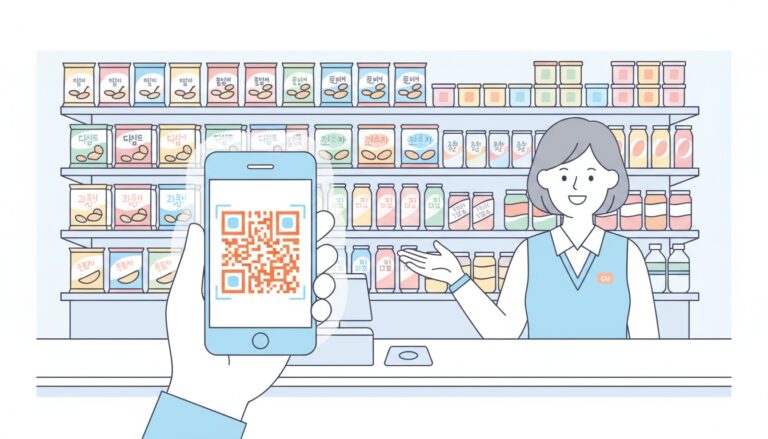
- Editor’s Insight: This is the ultimate “Palli-palli” (Hurry-hurry) phrase. Korean service moves at the speed of light. If you say this while holding up your screen, the clerk will love you.
Phase 3: Textbook vs. Real Life
| Situation | 📖 Textbook Korean | 🗣️ Real Korean | 💡 Why is it different? |
|---|---|---|---|
| Entering the store | 안녕하세요. 소포를 수령하러 왔습니다. (Hello, I came to receive a parcel.) | (Go straight to counter) 택배 찾으러 왔는데요. | ‘Receive’ (수령) sounds like you’re accepting a government award. ‘Find’ (찾다) is for daily life. |
| Verification | 예약 번호는 1234입니다. (The reservation number is 1234.) | (Shows phone screen) 여기요. (Here.) | In Korea, visual proof (QR/Barcode) beats reading numbers aloud. It’s faster. |
| Leaving | 안녕히 계십시오. (Goodbye politely.) | 수고하세요~ (Keep up the good work~) | ‘Sugo-haseyo’ acknowledges their labor. It’s the standard exit phrase for workers. |
Bottom Note: Don’t be too formal. You aren’t meeting the President; you’re meeting a college student working a part-time job (Alba).
Phase 4: Cultural Context — The Art of ‘Pick-up’
4-1. Non-verbal: The “Ready Screen” Etiquette
In Korea, efficiency is a form of politeness. Before you even reach the counter, have your pick-up app (CJ, Post Office, or Convenience Store app) open with the barcode brightness turned up. Fumbling for your phone at the counter creates a “bottleneck” that stresses everyone out.
4-2. K-Culture Connection: The “Pyeon-u-jeom” Lifestyle
In K-Dramas like Convenience Store Saet-byul, the store is a community hub. It’s where people eat ramen, drink soju, and yes, pick up packages. Because many Koreans live in single-person households or apartments without concierges, the convenience store acts as a safe delivery locker. It’s safe, 24/7, and no one steals your kimchi.
Phase 5: Immersive Roleplay
Setting: It’s a rainy Tuesday evening at a small CU convenience store in Hongdae. The store is cramped. A part-timer is busy arranging banana milk bottles.
Characters:
– YOU: Excited fan waiting for a concert ticket delivery.
– Min-ji (Alba): 20-something part-timer, wearing a vest, looking slightly tired but efficient.
Dialogue:
Min-ji: (Doesn’t look up immediately) 어서 오세요~
(Eoseo oseyo~ / Welcome~)
YOU: (Approaching the counter) 저기요, 택배 찾으러 왔는데요.
(Jeogiyo, taekbae chajeureo wanneundeyo.)
[Translation: Excuse me, I came to pick up a package.]
Min-ji: (Moves to the POS machine) 아, 네. 혹시 쇼핑몰 어디세요?
(Ah, ne. Hoksi syopingmol eodiseyo?)
[Translation: Ah, okay. Which shopping mall sent it?]
🔀 Decision Point: What do you say?
- A) “CJ 대한통운이요.” (Name the logistics company/sender)
- B) “몰라요.” (I don’t know.)
- C) “내 택배 내놔.” (Give me my package!)
✅ Best Choice: A – Usually, they organize boxes by the delivery company or sender. Giving this info helps them search faster.
⚠️ Choice C Analysis: This is rude banmal (casual speech). Unless you want to start a fight in a K-Drama villain arc, don’t say this.
Min-ji: (Finds a box) 이거 맞으세요? 전화번호 뒷자리 확인 좀 할게요.
(Igeo majeuseyo? Jeonhwabeonho dwitjari hwagin jom halgeyo.)
[Translation: Is this right? I need to check the last 4 digits of your phone number.]
YOU: 네, 맞아요. 1234요.
(Ne, majayo. 1234-yo.)
(🎭 Stage Direction: Min-ji scans the barcode on the box.)
Min-ji: 네, 처리됐습니다. 안녕히 가세요.
(Ne, cheoridwaetseumnida. Annyeonghi gaseyo.)
YOU: 감사합니다. 수고하세요!
(Gamsahamnida. Sugohaseyo!)
Phase 6: 10-Second Shadowing Drill
Let’s practice the flow. Don’t sound robotic; sound like you’re in a hurry but polite.
Sentence: 저기요 / 택배 / 찾으러 왔는데요.
Romanization: Jeo-gi-yo / taek-bae / cha-jeu-reo wan-neun-de-yo.
Emotion: 😊 (Polite but purposeful)
Sentence: 여기 / 바코드 / 있어요.
Romanization: Yeo-gi / ba-ko-deu / i-sseo-yo.
Emotion: 📱 (Helpful, thrusting phone forward)
Phase 7: K-Culture Mini Glossary
| Korean | Romanization | English | Context |
|---|---|---|---|
| 택배 | Taekbae | Parcel Service | The lifeline of Korean shopping. Known for extreme speed (often next-day). |
| 알바 | Alba | Part-timer | Short for ‘Arbeit’ (German). The person running the convenience store. |
| 운송장 | Unsongjang | Waybill/Label | The sticker on the box with the tracking number. |
| 착불 | Chakbul | Cash on Delivery | Receiver pays shipping fee. Rare these days, but happens! |
Phase 8: Traveler’s Survival Kit
Even if you aren’t living in Korea, you might use “Luggage Storage Services” at convenience stores or stations.
🆘 Survival Expression #1
– 🇰🇷 “이거 맡아주실 수 있나요?” (Igeo mata-jusil su innayo?)
– 🗣️ Meaning: “Can you keep/hold this for me?”
– 📍 Where: Hotels, some convenience stores with storage service, concierge.
– 💡 Pro Tip: Not all convenience stores accept luggage. Look for the “Yellow Box” or specific storage app logos on the door.📌 Editor’s Note
In Korea, you can send packages from a convenience store too. Just look for the machine that looks like a scale with a screen (Postbox).
Phase 9: Think Deeper — “Trust & Technology”
Why is pickup so simple?
Have you noticed how little ID checking actually happens compared to some other countries? Often, just a phone number or a barcode is enough. This reflects Korea’s high-trust society combined with digital verification.
Also, the fact that you can pick up anything at a convenience store (sim cards, gold bars, concert tickets, fresh kimchi) shows how these spaces have evolved beyond just “shops.” They are the logistical veins of the city. In your country, is there a single place that serves as a bank, restaurant, post office, and pantry all at once?
Phase 10: FAQ & Troubleshooting
Q: Can I pick up a package for my friend?
A: Usually, yes, IF you have the barcode/QR code screenshot sent by your friend. Without that, it’s tricky. The clerk needs to scan something to close the transaction in the system.
Q: What if the clerk says “Op-seoy-yo” (It’s not here)?
A: Don’t panic. Check your tracking app. If it says “Delivered,” show the app to the clerk. Sometimes boxes are hidden in the back room or under the counter. Say: “앱에는 도착했다고 나와요” (The app says it arrived).
❌ Common Mistake: Trying to pick up a package immediately after getting the “Out for Delivery” text.
✅ Fix: Wait for the “Delivery Complete” (배송 완료) notification. The driver might still be on the way!
Phase 11: Wrap-up & Mission
Summary: Use “Taekbae chajeureo wasseoyo,” have your barcode ready, and end with “Sugohaseyo.”
Action Mission:
– 🥉 Bronze: Say “Taekbae chajeureo wasseoyo” 5 times while pretending to hold a phone.
– 🥈 Silver: Next time you go to a Korean mart or restaurant, notice if people say “Sugohaseyo” when leaving.
– 🥇 Gold: Order something online in Korea (or ask a friend) and pick it up at a convenience store yourself!
💬 Your Turn: Have you ever experienced the Korean “Palli-palli” delivery speed? Tell me in the comments!
Phase 12: Quiz Challenge
1. Situation: The clerk asks for your phone number digits. You should give:
a) The first 4 digits
b) The last 4 digits
c) Your entire passport number
2. True or False:
“It is rude to show your barcode screen to the clerk before they ask for it.”
(True / False)
3. Fill in the blank:
When leaving the store with your package, you should say: “_______ haseyo!”
(Answers: 1-b, 2-False [Efficiency is loved!], 3-Sugo)
Frequently Asked Questions (FAQ)
Q: What does "택배 찾으러 왔어요 (Taekbae chajeureo wasseoyo)" mean in Korean and how do you pronounce it?
A: In Korean, "택배 찾으러 왔어요 (Taekbae chajeureo wasseoyo)" is pronounced [Taek-bae cha-jeu-reo wa-sseo-yo] and means: Literal: "I came to find a package." / Real Nuance: "I'm here to pick up my delivery."
Q: What does "제 이름으로 된 거요 (Je ireumeuro doen geoyo)" mean in Korean and how do you pronounce it?
A: In Korean, "제 이름으로 된 거요 (Je ireumeuro doen geoyo)" is pronounced [Je i-reum-eu-ro doen geo-yo] and means: "The one under my name."
Q: What does "바코드 보여드릴게요 (Bakodeu boyeodeurilgeyo)" mean in Korean and how do you pronounce it?
A: In Korean, "바코드 보여드릴게요 (Bakodeu boyeodeurilgeyo)" is pronounced [Ba-ko-deu bo-yeo-deu-ril-ge-yo] and means: "I'll show you the barcode."







