

Unlock Korea: The Magic Word That Opens Doors (and Wi-Fi)
Phase 1: The Panic at the Café Counter
Hello! This is your editor from Daily Hangul.
Picture this: You are in a trendy café in Hongdae. You just bought an Iced Americano (the official fuel of Seoul). You sit down, open your laptop to upload some photos, and… locked. A row of Wi-Fi networks appears, all asking for a password.
You look at the counter. The barista is busy making three lattes at once. You don’t want to be that annoying foreigner asking long questions. You just need the code.
Or worse—you really need to use the bathroom, but the door handle won’t turn. There’s a keypad on the door. You are standing there, dancing a little bit, panicking.
Don’t worry. You don’t need a complex sentence. You just need one magic abbreviation: “Bi-beon” (비번).
Today, I’m going to teach you how to unlock everything in Korea without breaking a sweat.
Phase 2: Deep Dive — “Bi-beon” (비번)
1. 비번 [bi-beon]
- Pronunciation: bee-buhn (Sounds like the “be” in because + “bun” in hamburger)
- Original Word: 비밀번호 (Bi-mil-beon-ho) = Secret Number (Password)
- Meaning: Password / Code / PIN
Editor’s Insight:
Koreans love speed (Palli-palli culture). Saying four syllables (“Bi-mil-beon-ho”) takes too long when you are in a rush. Everyone—from elementary school kids to grandmothers—uses “Bi-beon.” It’s not slang; it’s just efficiency.
K-Culture Moment:
In K-Dramas, when the protagonist tries to guess their ex-lover’s door lock code, they are muttering, “Ah, bi-beon mwo-ye-ot-ji?” (Ah, what was the password?). It is usually their birthday or the day they first met. Classic.
Situation Spectrum:
[🚫 Formal Interview] ———— [✅ Café/Friends/Everyday] ———— [✅ Texting]
🤔 Think About It:
English speakers shorten “Application” to “App.” Why do you think Korean shortens a security word like “Password”? Does it make the concept feel less serious and more casual?
Phase 3: Textbook vs. Real Life
| Situation | 📖 Textbook Korean | 🗣️ Real Korean | 💡 Why the difference? |
|---|---|---|---|
| Asking for Wi-Fi | 비밀번호가 무엇입니까? (Bi-mil-beon-ho-ga mu-eot-im-nikka?) | 와이파이 비번 뭐예요? (Wi-Fi bi-beon mwo-ye-yo?) | The textbook version sounds like a police interrogation. The real version is friendly and quick. |
| Restroom Lock | 화장실 비밀번호를 알려주세요. (Please tell me the restroom password.) | 화장실 비번 있어요? (Hwa-jang-sil bi-beon isseo-yo?) | You usually ask if there is a password first, because not all doors are locked. |
Bottom Note: Level A2 learners, stick to “Bi-beon mwo-ye-yo?” (What is the password?). It works 99% of the time.
Phase 4: Cultural Context — The “Locked Door” Mystery
4-1. Why is everything locked?
If you visit a commercial building in Korea, you will find that many restrooms are locked. This isn’t because they are stingy. It’s because many restrooms are shared by the whole floor, but maintained by specific shop owners. To keep them clean and safe for customers only, they use digital locks.
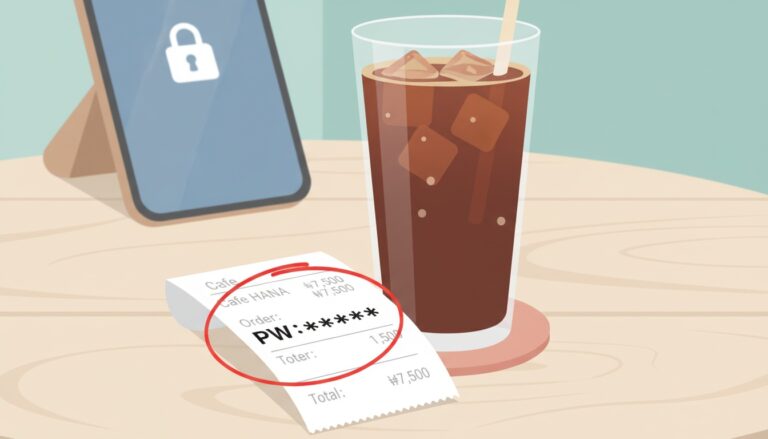
4-2. The Receipt is Your Key (Don’t throw it away!)
This is a classic rookie mistake. You buy your coffee, crumple the receipt, and throw it in the trash. Then you sit down and realize… the Wi-Fi and restroom codes were printed on the bottom of that receipt.
K-Food/Cafe Tip:
Before you ask the staff, look at your receipt (Yeong-su-jeung). Look for words like:
* WIFI ID / PW
* 화장실 (Restroom)
Phase 5: Roleplay — The Café Survival
Setting: A hip, industrial-style café in Seongsu-dong. It’s crowded.
Characters:
* YOU: A thirsty traveler needing internet.
* Barista: Fast, efficient, wearing a cool apron.
(You order your coffee and receive the buzzer)
YOU: 저기요, 혹시 와이파이 돼요?
(Jeogiyo, hoksi wai-pai dwae-yo?)
(Excuse me, does the Wi-Fi work?)
Barista: 네, 됩니다.
(Ne, doemnida.)
(Yes, it works.)
YOU: 비번 뭐예요?
(Bi-beon mwo-ye-yo?)
(What is the password?)
🔀 Decision Point: How does the Barista reply?
- Option A: “영수증에 있어요.” (It’s on the receipt.)
- Option B: “벽에 적혀 있어요.” (It’s written on the wall.)
If A happens: You check your hand. Oh no, you don’t have it.
You: 아! 영수증 버렸어요… (Ah! I threw away the receipt…)
Barista: (Sighs kindly) 일이삼사 일이삼사입니다. (It’s 12341234.)
Phase 6: 10-Second Shadowing Drill
Let’s practice the most useful sentence. Say it with a “curious but polite” tone.
😊 혹시 / 와이파이 / 비번 / 뭐예요?
(Hoksi / Wai-pai / Bi-beon / Mwo-ye-yo?)
Key: Don’t stress the “Bi-beon.” Stress the “Mwo” (What).
Phase 7: K-Culture Mini Glossary
| Korean | Romanization | English | Context |
|---|---|---|---|
| 영수증 | Yeong-su-jeung | Receipt | The paper that holds all the secrets (passwords). |
| 화장실 | Hwa-jang-sil | Restroom | Often located outside the cafe, near the elevator. |
| 개방 | Gae-bang | Open/Unlocked | Seen on Wi-Fi lists (meaning no password). |
Phase 8: Traveler’s Survival Kit
In Seoul, you will encounter digital locks everywhere—even on Airbnb doors and luggage lockers.
🆘 Survival Expression #1
* 🇰🇷 “여기 비번이 뭐예요?” (Yeogi bi-beoni mwo-ye-yo?)
* 🗣️ Meaning: What is the password here?
* 📍 Where: Airbnb entrance, Cafe restroom, Suitcase locker.
📌 Editor’s Pro Tip
Most cafe Wi-Fi passwords in Korea are surprisingly simple. Try the shop’s telephone number (printed on the receipt) or standard sequences like a123456789! or 00000000. Koreans hate typing long, complicated passwords on mobile just as much as you do.
Phase 9: Think Deeper — Trust vs. Locks
Here is something interesting to observe. In a Korean cafe, people leave their expensive laptops and phones on the table while they go to the bathroom. No one steals them. The social trust is incredibly high.
However, the bathroom doors are heavily locked with digital keypads.
🧠 Think About It:
Why do you think Korean society trusts strangers with laptops (high value) but restricts access to restrooms (low value)? It likely has to do with the concept of “Cleanliness” and “Maintenance responsibility” rather than theft. How does this compare to public spaces in your country?
Phase 10: FAQ & Troubleshooting
Q: Can I just say “Password” in English?
A: Yes! Most young Koreans understand “Password.” But saying “Bi-beon” shows you understand the local vibe. It breaks the ice.
Q: Is it rude to ask for the password immediately?
A: Not rude, but it’s better to check your receipt or the wall/counter first. There is usually a small sign that says Wi-Fi ID: ... PW: .... asking without looking might make you look a bit unobservant!
❌ Common Mistake:
Thinking “Service” means free food.
* If a server says “Service” (Seo-bi-seu) while giving you a side dish, it means it’s free/on the house. It’s a special noun in Korea, not just “good service.”
Phase 11: Wrap-up & Mission
Today’s Summary: Don’t say “Bi-mil-beon-ho.” Say “Bi-beon.” Check your receipt first!
🚀 Action Mission:
* 🥉 Bronze: Say “Wai-pai Bi-beon” three times in the mirror.
* 🥈 Silver: Look at a receipt from your country. Can you find any codes on it? (Probably not, which makes Korea unique!)
* 🥇 Gold: Next time you go to a Korean restaurant or cafe, check the receipt. If you can’t find the code, ask: “Hoksi bi-beon isseo-yo?”
Phase 12: Quiz — Did you get it?
Scenario: You are standing in front of a locked restroom door. There is a keypad. What is the most natural thing to ask the staff?
- “Open Sesame!”
- “Hwa-jang-sil bi-mil-beon-ho-ga mu-eot-ip-ni-kka?”
- “Hoksi hwa-jang-sil bi-beon isseo-yo?”
- “Bathroom code please.”
Answer: 3. It is polite (“Hoksi” = by any chance) and uses the natural abbreviation (“Bi-beon”).
Frequently Asked Questions (FAQ)
Q: What does "비번 [bi-beon]" mean in Korean and how do you pronounce it?
A: In Korean, "비번 [bi-beon]" is pronounced [bee-buhn (Sounds like the "be" in because + "bun" in hamburger] and means: Password / Code / PIN







