

Introduction: The Scent You Can’t Ignore
Hello! This is your Daily Hangul editor.
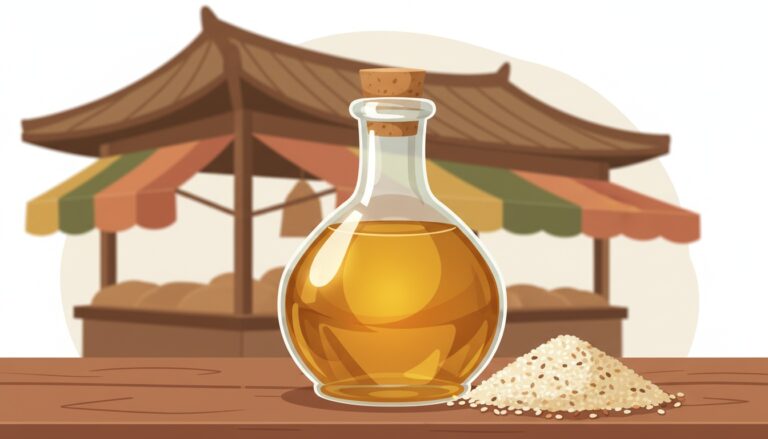
Let’s be honest—you can usually smell a traditional Korean market before you see it. There is a specific, nutty, savory aroma that floats in the air, pulling you in like a cartoon character floating towards a pie. That smell? That is Chamgireum (Sesame Oil).
In K-Dramas like Reply 1988, you see moms putting a drop of this brown liquid on everything—Bibimbap, spinach, fried eggs. It’s the finishing touch of Korean soul food. But here is a secret: The stuff in the supermarket bottles? It’s okay. But the stuff squeezed fresh at a market mill (Banggagan)? That is liquid gold.
If you want to buy the real deal and impress the halmeoni (grandma) selling it, you need more than just “How much?”
Phase 1: The Core Expressions (Deep Dive)
1. 냄새가 정말 고소해요! (Naemsae-ga jeongmal gosohaeyo!)
- Pronunciation: Nem-se-ga jeong-mal go-so-he-yo! [Sounds like: Nem-say-ga jung-mal go-so-hey-yo]
- Meaning: “The smell is really nutty/savory!”
- Editor’s Insight: English doesn’t really have a perfect word for Goso-hada. It’s the smell of roasted nuts, toasted bread, or popcorn. Saying this instantly makes the seller smile because you are complimenting their craft.
- K-Culture Moment: In food variety shows, when a host smells sesame oil, they close their eyes and inhale deeply. It’s almost a spiritual experience.
- Situation Spectrum:
[🚫 Formal Meeting] ———— [✅ Market/Restaurant] ———— [✅ Friends] - 🤔 Think About It: In Western culture, strong food smells can sometimes be considered rude. In Korea, a strong smell of sesame oil is a sign of generosity and flavor. Why the difference?
2. 직접 짠 거예요? (Jikjeop jjan geoyeyo?)
- Pronunciation: Jik-jeop jjan geo-ye-yo? [Sounds like: Jik-jup jjan gu-ye-yo]
- Meaning: “Is this freshly pressed?” (literally: Did you squeeze it directly?)
- Editor’s Insight: This is the magic question. It shows you know the difference between factory oil and market oil. Even if you know the answer is yes, asking it builds trust.
- Situation Spectrum:
[🚫 Office] ———— [✅ Market/Shopping] ———— [✅ Casual]
3. 한 병 주세요 (Han byeong juseyo)
- Pronunciation: Han byung ju-se-yo
- Meaning: “Please give me one bottle.”
- Editor’s Insight: Korean has different counters for everything. ‘Byeong’ is for bottles. If you forget, just say “Hana (one) juseyo,” but using ‘Byeong’ makes you sound like a pro.
Phase 2: Textbook vs. Real Life
| Situation | 📖 Textbook Korean | 🗣️ Real Market Korean | 💡 Why? |
|---|---|---|---|
| Asking for oil | 참기름 있어요? (Do you have sesame oil?) | 이거 국산이에요? (Is this domestic?) | Locals assume they have it. The real question is whether the sesame seeds are Korean (Premium) or imported. |
| Asking price | 얼마입니까? (How much is it?) | 이거 얼마예요? (How much is this?) | “Im-ni-kka” is too military/formal for a market grandma. |
| Reacting | 냄새가 좋습니다. (The smell is good.) | 와, 냄새 대박! (Wow, smell is daebak!) | “Good” is boring. “Daebak” (Big hit) is how you show excitement. |
💡 Editor’s Note: For A1 beginners, sticking to “Naemsae-ga joayo” (Smell is good) is perfectly fine. “Daebak” is fun, but use it only if you want to sound young!
Phase 3: Cultural Deep Dive
The Mystery of the Soju Bottle
If you go to a traditional market, you might see dark brown liquid sold in green glass bottles with Soju labels still on them. Don’t panic! You aren’t buying alcohol.
For decades, Korean grandmothers have recycled glass Soju bottles to store sesame oil. It’s the ultimate recycling.
* K-Drama Connection: If a character in a drama visits their hometown, their mom often stuffs their bag with newspapers. Inside? A Soju bottle wrapped in plastic. It’s not booze; it’s a mother’s love in the form of oil.
Non-verbal Tip: The “Sniff”
When you walk past a mill (Banggagan), don’t just walk. Slow down, take an exaggerated sniff, and look at the seller. That shared moment of “Ah, smells good” connects you instantly without words.
Phase 4: Roleplay Scenario
Setting: A bustling alley in Gwangjang Market. The air is thick with steam and the nutty scent of roasting sesame seeds. An old machine is clanking rhythmically.
Characters:
* YOU: A traveler looking for a souvenir.
* Grandma (Sajangnim): The owner, wearing a floral apron and a visor.
Dialogue:
Grandma: (Smiling) 아이고, 어서 와요! 냄새 좋지?
(Aigo, eoseo wayo! Naemsae joji?)
(Oh my, welcome! Smell is good, right?)
YOU: 네! 냄새가 정말 고소해요! 😍
(Ne! Naemsae-ga jeongmal gosohaeyo!)
(Yes! It smells really nutty/savory!)
Grandma: 이거 오늘 아침에 짠 거야. 맛있어.
(Igeo oneul achim-e jjan geoya. Masisseo.)
(I pressed this just this morning. It’s delicious.)
🔀 Decision Point: What do you ask next?
- Option A: “Is it spicy?” (Wrong category!)
- Option B: “Is this freshly pressed?” (Validation)
- Option C: “Give me a discount!” (Too early to haggle)
✅ Best Choice: Option B. Even though she said it, asking “이거 직접 짠 거예요? (Igeo jikjeop jjan geoyeyo?)” shows you value the process.
YOU: 우와… 이거 직접 짠 거예요?
(Uwa… igeo jikjeop jjan geoyeyo?)
(Wow… is this freshly pressed?)
Grandma: 그럼! 저기 기계 봐봐. 진짜지?
(Geureom! Jeogi gigye bwabwa. Jinjjaji?)
(Of course! Look at the machine over there. It’s real, right?)
Phase 5: 10-Second Shadowing Drill
Practice this sentence to perfect your intonation. Imagine you are holding a warm bottle of oil.
“냄새가 / 정~~말 / 고소해요!”
(Naem-sae-ga / jeong~~mal / go-so-hae-yo!)
- Emotion: 😊 Delight & Hunger
- Tip: Stretch the “Jeong~~mal” to emphasize how good it is.
Phase 6: Traveler’s Survival Kit
Here are the essentials for buying oil in a market.
🆘 Survival Card
* 🇰🇷 “얼마예요?” (Eol-ma-ye-yo?) – How much is it?
* 🇰🇷 “깨지지 않게 포장해 주세요.” (Kkae-ji-ji an-ke po-jang-hae ju-se-yo) – Please pack it so it doesn’t break. (Crucial for flights!)
* 📍 Where to find it: Look for signs saying 방앗간 (Bang-a-ggan) or follow your nose.📌 Editor’s Travel Note
Fresh sesame oil has a short shelf life compared to factory oil. Keep it in a cool, dark place. Do not put it in the fridge; it might freeze or lose flavor!
Phase 7: Critical Thinking — Food & Identity
🧠 Think Deeper:
Korean cuisine is often defined by “Goso-ham” (the nutty/savory taste). While Western cuisine often finishes a dish with butter or olive oil, Koreans finish with sesame oil. It represents a “warm” finish to a meal. Why do you think a “warm” and “nutty” flavor is considered the ultimate comfort in Korea? Does your culture have a specific fat or oil that defines “home cooking”?
Phase 8: Your Mission
- 🥉 Bronze: Say “Naemsae-ga gosohaeyo” next time you smell toasted bread or popcorn.
- 🥈 Silver: Go to a Korean supermarket, find the sesame oil section, and try to read the word ‘참기름’ (Chamgireum).
- 🥇 Gold: Visit a local market in Korea, find a mill, and tell the owner, “Naemsae-ga jeongmal joayo!”
See you in the next lesson! Stay savory! 🌿
Frequently Asked Questions (FAQ)
Q: What does ""얼마예요?"" mean in Korean and how do you pronounce it?
A: In Korean, ""얼마예요?"" is pronounced [Eol-ma-ye-yo?] and means: - How much is it?
Q: What does ""깨지지 않게 포장해 주세요."" mean in Korean and how do you pronounce it?
A: In Korean, ""깨지지 않게 포장해 주세요."" is pronounced [Kkae-ji-ji an-ke po-jang-hae ju-se-yo] and means: - Please pack it so it doesn't break. (Crucial for flights!)
Q: What does "방앗간" mean in Korean and how do you pronounce it?
A: In Korean, "방앗간" is pronounced [Bang-a-ggan] and means: or follow your nose.







