

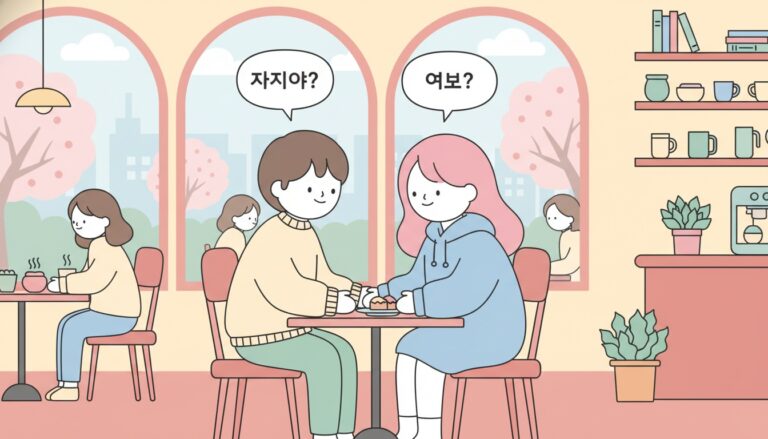
Phase 1: The ‘Wait, Who?’ Moment (Immersive Hook)
Hello! Daily Hangul Editor here.
Picture this: You are watching a K-Drama. The main couple finally got together in episode 12 (took them long enough, right?). Suddenly, the male lead stops calling the girl by her name. He looks at her with those soft puppy eyes and says, “Jagiya.”
The subtitles say “Honey.” But just five minutes ago, an old married couple at the market also called each other “Honey.” Yet, in Korean, they used a completely different word: “Yeobo.”
Confused? You should be. In English, “Honey,” “Babe,” and “Darling” are pretty interchangeable. You can call your husband “Babe” or your boyfriend of two weeks “Babe.”
But in Korea? If you use the wrong one, you might sound like you are engaged, married, or weirdly old-fashioned.
I’ve seen foreign students call their new Korean boyfriend “Yeobo” and watch him choke on his iced americano. It’s hilarious, but let’s save you from that embarrassment. Today, we are decoding the hierarchy of romance.
Phase 2: Deep Dive into Romantic Titles
Here are the big three. Pay attention to the “Situation Spectrum.”
1. 자기야 (Jagiya)
- Pronunciation: [Ja-gi-ya] (Sounds like ‘Jah’ + ‘Ghee’ + ‘Ya’)
- Meaning: Literal: “Self” / Real nuance: “Honey/Babe” (for dating couples)
- K-Culture Moment: Every rom-com ever. The moment the title switches from “Team Leader” or “Oppa” to “Jagiya,” the relationship is officially serious.
- Editor’s Insight: The literal meaning is “Self.” It implies “You are a part of me.” It’s sweet, but also a bit possessive in a romantic way. It is the gold standard for dating.
- Situation Spectrum:
[🚫 First Date] ———— [✅ Dating] ———— [✅ Married (Young)]2. 여보 (Yeobo)
- Pronunciation: [Yeo-bo] (Sounds like ‘Yuh’ + ‘Bow’ as in bow and arrow)
- Meaning: Literal: “Look here” (old roots) / Real nuance: “Honey/Spouse” (strictly married)
- K-Culture Moment: Weekend family dramas. The dad comes home tired and yells, “Yeobo, is dinner ready?”
- Editor’s Insight: This word carries the weight of a marriage license. It implies shared bank accounts and raising kids. If you aren’t married, using this is like wearing a fake wedding ring. It feels heavy.
- Situation Spectrum:
[🚫 Dating] ———— [⚠️ Engaged] ———— [✅ Married]3. 애기야 (Aegiya)
- Pronunciation: [Ae-gi-ya] (Sounds like ‘Eh’ + ‘Ghee’ + ‘Ya’)
- Meaning: Literal: “Baby” / Real nuance: “Babe” (treating partner cutely)
- K-Culture Moment: “Lovers in Paris” (Classic Drama). The main lead yells, “Let’s go, Baby (Aegi)!” and it became a legendary line.
- Editor’s Insight: Use with caution. It can sound incredibly cringe or incredibly sweet depending on your tone. Usually used by older guys to younger girlfriends, or playfully between same-age couples.
- Situation Spectrum:
[🚫 Formal Setting] ———— [⚠️ Public Space] ———— [✅ Private/Playful]🤔 Think About It: Why does Korean use “Jagi” (Self) for a lover? It suggests that in a relationship, the boundary between ‘you’ and ‘me’ disappears. Does your language have a term that implies becoming “one person”?
Phase 3: Textbook vs. Real Life
Let’s be real. Textbooks are too polite.
| Situation | 📖 Textbook Korean | 🗣️ Real Korean | 💡 Why the difference? |
|---|---|---|---|
| Calling your spouse | 당신 (Dangsin) | 여보 (Yeobo) / 자기 (Jagi) | Warning: “Dangsin” is poetic in songs, but in real life, it’s often used when fighting! (e.g., “Ya! Dangsin!”) |
| Calling boyfriend | 남자친구분 (Namjachingu-bun) | 오빠 (Oppa) / 자기 (Jagi) | “Namjachingu” is too descriptive. Once you are close, titles disappear or change to endearing terms. |
| Asking “Who?” on phone | 누구세요? (Nuguseyo?) | 어, 자기야~ (Oh, Jagi-ya~) | If their number is saved, you answer with the nickname immediately to show affection. |
Bottom Note: Never use “Dangsin” to call your partner unless you are writing a poem or starting a divorce argument. Trust me on this.
Phase 4: Cultural Context — The “Oppa” Trap
The Non-Verbal Shift
In Korea, changing a title is a massive event. You don’t just start calling someone Jagiya one day without checking the vibe. It usually happens after the “Day 1” declaration (the official start of dating).
K-Drama Connection: The Evolution of “Oppa”
You know the scene. The female lead has been calling the guy “Director” or “Sunbae” for 10 episodes. Then, they drink soju, holding hands under the table. She whispers, “Oppa…” and he freezes.
- Oppa (Brother/Friend): Casual, friendly.
- Oppa (Lover): Soft tone, prolonged ending (Oppaaa~).
- Jagiya: The endgame. You are a unit now.
Editor’s Tip: Many Korean women continue to call their husbands “Oppa” even after marriage because “Yeobo” makes them feel old!
Phase 5: Roleplay — The “First Time” Jitter
Setting: A trendy café in Yeonnam-dong. Saturday afternoon. You (Foreigner) and Min-jun (Korean boyfriend, dating for 1 month). You want to try using a pet name.
Min-jun: (Sipping coffee) 이 카페 분위기 진짜 좋다.
(I kape bunwigi jinjja joda.)
[The vibe in this cafe is really good.]
YOU: 그러게. 민준… 아, 아니.
(Geureoge. Min-jun… ah, ani.)
[Yeah. Min-jun… oh, no.]
(🎭 Stage Direction: You hesitate, blushing a little.)
Min-jun: 응? 왜 그래?
(Eung? Wae geurae?)
[Huh? What’s wrong?]
🔀 Your Turn! How do you drop the J-bomb?
A) “여보, 커피 맛있어?” (Yeobo, is the coffee good?)
B) “자기야, 오늘 멋있다.” (Jagiya, you look cool today.)
C) “헤이 베이비!” (Hey Baby!)
✅ Best Choice: B
“Jagiya” is perfect here. It pushes the relationship to the next level without making it sound like a marriage proposal.
⚠️ Choice A Analysis:
Min-jun might check his finger for a ring. It’s too fast!
Phase 6: 10-Second Shadowing Drill
Let’s practice the tone. It’s not just the word; it’s the “honey dripping” voice.
- The Whiny/Cute Request (Use when you want a bite of his food)
🥺 자기야~ 나 한입만!
(Ja-gi-ya~ / na han-im-man!) -
The “Old Couple” Vibe (Use jokingly with friends or seriously if married)
😤 아이고~ 여보! 빨리 좀 와요.
(Aigo~ / Yeo-bo! / ppalli jom wayo.)
Phase 7: K-Culture Mini Glossary
| Korean | Romanization | English | Context |
|---|---|---|---|
| 애교 | Aegyo | Cute behavior | acting overly cute to get what you want from your Jagiya |
| 커플룩 | Keopeul-look | Couple Look | Wearing matching outfits. A MUST for new “Jagiyas” in Korea. |
| 1일 | Il-il | Day 1 | The first day of officially dating. Titles change here. |
Phase 8: Survival Kit (Public vs. Private)
Using these words in public in Korea requires Nunchi (Reading the room).
🆘 Survival Rule #1: Tone Down the Volume
Koreans do PDA (Public Displays of Affection), but loud verbal PDA is frowned upon.
– ❌ Screaming “JAGIYAAAA!” across the subway station.
– ✅ Whispering “Jagiya” when leaning in.🆘 Survival Rule #2: With Parents
When meeting his/her parents, drop the “Jagiya.” Go back to names (Name-ssi) or “Oppa” to show respect and modesty.
Phase 9: Think Deeper — Language & Collectivism
Why do we call lovers “Oppa” (Brother)?
To a Western ear, calling a boyfriend “Older Brother” sounds… well, illegal. But in Korea, family titles are the ultimate sign of closeness. By calling a non-relative “Oppa” or “Nuna,” you are pulling them into your inner circle.
“Jagi” (Self) goes even further. It reflects the high-context, collectivist culture where the goal of a relationship is to merge identities. You aren’t just partners; you are a shared entity.
💬 Your Turn: Does calling someone “Self” sound romantic or creepy in your culture? Tell me in the comments!
Phase 10: FAQ & Troubleshooting
Q: Can I call my girlfriend ‘Yeobo’ as a joke?
A: Yes! It can be funny and charming, implying “I want to marry you someday.” But don’t use it 24/7 unless you want to sound like a grandpa.
Q: My Korean boyfriend calls me by my name, not Jagiya. Does he hate me?
A: No! Some Koreans are shy or prefer the intimacy of a first name. Or, he might be waiting for you to start.
❌ Common Mistake: Calling a waiter “Jagiya.”
✅ Correction: Never. Ever. Use “Sajangnim” (Boss) or “Jeogiyo” (Excuse me). “Jagiya” to a stranger implies you are hitting on them or you are crazy.
Phase 11: Wrap-up & Mission
Summary:
– Dating? Jagiya.
– Married? Yeobo.
– Trying to start a fight? Dangsin.
🚀 Action Mission:
– Bronze: Look in the mirror and say “Jagiya~” without laughing.
– Silver: Find a scene in a K-Drama where the title switches. (Bonus points if it’s a drunk scene).
– Gold: If you have a Korean partner/friend, ask them: “When is the right time to use Jagiya?” Watch their reaction.
See you in the next lesson, Jagidul (Plural of Jagi/Darlings)! 👋
Frequently Asked Questions (FAQ)
Q: What does "자기야 (Jagiya)" mean in Korean and how do you pronounce it?
A: In Korean, "자기야 (Jagiya)" is pronounced [Ja-gi-ya] and means: Literal: "Self" / Real nuance: "Honey/Babe" (for dating couples)
Q: What does "여보 (Yeobo)" mean in Korean and how do you pronounce it?
A: In Korean, "여보 (Yeobo)" is pronounced [Yeo-bo] and means: Literal: "Look here" (old roots) / Real nuance: "Honey/Spouse" (strictly married)
Q: What does "애기야 (Aegiya)" mean in Korean and how do you pronounce it?
A: In Korean, "애기야 (Aegiya)" is pronounced [Ae-gi-ya] and means: Literal: "Baby" / Real nuance: "Babe" (treating partner cutely)







