

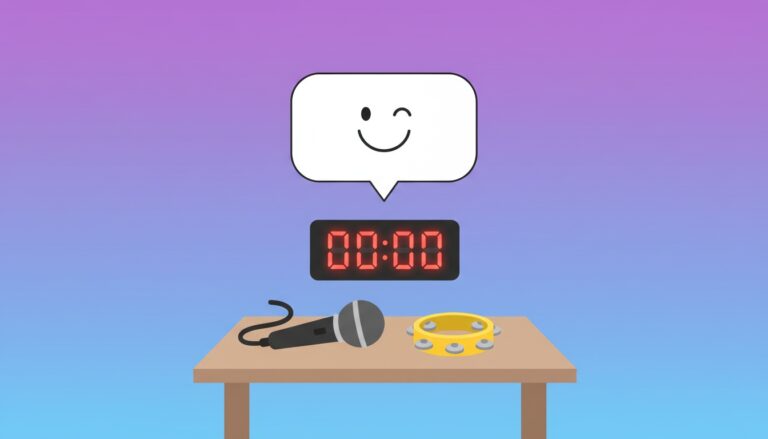
Phase 1: The Panic of “0 Minutes Left”
Hello! It’s your Daily Hangul editor here.
Picture this: You are in a neon-lit room in Hongdae with your new Korean friends. The tambourines are rattling, you’ve just queued up Blackpink’s “As If It’s Your Last,” and everyone is hyped. Suddenly, the monitor flashes red.
“1분 남았습니다” (1 minute left).
The vibe is about to die. In Western karaoke bars, you usually pay per song or strictly by the hour, and when time’s up, the machine shuts off. But in Korea? This is where the real game begins.
If you know the right words, that 00:00 timer is just a suggestion. I’ve seen students pack up their bags sadly, while locals say one magic sentence and get 30 minutes added for free. Today, I’m teaching you how to negotiate for “Service” (서비스) like a true local.
Phase 2: The Magic Words (Deep Dive)
Here are the three levels of asking for extra time. Choose your fighter based on how brave you feel.
1. 사장님, 서비스 좀 주세요! (Sajang-nim, sseobiseu jom juseyo!)
- Pronunciation: [Sa-jang-nim, sseo-bi-seu jom ju-se-yo!]
- Meaning: “Boss, please give us some service (free time)!”
- K-Culture Moment: You’ll hear this in almost every K-Drama scene set in a karaoke bar or a pojangmacha (tent bar). It’s the standard phrase.
- Editor’s Insight: In Korea, “Service” (서비스) doesn’t mean “customer service.” It specifically means “freebies.” Whether it’s free dumplings at a restaurant or extra time at a Noraebang, it’s all “service.”
- Situation Spectrum:
[🚫 Formal/Boss] ———— [⚠️ Semi-formal] ———— [✅ Casual/Friendly]
(Note: Use this with the Noraebang owner, not your own boss!)- 🤔 Think About It: Why does Korean use the English word “Service” to mean “Free”? It implies that the owner is giving you special treatment because they value you as a customer, not just because it’s a discount policy.
2. 저희 시간 다 됐는데… (Jeo-hui si-gan da dwaet-neun-de…)
- Pronunciation: [Jeo-hui shi-gan da dwaet-neun-de…]
- Meaning: “Our time is up, but…” (Implied: Can we have more?)
- Editor’s Insight: This is the indirect, polite Korean way. You aren’t demanding; you are stating a sad fact and leaving the space open for the owner to step in and save the day. It relies on Nunchi (sensing the mood).
- Situation Spectrum:
[🚫 ] ———— [⚠️ Safe & Polite] ———— [✅ ]3. 마지막 곡인데 끊겼어요 ㅠㅠ (Majimak gogin-de kkeun-gyeoss-eoyo)
- Pronunciation: [Ma-ji-mak go-gin-de kkeun-gyeoss-eo-yo]
- Meaning: “It was the last song, but it got cut off! (crying face)”
- K-Drama Trope: The protagonist is belting out a ballad, tears streaming down their face, and click—the music stops. This phrase appeals to the owner’s humanity.
- Editor’s Insight: Even if it wasn’t actually your last song, this is a valid excuse to get 10 extra minutes. It’s a guilt trip, but a socially acceptable one.
Phase 3: Textbook vs. Real Life
| Situation | 📖 Textbook Korean | 🗣️ Real Street Korean | 💡 Why the difference? |
|---|---|---|---|
| Asking for time | 시간을 추가하고 싶습니다. (I would like to add time.) | 사장님~ 서비스 딱 10분만요! (Boss~ Service just 10 mins!) | Textbook is for business transactions; Real life is about building a connection (Jeong). |
| Calling the owner | 저기요 (Excuse me) | 사장님 / 이모님 (Boss / Auntie) | Titles like “Auntie” create instant intimacy, making it harder for them to refuse you. |
Bottom Note: Never say “I want to buy more time” immediately. Try to get it for free (Service) first. If they say no, then pay.
Phase 4: Cultural Context — The Art of “Nunchi”
Asking for service isn’t a constitutional right; it’s a game of Nunchi (reading the room).
When to ASK ✅:
– The hallway is quiet.
– You ordered expensive drinks or snacks.
– The owner looks bored.
When to STAY QUIET 🚫:
– It’s Friday night at 9 PM and there’s a line of people waiting outside.
– You are at a Coin Noraebang (Coin-No). Crucial: Coin Noraebangs (small booths) are automated. There is no human to bargain with. Do not yell at the coin machine.
Phase 5: Immersive Roleplay
Setting: A regular Noraebang in Gangnam. It’s 11 PM. You are with Min-ji (your Korean friend). The timer shows 00:00 and the music just died.
Min-ji: 아, 뭐야! 벌써 끝났어? 아직 부르고 싶은 거 많은데.
(Ah, mwo-ya! Beolsseo kkeut-nass-eo? Ajik bureugo sipeun geo maneunde.)
“Ah, what the? It’s over already? I still have so much I want to sing.”
(Stage Direction: Min-ji looks at you. It’s your turn to be the hero. You pick up the intercom phone connected to the counter.)
Owner (Voice): 네, 카운터입니다.
(Ne, ka-un-teo-im-ni-da.)
“Yes, counter here.”
🔀 YOUR TURN! How do you respond?
- Option A: “시간 더 살게요.” (I will buy more time.)
- Option B: “사장님~ 저희 너무 재밌게 놀았는데 서비스 조금만 주시면 안 돼요?” (Boss~ We had so much fun, can’t you give us a little service?)
- Option C: “돈 더 내기 싫어요.” (I don’t want to pay more.)
✅ Best Choice: B.
Why? Flattery works. You acknowledged that you enjoyed their establishment (“had so much fun”), which makes the owner feel good. Option A is a waste of money (you might get free time if you ask B first). Option C is just rude.
Owner: (Laughs) 아, 그래요? 알겠어요. 20분 더 넣어드릴게요.
“Ah, really? Okay. I’ll put in 20 more minutes.”
Phase 6: 10-Second Shadowing Drill
Practice this before you press the intercom button. Use a “pleading” but “cute” tone.
🥺 Aegyo Mode (Cute/Pleading):
사장님~ / 서비스 / 조금만 / 주시면 안 돼요? 🎶
(Sa-jang-nim~ / sseo-bi-seu / jo-geum-man / ju-si-myeon an dwae-yo?)
Phase 7: K-Culture Glossary
| Korean | Romanization | Meaning | Context |
|---|---|---|---|
| 18번 | Sip-pal-beon | Go-to song | Your signature song that you sing best. “What is your 18-beon?” |
| 코노 | Ko-no | Coin Noraebang | Cheap, booth-style karaoke. No service time here! |
| 탬버린 | Taem-beo-rin | Tambourine | The ultimate hype tool. Shake it when you aren’t singing. |
Phase 8: Traveler’s Survival Kit
Going to a Noraebang for the first time? Here is what you need to know about the Remote Control.
🆘 Survival Buttons
– 시작 (Si-jak): Start. The most important button.
– 취소 (Chi-so): Cancel. Use this if you picked the wrong song.
– 점수 제거 (Jeom-su Je-geo): Remove Score. Pro Tip: Turn this ON. Otherwise, the machine pauses after every song to tell you “85 points,” which kills the vibe and wastes your precious time.📌 Editor’s Travel Note: Most Noraebang remotes are in Korean only. If you are lost, use the Papago Image Translate function on the remote!
Phase 9: Think Deeper — The Economics of “Jeong”
Why do they give free time? Isn’t that losing money?
In many Western cultures, business is transaction-based. You pay for X, you get X. In Korea, business is often relationship-based. This is tied to Jeong (정 – affection/attachment).
Giving “Service” is the owner’s way of saying, “I like you, come back again.” It transforms a cold transaction into a warm interaction. By asking for service, you aren’t being cheap; you are initiating a relationship. You are saying, “I want to stay in your place longer because I like it here.”
💬 Your Turn: Does your culture have a concept like “Service”? Or would asking for free time get you kicked out? Tell me in the comments!
Phase 10: FAQ & Troubleshooting
Q: Can I ask for service if I’m at a Coin Noraebang (Coin-No)?
A: No! Since you pay 500 or 1,000 won per song/time block into a machine, there is no one to ask. Don’t shout at the kiosk.
Q: What if the owner says no?
A: Don’t push it. Just say “Ah, ne!” (Okay!) and either pack up or pay for another hour. Pushing too hard makes you a “Jin-sang” (annoying customer).
❌ Common Mistake:
Don’t call the owner “Ah-jus-si” (Middle-aged man) or “Ah-jum-ma” (Middle-aged woman). It can sound blunt or rude in a service setting. Always use “Sa-jang-nim” (Boss).
Phase 11: Wrap-up & Mission
One-Liner: “Service” is not a right, but a reward for your bravery and politeness!
🎯 Action Mission:
– 🥉 Bronze: Look in the mirror and practice the “Aegyo” face while saying “Sajang-nim~ Service!”
– 🥈 Silver: Watch a YouTube video of a foreigner visiting a Korean Noraebang and see if they get service.
– 🥇 Gold: Go to a real Noraebang (not Coin) with friends. When the timer hits 5 minutes, pick up the phone and try the magic phrase!
K-Culture Mission: Find out what your “18-beon” (Signature Song) is. It should be a song you can sing even if you are drunk or sleepy!
Phase 12: Quiz — Will You Survive the Noraebang?
- Situation: You are at a Coin Noraebang. The time runs out. What do you do?
- A) Shout “Service please!”
- B) Put another 1,000 won bill in the machine.
- C) Call the police.
- True or False: Calling the owner “Sajang-nim” (Boss) is polite, even if they look young.
-
Situation: The owner gave you 20 minutes of service. What do you say?
- A) “Why only 20?” (왜 20분만 줘요?)
- B) “Thank you!” (Sajang-nim jjang!/Gamsahamnida!)
(Answers: 1-B, 2-True, 3-B)
Frequently Asked Questions (FAQ)
Q: What does "사장님, 서비스 좀 주세요! (Sajang-nim, sseobiseu jom juseyo!)" mean in Korean and how do you pronounce it?
A: In Korean, "사장님, 서비스 좀 주세요! (Sajang-nim, sseobiseu jom juseyo!)" is pronounced [Sa-jang-nim, sseo-bi-seu jom ju-se-yo!] and means: "Boss, please give us some service (free time)!"
Q: What does "저희 시간 다 됐는데... (Jeo-hui si-gan da dwaet-neun-de...)" mean in Korean and how do you pronounce it?
A: In Korean, "저희 시간 다 됐는데... (Jeo-hui si-gan da dwaet-neun-de...)" is pronounced [Jeo-hui shi-gan da dwaet-neun-de...] and means: "Our time is up, but..." (Implied: Can we have more?)
Q: What does "마지막 곡인데 끊겼어요 ㅠㅠ (Majimak gogin-de kkeun-gyeoss-eoyo)" mean in Korean and how do you pronounce it?
A: In Korean, "마지막 곡인데 끊겼어요 ㅠㅠ (Majimak gogin-de kkeun-gyeoss-eoyo)" is pronounced [Ma-ji-mak go-gin-de kkeun-gyeoss-eo-yo] and means: "It was the last song, but it got cut off! (crying face)"







