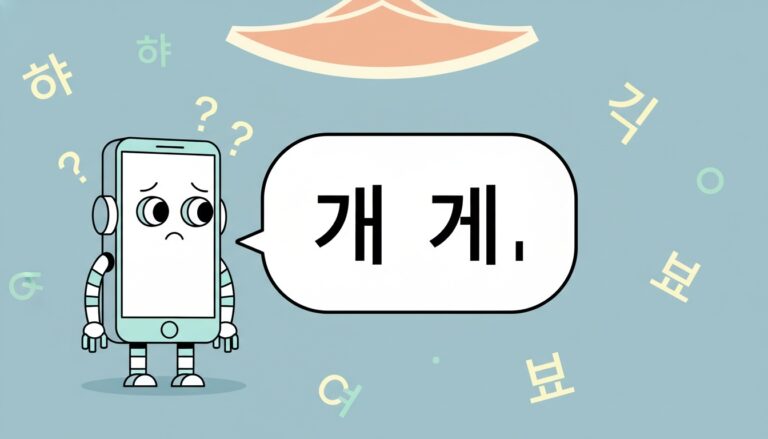
Phase 1: The “Sorry, I Didn’t Catch That” Struggle
Hello! Your Daily Hangul editor here.
Picture this: You are standing in the middle of Hongdae, feeling confident. You open Naver Map and tap the microphone icon. You clearly say, “Sinchon Station.”
But the app spins for a second and routes you to “Incheon Station.”
That is a 30-kilometer difference. Suddenly, your confidence drops to zero. “Is my pronunciation that bad?” you wonder. “Do I sound like a malfunctioning robot?”
Here is the truth: It’s not just you. Voice recognition technology (SRT) in Korea—whether it’s Siri, Bixby, or the sweet lady inside the Kakao Taxi app—is notoriously picky about aspirated (격음) and tense (경음) sounds. Even native Koreans get ghosted by their AI speakers when they are tired or mumbling.
Today, we are going to debug your pronunciation. We aren’t just fixing this for the machines; if you can pass the “Siri Test,” you will sound crystal clear to human ears too.
Phase 2: The Glitch in the Matrix (Deep Dive)
At the C1 level, you know the basics. But AI struggles with the energy behind your voice. English relies on vibration (voiced/unvoiced); Korean relies on air pressure.
1. 쌀 (Rice) vs. 살 (Flesh/Age)
The Classic Nemesis
- Pronunciation:
- 쌀 (Rice): [Ssal] – High pitch, high tension. Imagine a snake hissing sharply: Sss.
- 살 (Flesh): [Sal] – Looser, breathier. Like the ‘s’ in “soup.”
- Meaning: Uncooked rice vs. Flesh/Meat (or years of age).
- K-Culture Moment: You might recall variety shows where MCs make fun of someone asking for “Sal-bap” (Flesh rice?) instead of “Ssal-bap.” It sounds terrifyingly cannibalistic.
- Editor’s Insight: To trigger the AI correctly for ‘쌀’, you need to tense your throat before you speak. It should feel like you are holding your breath for a split second. If the AI hears ‘sal’, it thinks you are talking about losing weight (살 빠지다).
- Situation Spectrum:
[🚫 Formal: N/A] ———— [✅ Essential for Survival] - 🤔 Think About It: Why does Korean distinguish these sounds so strictly? Historically, accurate agricultural terms were survival. Confusing rice with anything else wasn’t an option.
2. 개 (Dog) vs. 게 (Crab)
The Vowel Merger Problem
- Pronunciation:
- 개 (Dog): [Gae] – Open mouth wider.
- 게 (Crab): [Ge] – Mouth slightly more closed.
- The Reality Check: Here is the kicker—modern young Seoulites barely distinguish these vowels in speech. They sound almost identical. AI struggles here immensely.
- Editor’s Insight: So how do we fix it? Context cues. If the AI fails, natives add a descriptor. We rarely just say “Get me some ‘Ge’.” We say “Kkot-ge” (Blue crab) or “Meong-meong-i” (Puppy – mostly for cute effect or clarification).
- Situation Spectrum:
[⚠️ Caution needed in ordering]
3. 방 (Room) vs. 빵 (Bread)
The Navigation Nightmare
- Pronunciation:
- 방 (Room): [Bang] – Soft ‘B’. Low pitch.
- 빵 (Bread): [Ppang] – Explodes from the lips. No air comes out (hold a tissue in front of your mouth; it shouldn’t move much).
- K-Culture Moment: In K-Dramas, when a character is angry, they stress their consonants. “Bang!” (Room) becomes almost “Ppang!” out of sheer frustration. But to an AI, anger changes the meaning.
- 🤔 Think About It: English speakers use stress (volume) for emphasis. Koreans use pitch and glottal tension. Changing your volume doesn’t fix the error; changing your throat tension does.
Phase 3: Textbook vs. Real Life (The AI Gap)
| Situation | 📖 Textbook / AI Expectation | 🗣️ Real Korean (Human) | 💡 Why the difference? |
|---|---|---|---|
| Calling a friend | “전화 걸어 줘.” (Jeon-hwa geol-eo jwo.) | “전화 좀 해봐.” (Jeon-hwa jom hae-bwa.) | ‘걸다’ is the mechanical verb; ‘하다’ is the social verb. AI prefers specific commands. |
| Music Request | “[Artist]의 노래를 틀어 주세요.” | “야, [Artist] 노래 좀.” (Ya, [Artist] norae jom.) | Humans rely on context and dropped particles. AI often needs the object marker (을/를) to process correctly. |
| Clarifying ‘Dog’ | “개입니다.” (It is a dog.) | “멍멍이 말이야, 멍멍이.” (Meong-meong-i mariya.) | Since ‘ae’ and ‘e’ sounds merged, humans use onomatopoeia to clarify. |
Bottom Note: When talking to machines (Siri/Bixby), speak like a 1980s news anchor—stiff and precise. When talking to people, relax.
Phase 4: Cultural Deep Dive — Read the Room (Literally)
4-1. The “Nunchi” of AI
Koreans often joke that AI has “no nunchi.” In a noisy pocha (tent bar), a human waiter understands “Igeo (This)” even if you slur, because they see you pointing at the empty Soju bottle. Siri is blind. When practicing voice commands, remember you are training for a situation with zero context. It is the ultimate pronunciation test.
4-2. K-Drama Connection: The “Dialect” Barrier
Have you seen the drama Reply 1994? The characters speak with heavy Gyeongsang-do accents. Even today, voice recognition systems struggle with Satoori (dialects). If you learn Korean from dramas set in Busan, standard AI might not understand your intonation (which is famously tonal, unlike Seoul standard).
Critique: Standard Seoul Korean is considered the “prestige” dialect for technology. It raises questions about digital accessibility for the elderly in rural areas who speak heavy Satoori.
Phase 5: Roleplay Scenario — The Stubborn Smart Speaker
Setting: Sunday afternoon. You are lying on the sofa, trying to order lunch through a smart speaker named “Gini.”
Characters:
* YOU: Hungry, tired, craving intense flavors.
* Gini (NPC): An overly polite but slightly deaf AI assistant.
Dialogue:
YOU: 기니야, 점심 메뉴 추천해 줘.
(Gini-ya, jeomsim menyu chucheon-hae jwo.)
(Gini, recommend a lunch menu.)
Gini: 네, 오늘의 추천 메뉴는 ‘죽’입니다.
(Ne, oneul-ui chucheon menyu-neun ‘juk’ imnida.)
(Yes, today’s recommendation is ‘porridge’.)
YOU: 아, 죽 싫어! 매운 거 먹고 싶어.
(Ah, juk sireo! Mae-un geo meok-go sipeo.)
(Ah, I hate porridge! I want to eat something spicy.)
Gini: 죄송합니다. ‘매운 게’를 찾으시나요? 근처 해물탕 집을 검색할까요?
(Joesong-hamnida. ‘Mae-un ge’-reul chajeusinayo? Geuncheo haemultang jibeul geomsaek-halkkayo?)
(Sorry. Are you looking for ‘Spicy Crab’? Shall I search for seafood stew places?)
🔀 Decision Point! Gini confused ‘Geo’ (Thing) with ‘Ge’ (Crab). How do you fix it?
- A) Shout louder: “ANI!! MAE-UN GEO!!”
- B) Articulate precisely: “M – ae – un – G – eo.”
- C) Change the word entirely: “떡볶이 찾아줘.” (Find Tteokbokki.)
✅ Best Choice: C.
Analysis: When AI gets stuck in a loop (mishearing a specific phoneme), repeating it usually yields the same error. It’s smarter to switch to a specific concrete noun like Tteokbokki or Jjamppong. This is what Koreans do—we don’t fight the machine; we pivot.
Phase 6: 10-Second Shadowing Drill
Let’s train your tongue muscle tension. Focus on the pitch change.
- Emotion: 😤 Frustrated but clear (Talking to a dumb machine).
- Sentence:
“아니 / 방 말고 / 빵집을 / 찾아달라고요!”
(Ani / bang malgo / ppang-jibeul / chaja-dallagoyo!)
“No, not a room, I said find a bakery (bread house)!”
Phase 7: K-Culture Mini Glossary
| Korean | Romanization | Meaning | Context |
|---|---|---|---|
| 인식 | Insik | Recognition | Often used in “음성 인식” (Voice Recognition). |
| 못 알아듣다 | Mot aradeutda | To not understand (by hearing) | Used when the AI (or a person) fails to catch what you said. |
| 오타 / 오인식 | Ota / O-insik | Typo / Misrecognition | ‘Ota’ is for typing, ‘O-insik’ is when the machine hears wrong. |
| 사투리 | Satoori | Dialect | The nemesis of voice recognition software. |
Phase 8: Traveler’s Survival Kit (When Tech Fails)
Voice recognition is great, but when you are in a taxi and the driver’s navigation app won’t understand your pronunciation of “Gyeongbokgung”:
🆘 Survival Strategy
* Don’t keep repeating. It gets awkward.
* The Magic Phrase: “여기 찍어주세요.” (Yeogi jjigeo-juseyo.)
* Action: Show the address on your phone map to the driver. ‘찍다’ means to ‘stamp’ or ‘input’ the location into the GPS.💡 Pro Tip: Naver Map and Kakao Map allow you to play the pronunciation of the location. Press the speaker icon next to the place name. Let the native AI talk to the native driver.
Phase 9: Think Deeper — Technology & Standardization
Standardization vs. Diversity: Voice recognition technology forces us to speak “Standard Seoul Korean.” If you have a unique accent or intonation, the machine excludes you. In Korea, this reinforces the idea that the Seoul dialect is the “correct” one, potentially marginalizing regional identities. As a learner, you are aiming for standard pronunciation, but ask yourself: Is perfectly “clean” speech the only way to be understood, or is it just what the machines demand?
💬 Your Turn: Does voice recognition work well in your native language? Or does it struggle with accents there too?
Phase 10: FAQ & Troubleshooting
- Q: Why does the AI understand my ‘Hello’ but not my ‘Thank you’?
- A: ‘Annyeonghaseyo’ has a distinct rhythm. ‘Gamsahamnida’ is often mumbled by learners. Pronounce the ‘Gam’ and ‘Sa’ clearly with a distinct stop. Don’t rush.
- Q: Can I use casual speech (Banmal) with AI?
- A: Yes! Most Korean AIs (Siri, Bixby) are programmed to understand plain forms like “날씨 알려줘” (Tell me the weather). It feels cooler, to be honest.
❌ Common Mistake: Rising intonation at the end of every command.
✅ Fix: Korean commands usually have a falling intonation. “Gwanghwamun-euro ga-jwo ↘” (Go to Gwanghwamun). Rising intonation sounds like a question, confusing the AI.
Phase 11: Wrap-up & Mission
Summary: To beat the AI, you must master the tension in your throat (Double Consonants) and know when to pivot to different words.
Action Mission:
* 🥉 Bronze: Open Google Translate (Voice Mode) and try to say “Buy Bread” (빵 사줘) vs “Buy a Room” (방 사줘) until it recognizes the difference.
* 🥈 Silver: Set your phone’s navigation to Korean and try to voice-search for a location.
* 🥇 Gold: Use a Korean voice command to take a selfie. Say “Kimchi!” or “Shoot!” (Chwal-yeong) to your phone camera.
K-Culture Mission: Watch a clip of a K-Pop idol doing a “Whisper Challenge” (Shouting in Silence). Watch how they exaggerate their mouth shapes when sound is removed. That is the level of articulation AI needs!
Phase 12: Quiz — The AI Test
- Situation: You want to ask the AI to turn off the light (Bul), but it thinks you said Fire (Bul). Wait, they are the same word! How does the AI know?
- A) It guesses.
- B) Context (verb difference: ‘Turn off’ vs ‘Start’).
- C) Pitch difference.
- True or False: You should shout loudly if the AI doesn’t understand you.
-
Scenario: The taxi navigation thinks you said “Jamsil” but you said “Jamsill”. What is the likely error?
- A) You missed the ‘L’ patchim.
- B) You didn’t tense the ‘S’ sound enough (S vs Ss).
(Answers: 1-B [Lights ‘kkeo’, Fire ‘na’], 2-False [Change tension, not volume], 3-A)
Frequently Asked Questions (FAQ)
Q: What does "쌀" mean in Korean and how do you pronounce it?
A: In Korean, "쌀" is pronounced [Rice] and means: [Ssal] - High pitch, high tension. Imagine a snake hissing sharply:
Q: What does "살" mean in Korean and how do you pronounce it?
A: In Korean, "살" is pronounced [Flesh] and means: [Sal] - Looser, breathier. Like the 's' in "soup."
Q: What does "개" mean in Korean and how do you pronounce it?
A: In Korean, "개" is pronounced [Dog] and means: [Gae] - Open mouth wider.
Q: What does "게" mean in Korean and how do you pronounce it?
A: In Korean, "게" is pronounced [Crab] and means: [Ge] - Mouth slightly more closed.