

Hello! Daily Hangul Editor here.
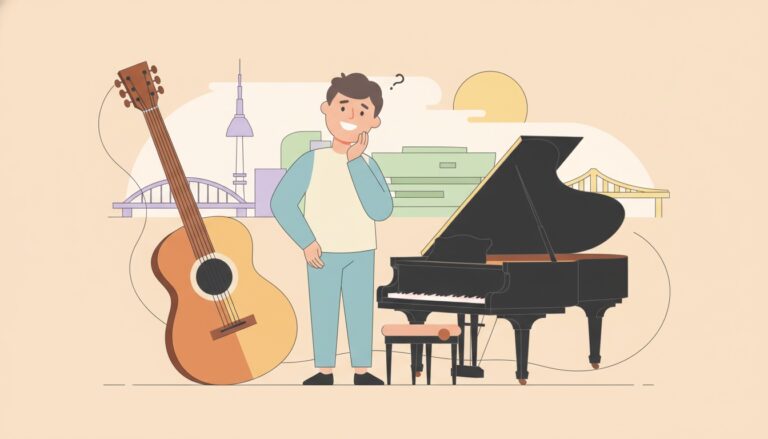
Picture this: You’re watching Crash Landing on You, and there’s that scene where Hyun Bin plays the piano by the lake. Or maybe you’ve seen your favorite K-Pop idol strumming a guitar during a late-night V-Live, looking effortlessly cool.
Suddenly, you think, “I want to do that.”
But here’s the problem. You walk into a music academy (we call them Hagwon) or meet a Korean friend, and you don’t know how to ask for advice. You don’t want to just say “I like music.” You want to say, “I’m thinking of picking up an instrument, but I have zero talent—what won’t make me look foolish?”
Today, we’re going to learn how to ask for recommendations with the nuance of a local. Let’s get you ready for your own K-Drama main character moment.
Phase 1: Deep Dive into Core Expressions
Here are the three sentences that will make you sound like you’ve been living in Seoul for years.
1. 악기를 하나 배워 볼까 하는데…
- Pronunciation: [akkireul hana baewo bolkka haneunde…]
- Sound-alike: Ah-kki-reul ha-na bae-wo bol-kka ha-neun-deh…
- Meaning: “I’m thinking about trying to learn an instrument, but…”
- Context: This is the ultimate conversation starter. You aren’t just stating a fact; you are trailing off with “…하는데” (…haneunde) to signal, “Please give me your opinion!”
- Editor’s Insight: In English, we might ask directly, “What should I learn?” In Korean, we set the scene first. It’s softer and invites the other person to step in.
- Situation Spectrum:
[🚫 Formal Presentation] ———— [✅ Friends/Colleagues] ———— [✅ Teachers]- 🤔 Think About It: Why do Koreans often end sentences with “…but” (…하는데/…는데요)? It leaves room for the listener to react, showing consideration. It’s less aggressive than a direct question.
2. 초보자가 배우기에 뭐가 제일 좋아요?
- Pronunciation: [chobojaga baeugie mwoga jeil joayo?]
- Sound-alike: Cho-bo-ja-ga bae-u-gi-eh mwo-ga jay-il jo-ah-yo?
- Meaning: “What is the best thing for a beginner to learn?”
- K-Culture Moment: Imagine walking into Nakwon Sangga (Korea’s massive instrument arcade). You look overwhelmed by thousands of guitars. This is the phrase that saves you.
- Editor’s Insight: You can replace “좋아요” (good) with “쉬워요?” (easy) if you want to be more direct about your lack of skills!
3. 혹시 추천해 주실 만한 거 있어요?
- Pronunciation: [hoksi chucheonhae jusil manhan geo isseoyo?]
- Sound-alike: Hok-shi chu-cheon-hae ju-shil man-han guh i-ssuh-yo?
- Meaning: “By any chance, is there anything worth recommending?”
- Editor’s Insight: The word “혹시” (Hoksi – by any chance) is magic. It makes you sound polite and humble. It lowers the pressure on the listener.
- Situation Spectrum:
[⚠️ Close Friends (Too polite?)] ———— [✅ Coworkers] ———— [✅ Store Clerks]
Phase 2: Textbook vs. Real Life
Let’s be honest. Textbooks make you sound like a robot. Here is how actual Koreans talk in Hongdae cafes.
| Situation | 📖 Textbook Korean | 🗣️ Real Korean | 💡 Why the difference? |
|---|---|---|---|
| Asking for a suggestion | 무슨 악기를 추천합니까? (What instrument do you recommend?) | 요즘 뭐 배우는 게 핫해요? (What’s hot to learn these days?) | Koreans love trends. Asking what is “hot” shows you are culturally aware. |
| Admitting you are bad | 저는 음악에 재능이 없습니다. (I have no talent in music.) | 저 완전 ‘똥손’이에요. (I have ‘poop hands’ / I’m clumsy.) | ‘똥손’ (Ddong-son) is self-deprecating slang for someone with no manual dexterity. It’s funny and instant bonding. |
| Asking what is easiest | 무엇이 가장 쉽습니까? (What is the easiest?) | 뭐가 제일 만만해요? (What’s the most manageable?) | ‘만만하다’ implies something isn’t intimidating. It’s more nuanced than just ‘easy’. |
Phase 3: Cultural Context — The “Hobby” Pressure
4-1. Non-verbal Cue: The “Thinking” Tilt
When you say, “악기를 하나 배워 볼까 하는데…” (Expression #1), don’t look the person in the eye intensely. Tilt your head slightly, look a bit into the distance, and pause. This shows you are genuinely pondering and valuing their potential input.
4-2. K-Culture Connection: The “Adult Piano” Trend
In Korea, learning an instrument isn’t just for kids. There is a huge trend called “Seong-in Piano” (Adult Piano) academies. These aren’t stuffy classrooms; they are like social clubs with coffee, beer, and practice rooms. It’s a popular way for office workers to de-stress and make friends. If you ask for a recommendation, don’t be surprised if someone suggests a “Piano Hagwon”—they might just want a drinking buddy who plays Chopin!
Phase 4: Immersive Roleplay
Setting: It’s a breezy Friday evening at Yeonnam-dong Park. You and your Korean friend, Min-ji, are sitting on a picnic mat, watching a busker play the guitar.
Characters:
– YOU: Looking for a new hobby to escape work stress.
– Min-ji (28): A trendy office worker who knows all the cool spots.
(The busker finishes a song. Applause.)
YOU: 와, 진짜 잘한다. 분위기 너무 좋다.
(Wa, jinjja jalhanda. Bunwigi neomu joda.)
(Wow, he’s really good. The vibe is so good.)
Min-ji: 그치? 너도 악기 같은 거 관심 있어?
(Geuchi? Neodo akki gateun geo gwansim isseo?)
(Right? Are you interested in instruments too?)
YOU: 응. 사실 요즘… 악기를 하나 배워 볼까 하는데…
(Eung. Sasil yojeum… akkireul hana baewo bolkka haneunde…)
(Yeah. Actually, these days… I’m thinking of learning an instrument, but…)
Min-ji: 오, 진짜? 어떤 거? 피아노? 기타?
(Oh, jinjja? Eotteon geo? Piano? Gita?)
(Oh, really? Which one? Piano? Guitar?)
🔀 Decision Point: What do you say?
Option A: “뭐가 제일 만만해요? 저 완전 똥손이잖아요.”
(What’s the most manageable? You know I have ‘poop hands’.)Option B: “기타요! 아이유처럼 치고 싶어요.”
(Guitar! I want to play like IU.)
✅ If you chose A:
Min-ji: ㅋㅋㅋ 똥손이라니! 음… 그럼 우쿨렐레 어때? 줄이 4개라 기타보다 훨씬 쉬워!
(Haha, poop hands! Hmm… then how about Ukulele? It has 4 strings so it’s much easier than guitar!)
✅ If you chose B:
Min-ji: 대박! 그럼 우리 회사 근처 실용음악학원 같이 다닐래? 나도 배우고 싶었거든!
(Daebak! Then wanna go to the applied music academy near our office together? I wanted to learn too!)
Phase 5: 10-Second Shadowing Drill
Listen to the rhythm. The “…” part is crucial!
Emotion: Slightly hesitant but hopeful 🥺
저 / 악기를 하나 / 배워 볼까 하는데… / 뭐가 좋을까요?
(Jeo / akkireul hana / baewo bolkka haneunde… / mwoga joeulkkayo?)
“I… am thinking of learning an instrument… what would be good?”
Phase 6: K-Culture Mini Glossary
| Korean | Romanization | Meaning | Context |
|---|---|---|---|
| 버스킹 | Beoseuking | Busking | Street performances, famous in Hongdae & Han River parks. |
| 학원 | Hagwon | Academy | Private cram schools/academies. Music hagwons are everywhere. |
| 똥손 | Ddong-son | Poop hand | Slang for being clumsy or bad with hands (opposite of Geum-son/Gold hand). |
| 장비빨 | Jangbi-bbal | Gear effect | Relying on expensive equipment rather than skill. (Don’t be this person!) |
Phase 7: Traveler’s Survival Kit (Nagwon Arcade Edition)
If you are in Seoul and love music, you must visit Nagwon Instrument Arcade (낙원상가) in Insadong. It is the world’s largest musical instrument mall.
🆘 Survival Phrases for Shoppers
1. “입문용으로 제일 잘 나가는 게 뭐예요?”
(Immun-yong-euro jeil jal naganeun ge mwoyeyo?)
“What sells best for beginners?”
2. “이거 쳐 봐도 돼요?”
(Igeo chyeo bwado dwaeyo?)
“Can I try playing this?”
3. “현금으로 하면 깎아 주시나요?”
(Hyeongeum-euro hamyeon kkakka jusinayo?)
“Do you give a discount if I pay in cash?” (Classic Korean market tactic!)💡 Pro Tip: Many shops in Nagwon Arcade are run by older experts. Being polite (bowing, using “yo” endings) will get you better service than just pointing at things.
Phase 8: Think Deeper — “One Person, One Instrument”
Why is asking about instruments so common in Korea?
In many Korean schools, there is a concept called “1인 1악기” (One person, One instrument). It’s an educational philosophy that encourages every student to master at least one musical instrument for emotional development. Because of this, asking someone “What instrument do you play?” is a very normal conversation starter, unlike in some cultures where playing music is seen as a specialized talent.
🧠 Your Turn: Does your culture view playing music as a common hobby or a special talent? How does that change how you ask for advice?
Phase 9: Wrap-up & Mission
Today’s Takeaway: Don’t ask directly! Use “…하는데” to soften your request and invite advice.
🚀 Action Mission:
– 🥉 Bronze: Stand in front of a mirror, tilt your head, and practice the “…Ha-neun-de” fade out.
– 🥈 Silver: Search for “낙원상가” (Nagwon Sangga) on YouTube/Instagram to see the vibe.
– 🥇 Gold: Ask a Korean friend (or a language exchange partner): “요즘 취미로 악기 배우고 싶은데, 뭐가 핫해요?”
💬 Question: If you could play the piano theme from a K-Drama, which one would it be? Tell me in the comments!
Frequently Asked Questions (FAQ)
Q: What does "악기를 하나 배워 볼까 하는데..." mean in Korean and how do you pronounce it?
A: In Korean, "악기를 하나 배워 볼까 하는데..." is pronounced [akkireul hana baewo bolkka haneunde...] and means: "I'm thinking about trying to learn an instrument, but..."
Q: What does "초보자가 배우기에 뭐가 제일 좋아요?" mean in Korean and how do you pronounce it?
A: In Korean, "초보자가 배우기에 뭐가 제일 좋아요?" is pronounced [chobojaga baeugie mwoga jeil joayo?] and means: "What is the best thing for a beginner to learn?"
Q: What does "혹시 추천해 주실 만한 거 있어요?" mean in Korean and how do you pronounce it?
A: In Korean, "혹시 추천해 주실 만한 거 있어요?" is pronounced [hoksi chucheonhae jusil manhan geo isseoyo?] and means: "By any chance, is there anything worth recommending?"







