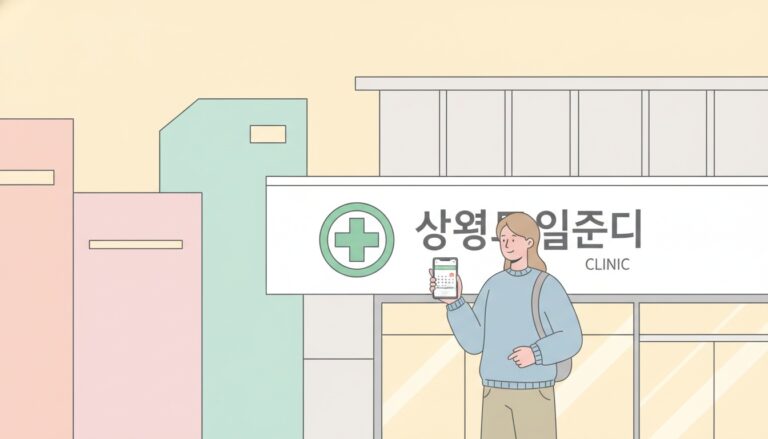
Phase 1: The ‘Sick Day’ Panic (Immersive Hook)
Greeting: Hello! I’m your Daily Hangul editor.
Imagine this: You wake up in Seoul. Your throat feels like you swallowed sandpaper. In K-Dramas, this is the moment the handsome CEO rushes the protagonist to a VIP hospital room that looks like a 5-star hotel. There’s dramatic music, a private doctor, and a slow-motion IV drip scene.
Real Life Check: You are not in a drama. You are alone in your room, you need a doctor, and you are terrified of picking up the phone. “What if I book a surgery instead of a check-up?”
Don’t worry. I’ve been there. I once had a fever in a foreign country and used body language to mime “coughing” to a pharmacist. It wasn’t pretty.
Today, we are going to fix that anxiety. We will learn the absolute survival phrases to get you a doctor’s appointment without the drama.
Phase 2: The Magic Phrases (Deep Dive)
Here are the only two sentences you truly need to start.
1. 예약하고 싶어요 (Ye-yak-ha-go si-peo-yo)
- Pronunciation: [Ye-yak-ha-go] + [she-puh-yo]
- Sound Analogy: Ye (like Yes) + yak (like a yak animal) + hago + she-puh (like sheep + uh).
- Meaning: I want to make an appointment.
- K-Culture Moment: Think of any K-Pop idol doing a “V-Live.” When they say “I want to see you,” they use this grammar structure
~go si-peo-yo(I want to…).- Editor’s Insight: This is your opening move. It tells the receptionist exactly what you need. It’s polite but direct.
- Situation Spectrum:
[🚫 Boss] ———— [✅ Stranger/Receptionist] ———— [✅ Friend]2. 언제 가능해요? (Eon-je ga-neung-hae-yo?)
- Pronunciation: [On-je] + [gah-neung-heh-yo?]
- Sound Analogy: On (like on top) + je (like Jelly) … Ga (like Garden).
- Meaning: When is it possible? / When are you available?
- K-Culture Moment: You hear this in variety shows like Running Man when they try to schedule a mission. “Is it possible?” (
Ga-neung-hae-yo?) is used everywhere.- Editor’s Insight: If you can’t say long sentences with dates and times, just ask this. They will give you options.
- 🤔 Think About It: Why does Korean focus on “possibility” (
ganeung)? It’s a very practical language. It doesn’t ask “When would you like?” (preference), it asks “When can it be done?” (efficiency).
Phase 3: Textbook vs. Real Life
Korean clinics are fast. Really fast. If you speak too slowly, the receptionist might already be typing.
| Situation | 📖 Textbook Korean | 🗣️ Real Korean | 💡 Why different? |
|---|---|---|---|
| Calling | “Check-up” medical words | “Just describe pain” | Doctors speak English usually, but receptionists might not. Simple is best. |
| Availability | “Is Monday 2 PM okay?” | “Monday 2 PM?” (Wol-yo-il du-si?) | Speed. In Korea, efficiency is polite. |
| Arrival | “I am here for my 2 PM…” | “Name? Phone number?” | They process hundreds of patients. They skip the small talk. |
Bottom Note: Don’t be offended if they are brief. It’s not rude; it’s the “Palli-palli” (Hurry, hurry) culture in action.
Phase 4: Cultural Context — The “Wait” Game
4-1. The “Walk-in” Culture
Unlike in the UK or US where you might wait weeks for a GP appointment, in Korea, you can often just walk into a local clinic (called Uiwon or Naegwa). You might wait 30 minutes, but you will see a doctor.
K-Drama Connection: Ever notice how characters just run into a hospital and see a doctor immediately? That’s actually one of the few realistic parts! Access to healthcare is incredibly fast here.
4-2. Non-verbal Tips (Nunchi)
When you walk into the waiting room, silence is golden. If you talk loudly on your phone, you will feel the stare of ten grandmothers. That is the power of Nunchi (reading the room).
Phase 5: Roleplay Scenario (Interactive)
Setting: Monday morning. You have a stomach ache. You call a local internal medicine clinic (Naegwa). The receptionist sounds busy.
Characters:
* YOU: A foreigner living in Seoul.
* Receptionist: Efficient, fast-talking, typing while talking.
Dialogue:
Receptionist: 네, 사랑 내과입니다. (Ne, Sarang Naegwa-imnida.)
(Hello, this is Sarang Internal Medicine.)
YOU: 안녕하세요. 예약하고 싶어요.
(Hello. I want to make an appointment.)
Receptionist: 언제 오시겠어요? (Eonje osigesseoyo?)
(When will you come?)
YOU: 오늘 3시 가능해요?
(Is today 3 PM possible?)
Receptionist: 3시는 안 돼요. 4시는 어때요?
(3 PM is not possible. How about 4 PM?)
🔀 Decision Point! How do you reply?
- A) “네, 좋아요.” (Ne, jo-a-yo.) – Yes, that’s good.
- B) “싫어요.” (Si-reo-yo.) – I hate it.
- C) “빨리 빨리!” (Palli palli!) – Hurry hurry!
✅ Best Choice: A. Simple and polite.
⚠️ Choice B Analysis: “I hate it” sounds like a child refusing to eat vegetables. Don’t say this to a receptionist!
Phase 6: 10-Second Shadowing Drill
Let’s practice the rhythm. Don’t sound like a robot. Put some emotion into it—you are sick!
Emotion: 😷 Weak and polite.
Korean: 저 / 오늘 / 진료 / 예약하고 싶어요.
Romanization: Jeo / oneul / jin-ryo / ye-yak-ha-go si-peo-yo.
Meaning: I / today / check-up / want to book.
Tip: The “ryo” in jin-ryo sounds more like an ‘L’ or a soft ‘R’.
Phase 7: K-Culture Mini Glossary
| Korean | Romanization | Meaning | Context |
|---|---|---|---|
| 내과 | Naegwa | Internal Medicine | The standard doctor for colds, flu, stomach aches. |
| 정형외과 | Jeonghyeong-oegwa | Orthopedics | Go here for muscle pain or broken bones. |
| 신분증 | Sinbun-jeung | ID Card | Crucial. You need your Alien Registration Card (ARC) or Passport to see a doctor now. |
Phase 8: Traveler’s Survival Kit
Visiting Korea? You might get sick. It happens.
🆘 Survival Expression #1
* 🇰🇷 “여기 아파요.” (Yeo-gi a-pa-yo.)
* 🗣️ Pronunciation: [Yuh-gi] + [ah-pah-yo]
* 📍 Usage: Point to your throat/stomach/head and say this.
* 💡 Pro Tip: You don’t need to know the medical word for “tonsillitis.” Just point and say “It hurts here.” The doctor will figure it out.📌 Editor’s Travel Note
* Insurance: If you don’t have Korean National Insurance, you will pay 100%. But don’t panic—a standard clinic visit is often under $30 USD (without insurance). It is surprisingly affordable compared to the US.
* Pharmacy: The clinic gives you a prescription. You take that paper to a nearby sign that says 약 (Yak).
Phase 9: Think Deeper — “Medical Shopping”
Topic: Fast Healthcare vs. Deep Healthcare
In Korea, there is a concept called “Medical Shopping.” Because seeing a doctor is cheap and fast, some patients visit 2 or 3 different clinics for the same symptom to see which doctor they like best. This is almost impossible in many Western countries due to cost or wait times.
🧠 Think Deeper: Does this speed and accessibility make people value doctors less? Or does it keep the society healthier because people go to the doctor before they get extremely sick?
Phase 10: FAQ & Troubleshooting
- Q: Can I just walk in without a reservation?
- A: Yes! For small local clinics (Naegwa), walking in is normal. You might wait 20-40 minutes. For big university hospitals, you absolutely need a reservation.
- Q: Will the doctor speak English?
- A: Maybe. Many Korean doctors studied using English textbooks. However, they might be shy about speaking it. Use simple English and Papago (translation app).
❌ Common Mistake: Forgetting your ID.
✅ Fix: As of 2024, Korea strictly checks ID at hospitals to prevent insurance fraud. Bring your Passport or ARC. No ID, no doctor.
Phase 11: Wrap-up & Mission
Summary: Use “Ye-yak-ha-go si-peo-yo” to book, point to where it hurts, and bring your ID!
Action Mission:
* 🥉 Bronze: Save the nearest hospital location on your Naver Map app.
* 🥈 Silver: Practice saying “Eonje ganeung-haeyo?” quickly 5 times.
* 🥇 Gold: If you are in Korea and feeling unwell, go to a Naegwa and register using your name and phone number!
K-Culture Mission: Watch a medical K-Drama like Hospital Playlist. Notice how they talk to patients. Is it formal or casual?
Phase 12: Interactive Quiz
- Situation: You walk into a clinic. The receptionist asks for your “Sinbun-jeung.” What do you give them?
- A) Your credit card
- B) Your prescription
- C) Your ID/Passport
- True or False: You must wait 2 weeks to see a doctor for a cold in Korea.
- (True / False)
Answers:
1. C) Sinbun-jeung means ID Card.
2. False. You can usually walk in and see a doctor the same day.
Frequently Asked Questions (FAQ)
Q: What does "예약하고 싶어요 (Ye-yak-ha-go si-peo-yo)" mean in Korean and how do you pronounce it?
A: In Korean, "예약하고 싶어요 (Ye-yak-ha-go si-peo-yo)" is pronounced [Ye-yak-ha-go] and means: I want to make an appointment.
Q: What does "언제 가능해요? (Eon-je ga-neung-hae-yo?)" mean in Korean and how do you pronounce it?
A: In Korean, "언제 가능해요? (Eon-je ga-neung-hae-yo?)" is pronounced [On-je] and means: When is it possible? / When are you available?