

Beyond K-Drama Heroes: How to Save a Life in Korean (CPR & AED)
Phase 1: The Reality Check
Hello, Daily Hangul family. It’s your editor here.
We’ve all seen that scene in a medical K-Drama like Hospital Playlist or Dr. Romantic. The monitor flatlines, the dramatic music swells, and the doctor leaps onto the bed to perform chest compressions while shouting complex medical terms. It’s gripping television. But let’s step out of the screen and onto the pavement of a bustling Friday night in Hongdae or a quiet jogging path along the Han River.
If someone collapses in front of you, the subtitles won’t appear. The dramatic music won’t tell you what to do. And simply shouting “Help!” (dowa-juseyo) might get lost in the noise.
In Korea, we talk a lot about “Golden Time” (goldeun taim)—those critical few minutes that determine survival. As a C2 learner, you’re past asking where the bathroom is. You are now equipped to handle high-stakes reality. Today, we aren’t just learning words; we are learning how to command a chaotic situation, understand the legal landscape of the “Good Samaritan,” and potentially save a life using Korean.
This isn’t just language; it’s citizenship.
Phase 2: The Vocabulary of Survival
Let’s dissect the heavy hitters. These aren’t words you’ll use daily, but when you need them, you need them.
1. 심폐소생술 (Sim-pye-so-saeng-sul)
- Pronunciation: [sim-pye-so-sæng-sul] (Think: Sim card + Paella + Soda + Sangria + Soul)
- Meaning: CPR (Cardiopulmonary Resuscitation).
- Sim (Heart) + Pye (Lungs) + So-saeng (Revival/Resuscitation) + Sul (Technique).
- K-Culture Moment: You will hear this on the news constantly. “Citizens performed simpyesosaengsul on the subway platform…” It’s portrayed as the ultimate act of civic duty.
- Editor’s Insight: It’s a mouthful. In a panic, you don’t necessarily need to say the whole word to do it, but you need to recognize it when a 119 dispatcher says it.
- Situation Spectrum:
[🚫 Formal Only] ———— [✅ Standard Term](There is no slang for this.)- 🤔 Think About It: Notice the Sino-Korean roots (Hanja). Why does Korean medical terminology rely so heavily on four-character idioms (Saja-seong-eo) structure? It packs dense meaning into a rhythmic block, much like Latin roots in English medicine.
2. 자동 제세동기 (Jadong Je-se-dong-gi) / AED
- Pronunciation: [ja-dong je-se-dong-gi]
- Meaning: Automated External Defibrillator.
- Jadong (Automatic) + Je (Remove/Eliminate) + Se-dong (Fibrillation/Trembling) + Gi (Machine). Literally: “Machine that removes heart trembling.”
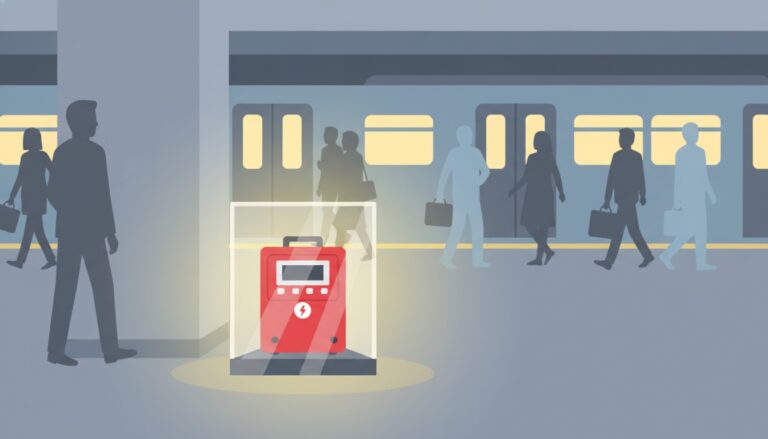
- K-Culture Moment: In almost every Seoul subway station, you’ll see a glass box with this written on it. Next time you tap your T-Money card, look for it.
- Editor’s Insight: While the younger generation understands “AED,” the older generation or panic-stricken locals respond faster to the full Korean name. Memorize it.
- Situation Spectrum: Essential for directing others.
3. 의식 (Ui-sik)
- Pronunciation: [ui-sik]
- Meaning: Consciousness.
- Context: “Uisigi eopseoyo!” (There is no consciousness / They are unconscious).
- Editor’s Insight: This is the bridge between a drunk person sleeping on the street (a common sight in Seoul, let’s be honest) and a medical emergency. Establishing the lack of uisik changes the bystander’s reaction from annoyance to action.
Phase 3: Textbook vs. Real Life
Emergency Korean is different from Classroom Korean. Politeness markers are dropped for brevity and impact.
| Situation | 📖 Textbook Korean | 🗣️ Real Survival Korean | 💡 The “Why” |
|---|---|---|---|
| Calling for help | 도와주세요! (Dowa-juseyo!) | 거기 파란 옷 입은 분! (Geogi paran ot ibeun bun!) | The “Bystander Effect.” Vague cries for help are ignored. You must target a specific individual to break the paralysis. |
| Ordering a call | 119에 전화해 주시겠어요? (Would you please call 119?) | 119 신고해 주세요! (Il-il-gu singo-hae juseyo!) | “Singo” implies reporting an incident/emergency. It’s more urgent and authoritative than just “telephone” (jeonhwa). |
| Clearing space | 좀 비켜주세요 (Please move a little) | 나오세요! / 비키세요! (Na-o-seyo! / Biki-seyo!) | In a life-or-death moment, politeness takes a backseat to physics. You need space now. |
Bottom Note: While Banmal (casual speech) is usually rude with strangers, in a dire emergency, short imperatives are forgiven. However, adding “-yo” or “-seyo” (polite endings) helps maintain cooperation without losing authority.
Phase 4: Cultural Context — The Good Samaritan
4-1. The Fear of Intervention (Nunchi gone wrong)
Historically, Koreans were hesitant to intervene in medical emergencies due to fear of liability—what if I break a rib and get sued? This is where Nunchi (reading the room) traditionally worked against survival; nobody wanted to be the one standing out or taking the blame.
However, the “Good Samaritan Law” (착한 사마리아인의 법) was introduced to protect rescuers. As an advanced speaker, if someone hesitates, you can yell: “법적 책임 없으니까 도와주세요!” (There is no legal liability, so please help!). This single sentence can unlock the crowd’s willingness to act.
4-2. K-Drama vs. Reality
In dramas, CPR often involves passionate mouth-to-mouth resuscitation.
Reality check: Current guidelines in Korea (and globally) emphasize “Hands-Only CPR” (가슴압박 소생술) for laypeople. Don’t worry about the kissing part. Just push hard. If you try to do mouth-to-mouth on a stranger in Seoul, it might actually confuse bystanders who are trained in the modern “compression-only” method.
Phase 5: Immersive Roleplay
Setting: It’s a humid summer evening at Yeouido Han River Park. Cyclists are whizzing by. Suddenly, a middle-aged man clutching his chest collapses near the convenience store ramyun machines.
Characters:
– YOU: An expat who knows CPR.
– Bystander (Min-su): A young Korean man, frozen in shock.
The Dialogue:
YOU: (Rushing over and tapping the man’s shoulders hard)
여보세요! 여보세요! 제 말 들리세요? 🚑
(Yeoboseyo! Yeoboseyo! Je mal deulliseyo?)
(Hello! Hello! Can you hear me?)
(Stage Direction: The man does not respond. No breathing.)
YOU: (Pointing directly at Min-su)
거기 검은색 모자 쓰신 분! 119에 신고해 주시고, 제세동기 가져다주세요!
(Geogi geomeun-saek moja sseusin bun! 119-e singo-hae jusigo, jesedonggi gajyeoda-juseyo!)
(You there in the black hat! Report this to 119 and bring the AED!)
Min-su: (Stammering) 네? 아… 저요?
(Ne? Ah… jeoyo?)
(Huh? Ah… me?)
🔀 Decision Point! Min-su is hesitating. He’s panicking. How do you snap him out of it?
- A) “빨리요! 사람이 죽어가요!” (Hurry! A person is dying!)
- B) “제발 도와주세요, 무서워요.” (Please help, I’m scared.)
- C) “AED 위치 모르세요? 편의점에 있어요!” (Don’t you know the AED location? It’s at the convenience store!)
✅ Best Choice: A. It establishes immediate urgency and breaks his freeze response.
⚠️ Why not C? In a panic, giving instructions is better than asking questions. Tell him what to do, don’t quiz him.
YOU: (Starting compressions)
빨리요! 사람이 죽어가요! 서두르세요!
(Ppalliyo! Sarami jugeogayo! Seodureuseyo!)
Min-su: (Snaps into action) 네, 알겠습니다!
(Ne, algesseumnida!)
(Okay, got it!)
Phase 6: 10-Second Shadowing Drill
Repeat this until it’s muscle memory. The rhythm matters more than the grammar.
- Checking Consciousness:
😤 (Urgent/Loud) 환자분의 / 의식이 / 없습니다!
(Hwanja-buneui / ui-sigi / eopseumnida!) -
Delegating Tasks:
👉 (Direct/Clear) 제세동기 / 가져와 / 주세요!
(Je-se-dong-gi / gajyeo-wa / juseyo!) -
Clearing the Crowd:
✋ (Authoritative) 뒤로 / 물러나 / 주세요!
(Dwiro / mul-leo-na / juseyo!)
Phase 7: K-Culture Mini Glossary
| Korean | Romanization | English | Context |
|---|---|---|---|
| 골든 타임 | Goldeun Taim | Golden Time | The critical window for survival (usually 4-5 mins). |
| 119 (일일구) | Il-il-gu | 119 | Korea’s emergency number (Fire & Ambulance). |
| 심근경색 | Sim-geun-gyeong-saek | Myocardial Infarction | Heart attack. Often the cause requiring CPR. |
| 응급실 | Eung-geup-sil | Emergency Room | Where you go after the ambulance arrives. |
| 하임리히법 | Ha-im-ri-hi-beop | Heimlich Maneuver | Another common emergency term to know. |
Phase 8: Traveler’s Survival Kit
Even if you aren’t doing CPR, you need to know how to summon help.
🆘 Survival Card: The Emergency Call
– 🇰🇷 “여기 [Location]인데요, 응급환자가 발생했어요.”
(Yeogi [Location]-indeyo, eung-geup-hwanjaga balsaeng-haesseoyo.)
“I’m at [Location], and an emergency patient has occurred.”
– 💡 Pro Tip: If you don’t know your address, look for the nearest utility pole (jeonbotdae). They often have a serial number that 119 can track to find your exact GPS coordinates.📌 Editor’s Tech Note
– App: The “Emergency Ready App” (e-Gen) provided by the Korean government supports English and shows the location of the nearest AED and ER.
– Translation: 119 has interpretation services. You can speak English, but knowing “Simpyesosaengsul” helps them categorize the priority immediately.
Phase 9: Think Deeper — “The Collective Heart”
Language & Responsibility:
Korean culture is deeply collectivist, yet the “Bystander Effect” can be particularly strong here due to the fear of breaking social harmony or overstepping boundaries. When you use the specific imperative form “You in the blue shirt” (Geogi paran ot ibeun bun), you are linguistically piercing that veil of anonymity.
Interestingly, the Korean word for “to rescue” or “save” is 구하다 (Guhada). It implies seeking, looking for, and saving. It’s an active verb. In recent years, campaigns for CPR education have been framed as “Love for Family/Neighbors,” appealing to the collectivist heart rather than individual heroism. How does your culture view public intervention? Is it a duty or a liability?
Phase 10: FAQ & Troubleshooting
Q: Do I really need to use honorifics (Jondaetmal) when someone is dying?
A: Generally, yes, but simplify it. Use the “-yo” form or “-sipsiyo” (formal imperative). Dropping to complete Banmal (casual) might shock bystanders or make you sound aggressive rather than authoritative.
* Good: 비키세요! (Please move!)
* Bad: 비켜! (Move it! – unless you are physically pushing through)
Q: What if I don’t know the address?
A: Use landmark navigation, which Koreans excel at. “Near the GS25,” “In front of the Starbucks.” In Korea, brand names are valid navigational landmarks.
❌ Common Mistake: Trying to explain symptoms too much to 119.
✅ Fix: Just say “Breath X, Consciousness X” (Sum an-swiyeoyo, Uisik eopseoyo). Keep it binary.
Phase 11: Wrap-up & Mission
Summary: Today we moved beyond polite conversation to life-saving commands. We learned Simpyesosaengsul, the power of pointing out a specific bystander, and how to navigate the Golden Time.
🚀 Action Mission:
– 🥉 Bronze: Look at a mirror and practice shouting “119에 신고해 주세요!” with authority.
– 🥈 Silver: Download the “Emergency Ready App” (e-Gen) and locate the AED nearest to your home or hotel.
– 🥇 Gold: Next time you are in a subway station, find the AED box. Read the instructions (usually in Korean/English) and mentally simulate grabbing it.
K-Culture Mission: Watch a scene from Dr. Romantic (낭만닥터 김사부) on YouTube. Search for “CPR scene.” Notice how they check for consciousness before starting compressions. Is it accurate?
💬 Your Turn: Does your country have a “Good Samaritan Law”? Would you feel confident stepping in? Let me know in the comments.
Stay safe, and stay prepared.
Phase 12: Quiz — Survival Check
- Situational Judgment: You see someone collapse. You shout “Help!” but no one moves. What is the most effective Korean phrase to use next?
- A) 도와주실 수 있으세요? (Could you help?)
- B) 거기 안경 쓰신 분, 119 신고하세요! (You there with the glasses, call 119!)
- C) 어떡해… 어떡해… (Oh no… oh no…)
- K-Culture True/False:
- “In Korea, you can be sued for breaking a rib while performing CPR on a cardiac arrest patient.”
- (True / False)
- Vocabulary: What is the Korean acronym/word for the machine that shocks the heart?
- [ ] [ ] [ ] [ ] [ ] [ ]
📝 Click for Answers
- B. Specific designation breaks the bystander effect.
- False. The Good Samaritan Law protects you from civil and criminal liability for good-faith rescue attempts.
- 자동 제세동기 (Jadong Jesedonggi)
Frequently Asked Questions (FAQ)
Q: What does "심폐소생술 (Sim-pye-so-saeng-sul)" mean in Korean and how do you pronounce it?
A: In Korean, "심폐소생술 (Sim-pye-so-saeng-sul)" is pronounced [sim-pye-so-sæng-sul] and means: CPR (Cardiopulmonary Resuscitation).
Q: What does "자동 제세동기 (Jadong Je-se-dong-gi) / AED" mean in Korean and how do you pronounce it?
A: In Korean, "자동 제세동기 (Jadong Je-se-dong-gi) / AED" is pronounced [ja-dong je-se-dong-gi] and means: Automated External Defibrillator.
Q: What does "의식 (Ui-sik)" mean in Korean and how do you pronounce it?
A: In Korean, "의식 (Ui-sik)" is pronounced [ui-sik] and means: Consciousness.







