

Phase 1: The “Closed Door” Heartbreak 🚪💔
Hello, Daily Hangul family! It’s your editor here.
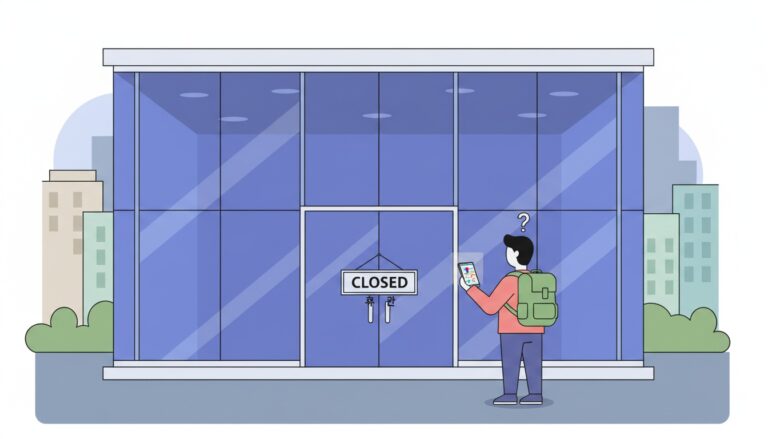
Picture this: You are the main character in a K-Drama. You’ve finally gathered the courage to visit that beautiful library where the lead actor studies. You put on your best outfit, take the subway, walk up the hill, and… the lights are off. The door is locked. A sign hangs there, mocking you.
cue sad ballad music
In K-Dramas, this is usually when it starts raining. In real life, it’s just annoying! Whether it’s the Starfield Library at COEX or a small neighborhood book cafe, arriving on a “closed day” is a rookie mistake we want to avoid.
Today, we’re learning how to ask, “When are you closed?” so you never have to stand in the rain like a sad drama protagonist. Let’s get your schedule sorted!
Phase 2: Deep Dive into Key Expressions 🧐
Here are the three golden phrases you need to save your time.
1. 휴관일이 언제예요? (Hyu-gwan-il-i eon-je-ye-yo?)
- Pronunciation: [Hyu-gwan-il] sounds like Hugh + Gwan (like Taekwondo) + Eel (the fish).
- Meaning: “When is the closing day?”
- Context: This is the standard, polite question for public buildings like libraries, museums, or art galleries. ‘휴(Hyu)’ means rest, ‘관(Gwan)’ means building.
- Situation Spectrum:
[🚫 Casual Friend] ———— [✅ Stranger/Staff] ———— [✅ Formal]- 🤔 Think About It: Why do we say the building is “resting” (휴)? In Korea, spaces often have “rest days” just like people do.
2. 매주 월요일이에요. (Mae-ju wol-yo-il-i-e-yo.)
- Pronunciation: [Mae-ju] + [Wol-yo-il] (Wall-yo-il).
- Meaning: “It is every Monday.”
- K-Culture Moment: Most public facilities in Korea (palaces, museums, libraries) close on Mondays. If you plan a cultural trip on a Monday, double-check! Gyeongbokgung Palace is the odd one out—it closes on Tuesdays.
- Editor’s Insight: Memorizing days of the week is crucial. Monday = Wol-yo-il (Moon day).
3. 오늘 문 열어요? (O-neul mun yeol-eo-yo?)
- Pronunciation: [Mun] (Moon) + [Yeol-eo-yo].
- Meaning: “Are you open today?” (Literally: Do you open the door today?)
- Nuance: This is slightly more casual and practical. You can use this at libraries, but also at restaurants, cafes, and shops.
- Situation Spectrum:
[✅ Casual Friend] ———— [✅ Stranger/Staff] ———— [⚠️ Very Formal]
Phase 3: Textbook vs. Real Life 🗣️
Does anyone actually talk like a textbook? Not really. Here is the reality check.
| Situation | 📖 Textbook Korean | 🗣️ Real Korean (Daily Hangul Style) | 💡 Why the difference? |
|---|---|---|---|
| Asking for days off | 휴관일이 무엇입니까? (What is the closing day?) | 언제 쉬어요? (When do you rest?) | “Resting” (쉬다) is the verb used for both humans and shops/places. It feels softer. |
| Confirming status | 개관 중입니까? (Is it currently open?) | 지금 해요? (Are you doing [business] now?) | Koreans love efficiency. “Doing?” implies “Are you operating?” |
💡 Editor’s Tip: If you are talking to a librarian, stick to “휴관일이 언제예요?” It sounds more educated and appropriate for the setting!
Phase 4: Cultural Context — The “Monday Blues” of Korean Tourism 🇰🇷✈️
Let’s talk about checking schedules like a pro traveler.
1. The “Red Day” (빨간 날) Concept:
If you look at a Korean calendar, Sundays and public holidays are printed in red. These are called “Red Days.” Unlike some Western countries where libraries might open on weekends and close weekdays, big Korean libraries often stay open on weekends (because students study hard!) and take their “rest” on a Monday or Tuesday.
2. Nunchi (눈치) at the Door:
If you approach a library and see the lights are dim, don’t just yank the handle! Check for a small sign that says “휴관” (Closed) or “금일 휴업” (Closed Today). Use your Nunchi (situational awareness). If there are no cars in the parking lot, it’s a bad sign.
3. K-Drama Connection:
Remember in the drama “Start-Up”? Libraries and bookstores are crucial meeting spots. But notice how characters often check their phones before running there? They are checking Naver Maps. In Korea, trusting Google Maps hours can be risky. Naver Maps is the bible of opening hours.
Phase 5: Roleplay — At the Information Desk 🎭
Setting: A quiet afternoon at a local district library in Seoul. You want to visit again next week.
Characters:
– YOU: An eager Korean learner.
– Librarian: A kind middle-aged woman wearing glasses.
(Dialogue Start)
YOU: 저기요, 질문 있어요.
(Jeogiyo, jilmun isseoyo.)
Excuse me, I have a question.
Librarian: 네, 말씀하세요.
(Ne, malseum-haseyo.)
Yes, go ahead.
YOU: 이 도서관은 휴관일이 언제예요?
(I doseogwan-eun hyugwanil-i eonjeyeyo?)
When is this library’s closing day?
Librarian: 저희는 매주 월요일에 쉬어요.
(Jeohui-neun maeju wol-yo-il-e swieoyo.)
We rest every Monday.
YOU: 아, 월요일이요? 그럼 일요일은요?
(Ah, wol-yo-il-iyo? Geureom iryoil-eun-yo?)
Ah, Monday? Then what about Sunday?
Librarian: 일요일은 문 열어요. 오셔도 돼요.
(Iryoil-eun mun yeoleoyo. Osyeodo dwaeyo.)
We open the door on Sundays. You can come.
🔀 Decision Point! How do you respond?
- A) “아, 다행이다! 감사합니다.” (Ah, that’s a relief! Thank you.)
- B) “왜 월요일에 쉬어요?” (Why do you rest on Mondays?)
- C) “오케이, 바이!” (Okay, bye!)
✅ Best Choice: A. It shows appreciation and relief. Very natural.
⚠️ Choice B Analysis: This might sound like a complaint! In Korea, questioning the rules can sometimes be seen as challenging authority unless you smile very brightly.
Phase 6: 10-Second Shadowing Drill 🎤
Don’t just read it, say it! Watch your intonation.
😊 Bright & Curious:
혹시 / 오늘 / 문 열어요? ↗
(Hoksi / o-neul / mun yeol-eo-yo?)
By any chance / today / are you open?
Phase 7: K-Culture Glossary 📖
| Korean | Romanization | English | Context |
|---|---|---|---|
| 휴관일 | Hyugwanil | Closing Day | Used for public buildings (libraries, museums). |
| 쉬는 날 | Swineun nal | Rest Day | Colloquial term for day off (people or shops). |
| 영업시간 | Yeongeop sigan | Business Hours | Seen on glass doors of shops/cafes. |
| 공휴일 | Gonghyuil | Public Holiday | The “Red Days” on the calendar. |
| 24시 | Isipsasi | 24 Hours | Usually for convenience stores or study cafes. |
Phase 8: Traveler’s Survival Kit 🧳
Heading to a library or museum? Don’t leave your hotel without checking this.
🆘 Survival Phrases
– 🇰🇷 “몇 시까지 해요?” (Myeot si-kkaji haeyo?)
– Meaning: Until what time are you open?
– Use it: When you arrive late in the afternoon.
– 🇰🇷 “주말에도 해요?” (Jumal-edo haeyo?)
– Meaning: Do you do (business) on weekends too?📌 Editor’s Travel Note
Naver Maps is King.
Search for the place on Naver Maps. Look for “영업시간” (Business Hours). If it says “영업 중”, it’s open now. If it says “영업 종료”, it’s closed. Don’t trust the static website; trust the map app!
Phase 9: Critical Thinking — “Think Deeper” 🧠
Topic: The Culture of “Hard Work” vs. “Resting Spaces”
In many Western countries, shops close early, and Sunday is a quiet day. In Korea, “convenience” is a major social value. Many study cafes are open 24/7, and libraries often operate on weekends because that’s when students and workers have time to study. However, the strict designation of “Monday Closing” for cultural centers balances this intensity. It’s a structured break in a society that runs on a “Pali-Pali” (Hurry-Hurry) clock.
💬 Your Turn: In your country, do libraries open on Sundays? Is convenience more important than the staff’s rest day? Tell me in the comments!
Phase 10: FAQ & Troubleshooting ⚠️
Q: Can I ask a convenience store staff “휴관일이 언제예요?”
A: No! That sounds weird. “휴관” implies a public/cultural building. For a store, just ask “언제 쉬어요?” (When do you rest?) or “쉬는 날이 언제예요?”.
Q: What if I forget the word “휴관일”?
A: No panic. Just ask “Open?” (O-peun?) while making a question face. Or point to the calendar and ask “When close?”. Body language is universal language!
❌ Common Mistake:
Don’t confuse 화요일 (Tuesday) and 월요일 (Monday). They sound different, but beginners mix them up constantly. Remember: Wol (Moon/Monday) comes before Hwa (Fire/Tuesday).
Phase 11: Wrap-up & Mission 🎁
One-Liner: To avoid a wasted trip, ask “Hyugwanil-i eonjeyeyo?” or check Naver Maps for “영업시간”.
🔥 Action Mission:
– 🥉 Bronze: Say “오늘 문 열어요?” three times while looking at your bedroom door.
– 🥈 Silver: Go to a Korean map app (Naver/Kakao), find a library in Seoul, and find out which day it is closed.
– 🥇 Gold: If you are in Korea, ask a staff member at a cafe or library: “혹시 언제 쉬어요?”
🎬 K-Culture Mission:
Next time you watch a K-Drama, look for a scene where a character is waiting outside a shop or library. Are they checking the time? Are they disappointed? Scream “휴관일!” at the screen!
Phase 12: Quiz — Interactive Challenge 📝
- Situation: You are at a museum. Which phrase is most appropriate?
- A) 언제 놀아요? (When do you play?)
- B) 휴관일이 언제예요? (When is the closing day?)
- C) 밥 먹었어요? (Did you eat?)
- True or False: Most Korean palaces and museums are open every single day of the year.
- (True / False)
(Scroll down for answers)
.
.
.
Answers:
1. B (A is for asking a friend when they are free to hang out!)
2. False (They usually have one specific closing day, often Monday or Tuesday.)
Frequently Asked Questions (FAQ)
Q: What does "휴관일이 언제예요? (Hyu-gwan-il-i eon-je-ye-yo?)" mean in Korean and how do you pronounce it?
A: In Korean, "휴관일이 언제예요? (Hyu-gwan-il-i eon-je-ye-yo?)" is pronounced [Hyu-gwan-il] and means: "When is the closing day?"
Q: What does "매주 월요일이에요. (Mae-ju wol-yo-il-i-e-yo.)" mean in Korean and how do you pronounce it?
A: In Korean, "매주 월요일이에요. (Mae-ju wol-yo-il-i-e-yo.)" is pronounced [Mae-ju] and means: "It is every Monday."
Q: What does "오늘 문 열어요? (O-neul mun yeol-eo-yo?)" mean in Korean and how do you pronounce it?
A: In Korean, "오늘 문 열어요? (O-neul mun yeol-eo-yo?)" is pronounced [Mun] and means: "Are you open today?" (Literally: Do you open the door today?)







