

Phase 1: The Immersive Hook
Hello! This is your Daily Hangul Editor.
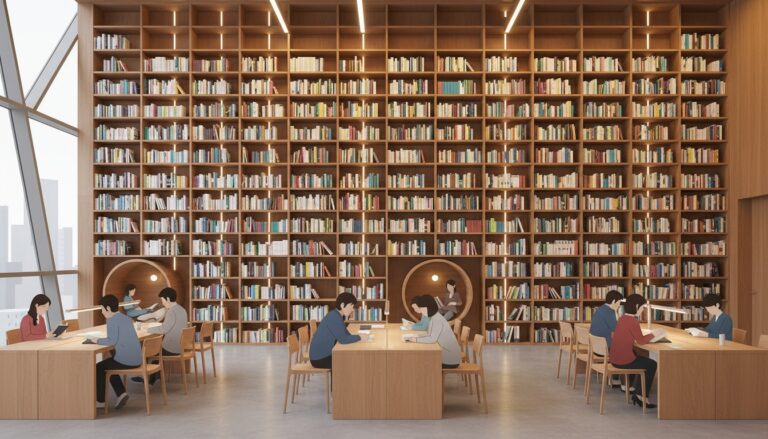
Picture this: You are in a scene straight out of a K-Drama. You’re at a stunning, silent library—maybe the massive Starfield Library in COEX or a cozy university reading room. You’ve found the perfect book (perhaps a Korean novel to practice your reading?). You walk up to the desk, the librarian looks at you, and suddenly… silence.
The dramatic music stops. You don’t know how to say “I want to borrow this.” You just smile awkwardly and slide the book forward.
We’ve all been there. But today, we’re fixing that. In Korea, libraries aren’t just for books; they are high-tech, efficient hubs of life. If you don’t know the rules, you might accidentally become the “rude foreigner.” Let’s make sure you get that book and know exactly when to bring it back, K-style.
Phase 2: Deep Dive into Core Expressions
Here are the three phrases that will make you sound like a local intellectual.
1. 이거 대출해 주세요. (Igeodaechul-hae juseyo.)
- Pronunciation: I-geo [dae-chul]-hae ju-se-yo.
(Think of ‘dae-chul’ like ‘dead’ without the final d + ‘chul’ rhymes with ‘pull’.) - Meaning: “Please check this out for me.”
- Literal: Do a loan for this, please.
- K-Culture Moment: You’ll see the word 대출 (daechul) on every self-checkout machine screen. It sounds formal, but it’s the standard word for “checking out” items in a system.
- Editor’s Insight: You could say “빌려 주세요” (lend me), but 대출 implies an official process. It sounds much more professional.
- Situation Spectrum:
[🚫 Boss] ———— [⚠️ Colleague] ———— [✅ Librarian/Clerk]
(This is specific to service interactions.) - 🤔 Think About It: The word ‘대출’ is also used for bank loans. Why do you think Koreans use the same heavy word for money and library books? (Hint: It’s about responsibility!)
2. 반납일이 언제예요? (Bannab-iri eonjeyeyo?)
- Pronunciation: Ban-nab-i-ri eon-je-ye-yo?
(The ‘b’ in ban flows into ‘nab’. It sounds smooth: bannab-iri.) - Meaning: “When is the due date?”
- K-Culture Moment: In Korean universities, missing a 반납일 (return date) often blocks you from graduating or borrowing other books. It’s taken very seriously!
- Editor’s Insight: Don’t ask “When do I give it back?” Ask for the specific date. Koreans love precision.
- Situation Spectrum:
[🚫 Close Friend] ———— [✅ Library/Rental Shop]
3. 기간 연장할 수 있어요? (Gigan yeonjang-hal su isseoyo?)
- Pronunciation: Gi-gan [yeon-jang]-hal su i-sseo-yo?
- Meaning: “Can I extend the period?”
- Editor’s Insight: Life happens. Maybe you were too busy streaming BTS videos to finish the book. This phrase is your lifesaver.
- 🤔 Think About It: In many Western libraries, renewals are automatic. In Korea, you often have to ask or click a button manually. It emphasizes active management of your time.
Phase 3: Textbook vs. Real Life
Let’s see how a robot talks vs. how a Seoulite talks.
| Situation | 📖 Textbook Korean | 🗣️ Real Korean | 💡 Why the difference? |
|---|---|---|---|
| Checking out | 책을 빌리고 싶습니다. (I want to borrow a book.) | 이거 대출이요. (Check out, please.) | Efficiency. We know it’s a book. We know you want it. |
| Asking due date | 언제까지 반납해야 합니까? (Until when must I return?) | 언제까지예요? (Until when?) | Context is king. Short is polite in busy lines. |
| No card | 회원 카드를 안 가져왔습니다. (I did not bring my member card.) | 카드 없는데 번호로 돼요? (I don’t have a card; does my number work?) | Practical problem-solving beats explaining the situation. |
Editor’s Note: B1 level means you can drop the robotic subjects (“I”, “You”). Just go straight to the verb or the object!
Phase 4: Cultural Deep Dive
4-1. The Art of Silence (Nunchi)
Non-verbal Tip: When you approach the librarian, do NOT talk loudly. Even saying “Hello” too enthusiastically can earn you glares. Use a “library voice” (whisper-talking). Also, hand your library card with two hands (or one hand supporting the elbow). It shows you respect their service.
4-2. The “Self-Checkout” Culture
If you visit a modern Korean library (like the ones in Mapo or Gangnam), you might not even talk to a human.
- K-Tech Moment: Look for the machine that says 자가 대출 반납기 (Self check-out/return machine). You scan your card, place the books on the pad (RFID technology reads them all at once!), and boom—you’re done.
- The Vibe: Koreans value ppalli-ppalli (hurry-hurry). Using the machine is often considered more polite because you aren’t “bothering” the staff or holding up the line.
Phase 5: Immersive Roleplay
Setting: A quiet district library in Seoul on a Tuesday afternoon. You found a travel guide for Jeju Island.
Characters:
– YOU: An expat eager to travel.
– Librarian (사서): A focused woman in her 30s, wearing glasses, typing fast.
Dialogue:
Librarian: (Without looking up much) 오셨어요? 카드 주세요.
(O-syeo-sseo-yo? Kadeu juseyo.)
(Welcome. Card, please.)
YOU: 네, 여기요. 이거 대출해 주세요.
(Ne, yeogiyo. Igeo daechul-hae juseyo.)
(Yes, here. Please check this out for me.)
Librarian: (Beep. Beep.) 대출되셨고요. 반납은 2주 뒤입니다.
(Daechul-doesyeot-goyo. Bannab-eun i-ju dwi-imnida.)
(It’s checked out. Return is in 2 weeks.)
🔀 Decision Point! You think 2 weeks is too short. What do you ask?
A) “아, 시간이 없어요.” (Ah, I have no time.)
B) “기간 연장할 수 있어요?” (Can I extend the period?)
C) “더 빌려주세요!” (Lend me more!)
✅ Best Choice: B. It’s direct and uses the correct terminology.
⚠️ Analysis: Choice A is just complaining. Choice C sounds like you want more books, not more time.
(Selecting B…)
YOU: 혹시 기간 연장할 수 있어요?
(Hoksi gigan yeonjang-hal su isseoyo?)
(By any chance, can I extend the period?)
Librarian: 예약이 없으면 홈페이지에서 1주일 연장 가능해요.
(Yeyagi eopseumyeon homepage-eseo il-ju-il yeonjang ganeunghaeyo.)
(If there are no reservations, you can extend for 1 week on the website.)
Phase 6: 10-Second Shadowing Drill
Let’s practice the rhythm. Don’t be flat!
- Polite Request (Softly)
😊 이거 / 대출해 / 주세요.
(i-geo / dae-chul-hae / ju-se-yo) -
Checking the Date (Curious)
🤔 반납일이 / 언제 / 예요?
(ban-nab-i-ri / eon-je / ye-yo?) -
Asking for Extension (Hopeful)
🥺 기간 / 연장 / 돼요?
(gi-gan / yeon-jang / dwae-yo?)
Phase 7: K-Culture Mini Glossary
| Korean | Romanization | Meaning | Context |
|---|---|---|---|
| 열람실 | yeollamsil | Reading Room | The quiet study area (often separated from bookshelves). |
| 반납함 | bannap-ham | Return Box | The metal chute you drop books into when the library is closed. |
| 연체료 | yeoncheryo | Late Fee | The money you pay if you are late. (Though many libraries just suspend your borrowing rights instead!) |
| 신작 | sinjak | New Arrival | The section where the newest books are kept. |
Phase 8: Traveler’s Survival Kit
Even if you aren’t joining a library, you will likely visit a bookstore like Kyobo or YP Books.
🆘 Survival Expression #1
– 🇰🇷 “이 책 재고 있어요?” (I chaek jaego isseoyo?)
– 🗣️ English: “Do you have this book in stock?”
– 📍 Where: Kyobo Bookstore, Aladin Used Bookstore.
– 💡 Pro Tip: If you can’t find a book, look for the 도서 검색대 (Book Search Computer). You can print a receipt with the shelf location!📌 Editor’s Travel Note
– Kyobo Bookstore (Gwanghwamun): It’s not just a store; it’s a cultural landmark. You can sit and read there. The smell of books and coffee is quintessential Seoul.
– Aladin Used Books: Great for finding cheap Korean manhwa (comics) or souvenirs.
Phase 9: Think Deeper — “Wait, Why?”
Topic: The “Study Cafe” Phenomenon
In many countries, libraries are for borrowing books. In Korea, libraries (and specifically “Reading Rooms” or 열람실) are intensely focused on studying for exams. You’ll see students lining up at 6 AM to get a seat.
Why? Because of the intense competitive pressure in Korean society regarding education and employment. The library isn’t just a place to relax; it’s a battlefield for the future. This is why silence is so strictly enforced—someone’s future career might depend on that concentration.
💬 Your Turn: In your country, are libraries loud community hubs or silent study zones? Tell me in the comments!
Phase 10: Troubleshooting & FAQ
Q: Can I underline text in library books?
A: Absolutely NO. Korean citizens are very protective of public property. If you damage a book, you will likely have to pay for a brand new replacement, not just a fine.
Q: I lost my library card. Can I show a photo of it on my phone?
A: Usually, yes! Or better yet, most libraries have an app. Download the library’s specific app and use the QR code. Korea is mobile-first.
❌ Common Mistake: Talking on the phone in the stacks.
✅ Fix: If your phone rings, run (quietly) to the hallway or the stairwell before answering. Answering inside is a major faux pas.
Phase 11: Wrap-up & Mission
One-Liner: To borrow a book, say “대출해 주세요”, and to avoid trouble, always check the “반납일”.
Action Missions:
– 🥉 Bronze: Say “반납일이 언제예요?” out loud three times right now.
– 🥈 Silver: Go to a Korean book website (like Kyobo or Yes24) and find the button that says “재고 확인” (Check Stock).
– 🥇 Gold: Visit a local library or bookstore in Korea (or a Korean section in your local library) and ask a staff member a question using these words!
K-Culture Mission: Watch a scene from the drama “Romance is a Bonus Book” (it’s set in a publishing company/bookstore world). Notice how they treat books with such respect!
Phase 12: Interactive Quiz
- Situation: The machine says “대출 불가” (Loan Impossible). What does this likely mean?
a) The library is closed.
b) You have too many late fees or the book is for reference only.
c) The machine is broken. -
True or False: It is culturally acceptable to answer a phone call at the library desk while checking out a book.
(True / False) -
Fill in the blank:
“I need more time to read this.”
→ “기간
할 수 있어요?”
Answers:
1. (b) “불가” means impossible/not allowed.
2. False. Hang up before approaching the desk!
3. 연장 (yeonjang) – extension.
Frequently Asked Questions (FAQ)
Q: What does "이거 대출해 주세요. (Igeodaechul-hae juseyo.)" mean in Korean and how do you pronounce it?
A: In Korean, "이거 대출해 주세요. (Igeodaechul-hae juseyo.)" is pronounced [I-geo [dae-chul] and means: "Please check this out for me."
Q: What does "반납일이 언제예요? (Bannab-iri eonjeyeyo?)" mean in Korean and how do you pronounce it?
A: In Korean, "반납일이 언제예요? (Bannab-iri eonjeyeyo?)" is pronounced [Ban-nab-i-ri eon-je-ye-yo?] and means: "When is the due date?"
Q: What does "기간 연장할 수 있어요? (Gigan yeonjang-hal su isseoyo?)" mean in Korean and how do you pronounce it?
A: In Korean, "기간 연장할 수 있어요? (Gigan yeonjang-hal su isseoyo?)" is pronounced [Gi-gan [yeon-jang] and means: "Can I extend the period?"







