

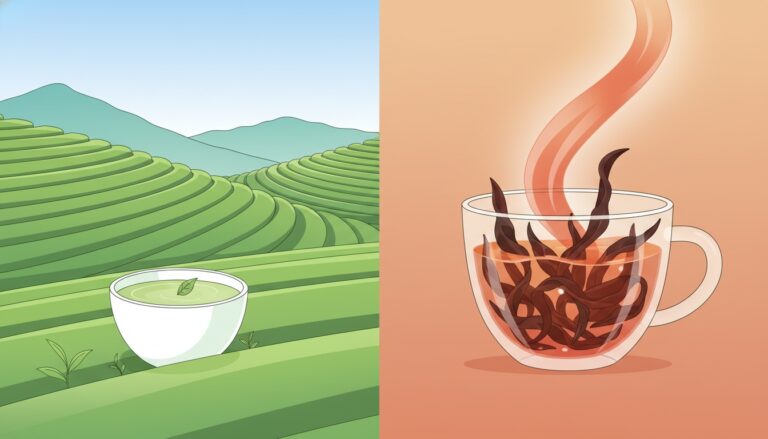
Phase 1: The “Red” Tea Mystery
Hello! It’s your Daily Hangul editor here.
Let me take you to a scene I witnessed just last week in a cozy Hanok cafe in Ikseon-dong. A student of mine, confident in her B1 Korean, walked up to the counter and asked for “Black Tea.”
The barista paused. “Black… Coffee?”
“No, tea. Tea,” she insisted.
Eventually, she pointed to the English menu. The barista’s face brightened. “Ah! Hongcha (홍차)!”
My student looked at me, confused. “Wait, doesn’t ‘Hong’ mean red? Why did he call it Red Tea when I wanted Black Tea?”
Welcome to the colorful world of Korean tea. In the West, we name the tea by the color of the dried leaf (Black). In Korea (and much of East Asia), we name it by the color of the brewed water (Red). If you don’t know this distinct cultural switch, you might end up ordering coffee when you crave Earl Grey.
Today, we aren’t just learning words; we’re learning how to see color through Korean eyes.
Phase 2: The Taste of Korea (Deep Dive)
Here are the three heavy-hitters you need to navigate a Korean tea menu beyond just “coffee.”
1. 홍차 (Hongcha)
- Pronunciation: [Hong-cha]
- Meaning: Black Tea (Literally: Red Tea)
- K-Culture Moment: Think of that scene in a generic ‘Chaebol’ drama where the rich mother-in-law is sitting in a European-style drawing room. She isn’t drinking instant mix coffee; she is sipping Hongcha from a bone china cup. It symbolizes a certain level of Westernized sophistication or traditional elegance, depending on the setting.
- Editor’s Insight: Don’t ask for “Black Tea” in Korean (Geomeun-cha). People might think you are talking about Heuk-cha (fermented dark tea like Pu-erh) or just look confused. Stick to ‘Red Tea’.
- Situation Spectrum:
[🚫 Formal] ———— [✅ Casual](It’s a noun, use it anywhere!) - 🤔 Think About It: Why does English focus on the dry leaf while Korean focuses on the liquid? What does that say about process vs. result?
2. 고소하다 (Goso-hada)
- Pronunciation: [Go-so-ha-da]
- Meaning: Nutty / Savory / Aromatic (grain-like)
- K-Culture Moment: If you watch “Three Meals a Day” (K-Variety), guests often drink water boiled with roasted corn or barley. They take a sip and sigh, “Ah, goso-hae.”
- Editor’s Insight: This is arguably the most important flavor adjective in Korea. It’s the smell of sesame oil, the taste of roasted nuts, or a good Genmaicha (brown rice green tea). If you tell a barista, “I like goso-han flavors,” they will know exactly what to recommend (usually a grain latte or soothing tea).
- Situation Spectrum:
[✅ Used everywhere]
3. 떫다 (Teolp-da)
- Pronunciation: [Teolp-da] (The ‘lp’ sound is tricky! Imagine stopping your tongue mid-L)
- Meaning: Astringent / Puckery / Bitter (in a dry way)
- K-Culture Moment: Watching someone bite into an unripe persimmon in a village drama. That face they make? That’s teolp-da.
- Editor’s Insight: This isn’t just “bitter” (sseuda). It’s that dry sensation on your tongue after drinking strong green tea or dry red wine. Using this word correctly instantly upgrades your Korean level from B1 to B2 because it shows you understand texture, not just taste.
Phase 3: Textbook vs. Real Life
| Situation | 📖 Textbook Korean | 🗣️ Real Korean (Cafe/Daily) | 💡 Why the difference? |
|---|---|---|---|
| Choosing tea | 저는 녹차를 좋아해요. (I like green tea.) | 전 녹차 파예요. (I’m on ‘Team Green Tea’.) | “~Pa” (faction/team) is slang used to define preferences (like Mint-Choco Pa). |
| Describing taste | 맛이 아주 좋아요. (The taste is very good.) | 깔끔하네요. (It’s clean/neat.) | Koreans value a “clean finish” (aftertaste) more than just generic “good” taste. |
| Ordering | 홍차 주세요. (Give me black tea.) | 홍차, 따뜻한 걸로요. (Black tea, the warm version.) | Efficiency. You anticipate the “Hot or Iced?” question. |
Editor’s Note: If you are at a traditional tea house, avoid slang like “~Pa.” Stick to polite descriptors like “Hyang-i jonneyo” (The fragrance is good).
Phase 4: Cultural Deep Dive — The “Nunchi” of Tea
4-1. The Pouring Etiquette (Non-verbal)
When drinking tea with older Koreans, you might notice they turn their head slightly away when taking a sip. While this is strictly required for alcohol (soju), it often bleeds into tea culture if the setting is very formal. Also, never fill your own cup if you are with a superior. Wait for them to notice your empty cup, or fill theirs first to hint at it. That’s Nunchi in action.
4-2. K-Drama Connection: The “Stress” Drink
Have you noticed in K-Dramas, when a character gets shocked or angry, they grab the back of their neck? The next scene often involves someone bringing them cold water or honey water, not hot tea. Why? In Korean conceptualization of health, anger is “fire” (Hwa-byung). Hot tea adds heat. Cold water cools the fire. But if the scene is a calm, scheming negotiation? It’s always hot Nokcha or Hongcha.
Phase 5: Roleplay — At a Hanok Tea House
Setting: It’s a rainy Tuesday afternoon in Bukchon Hanok Village. The floor is heated (Ondol), and the air smells of dried mugwort. You are with Ji-min, a Korean friend who loves traditional culture.
Characters:
* YOU: A tea enthusiast who wants to try something authentic.
* Ji-min (NPC): 28, works in design, knows all the good spots.
Dialog:
Ji-min: 여기 분위기 진짜 좋다, 그치? 빗소리 들으면서 차 마시면 딱이야.
(Yeogi bunwigi jinjja jota, geuchi? Bitsori deureumyeonseo cha masimyeon ttakiya.)
(The vibe here is really great, right? It’s perfect for drinking tea while listening to the rain.)
YOU: (Looking at the menu) 그러게. 나는 따뜻한 거 마시고 싶은데…
(Geureoge. Naneun ttatteutan geo masigo sipeunde…)
(I agree. I want to drink something warm…)
Ji-min: 음, 녹차는 어때? 여기 세작(Sejak)이 진짜 고소하고 맛있어.
(Eum, Nokcha-neun eottae? Yeogi Sejak-i jinjja goso-hago masisseo.)
(Hmm, how about Green Tea? The Sejak here is really nutty and delicious.)
🔀 Decision Point! How do you respond?
- A) “좋아! 나는 떫은 맛은 별로 안 좋아해.” (Okay! I don’t really like astringent tastes.)
- B) “나는 홍차 마실래.” (I’ll drink Black Tea.)
- C) “커피 있어?” (Do they have coffee?)
✅ Best Choice: A. This shows high-level vocabulary (Teolp-da) and clearly communicates your preference using the terms we learned.
Ji-min: 걱정 마. 세작은 어린 잎이라서 하나도 안 떫어. 깔끔해!
(Geokjeong ma. Sejak-eun eorin ip-iraseo hanado an teolp-eo. Kkalkkeum-hae!)
(Don’t worry. Sejak uses young leaves so it’s not astringent at all. It’s clean!)
YOU: 그래? 그럼 그걸로 할게.
(Geurae? Geureom geugeollo halge.)
(Really? Then I’ll go with that.)
Phase 6: 10-Second Shadowing Drill
Practice saying this naturally. Don’t sound like a robot!
Context: Describing a tea that fits your taste perfectly.
“이 차는 / 떫지도 않고 / 정말 고소해요!”
(I cha-neun / teolp-ji-do an-ko / jeongmal goso-haeyo!)
- Emotion: 😊 pleasantly surprised / satisfied
- Meaning: This tea isn’t astringent at all, and it’s really nutty!
Phase 7: K-Culture Mini Glossary
| Korean | Romanization | English | Context |
|---|---|---|---|
| 다도 | Dado | Tea Ceremony | The traditional way of preparing and drinking tea. Less common now, but practiced as a meditative hobby. |
| 입맛 | Ip-mat | Taste/Appetite | Literally “Mouth taste.” Used to say something suits your preference: “Ip-mat-e maja•yo” (It fits my taste). |
| 리필 | Ripil | Refill | In tea houses, you can often ask for hot water refills for your pot. |
| 세작 | Sejak | Sejak | A high grade of green tea made from young leaves harvested in late April (less bitter). |
Phase 8: Traveler’s Survival Kit
Tea houses in places like Insadong or Boseong can be intimidating. Here is your cheat sheet.
🆘 Survival Phrases
* 🇰🇷 “이거 카페인 있어요?” (Igeo kapein isseoyo?)
* Meaning: Does this have caffeine?
* Why: Many traditional Korean teas (Omija, Citron, Jujube) are caffeine-free.
* 🇰🇷 “따뜻한 물 좀 더 주시겠어요?” (Ttatteutan mul jom deo jusigesseoyo?)
* Meaning: Could you give me some more hot water?
* Use: When your tea pot is empty but you still have tea leaves.
* 🇰🇷 “너무 떫어요.” (Neomu teolp-eoyo.)
* Meaning: It’s too astringent.
* Use: If the tea steeped too long. A good host will know to give you more water.📌 Editor’s Travel Note
* O’Sulloc: You will see this brand everywhere. It’s the ‘Starbucks of Tea’ from Jeju Island. Great place to try different types of Nokcha and Hongcha lattes without the pressure of a traditional tea house.
Phase 9: Think Deeper — “One Leaf, Two Colors”
Why do Koreans see “Red” (Hongcha) where English speakers see “Black”?
It comes down to a fundamental difference in observation. Western traders in the 17th century encountered the withered, oxidized tea leaves, which looked black. They named it based on the raw material. East Asian cultures, however, focused on the result of the transformation—the reddish-amber color of the water when brewed.
This isn’t just about tea; it reflects a broader linguistic habit. Korean often emphasizes the state or the result of an action, whereas English often categorizes by the object itself. Next time you order Hongcha, remember: you are ordering the beautiful amber result, not just the dry dark leaf.
Phase 10: FAQ & Troubleshooting
- Q: Can I ask for milk in my tea at a traditional tea house?
- A: 🚫 generally No. Traditional Korean tea (Nokcha, etc.) is drunk straight. If you want milk, go to a modern cafe and order a “Green Tea Latte” or “Black Tea Latte (Milk Tea).” Asking for milk in a Hanok tea house is like asking for ketchup at a sushi bar.
- Q: Is ‘Bori-cha’ (Barley Tea) considered ‘Nokcha’?
- A: No! Boricha is grain tea. It has zero caffeine and is often served instead of water in restaurants. Nokcha is actual green tea leaves with caffeine.
- ❌ Common Mistake: Saying “Black Tea 주세요” (Black Tea Juseyo).
- ✅ Fix: Say “Mr. Hong” to remember it. Hong-cha 주세요.
Phase 11: Wrap-up & Mission
One-Liner: In Korea, look for the “Red” (Hongcha) if you want the “Black,” and remember “teolp-da” describes that dry tea sensation.
🚀 Action Mission:
* 🥉 Bronze: Look at your tea or coffee today. Is the taste ‘goso’ (nutty) or ‘teolp’ (astringent)? Say the word out loud.
* 🥈 Silver: Go to a Korean supermarket or cafe. Find a box of tea that says “홍차” (Hongcha).
* 🥇 Gold: Order a tea in Korean. “따뜻한 녹차/홍차 한 잔 주세요.” (One cup of warm green/black tea, please.)
💬 Comment Below: Does your language call it Black Tea, Red Tea, or something else entirely? Let me know!
Phase 12: Interactive Quiz
- Situation: You drink a very strong green tea that makes your tongue feel dry and fuzzy. Which adjective fits?
- a) Goso-hada
- b) Teolp-da
- c) Siwon-hada
- True or False: You should always ask for milk/sugar when ordering tea at a traditional Hanok cafe.
-
Vocab Match: What does ‘Ip-mat’ mean?
- a) Leaf taste
- b) Mouth taste (Palate/Preference)
- c) Hot water
(Answers below)
🔑 Answers:
1. b) Teolp-da (Goso-hada is nutty/savory).
2. False (It’s not customary and might confuse the host).
3. b) Mouth taste (It means your appetite or taste preference).
Frequently Asked Questions (FAQ)
Q: What does "홍차 (Hongcha)" mean in Korean and how do you pronounce it?
A: In Korean, "홍차 (Hongcha)" is pronounced [Hong-cha] and means: Black Tea (Literally: Red Tea)
Q: What does "고소하다 (Goso-hada)" mean in Korean and how do you pronounce it?
A: In Korean, "고소하다 (Goso-hada)" is pronounced [Go-so-ha-da] and means: Nutty / Savory / Aromatic (grain-like)
Q: What does "떫다 (Teolp-da)" mean in Korean and how do you pronounce it?
A: In Korean, "떫다 (Teolp-da)" is pronounced [Teolp-da] and means: Astringent / Puckery / Bitter (in a dry way)







