

Phase 1: The “Glass Skin” Lie? (Immersive Hook)
Hello! Your Daily Hangul editor here. 👋
Let’s be honest. You’ve seen it in every K-Drama. The protagonist wakes up, rolls out of bed, and her skin is glowing like she just stepped out of a facial spa. There is no drool, no puffiness, and certainly no pimples.
In Korea, we call this 물광 (mul-gwang) or “water-glow” skin. But here is the reality check: even K-Pop idols don’t wake up like that. They work for it. Hard.
If you walk into an Olive Young (the holy grail drugstore of Korea) and just ask for “lotion,” you might end up with a product that makes your face feel like an oil slick. Why? Because Koreans describe skin conditions with surprisingly specific vocabulary.
Today, we are moving beyond “dry” and “oily.” We are going to learn how to complain about your skin like a true Seoulite, so you can get the exact solution you need.
Phase 2: Deep Dive into Core Expressions
1. 속건조 [sok-geon-jo]
- Pronunciation: [sok-geon-jo] (Think of ‘Soak’ + ‘Gun’ + ‘Joe’)
- Meaning: Inner dryness (Literal: Inside + Dryness)
- Real Nuance: This is the most crucial word in modern K-Beauty. It describes skin that looks oily on the surface but feels tight and dehydrated underneath. If you tell a shop assistant “My skin is dry,” they give you heavy cream. If you say “I have sok-geon-jo,” they give you a hydrating serum. Huge difference.
- K-Culture Moment: You’ll see this on almost every YouTuber’s thumbnail reviewing skincare: “속건조 해결!” (Inner dryness solved!).
- Editor’s Insight: Use this when your face feels like it’s pulling or tight after washing, even if your T-zone is shiny.
- Situation Spectrum:
[🚫 Formal Ban] ———— [✅ Universal] ———— [✅ Casual]
(You can use this with dermatologists, friends, or shop staff perfectly.)
🤔 Think About It: Why does Korean differentiate between surface dryness and inner dryness? It reflects a cultural obsession with the foundation of health rather than just the surface appearance.
2. 피부가 뒤집어지다 [pi-bu-ga dwi-ji-beo-ji-da]
- Pronunciation: [dwi-ji-beo-ji-da] (‘Dwee’ + ‘Ji’ like ‘Gee’ + ‘buh’ + ‘ji-da’)
- Meaning: My skin broke out bad (Literal: My skin flipped inside out/upside down)
- Real Nuance: “I have a pimple” is too weak. Dwijibeojida implies chaos. It means your skin condition suddenly worsened due to stress, bad food, or a product reaction. It’s dramatic and very Korean.
- K-Drama Scene: The main character has a date with her crush tomorrow, looks in the mirror, screams, and calls her best friend: “My skin flipped inside out! Otteokhae (What do I do)?!”
- Situation Spectrum:
[🚫 Formal Biz] ———— [⚠️ Semi-formal] ———— [✅ Casual]
(Great for friends/family. At a clinic, say “트러블이 생겼어요” – troubles appeared – to be polite.)
3. 관리하다 / 관리 받다 [gwan-li-ha-da]
- Pronunciation: [gwalli-hada]
- Meaning: To manage / To receive management (treatment)
- Real Nuance: In the West, skincare is often “maintenance.” In Korea, it is “management” (gwanli). If someone says, “You got prettier!” a humble/cheeky response is “I’m receiving management these days” (dermatology, facials, or strict diet).
- Editor’s Insight: It implies effort and investment. It’s not just luck; it’s a project.
Phase 3: Textbook vs. Real Life
| Situation | 📖 Textbook Korean | 🗣️ Real Korean (Street) | 💡 Why the difference? |
|---|---|---|---|
| Checking ingredients | 이 성분은 무엇입니까? (What is this ingredient?) | 이거 순해요? (Is this mild?) | Koreans prioritize “mild” (sun-hae-yo) products because of pollution and sensitive skin issues. |
| Skin feels tight | 피부가 건조해요. (My skin is dry.) | 얼굴이 당겨요. (My face is pulling.) | Describe the sensation, not just the condition. “Pulling” describes that dehydrated feeling perfectly. |
| Oily skin | 저는 지성 피부예요. (I have oily skin.) | 저 산유국이에요. (I am an oil producing country.) | A common joke. Comparing your face to an oil-rich nation (like Saudi Arabia) is classic self-deprecating humor. |
Note: “San-yu-guk” (Oil producing country) is slang. Don’t use it with a serious dermatologist unless you want to make them laugh.
Phase 4: Cultural Deep Dive
4-1. The Sound of Skincare: “Chap Chap” vs. Rubbing
If you watch a Korean apply toner, you will hear a sound: Chap chap chap!
We rarely “rub” products in; we pat them in. It’s believed to absorb better and keeps the skin elastic. If you rub your face aggressively in a Korean sauna or powder room, an ajumma (middle-aged lady) might actually scold you for creating wrinkles!
4-2. The “Olive Young” Phenomenon
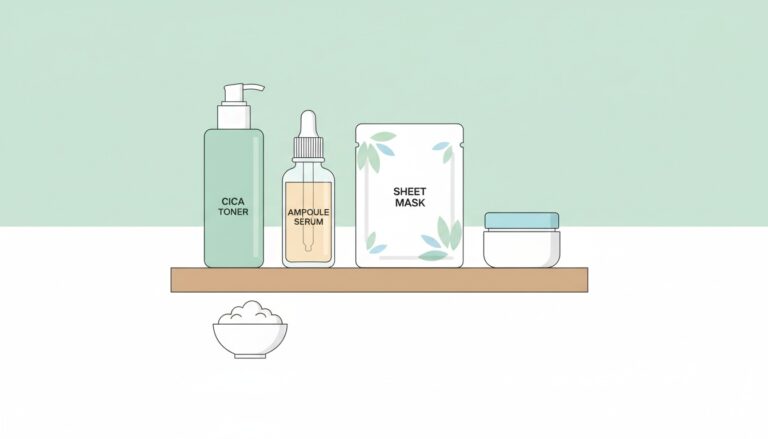
Olive Young isn’t just a store; it’s a checkpoint. In Korea, skincare is categorized by steps (toner, essence, ampoule, lotion, cream) and concerns (soothing/calming is huge right now due to masks and fine dust).
Critical Insight: Notice how many products say “Whitening” (미백 – Mibaek). Don’t panic. In 99% of cases, this means brightening (evening out skin tone/fading acne scars), not actually bleaching your skin color. It’s a translation nuance that scares many Westerners.
Phase 5: Immersive Roleplay
Setting: Olive Young in Gangnam. Friday evening. Crowded. You are looking for a moisturizer, but everything is in Korean. You catch a staff member (wearing a vest).
Characters:
– YOU: Foreign resident, suffering from sudden breakouts.
– Staff: Helpful but busy employee.
Dialogue:
Staff: 찾으시는 거 있으세요? (Is there something you are looking for?)
(Cha-jeu-si-neun geo i-sseu-se-yo?)
YOU: 네, 요즘 피부가 뒤집어져서 좀 순한 거 찾고 있어요.
(Ne, yo-jeum pi-bu-ga dwi-ji-beo-jyeo-seo jom sun-han geo chat-go i-sseo-yo.)
(Yes, my skin flipped out lately, so I’m looking for something mild.)
Staff: 아, 그러세요? 건조하세요? 아니면 기름기가 많으세요?
(Ah, really? Are you dry? Or do you have a lot of oil?)
🔀 Decision Point: How do you describe your tricky skin?
A) “Oil is exploding!” (기름 폭발해요!)
B) “It’s oily on the outside, but dry inside.” (겉은 번들거리는데 속건조가 심해요.)
C) “Just give me the best seller.” (제일 잘 나가는 거 주세요.)
✅ Best Choice: B
This is the precise diagnosis (Su-bu-ji type). The staff will immediately lead you to the “Hydrating Ampoule” section rather than heavy creams.
Staff: 아! 수부지(Oily but dehydrated)시구나. 그럼 이 ‘시카(Cica)’ 크림 추천드려요. 진정에 좋아요.
(Ah! You are ‘Su-bu-ji’. Then I recommend this Cica cream. It’s good for calming.)
Phase 6: 10-Second Shadowing Drill
Let’s practice complaining about skin naturally. Use a slightly whining tone for the first part, and a hopeful tone for the second.
Sentence:
😢 요즘 / 피부가 / 완전히 뒤집어졌어요. / 😊 순한 것 좀 / 추천해 주세요!
Pronunciation:
Yo-jeum / pi-bu-ga / wan-jeon-hi dwi-ji-beo-jyeo-sseo-yo. / Sun-han geot jom / chu-cheon-hae ju-se-yo!
Translation:
These days / my skin / completely flipped out. / Mild thing please / recommend for me!
Phase 7: K-Culture Mini Glossary
| Korean | Rom | Meaning | Context |
|---|---|---|---|
| 수부지 | Su-bu-ji | Oily outside, dry inside | Short for Su-bun Bu-jok Ji-seong. The most common skin type complaint in Korea. |
| 진정 | Jin-jeong | Calming/Soothing | The magic word for acne-prone skin. Look for this on green bottles. |
| 1일 1팩 | 1-il 1-paek | 1 Day 1 Pack | The trend of using a sheet mask every single day. |
| 쌩얼 | Ssaeng-eol | Bare face | No makeup face. Often used with “confidence” (쌩얼 자신감). |
Phase 8: Traveler’s Survival Kit (Olive Young Edition)
You left your lotion at home. You are standing in the aisle. Here is what you need to say.
🆘 Survival Expression #1
– 🇰🇷 “테스터 있어요?” (Te-seu-teo i-sseo-yo?)
– 🗣️ Meaning: Do you have a tester?
– 💡 Pro Tip: Never buy without trying the texture on your hand first! Hygiene is key—don’t put it directly on your face.🆘 Survival Expression #2
– 🇰🇷 “트러블 전용이에요?” (Teu-reo-beul jeon-yong-i-e-yo?)
– 🗣️ Meaning: Is this specifically for [skin] trouble?
– 📍 Use when: You have acne and are scared a product will make it worse.
📌 Editor’s Shopping Note:
If you see 1+1 (One plus One), buy it. Even if you don’t need two. You can give one to a friend. In Korea, skipping a 1+1 deal on essential items is considered a minor financial crime by locals.
Phase 9: Think Deeper — “The Face of Society”
Observation: Lookism and Diligence
In many cultures, bad skin is just bad luck. In Korea, there is a subtle societal pressure where good skin is often equated with “self-management” (자기관리). Having “glowing” skin implies you are diligent, disciplined, and take care of yourself. This is why men’s skincare market in Korea is the largest in the world.
🧠 Think Deeper:
Does this pressure to “manage” one’s appearance empower people to take care of themselves, or does it create an exhausting standard where even your pores are judged as a personality trait?
Phase 10: FAQ & Troubleshooting
Q: Can I ask a stranger what skincare they use?
A: Generally, no. Unless you are very close friends. Asking a stranger implies you are staring at their skin closely, which can be burdensome. However, complimenting is okay: “피부가 정말 좋으시네요!” (Your skin is really good!).
Q: What is “Cica”? I see it everywhere.
A: It stands for Centella Asiatica. Koreans are obsessed with it for healing “flipped” (upset) skin. It’s the smell of Korean skincare.
❌ Common Mistake:
Saying “Please give me Whitening (White) cream” literally.
✅ Correction: Ask for “Tone-up” (톤업) or “Migwang” (Brightening). If you just say “White,” they might think you want heavy stage makeup style whitening.
Phase 11: Wrap-up & Mission
One-Liner Summary:
Don’t just say “dry” or “oily”; describe your “inner dryness” (sok-geon-jo) to get the real K-Beauty treatment.
Action Mission:
– 🥉 Bronze: Look in the mirror and determine if you are “Su-bu-ji” (Oily but dry inside). Say it out loud.
– 🥈 Silver: Go to a Korean cosmetic website (like Olive Young Global) and find a product that claims to solve “Sok-geon-jo.”
– 🥇 Gold: Walk into a Korean cosmetic store (or Sephora) and ask the staff, “Do you have anything for skin that feels tight inside?” (Practice the Korean phrase in your head!).
💬 Your Turn:
Does your language have a specific word for “skin that looks oily but feels dry”? Or is that just a Korean obsession? Let me know in the comments!
Frequently Asked Questions (FAQ)
Q: What does "속건조 [sok-geon-jo]" mean in Korean and how do you pronounce it?
A: In Korean, "속건조 [sok-geon-jo]" is pronounced [sok-geon-jo] and means: Inner dryness (Literal: Inside + Dryness)
Q: What does "피부가 뒤집어지다 [pi-bu-ga dwi-ji-beo-ji-da]" mean in Korean and how do you pronounce it?
A: In Korean, "피부가 뒤집어지다 [pi-bu-ga dwi-ji-beo-ji-da]" is pronounced [dwi-ji-beo-ji-da] and means: My skin broke out bad (Literal: My skin flipped inside out/upside down)
Q: What does "관리하다 / 관리 받다 [gwan-li-ha-da]" mean in Korean and how do you pronounce it?
A: In Korean, "관리하다 / 관리 받다 [gwan-li-ha-da]" is pronounced [gwalli-hada] and means: To manage / To receive management (treatment)







