

Phase 1: The “Phone Panic” Moment
Hello! I’m your Daily Hangul editor.
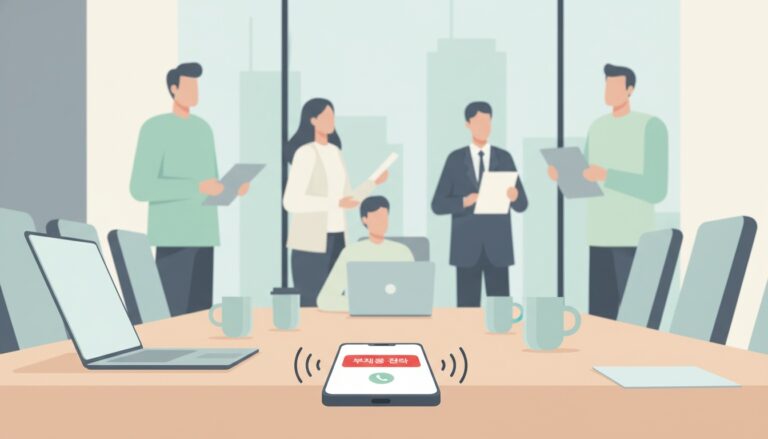
Picture this: You are in a quiet meeting room in Gangnam. Your boss is presenting the quarterly results. Suddenly, your phone starts vibrating against the table like an angry bee. Buzz. Buzz. Everyone looks at you.
It’s your friend. If you were in a K-Drama, you might grab the phone, bow apologetically to the room, and run into the hallway whispering. But in real life, you have about three seconds to make a choice. Do you hang up? Do you answer?
Many of my students panic and just hit the red “End Call” button without a word. In many cultures, that’s fine. In Korea? It can feel a bit cold unless you follow up immediately.
Today, we’re going to master the art of the “Whisper & Promise”—how to tell someone you can’t talk right now without making them feel rejected.
Phase 2: The “Whisper & Promise” Toolkit
Here are the three phrases you need to survive a call during a meeting.
1. 지금 회의 중이에요 (Jigeum hoe-ui jung-ieyo)
- Pronunciation: [Jee-geum hway-ee joong-ee-ay-yo]
- Meaning: I am in the middle of a meeting right now.
- Editor’s Insight: Notice the word 중 (jung). It literally means “middle,” but we use it to mean “in the process of.” You can use this structure for anything: Unjeon jung (driving), Siksa jung (eating).
- Situation Spectrum:
[🚫 Formal Boss]—[✅ Coworker/Friend]—[✅ Stranger]
(Note: This is polite standard Korean. Safe for almost anyone.)
2. 나중에 전화드릴게요 (Najung-e jeonhwa deurilgeyo)
- Pronunciation: [Na-joong-ay jun-hwa deu-ril-gay-yo]
- Meaning: I will give you a call later.
- K-Culture Moment: You will hear this constantly in Korea. It is the standard “closing” for almost any incomplete interaction.
- Grammar Note: We use 드릴게요 (give/offer) instead of 할게요 (do) to sound humble. You are offering the call as a service to them.
3. 급한 일 있으세요? (Geupan il isseuseyo?)
- Pronunciation: [Geup-han il is-seu-say-yo?]
- Meaning: Do you have an urgent matter?
- Use Case: Use this via text message immediately after rejecting the call. It shows you aren’t ignoring them; you are just prioritizing urgency.
🤔 Think About It: In English, we often just say, “Can I call you back?” In Korean, we almost always explain why we can’t talk first (meeting, driving, eating). Why do you think Korean culture emphasizes the “reason” before the “rejection”?
Phase 3: Textbook vs. Real Life
How does a real Korean whisper into their phone versus what the textbook says?
| Situation | 📖 Textbook Korean | 🗣️ Real Korean (The “Whisper”) | 💡 Why the difference? |
|---|---|---|---|
| Rejecting a friend | 지금은 통화할 수 없습니다. (I cannot talk right now.) |
어, 나 지금 회의 중! 이따 걸게. (Uh, meeting right now! Call you later.) |
“Uh” acknowledges the connection immediately. “Itta” is shorter than “najunge.” |
| Rejecting a client | 죄송하지만 지금 회의 중입니다. (Sorry, but I am in a meeting.) |
아, 고객님! 죄송해요, 제가 회의 끝나고 바로 연락드릴게요! (Ah, customer! Sorry, I’ll contact you right after this!) |
Adding “right after” (baro) reduces the client’s anxiety. |
Phase 4: Cultural Deep Dive — The Art of “Nunchi”
4-1. The “Silent” Answer
Here is a piece of non-verbal advice: In Korea, eye contact matters even when on the phone.
If your phone rings in a meeting:
1. Make eye contact with the person speaking (your boss/colleague).
2. Give a slight, apologetic nod.
3. Quietly silence the phone or reject it with a preset message.
This creates a “Nunchi shield.” You are signaling, “I know this noise is annoying, and I respect your time more than this call.”
4-2. The “Reject Message” Culture
If you have a Korean smartphone (Samsung/LG) or an iPhone set to Korean region, you will see preset messages like “회의 중입니다” (In a meeting) when a call comes in.
Sending this automated SMS is considered very polite in business settings. It is much better than just letting it ring out. It tells the caller: “I see you, but I can’t speak.”
Phase 5: Immersive Roleplay
Setting: It is Tuesday, 2 PM. You are in a serious strategy meeting. The room is dead silent. Suddenly, your phone vibrates loudly against the desk. It is Min-su, your talkative friend.
NPC (Boss Kim): (Stops talking and looks at your phone) …흠. (Hmm.)
YOU: (Quickly grab your phone)
🔀 Your Turn! How do you react?
– A) Answer loudly: “Hello? Oh, Minsu! I’m busy!”
– B) Reject the call, bow slightly to Boss Kim, and text Minsu: “지금 회의 중이라 나중에 전화할게.”
– C) Let it vibrate until it stops because you are too scared to move.
✅ Best Choice: B
This minimizes disruption. The bow apologizes to the room, and the text reassures the friend.
⚠️ Choice A Analysis: NEVER answer loudly in a meeting. It breaks the flow and is considered rude to the speaker.
⚠️ Choice C Analysis: The vibration sound is often more annoying than a ringtone. Silence it immediately!
Phase 6: 10-Second Shadowing Drill
Let’s practice the “Whisper Voice.” Imagine you are hiding under a desk.
Emotion: Apologetic but hurried (🥺 + 🏃)
죄송해요, / 지금 회의 중이라서요. / 이따가 / 다시 걸게요!
(Joe-song-hae-yo, / jigeum hoe-ui jung-i-ra-seo-yo. / it-ta-ga / da-si geol-ge-yo!)
Translation: Sorry, I’m in a meeting right now. I’ll call you back in a bit!
Phase 7: K-Culture Mini Dictionary
| Korean | Romanization | Meaning | Context |
|---|---|---|---|
| 부재중 전화 | Bujaejung jeonhwa | Missed call | Literally “Absence call.” You’ll see this notification often. |
| 진동 모드 | Jindong mode | Vibration mode | Essential for public transport and offices. |
| 카톡 남겨줘 | Katok namgyeo-jwo | Leave a KakaoTalk | Often used instead of voicemail. Koreans rarely leave voicemails. |
| 급한 불 | Geupan bul | Urgent fire | Metaphor for an urgent problem. “Is it an urgent fire?” |
Phase 8: Traveler’s Survival Kit
Even if you aren’t in a business meeting, you will need this in “Quiet Zones” like libraries, movie theaters, or crowded subways.
🆘 Survival Expression #1: Texting a Reject
If a delivery driver calls while you are in a museum:
– 🇰🇷 Message: “죄송합니다. 지금 통화가 어렵습니다. 문자로 부탁드려요.”
– 🗣️ Pronunciation: Jigeum tong-hwa-ga eo-ryeop-seum-nida. Munja-ro butak-deuryeoyo.
– meaning: Sorry. Talking is difficult right now. Please text me.
– 💡 Pro Tip: Copy-paste this into your notes app. It works for delivery drivers, taxi drivers, and Airbnb hosts.
Phase 9: Think Deeper — “Why We Always Explain”
Have you noticed that Koreans rarely give a flat “No”?
In Western cultures, “I can’t talk” is a neutral statement of fact. In Korea, rejecting a call creates a tiny social debt. By saying “I’m in a meeting” or “I’m driving,” you are providing evidence that the rejection isn’t personal. It is external circumstances forcing you to be unavailable.
This is part of Chemyon (Face) culture. You are saving the caller’s face by assuring them they aren’t being ignored willfully.
💬 Your Turn: In your country, if you reject a call without a text, is it considered rude? Or is it normal? Tell us in the comments!
Phase 10: FAQ & Troubleshooting
Q: Can I just ignore the call if it’s a number I don’t know?
A: Absolutely. Spam calls are common in Korea too. But if they call twice in a row, it might be a delivery driver or an emergency.
Q: Is it rude to text instead of calling back?
A: For friends? Totally fine. For a superior or an elder? It’s better to call back when you are free, or send a very polite text explaining when you will call.
❌ Common Mistake: Whispering ” 여보세요?” (Hello?) for 5 minutes during a movie.
✅ Fix: Just don’t answer! Send a text. Koreans hate noise in theaters.
Phase 11: Wrap-up & Missions
Summary: When you can’t talk, don’t just hang up—explain why (meeting/driving) and promise when (later).
Action Missions:
– 🥉 Bronze: Whisper the Shadowing Drill sentence 3 times while pretending to hold a phone.
– 🥈 Silver: Set your phone’s “Quick Decline Message” to the Korean phrase: “지금 회의 중입니다.”
– 🥇 Gold: Next time a friend calls you at an awkward time, answer with the Korean phrase (and then explain you are practicing!).
Phase 12: Quiz
Scenario: Your boss calls you while you are in the bathroom. What is the BEST move?
- Answer immediately and flush the toilet.
- Reject the call and text: “지금 화장실이라서 잠시 후에 전화드리겠습니다.”
- Ignore it and pretend you never saw it.
Answer:
! 2. Honesty is good, but you can also just say “잠시 자리를 비웠습니다” (I am away from my desk/seat) if “bathroom” feels too much! But definitely text back immediately. !<
Frequently Asked Questions (FAQ)
Q: What does "지금 회의 중이에요 (Jigeum hoe-ui jung-ieyo)" mean in Korean and how do you pronounce it?
A: In Korean, "지금 회의 중이에요 (Jigeum hoe-ui jung-ieyo)" is pronounced [Jee-geum hway-ee joong-ee-ay-yo] and means: I am in the middle of a meeting right now.
Q: What does "나중에 전화드릴게요 (Najung-e jeonhwa deurilgeyo)" mean in Korean and how do you pronounce it?
A: In Korean, "나중에 전화드릴게요 (Najung-e jeonhwa deurilgeyo)" is pronounced [Na-joong-ay jun-hwa deu-ril-gay-yo] and means: I will give you a call later.
Q: What does "급한 일 있으세요? (Geupan il isseuseyo?)" mean in Korean and how do you pronounce it?
A: In Korean, "급한 일 있으세요? (Geupan il isseuseyo?)" is pronounced [Geup-han il is-seu-say-yo?] and means: Do you have an urgent matter?







