

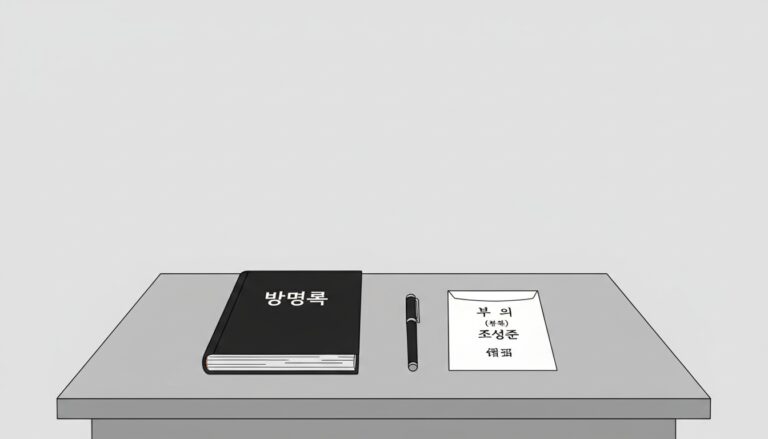
Phase 1: The ‘K-Drama’ Moment You Hope Never to Face
Hello! This is your Daily Hangul editor.
You’ve seen this scene a hundred times in K-Dramas like My Mister or Move to Heaven. The protagonist, wearing a black suit, walks into a hospital funeral hall. The air is heavy. They approach a small desk at the entrance, pick up a pen, and hesitate.
They aren’t just signing a book; they are officially announcing, “I am here to share your sadness.”
In real life, this moment is terrifying for foreigners. Do I write my name in English? In Korean? Do I write a message? What do I do with the white envelope?
Don’t worry. Today, we are going to navigate the very first step of Korean funeral etiquette: The Guestbook (Bangmyungrok). It’s simpler than you think, but the cultural weight is huge.
Phase 2: Core Expressions (Deep Dive)
1. 방명록 (Bangmyungrok)
- Pronunciation: [Bang-myeong-nok] (Sounds like: Bang as in ‘bangs’, myeong like ‘young’ with an m, nok)
- Meaning: Guestbook / Visitor log
- K-Culture Moment: In dramas, the camera often zooms in on this book to show that a long-lost friend or enemy has arrived.
- Editor’s Insight: You don’t write “I’m sorry for your loss” here. You just write your Name and Affiliation (Company or School). That’s it. Keep it clean.
- Situation Spectrum:
[🚫 Casual] ———— [⚠️ Semi-formal] ———— [✅ Formal]
(This word is strictly for formal events like funerals, weddings, or exhibitions.)
2. 조의금 (Jo-ui-geum)
- Pronunciation: [Jo-ui-geum]
- Meaning: Condolence money
- K-Culture Moment: You’ll see characters discreetly pulling a white envelope from their inside jacket pocket. It’s almost like a secret agent exchange, but it’s just respect.
- Editor’s Insight: You usually hand this over after signing the guestbook. Or, there is a box (함) where you drop the envelope.
- 🤔 Think About It: Why does Korea use money instead of flowers or cards? It’s practical. Funerals are expensive, and this is a way for the community to help pay the bills. It’s not cold; it’s supportive.
3. 소속 (Sosok)
- Pronunciation: [So-sok]
- Meaning: Affiliation / Organization
- Editor’s Insight: In the guestbook, there is often a column next to ‘Name’ that says
소속. If you are a coworker, write your company name. If you are a friend, you can just write친구(Friend).
Phase 3: Textbook vs. Real Life
| Situation | 📖 Textbook Korean | 🗣️ Real Korean (Survival) | 💡 Why different? |
|---|---|---|---|
| Writing your name | Write full name legibly. | Name (Company Name) | To help the family identify who you are later when they check the list. |
| Handing envelope | “Here is my condolence money.” | (Just bow silently and hand it over) | Actions speak louder than words. Silence is the highest form of respect here. |
| Greeting the receptionist | “Annyeonghaseyo?” | (Slight bow, no smile) | Saying “Hello” brightly is weird at a funeral. A solemn nod is perfect. |
Bottom Note: You don’t need fancy grammar here. You need silence and correct body language.
Phase 4: Cultural Deep Dive — The “Nunchi” of the Entrance
4-1. The Envelope Logic
In the West, you might bring a card. In Korea, you bring a white envelope.
– Pro Tip: Don’t seal the envelope with glue! Leave it open. It makes it easier for the family to count and record later.
– Writing on the Envelope: Usually, people write 부의 (Bu-ui) on the front (vertical Hanja characters), but blank white envelopes provided at the funeral hall are perfectly fine. Just write your Name on the back, vertical, bottom left corner.
4-2. Vertical vs. Horizontal
Many traditional guestbooks are written vertically (up to down, right to left). But modern funeral halls often use normal horizontal lines.
– K-Drama Connection: Watch Hospital Playlist. The doctors’ funerals show the modern, organized chaos of these events. The reception desk is where the “politics” happen—who came, who didn’t, and how much they paid.
Phase 5: Immersive Roleplay
Setting: A hospital funeral hall in Seoul. Grey floors, smell of incense and spicy beef soup (Yukgaejang). You approach the reception desk.
Characters:
– YOU: A foreign coworker of the deceased’s son.
– Receptionist (Cousin of deceased): Wearing a black armband, looking tired but polite.
(Dialogue)
Receptionist: (Bows silently and points to the book) 🖊️
YOU: (Bows back. Pick up the pen.)
Receptionist: 방명록 작성 부탁드립니다.
(Bangmyungrok jakseong butakdeurimnida.)
(English) Please sign the guestbook.
YOU: (Writes name) Smith John. (Writes affiliation) Daily Hangul Team.
Receptionist: (Looking at your envelope) 봉투는 함에 넣어주세요.
(Bongtuneun hame neoeojuseyo.)
(English) Please put the envelope in the box.
🔀 Decision Point! How do you put the envelope in?
- A) Toss it in casually like voting in an election.
- B) Use two hands to respectfully place it in the slot.
- C) Hand it directly to the receptionist’s face.
✅ Best Choice: B. Even if it’s just a box, using two hands shows you respect the offering.
⚠️ Choice A Analysis: Too casual. It looks like you don’t care.
Phase 6: 10-Second Shadowing Drill
Let’s practice the silence and the one phrase you might need if you don’t have a pen.
- 🥺 Polite & Soft:
볼펜 / 좀 / 빌릴 수 있을까요?
(Bol-pen / jom / bil-lil su i-sseul-kka-yo?)
Could I borrow a pen? -
😐 Solemn (Reading the sign):
방 / 명 / 록
(Bang / Myeong / Nok)
Guestbook
Phase 7: K-Culture Mini Glossary
| Korean | Romanization | Meaning | Context |
|---|---|---|---|
| 빈소 | Binso | Memorial Room | The room where the photo and altar are set up. |
| 상주 | Sangju | Chief Mourner | Usually the eldest son or spouse. They stand near the altar. |
| 육개장 | Yukgaejang | Spicy Beef Soup | The standard food served to guests at funerals. |
| 부조금 | Bujogeum | Mutual Aid Money | Another word for the money you give. |
Phase 8: Traveler’s Survival Kit (The Money Rules)
If you attend a funeral in Korea, you must know the money rules. This is where everyone gets stressed.
🆘 The “Odd Number” Rule
– 🇰🇷 Korean tradition likes odd numbers (3, 5, 7).
– 💸 30,000 KRW: Rare these days (too small).
– 💸 50,000 KRW (One yellow bill): The standard for acquaintances/coworkers.
– 💸 100,000 KRW: Close friends or direct team members. (10 is seen as 3+7, a full number, so it’s okay).
– 🚫 Even numbers like 40,000 or 60,000 are considered bad luck.📌 Editor’s Note:
Most funeral halls have an ATM and an envelope dispenser. You don’t need to buy an envelope at a convenience store beforehand.
Phase 9: Think Deeper — Why Money?
Community as Insurance (Pumasi)
In the past, Korean farming villages practiced Pumasi (labor exchange). Funerals were sudden and devastatingly expensive. The community would chip in to ensure the surviving family didn’t go bankrupt.
So, when you sign that guestbook and drop that envelope, you aren’t just “paying a ticket.” You are participating in a centuries-old social safety net. You are saying, “I will help carry your burden.”
💬 Your Turn: In your culture, do you bring money, flowers, or food to a funeral? Let me know in the comments!
Phase 10: FAQ & Troubleshooting
Q: Can I write my name in red ink?
A: NO! NEVER! 🚫 Writing a living person’s name in red ink is an old superstition associated with death. Use the black pen provided. If you bring your own, make sure it’s black or navy.
Q: Do I smile at the family?
A: No. A small, sad nod is better. Smiling can be seen as disrespectful or making light of the situation.
❌ Common Mistake: Shaking hands with the Chief Mourner (Sangju).
✅ Fix: Just bow. Physical contact like handshakes is usually avoided unless you are extremely close family.
Phase 11: Wrap-up & Action Mission
Summary: When arriving, bow silently, sign your Name + Affiliation in the Bangmyungrok, and put the money envelope in the box with two hands.
Action Mission:
– 🥉 Bronze: Practice writing your name and “friend” (친구) in Korean on a piece of paper.
– 🥈 Silver: Watch a funeral scene in a K-Drama (e.g., Reply 1988) and spot the guestbook.
– 🥇 Gold: If you are in Korea, locate a “Wedding/Funeral Envelope” pack at a convenience store just to see what they look like (don’t buy it unless you need it!).
Phase 12: Quiz — Do You Have ‘Nunchi’?
- Situation: You arrive at the desk. There is a black pen and a red pen. Which one do you use?
- A) Red (It stands out!)
- B) Black (Standard)
- True or False: You should seal the money envelope with glue so the money doesn’t fall out.
- (True / False)
- Money Check: You want to give condolence money. You have four 10,000 won bills. Is this okay?
- A) Yes, 40,000 won is fine.
- B) No, 4 is an unlucky number. Give 30,000 or 50,000.
(Answers: 1-B, 2-False, 3-B)
Frequently Asked Questions (FAQ)
Q: What does "방명록 (Bangmyungrok)" mean in Korean and how do you pronounce it?
A: In Korean, "방명록 (Bangmyungrok)" is pronounced [Bang-myeong-nok] and means: Guestbook / Visitor log
Q: What does "조의금 (Jo-ui-geum)" mean in Korean and how do you pronounce it?
A: In Korean, "조의금 (Jo-ui-geum)" is pronounced [Jo-ui-geum] and means: Condolence money
Q: What does "소속 (Sosok)" mean in Korean and how do you pronounce it?
A: In Korean, "소속 (Sosok)" is pronounced [So-sok] and means: Affiliation / Organization







