

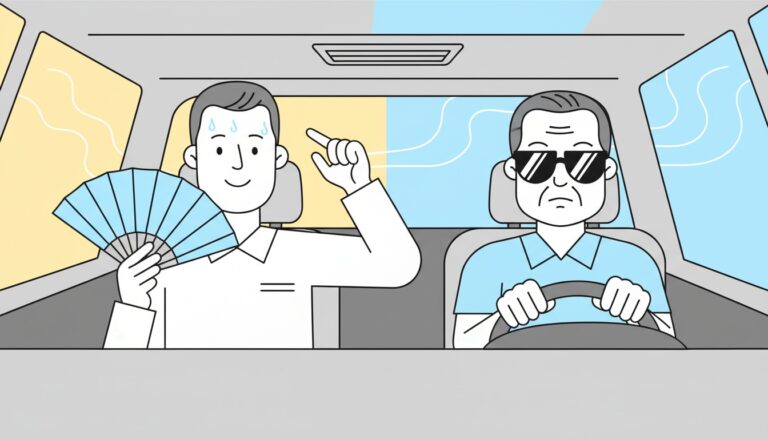
Phase 1: The ‘Sweat’ Reality Check
안녕하세요! This is your Daily Hangul editor.
Let me be honest with you. If you are planning to visit Korea between June and August, you are not just visiting a country; you are entering a sauna. The humidity hits you the moment you step out of Incheon Airport. It feels less like air and more like warm soup.
You walk into a convenience store, and bam—heaven. That blast of cold air is the best feeling in the world.
But what happens when you’re in a taxi and the driver is saving energy? Or you’re in an Airbnb and the remote is entirely in Korean? You need to know how to control the temperature to survive. Today, we aren’t just learning words; we are learning survival skills. Let’s master the Aircon (에어컨).
Phase 2: The Magic Words (Deep Dive)
In Korea, we don’t say “Air Conditioner.” It’s too long. We say “Aircon” (에어컨). It’s the first word you need to own.
1. 에어컨 좀 켜 주세요 (Please turn on the AC)
- Pronunciation: [E-eo-keon jom kyeo ju-se-yo]
- Sound Analogy:
- E-eo-keon: Sounds like “Air-con.”
- Jom: Rhymes with “Home.”
- Kyeo: Sounds like “K-yo” (like Tokyo without To).
- Meaning:
- Literal: Aircon a little turn on please.
- Real Nuance: “I’m dying of heat, please save me.”
- Editor’s Insight: You see that little word “Jom” (좀)? Literally, it means “a little.” But in Korea, it’s a magic softener. If you say “에어컨 켜 주세요!” it sounds like an order. Add “Jom,” and suddenly you sound polite and desperate. It’s the difference between “Do it” and “Could you please?”
- Situation Spectrum:
[🚫 Formal Boss] ———— [✅ Taxi Driver / Waiter] ———— [✅ Friend]
(Note: For friends, just drop the ‘ju-se-yo’ and say ‘Aircon jom kyeo-bwa’ or just point at it!)- 🤔 Think About It: Why do Koreans add “a little” (Jom) even when they want something a lot? It’s about indirectness. demanding things directly is often seen as aggressive.
2. 너무 추워요 (It’s too cold)
- Pronunciation: [Neo-mu chu-wo-yo]
- Sound Analogy:
- Neo-mu: “No-moo” (Like no cows).
- Chu-wo: Sounds like “Chew-war.”
- Meaning: It is too cold.
- K-Culture Moment: You know those K-Drama scenes where the guy silently takes off his jacket and puts it on the girl’s shoulders? Usually, she just whispered, “Ah, chu-wo” (It’s cold). It is the ultimate signal for care.
- Editor’s Insight: Korean cafes and subways have two settings: Sauna or Arctic. There is no middle ground. You will use this phrase as often as the “turn on” phrase.
Phase 3: Textbook vs. Real Life
Textbooks make you sound like a robot. Let’s fix that.
| Situation | 📖 Textbook Korean | 🗣️ Real Street Korean | 💡 Why? |
|---|---|---|---|
| Requesting AC | 에어컨을 켜 주십시오. (Please activate the machine.) | 에어컨 좀… 틀어주실래요? (Could you run the AC a bit?) | “틀다” (run/play) is used more often than “켜다” for appliances that run continuously. |
| Finding Remote | 리모컨이 어디에 있습니까? (Where is the remote located?) | 리모컨 어딨어요? (Remote, where?) | We love shortening words. Remote Control → Rimokan. |
| Too Cold | 온도를 높여 주세요. (Please raise the temperature.) | 너무 추워요… (It’s too cold…) | Stating your feeling (I’m cold) is a soft, indirect way to ask them to fix it. |
Bottom Note: If you are a beginner, stick to “Aircon jom kyeo ju-se-yo.” Everyone will understand, and the “Jom” makes you sound like a local.
Phase 4: Cultural Deep Dive — The “Nunchi” of Aircon
4-1. The Battle for the Remote
In a shared space (office, classroom, or cafe), the Aircon remote is a symbol of power. You never just pick it up and beep it. That is bad Nunchi (social awareness).
If you are cold in a cafe:
1. Look around. Is anyone else shivering?
2. Catch the staff’s eye.
3. Rub your arms dramatically (body language).
4. Then say, “Neo-mu chu-wo-yo.”
4-2. K-Food Connection: “Iyeol-chiyeol” (이열치열)
Here is a paradox. It’s 35°C (95°F) outside. You walk into a restaurant. What are people eating? Boiling hot Samgyetang (Ginseng Chicken Soup).
We call this Iyeol-chiyeol—fighting heat with heat. But here is the catch: We only do this if the Aircon is blasting at full power. Eating hot soup in a hot room isn’t culture; it’s torture. So, if you enter a restaurant and the AC is off, walk out. The locals would too.
Phase 5: Roleplay — The Taxi Fridge
Setting: Seoul, mid-August. You just hopped into a taxi to escape the heat. The driver, Mr. Kim (50s), loves freezing temperatures. It is practically snowing inside the car.
Characters:
* YOU: Wearing a t-shirt, shivering.
* Mr. Kim: Wearing cool-sleeves, chewing gum, listening to Trot music.
The Scene:
Mr. Kim: (Looking in the mirror) 어디로 모실까요?
(Eodi-ro mosil-kkayo? / Where to?)
YOU: 홍대입구역으로 가 주세요.
(Hongdae station, please.)
(5 minutes later… your teeth are chattering)
🔀 Decision Point: You are freezing. What do you say?
A) “아저씨! 에어컨 꺼!” (Mister! Turn off AC!)
B) “기사님, 에어컨 좀 꺼 주시겠어요?” (Driver, could you please turn off the AC?)
C) “아, 너무 춥다…” (Ah, it’s so cold…)
✅ Best Choice: B
* “Gi-sa-nim” (Driver) is the respectful title. Adding “Jom” softens it. This is the perfect standard.
⚠️ Choice C Analysis:
* Talking to yourself (“Ah, so cold…”) works, and a frantic driver with good Nunchi will turn it off. But if he’s focused on driving, he might ignore you. Direct but polite (Option B) is better here.
🚫 Choice A Warning:
* Never drop the “Yo” or “Juseyo” to an older stranger unless you want to get kicked out on the curb!
Phase 6: 10-Second Shadowing Drill
Let’s practice. Say this out loud. Don’t just read it!
Emotion: 😰 Desperate & Sweaty
기사님 / 에어컨 좀 / 켜 주세요!
(Gi-sa-nim / air-con jom / kyeo ju-se-yo!)
Emotion: 🥶 Shivering & Polite
저기요 / 너무 / 추워요.
(Jeo-gi-yo / neo-mu / chu-wo-yo.)
Phase 7: K-Culture Mini Glossary
| Korean | Romanization | Meaning | Context |
|---|---|---|---|
| 손풍기 | Son-pung-gi | Hand-fan | Those portable electric fans everyone holds in summer. Essential K-Item. |
| 냉방병 | Naeng-bang-byeong | Air-conditioningitis | Yes, Koreans believe you can get sick from too much AC. “Aircon disease.” |
| 은행 | Eun-haeng | Bank | Historically known as the best free summer shelter because their AC is the strongest. |
Phase 8: Traveler’s Survival Kit (The Remote)
You checked into your Airbnb. The remote is in Korean. Don’t panic. Match these symbols.
🆘 The Buttons You Must Know
* 운전 / 정지 (Un-jeon / Jeong-ji): Power On/Off. Sometimes just 전원 (Jeon-won).
* 냉방 (Naeng-bang): Cooling Mode. (Look for a snowflake icon ❄️).
* 제습 (Je-seup): Dehumidify. (Look for a water drop icon 💧). crucial for Korean rainy season (Jangma)!
* 온도 조절 (On-do): Temperature. Look for the ▲ ▼ arrows.📌 Editor’s Travel Note
If you can’t find the remote, look on the wall. In many motels or older hotels, the AC control is built into a panel on the wall near the bed, or sometimes… on the TV remote!
Phase 9: Think Deeper — The “Fan Death” Myth
Have you ever noticed that older Korean fans always have a timer dial? Or that your Korean friends insist on leaving a window cracked open when the AC or fan is on?
This stems from the urban legend of “Fan Death”—the belief that sleeping in a closed room with a fan running can kill you (hypothermia or suffocation). While science says “no,” the culture says “be careful.” It’s a fascinating example of how collective beliefs shape how we use technology.
💬 Your Turn: Does your country have any superstitions about electronics or sleeping habits? Tell me in the comments!
Phase 10: Troubleshooting & FAQ
Q: Can I ask to turn on the AC in a bus?
A: Generally, no. The bus driver controls the master switch based on company policy or the majority. If you are sitting under a vent that is blasting cold air, you can reach up and twist the vent close manually.
Q: How do I say “Turn it down” (make it less cold) without turning it off?
A: Say “약하게 해 주세요” (Ya-ka-ge hae ju-se-yo). “Make it weak, please.”
❌ Common Mistake:
* Don’t say “Open the Aircon.” In English, you start a machine. In Korean, we “turn on” (Kyeo-da). “Open” (Yeol-da) is for doors/windows.
Phase 11: Wrap-up & Action Mission
One-Liner: To survive a Korean summer, add “Jom” to your request, and check the button for “냉방” (Cooling).
🚀 Action Mission:
* 🥉 Bronze: Look at your AC remote right now. Can you find the Power button? Pretend it’s labeled in Korean.
* 🥈 Silver: Practice the pronunciation of “Gi-sa-nim, Aircon jom kyeo ju-se-yo” until you can say it without stuttering.
* 🥇 Gold: Next time you are in a cold room (even in your home country!), say “Ah, neo-mu chu-wo!” with a dramatic shiver.
K-Culture Mission: Watch a K-Drama summer scene. Spot the “Son-pung-gi” (hand fan). It’s usually hanging around the neck of a character waiting for a bus!
Phase 12: Quiz — Do You Have Nunchi?
Situation: You are at a friend’s house. Everyone is sweating, but the AC is off. The grandma is sitting in the corner fanning herself.
Q: What is the best move?
1. Grab the remote and turn it on. I’m a guest!
2. Loudly shout, “AIRCON JUSEYO!”
3. Quietly ask your friend, “Is it okay to turn on the AC?” or comment “Wa, oneul jinjja deopda” (Wow, it’s really hot today) to test the waters.
Answer: 3.
Reason: Electricity bills are a sensitive topic for older generations in Korea. Jumping straight to the remote is bad manners. Checking with your friend first shows respect and Nunchi.
Frequently Asked Questions (FAQ)
Q: What does "에어컨 좀 켜 주세요 (Please turn on the AC)" mean in Korean and how do you pronounce it?
A: In Korean, "에어컨 좀 켜 주세요 (Please turn on the AC)" is pronounced [E-eo-keon jom kyeo ju-se-yo] and means: a key conversational Korean expression covered in this lesson.
Q: What does "너무 추워요 (It's too cold)" mean in Korean and how do you pronounce it?
A: In Korean, "너무 추워요 (It's too cold)" is pronounced [Neo-mu chu-wo-yo] and means: a key conversational Korean expression covered in this lesson.







