

Phase 1: Immersive Hook — The “Belle Époque” Fantasy vs. Reality
Greeting: 안녕하세요! Welcome back to Daily Hangul. I’m your editor, connecting the dots between your textbook and the streets of Seoul.
The K-Culture Cold Open: You’ve likely seen the drama Hello, My Twenties! (Age of Youth). Five distinct personalities living in a stylish house called “Belle Époque,” sharing stories over beer, crying together, and navigating life. It paints a romantic picture of the Korean Share House (셰어하우스). But let’s cut to the chase—when you actually land in Seoul, finding that perfect balance of community and privacy is a sophisticated game of strategy, especially with the brutal reality of Seoul’s real estate market.
The ‘Why’: Why discuss this? Because according to recent urban planning statistics, over 33% of households in Korea are now 1인 가구 (single-person households). The cityscape is physically changing to accommodate this. If you want to understand modern Seoul—or survive living in it—you need to move beyond simple vocabulary like “house” (집) and understand the socio-economic terms that dictate where and how people live. Knowing these terms isn’t just about finding a room; it’s about understanding the pulse of the city.
Transparency: This guide synthesizes real conversations from international residents in Mapo-gu and Gangnam, navigating contracts, roommates, and the unspoken rules of communal living.
Phase 2: Deep Dive — The Language of Urban Survival
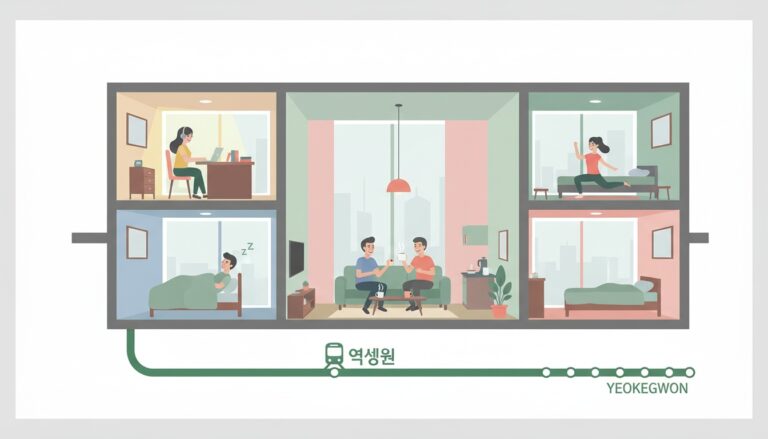
1. 역세권 (Yeoksegwon)
- Pronunciation: [Yeok-se-gwon]
Think of ‘Yeok’ like the ‘yuck’ sound but with an ‘o’, ‘Se’ like ‘set’, and ‘Gwon’ like ‘Taekwondo’.- Meaning: Literal: Station Influence Area / Real Nuance: A prime location within a 5-10 minute walk of a subway station. In Seoul, this is the gold standard of real estate.
- K-Culture Moment: In almost every drama, the protagonist’s financial status is subtly hinted at by how far they have to walk (or climb stairs) from the station to get home. If they live in a Yeoksegwon, they are doing well.
- Editor’s Insight: This isn’t just a noun; it’s a status symbol. You’ll hear variations like 스세권 (Seu-se-gwon)—near a Starbucks, or 맥세권 (Maek-se-gwon)—near a McDonald’s. It reflects the hyper-convenience lifestyle young Koreans crave.
- Situation Spectrum:
[🚫 Formal Documents Only] ———— [⚠️ Semi-Formal] ———— [✅ Essential Daily Life]
Use this freely. It’s an industry term that has become everyday slang.- 🤔 Think About It: Why does proximity to a subway define quality of life so intensely in Seoul compared to cities where car ownership is the norm?
2. 따로 또 같이 (Ttaro tto gachi)
- Pronunciation: [Tta-ro tto ga-chi]
- Meaning: Literal: Separately yet together / Real Nuance: The philosophy of shared living. Maintaining individual privacy while sharing community spaces.
- K-Culture Moment: You see this in variety shows like I Live Alone or Terrace House (though that’s Japanese, the vibe resonates). The cast gathers in the living room for a meal but retreats to their rooms for “me time.”
- Editor’s Insight: This phrase perfectly captures the modern Korean dilemma: the fear of loneliness (Godo) versus the exhaustion of social pressure. It’s the marketing slogan for almost every premium share house.
- Situation Spectrum:
[🚫 Professional] ———— [⚠️ Casual/Descriptive] ———— [✅ Philosophy/Marketing]- 🤔 Think About It: Korean society is traditionally collectivist. Does this phrase represent a breakdown of that collectivism, or an evolution of it?
3. 풀옵션 (Pul-op-syeon)
- Pronunciation: [Pul-op-syeon]
Sounds exactly like “Full Option”.- Meaning: Literal: Full Option / Real Nuance: Fully furnished (includes washing machine, fridge, AC, sometimes bed/desk). Essential for the nomadic young generation.
- K-Culture Moment: Watch any YouTube “Room Tour” (룸투어) video. If a room isn’t Pul-op-syeon, the comments will be filled with concerns about the cost of buying appliances.
- Editor’s Insight: In the West, “furnished” might be a perk. In the Korean 1-person household market (One-rooms, Share houses), this is the baseline expectation. If you have to buy your own fridge for a rental, you are in a very specific, likely older, housing bracket.
- Situation Spectrum:
[🚫 Formal Writing] ———— [⚠️ Real Estate Agents] ———— [✅ Hunting for Housing]- 🤔 Think About It: How does the demand for “Full Option” housing reflect the job market stability and mobility of Korea’s youth?
Phase 3: Textbook vs. Real Life
| Situation | 📖 Textbook Korean | 🗣️ Real Korean (Street/Slang) | 💡 Why the difference? |
|---|---|---|---|
| Describing roommates | 룸메이트 (Roommate) | 메이트 (Mate) / 하우스 메이트 (Hame) | “Roommate” implies sharing a room. In modern share houses, you share the house but have private rooms, hence “House Mate” or just “Mate.” |
| Splitting the bill | 비용을 나누다 (To divide costs) | N빵하다 (N-bbang hada) / 정산하다 | N-bbang is the colloquial king of splitting bills efficiently. Jeongsan is the administrative term used when the manager calculates utilities. |
| Complaining about noise | 조용히 해 주세요. (Please be quiet.) | 층간소음 대박이다… (The noise between floors is insane…) | Direct confrontation is hard. Koreans often complain about the situation (noise) rather than the person to avoid conflict. |
Bottom Note: At a C2 level, avoid N-bbang in formal complaints to your landlord. Use 공과금 정산 (Utility settlement) instead.
Phase 4: Cultural Deep Dive — The Context of “Space”
4-1. Non-verbal Communication: The “Invisible Wall”
In a share house, the door is your boundary. In Western share houses, an open door might be an invitation. In Korea, even if you are home, keeping your door closed is the universal signal for “charging social battery”. Knocking on a closed door for something trivial (like “wanna watch TV?”) can be seen as a violation of Ttaro tto gachi (Separately yet together). Read the room—or in this case, the door.
4-2. K-Culture Connection: The “Hell-Joseon” & Housing
The rise of share houses isn’t just about being social; it’s economic survival. You might hear the term 지옥고 (Ji-ok-go) in news or documentaries. It’s an acronym for Jiha (Basement), Oktapbang (Rooftop), and Goshiwon (Exam study room). These are the three lowest forms of housing. The modern “Premium Share House” is marketed as an escape from Ji-ok-go—offering the luxury of a living room and a nice kitchen that you couldn’t afford alone, in exchange for sharing space with strangers.
Phase 5: Immersive Roleplay — The “Recycling” Crisis
Setting: Tuesday night, 10 PM. The common kitchen of a share house in Mapo-gu. The recycling bin is overflowing with delivery food containers (not cleaned properly). You (the foreign tenant) walk in to find Min-ji (29, the unofficial ‘manager’ vibe, very organized) sighing deeply at the mess.
Min-ji: 아, 진짜… 배달 용기 씻어서 버리라고 몇 번을 말해요? 냄새 나잖아요.
(Ah, jinjja… baedal yonggi ssiseoseo beorirago myeot beoneul malhaeyo? Naemsae najanayo.)
(Ah, seriously… How many times have I said to wash the delivery containers before throwing them away? It smells.)
(🎭 Stage Direction: Min-ji aggressively crushes a plastic bottle.)
YOU: (Caught off guard, holding your own empty yogurt cup)
🔀 Decision Point: How do you respond?
- A) “미안해요. 제가 한 거 아니에요.” (Defensive: Sorry, I didn’t do it.)
- B) “그러게요. 누가 이렇게 했을까요? 같이 치울까요?” (Empathetic & Cooperative: I know, right? Who did this? Shall we clean it together?)
- C) “규칙을 다시 정하는 게 좋겠어요.” (Logical/C2 Level: We should redefine the rules.)
✅ Best Choice: B) Korean communal culture values emotional solidarity over finding the culprit immediately. Even if it wasn’t you, offering to help (Gongdongche mindset) builds massive social capital.
Min-ji: (Softening immediately) 아니에요, 메이트님보고 치우라는 건 아니고… 그냥 답답해서요. 혹시 이거 씻는 법 알아요?
(No, I’m not asking you to clean it… I’m just frustrated. Do you know how to wash this properly?)
YOU: 네, 라벨 제거하고 헹구면 되죠? 제가 도와드릴게요.
(Yes, remove the label and rinse, right? I’ll help you.)
Phase 6: 10-Second Shadowing Drill
Let’s practice a sentence you can use when looking for a house or clarifying rules.
😤 (Professional but firm)
관리비에 / 인터넷이랑 수도세가 / 포함된 건가요?
(Gwallibie / inteonesirang sudosega / pohamdoen geongayo?)
Is the internet and water bill / included / in the maintenance fee?
- Tip: Pitch up slightly at the end of “po-ham-doen” to sound polite but inquiring.
Phase 7: K-Culture Mini Glossary (Urban Housing Edition)
| Korean | Romanization | Meaning | Context |
|---|---|---|---|
| 보증금 | Bojeunggeum | Key Money / Deposit | The massive deposit (often $5k-$20k+) unique to Korea’s rental system. |
| 월세 | Wolse | Monthly Rent | The standard rent payment, distinct from the Jeonse (lump sum) system. |
| 반려 | Ballyeo | Companion | Usually ‘pet’ (Ballyeo-dongmul), but now used for plants (Ballyeo-sikmul) or furniture (Ballyeo-gagu) to combat loneliness. |
| 1코노미 | 1-conomy | Solo Economy | Economic trends targeting single households (e.g., solo dining, small appliances). |
| 홈카페 | Home Cafe | Home Cafe | The trend of setting up a cafe-like corner in one’s small apartment to enjoy aesthetic downtime. |
Phase 8: Traveler’s & Expat’s Survival Kit
If you are planning to stay in Korea for a month or more (long-term travel or workation), this is for you.
🆘 Survival Expression #1: The Real Estate Agent (Budongsan)
– 🇰🇷 “저 보증금 조절 가능한가요?” (Jeo bojeunggeum jojeol ganeunghan-gayo?)
– 🗣️ Meaning: “Is it possible to adjust the deposit?”
– 💡 Pro Tip: In Korea, raising the deposit usually lowers the monthly rent. It’s a standard negotiation tactic.📌 Editor’s Note: Trash is Serious Business
– Korea has one of the strictest recycling systems in the world.
– General Waste: Must go in official district bags (Jongnyangje).
– Food Waste: Separate bags or RFID bins. Never mix with general trash.
– Fines: You can actually get fined if you mess this up. In a share house, this is the #1 cause of fights.
Phase 9: Think Deeper — “Jeonse” and the vanish of a dream
🧠 Socio-Economic Insight:
Korea is famous for its unique Jeonse (전세) system, where you pay a huge lump sum (50-80% of house value) and live rent-free for two years, getting the money back upon moving out. However, due to low interest rates and economic shifts, Jeonse is becoming rarer, forcing more young people into Wolse (Monthly Rent) or Share Houses.
Think About It: How does the shift from Jeonse (saving money while living) to Wolse (losing money monthly) impact the ability of young Koreans to build wealth compared to their parents’ generation? How does this explain the obsession with stock markets or crypto among young Koreans?
💬 Your Turn: Does your country have a rental culture similar to Jeonse, or is monthly rent the only option? Let me know in the comments!
Phase 10: FAQ & Troubleshooting
Q: Can I bring a friend to sleep over in a share house?
A: ⚠️ CAUTION. Most share houses have strict “No Overnight Guests” rules or require prior approval from all housemates. Bringing a guest without asking is a major breach of Nunchi.
Q: Is it rude to cook smelly food (like Cheonggukjang) in a shared kitchen?
A: Yes. While it’s Korean food, strong smells in a shared space are generally avoided unless agreed upon. Stick to less pungent foods or ventilate aggressively.
❌ Common Mistake: Treating the “Public Area” like your storage.
✅ Fix: Never leave your laundry on the drying rack for days. In a share house, space is time. Move it to your room immediately.
Phase 11: Wrap-up & Action Mission
Summary: Today we navigated the vocabulary of Seoul’s Urban Planning & Housing, specifically the Share House lifestyle, focusing on terms like Yeoksegwon and Ttaro tto gachi.
Action Mission:
– 🥉 Bronze: Go to a Korean real estate app (like Zigbang or Dabang) and filter by “풀옵션” to see what it looks like.
– 🥈 Silver: In a comment below, describe your ideal house using the term “역세권” or “따로 또 같이.”
– 🥇 Gold: If you are in Korea, visit a Daiso and look for the section dedicated to “1-in gagu” (Single household) items. Buy something useful!
K-Culture Mission: Watch an episode of I Live Alone (나 혼자 산다). Notice how the celebrities describe their homes and how much emphasis they put on the “View” or “Station proximity.”
See you in the next lesson! 다음에 또 만나요!
Frequently Asked Questions (FAQ)
Q: What does "역세권 (Yeoksegwon)" mean in Korean and how do you pronounce it?
A: In Korean, "역세권 (Yeoksegwon)" is pronounced [Yeok-se-gwon] and means: Literal: Station Influence Area / Real Nuance: A prime location within a 5-10 minute walk of a subway station. In Seoul, this is the gold standard of real estate.
Q: What does "따로 또 같이 (Ttaro tto gachi)" mean in Korean and how do you pronounce it?
A: In Korean, "따로 또 같이 (Ttaro tto gachi)" is pronounced [Tta-ro tto ga-chi] and means: Literal: Separately yet together / Real Nuance: The philosophy of shared living. Maintaining individual privacy while sharing community spaces.
Q: What does "풀옵션 (Pul-op-syeon)" mean in Korean and how do you pronounce it?
A: In Korean, "풀옵션 (Pul-op-syeon)" is pronounced [Pul-op-syeon] and means: Literal: Full Option / Real Nuance: Fully furnished (includes washing machine, fridge, AC, sometimes bed/desk). Essential for the nomadic young generation.







