

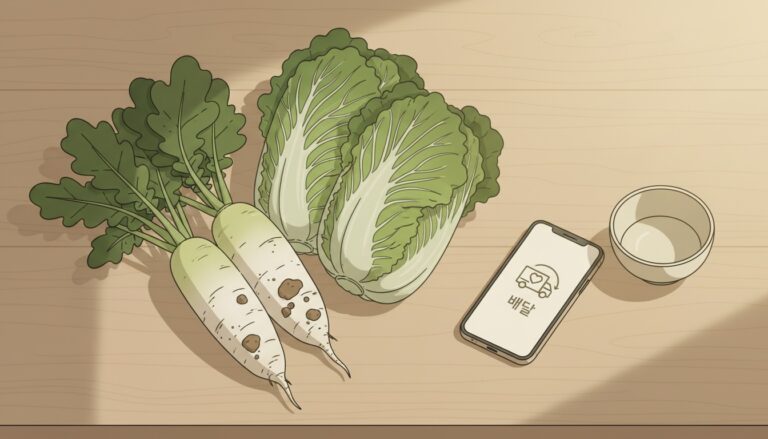
Phase 1: Immersive Hook
Hello! Daily Hangul Editor here.
Picture this: You are watching Three Meals a Day (삼시세끼) or perhaps the movie Little Forest. The actors pull a radish straight out of the ground, wipe the dirt off with their hands, and bite into it. They close their eyes and say, “Ah, dalda!” (It’s sweet!).
Wait, a raw radish is sweet?
In Korea, “freshness” isn’t just about hygiene; it’s a flavor profile. When you visit a high-end restaurant in Seoul or a local market in the countryside, understanding the story behind the ingredients changes the way you are treated. You go from “just a tourist” to a “gastronomic connoisseur.”
Today, we aren’t just learning how to order food. We are learning how to discuss the provenance of your meal. This is C1-level Korean: the language of taste, origin, and respect for nature.
Phase 2: Deep Dive (Key Expressions)
1. 산지 직송 (Sanji Jiksong)
- Pronunciation: [San-ji Jik-song] (San-ji sounds like ‘San’ Francisco + ‘Gee’; Jik-song implies a quick, direct line)
- Meaning: Direct delivery from the production area (Farm-to-table).
- K-Culture Moment: You’ll see this plastered on boxes when idols do “unboxing” videos of premium fruits sent by fans, or on menus in trendy restaurants in Seongsu-dong emphasizing fresh ingredients.
- Editor’s Insight: This is the magic word in Korean marketing. If a restaurant claims this, they are proud. It implies no middlemen and maximum freshness. It’s the difference between buying a bag from a reseller versus buying it straight from the atelier.
- Situation Spectrum:
[🚫 Formal Only] ———— [⚠️ Semi-Formal] ———— [✅ Casual & Formal]
(Used everywhere from market signs to business presentations)- 🤔 Think About It: Why is the specific “mountain” or “area” (Sanji) so important in Korea? Unlike vast flatlands in other countries, Korea’s mountainous terrain creates distinct microclimates. Do you think geography shapes language here?
2. 제철 재료 (Je-cheol Jaeryo)
- Pronunciation: [Je-cheol Jae-ryo]
- Meaning: Seasonal ingredients.
- K-Culture Moment: Think of Hospital Playlist. The characters are constantly obsessing over what food is “in season.” “It’s spring! We have to eat mudfish!” or “It’s winter, time for yellowtail (Bang-eo)!”
- Editor’s Insight: In Korea, eating out of season is almost considered a sin against your taste buds. Saying “This is je-cheol” is the highest compliment you can give to a meal’s timing. It means you are eating nature’s “Limited Edition.”
- Situation Spectrum:
[🚫 Slang] ———— [✅ Universal] ———— [⚠️ Academic]- 🤔 Think About It: In an era of global trade where we can get strawberries in December, why do Koreans still obsess over “Je-cheol”? Is it just taste, or a cultural desire to be in sync with time?
3. 본연의 맛 (Bon-yeon-ui Mat)
- Pronunciation: [Bon-yeo-ne Mat] (Link the ‘n’ sound: Bon-yeo-ne)
- Meaning: The natural/original taste of the ingredient itself.
- K-Culture Moment: Watching a judge on a cooking survival show like Culinary Class Wars. They frown when a dish is too spicy or salty. They praise a chef for bringing out the “Bon-yeon-ui Mat.”
- Editor’s Insight: This is sophisticated praise. It means the cook didn’t ruin the high-quality ingredient with excessive sauce. Use this when eating Hanwoo (Korean beef) or fresh Sashimi to sound like a true foodie.
- Situation Spectrum:
[🚫 Kids] ———— [⚠️ Casual] ———— [✅ Foodies & Formal]
Phase 3: Textbook vs. Real Life
Let’s see how a textbook student speaks versus how a Seoul local speaks at a farm-to-table bistro.
| Situation | 📖 Textbook Korean | 🗣️ Real Korean (C1) | 💡 Why different? |
|---|---|---|---|
| Praising freshness | 재료가 아주 신선해요. (The ingredients are very fresh.) |
재료가 살아있네요. (The ingredients are alive.) |
“Alive” (Sarat-ne) captures the texture and vitality, not just the condition. |
| Asking about origin | 이 채소는 어디에서 왔나요? (Where did this vegetable come from?) |
이거 혹시 어디 거예요? (By chance, whose/where is this from?) |
Native speakers focus on possession/origin (“Whose is this?”) rather than the verb “come.” |
| Describing taste | 소스 맛이 좋아요. (The sauce tastes good.) |
재료 본연의 맛이 잘 느껴져요. (I can feel the original taste well.) |
Focusing on the ingredient (material) rather than the seasoning shows higher gastronomic appreciation. |
Phase 4: Cultural Deep Dive — Sin-to-bul-yi (신토불이)
4-1. The Philosophy: Body and Soil are One
If you walk into a traditional restaurant, you might see a calligraphy frame reading 신토불이 (Sin-to-bul-yi). It literally means “Body and Earth are not two.” This isn’t just nationalism; it’s a health belief. Koreans believe that foods grown in the land you live on are the most compatible with your body.
4-2. Non-verbal Cue: The “Ssam” (Wrap) Inspection
When eating at a place serving fresh leafy greens (Ssam), don’t just stuff it in your mouth.
1. Pick up a leaf.
2. Inspect it for a split second (admiringly).
3. Shake off the water droplets gently.
This subtle pause shows respect for the freshness before you construct your wrap.
4-3. K-Drama Connection: The “Country Grandmother” Trope
In dramas, when the protagonist goes to the countryside to heal (e.g., Summer Strike), the grandmother always piles food on their spoon. This food is never bought; it’s always “dug up from the back garden this morning.” This represents Jeong (affection) delivered through the freshest possible medium. Refusing this is refusing love, not just calories.
Phase 5: Immersive Roleplay
Scenario: It is a Saturday evening in Hannam-dong, at a trendy wine bar that specializes in Korean seasonal tapas. You are there with a Korean friend, Ji-eun, who considers herself a foodie.
Characters:
* YOU: An expat who knows their way around Korean food culture.
* Server: Professional, wearing an apron, speaks softly.
(The server places a dish of seasonal Namul (herbs) and Hanwoo beef tartare on the table.)
Server: 주문하신 한우 타르타르 나왔습니다. 참기름은 지리산에서 짠 것입니다.
(Here is the Hanwoo tartare you ordered. The sesame oil was pressed in Jirisan Mountain.)
YOU: (Looking at the dish admiringly) 와, 지리산 참기름이라니… 향부터 다르네요.
(Wow, sesame oil from Jirisan… Even the aroma is different.)
Server: 네, 오늘 아침에 산지 직송으로 받은 고기라 아주 신선합니다.
(Yes, the meat arrived via direct delivery from the source this morning, so it is very fresh.)
🔀 Decision Point: How do you respond to show your appreciation?
A) “맛있겠네요. 감사합니다.” (Standard polite)
B) “역시! 재료가 좋으니까 빛깔이 살아있네요.” (Expert observation)
C) “비싸 보이네요.” (Too blunt)
✅ Best Choice: B — complimenting the “color” (Bit-kkal) and linking it to the quality of the ingredient shows you understand why it’s good.
YOU: 역시! 재료가 좋으니까 빛깔이 살아있네요. 잘 먹겠습니다.
(As expected! Since the ingredients are good, the color is alive. Thank you.)
Ji-eun: (Impressed) 야, 너 한국 사람 다 됐네? “빛깔”이라는 말은 어떻게 알았어?
(Hey, you’ve become totally Korean. How did you know the word “Bit-kkal”?)
Phase 6: 10-Second Shadowing Drill
Practice saying this sentence with the feeling of a food critic taking a first bite.
“Everything is so fresh, I can really taste nature itself.”
재료가 / 너무 신선해서 / 자연 그대~로의 맛이 / 느껴져요.
(Jae-ryo-ga / neo-mu sin-seon-hae-seo / ja-yeon geu-dae~ro-ui masi / neu-kkyeo-jyeo-yo.)
- Emotion: 😊 Amazed & Sophisticated
- Pro Tip: Elongate “Geu-dae~ro” slightly to emphasize the “purity” of the nature.
Phase 7: K-Culture Mini Glossary
| Korean | Romanization | Meaning | Context |
|---|---|---|---|
| 특산물 | Teuk-san-mul | Local Specialty | A product a region is famous for (e.g., Jeju tangerines). |
| 유기농 | Yu-gi-nong | Organic | Often seen on green labels in supermarkets. |
| 원산지 | Won-san-ji | Country of Origin | Legally required to be displayed on menus (e.g., Beef: Korea). |
| 텃밭 | Teot-bat | Vegetable Garden | A small garden patch near a house; symbol of self-sufficiency. |
| 당도 | Dang-do | Sugar Content / Brix | Used to boast about how sweet fruits are (High dang-do). |
Phase 8: Traveler’s Survival Kit (Market Edition)
Traveling to a local 5-day market (Oil-jang) in the countryside? Use these.
🆘 Survival Expression #1: Origin Check
– 🇰🇷 “이거 직접 키우신 거예요?” (Igeo jik-jeop ki-u-sin geo-yeyo?)
– 🗣️ Meaning: Did you grow this yourself?
– 📍 Use: At a traditional market stall run by an elder.
– 💡 Pro Tip: Even if the answer is “No,” asking this shows you respect their effort. If the answer is “Yes,” prepare for a story (and maybe a discount/service).🆘 Survival Expression #2: Seasonal Check
– 🇰🇷 “요즘 뭐가 제일 맛있어요?” (Yo-jeum mwo-ga je-il ma-si-sseo-yo?)
– 🗣️ Meaning: What is tastiest these days?
– 📍 Use: When you are overwhelmed by options.
– 💡 Pro Tip: This is code for “What is in season right now?”📌 Editor’s Travel Note:
If you visit rural areas, look for signs saying “로컬 푸드 직매장” (Local Food Direct Store). These are government-supported marts where local farmers sell produce dropped off that morning. It’s cheaper and fresher than Seoul department stores!
Phase 9: Think Deeper — “Guk-san” (Domestic) Premium
Food and Identity:
In many countries, imported food is sometimes seen as “fancy” (think French cheese or Italian wine). In Korea, “Guk-san” (Domestic) is almost always the premium option, often costing 2-3 times more than imports. Why? It ties back to Sin-to-bul-yi. There is a deep-seated belief that Korean soil produces flavors that fit the Korean palate perfectly.
🧠 Think Deeper:
Is there a food item in your country where the “Local” version is considered vastly superior to the imported one? Or is “Imported” seen as better? How does this reflect your country’s relationship with agriculture?
Phase 10: FAQ & Troubleshooting
Q: Can I ask for the “origin” (Won-san-ji) in a cheap restaurant?
A: Yes! It is actually a legal requirement for restaurants in Korea to display the origin of major ingredients (Meat, Rice, Kimchi) on the wall. If you can’t find the sign, asking “고기 원산지가 어디예요?” (Where is the meat from?) is a perfectly valid consumer question, though it might sound a bit strict in a tiny snack bar (Bunsik-jip).
❌ Common Mistake: Confusing “Domestic” (Guk-san) and “Local” (Ji-yeok).
* Guk-san: Made in Korea (anywhere).
* Ji-yeok/Local: Made in this specific town/city.
* If you are in Jeju Island, try to find “Jeju-san” (Jeju product), not just “Guk-san.”
Phase 11: Wrap-up & Action Mission
One-Liner: Knowing the source of your food isn’t just picky; in Korea, it’s a form of respect for the land and the cook.
🚀 Action Mission:
* 🥉 Bronze: Look at the “Origin” (Won-san-ji) label on a Kimchi package or Korean food item in your pantry.
* 🥈 Silver: Go to a Korean market or grocery and ask, “Igeo je-cheol-i-eyo?” (Is this in season?) about a fruit.
* 🥇 Gold: Post a photo of a meal and write a caption in Korean describing its “Bon-yeon-ui mat” (Natural taste).
K-Culture Mission: Watch an episode of Three Meals a Day (Youtube clips available) and try to spot how many times they mention the freshness of the ingredients they harvested!
Phase 12: Quiz — The “Foodie” Test
1. Which expression best compliments a chef on preserving the ingredient’s quality?
A) 소스가 너무 강해요. (The sauce is too strong.)
B) 재료 본연의 맛이 살아있네요. (The natural taste of the ingredients is alive.)
C) 이거 어디서 샀어요? (Where did you buy this?)
2. True or False?
“Sin-to-bul-yi” means that imported food is poisonous.
3. Situation: You see a sign saying “산지 직송” at a restaurant. What does it mean?
A) We deliver to the mountains.
B) Ingredients are delivered directly from the production area.
C) The owner is from the mountains.
Answers:
1. B (The ultimate C1 compliment.)
2. False (It means local food fits the body best, not that imports are poison—though some elders might act like it!)
3. B (Direct delivery ensures freshness.)
Frequently Asked Questions (FAQ)
Q: What does "산지 직송 (Sanji Jiksong)" mean in Korean and how do you pronounce it?
A: In Korean, "산지 직송 (Sanji Jiksong)" is pronounced [San-ji Jik-song] and means: Direct delivery from the production area (Farm-to-table).
Q: What does "제철 재료 (Je-cheol Jaeryo)" mean in Korean and how do you pronounce it?
A: In Korean, "제철 재료 (Je-cheol Jaeryo)" is pronounced [Je-cheol Jae-ryo] and means: Seasonal ingredients.
Q: What does "본연의 맛 (Bon-yeon-ui Mat)" mean in Korean and how do you pronounce it?
A: In Korean, "본연의 맛 (Bon-yeon-ui Mat)" is pronounced [Bon-yeo-ne Mat] and means: The natural/original taste of the ingredient itself.







