

Phase 1: The ‘Arctic’ Cafe Dilemma
Hello! Daily Hangul Editor here.
Picture this: It’s mid-July in Seoul. The humidity is 90%, and you feel like a walking dumpling. You rush into a cafe to escape the heat. Bliss, right? For about ten minutes. Then, the shivering starts. You look around—everyone else seems fine, or maybe they brought cardigans. You want to ask the staff to adjust the temperature, but you don’t want to sound like that complaining customer.
Or maybe you’re staying at an Airbnb, and your host texted you: “Please be careful with the electricity bill.” You nod, but you have no idea what constitutes “careful” in Korea.
Energy saving here isn’t just about hugging trees; it’s about avoiding the dreaded “Progressive Tax (Nujin-se)” tiers that can triple a bill overnight. Today, we’re learning how to navigate these conversations—whether you’re freezing in a cafe or trying to be a good guest.
Phase 2: Deep Dive into Key Expressions
1. [에어컨 좀 줄여주실 수 있나요?]
- Pronunciation: [eeo-keon jom ju-ryeo-ju-sil su innayo?]
- Sound analogy: “Ju-ryeo” sounds a bit like “Julia” said very quickly with a rolling ‘r’.
- Meaning: “Could you please turn down the air conditioner a bit?”
- K-Culture Moment: In office K-Dramas, there is always a silent war between the manager in a suit (hot) and the employee in a blouse (cold). This is the polite ceasefire flag.
- Editor’s Insight: The magic word here is 좀 (jom). Literally, it means “a little,” but in Korean requests, it’s a softener. Without “jom,” your request sounds like a military command. With “jom,” you sound considerate.
- Situation Spectrum:
[🚫 To Elders] ———— [⚠️ With Staff] ———— [✅ Friends]
(Actually, this specific polite phrasing is perfect for ✅ Staff and ⚠️ Elders. For friends, just say “에어컨 좀 줄이자.”) - 🤔 Think About It: In English, we say “turn down” the AC when we want it warmer (lowering the power). In Korean, 줄이다 (to reduce) refers to the intensity of the wind or power, not the temperature number. If you say “temperature down” (온도 낮춰주세요), it will get colder!
2. [전기세 폭탄 맞았어]
- Pronunciation: [jeon-gi-se pok-tan ma-ja-sseo]
- Meaning: “I got hit with an electricity bill bomb.”
- K-Culture Moment: You’ll hear this in every family drama when the dad walks into the living room and sees lights on in empty rooms. “Do you want us to get a bomb?!”
- Editor’s Insight: Koreans love the metaphor 폭탄 (bomb) for unexpected, huge expenses. Tax bomb, water bill bomb, electricity bomb. It captures the shock perfectly.
- Situation Spectrum:
[🚫 Formal Speech] ———— [⚠️ Colleagues] ———— [✅ Casual]
(Great for venting to friends or friendly neighbors.)
3. [코드 뽑는 거 잊지 마세요]
- Pronunciation: [ko-deu ppom-neun geo it-ji ma-se-yo]
- Meaning: “Don’t forget to unplug the cords.”
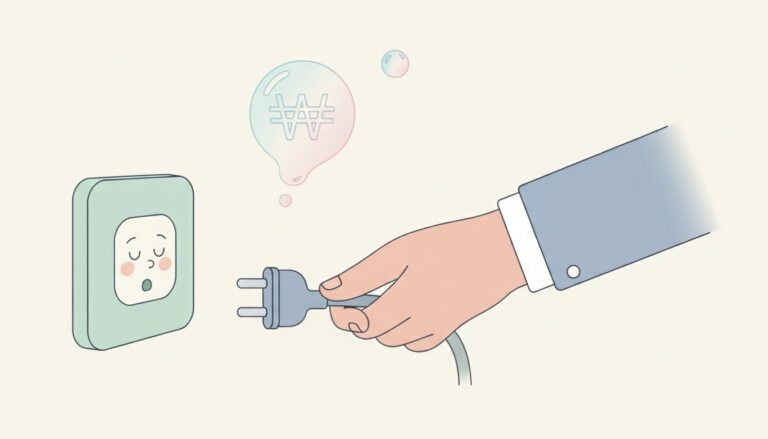
- Editor’s Insight: In many Western countries, leaving things plugged in is normal. In Korea, due to the cost of electricity, there is a distinct culture of “pulling the plug” (daegi jeollyeok – standby power). You will see stickers on outlets in schools and offices saying this.
Phase 3: Textbook vs. Real Life
| Situation | 📖 Textbook Korean | 🗣️ Real Korean | 💡 Why different? |
|---|---|---|---|
| Too cold in a cafe | 실내 온도를 높여 주십시오. (Please raise the indoor temperature.) | 여기 너무 추운데, 에어컨 좀 약하게 안 될까요? (It’s too cold here; can’t we make the AC weaker?) | The textbook version sounds like a robot reading a manual. The real version expresses your physical feeling (“It’s too cold”) first to gain empathy. |
| Leaving a room | 전등을 소등합시다. (Let’s extinguish the lights.) | 불 좀 꺼 (Turn off the light.) | “소등” is military/official language. “불” (fire/light) is what we actually use. |
Bottom Note: B2 learners, don’t use “소등” unless you are actually in the Korean army!
Phase 4: Cultural Context — The “Nunchi” of Temperature
In a Korean shared space (office or cafe), the remote control is a symbol of power. If you are the youngest (maknae), you generally do not touch the thermostat. You have to use “Nunchi” (reading the room).
If you see your senior colleague fanning themselves with a file folder, do not ask to turn down the AC, even if you are freezing. Instead, put on a jacket. If you must ask, frame it as a health concern: “I think I’m catching a cold (neng-bang-byeong), would it be okay to adjust it slightly?” This is the art of indirectness.
Phase 5: Immersive Roleplay
Setting: A coworking space in Gangnam. 2:00 PM. The AC is blasting directly at your desk.
Characters:
– YOU: Freelancer renting a desk.
– Manager Kim: The staff member managing the space (polite but busy).
Manager Kim: (Walking by) 불편한 거 없으세요? (Is everything okay?)
YOU: 아, 저기 매니저님…
(Ah, jeogi manager-nim…)
(Ah, excuse me, manager…)
Manager Kim: 네? 말씀하세요. (Yes? Go ahead.)
🔀 Decision Point: How do you ask to change the temp?
A) 에어컨 꺼주세요. (Turn off the AC.)
B) 에어컨 바람이 너무 세서 그런데, 조금만 조절해 주실 수 있나요? (The wind is a bit strong, so could you adjust it a little?)
C) 추워요. (I’m cold.)
✅ Best Choice: B. You provided a reason (“wind is strong”) and asked tentatively (“is it possible?”). This is the Korean standard of politeness.
⚠️ Choice A & C: Too direct. Manager Kim might think you are rude or angry.
(Dialogue Continues with Choice B)
Manager Kim: 아, 많이 추우셨어요? 바로 온도를 올릴게요. 26도로 괜찮으세요?
(Ah, were you very cold? I’ll raise the temperature right away. Is 26 degrees okay?)
YOU: 네, 감사합니다! 딱 좋을 것 같아요.
(Yes, thank you! I think that will be perfect.)
Phase 6: 10-Second Shadowing Drill
Try this sentence. It’s useful when you see a bill or check a price.
“Electricity bills in Korea / are really / no joke these days!”
🇰🇷 한국은 요즘 / 전기세가 / 장난 아니에요!
(Hangug-eun yojeum / jeongise-ga / jangnan anieyo!)
- Emotion: 😤 Shocked and emphatic
- Tip: Stretch the “Jang~~~nan” slightly to emphasize how big of a deal it is.
Phase 7: K-Culture Glossary (Energy Edition)
| Korean | Romanization | Meaning | Context |
|---|---|---|---|
| 누진세 | Nujin-se | Progressive Tax | The reason Koreans are scared of AC. The more you use, the higher the rate jumps. |
| 냉방병 | Neng-bang-byeong | Air-conditioningitis | A “disease” Koreans believe you get from too much AC (summer cold/body aches). |
| 멀티탭 | Multi-tap | Power strip | Everyone uses this word. “Do you have a multi-tap?” |
Phase 8: Traveler’s Survival Kit
Leaving the AC on in your hotel/Airbnb all day? Bad idea.
🆘 Survival Expression #1
– 🇰🇷 “나갈 때 에어컨 꺼야 돼요?” (Nagal ttae eeo-keon kkeoya dwaeyo?)
– 🗣️ Meaning: Do I need to turn off the AC when I go out?
– 📍 Use: Airbnb hosts, Guesthouses.📌 Editor’s Travel Note
Most Korean hotels require your key card to be in the slot by the door for electricity to work. If you take the card, the AC dies. Don’t try to trick it with a credit card; modern systems use chips! Also, Airbnb hosts will love you if you mention you turned everything off before checking out.
Phase 9: Think Deeper — “Frugality as Virtue”
Think About It: In modern Korea, despite its high-tech image, there is a deep-rooted cultural memory of poverty from the post-war era. This manifests in the older generation’s obsession with saving electricity. You might see a grandmother turning off lights in a room while you are still in it because the sun is out. It’s not rude; it’s a habit formed by survival. How does this compare to energy habits in your country? Is it about cost, or environment, or neither?
Phase 10: FAQ & Troubleshooting
Q: Can I open the window while the AC is on?
A: NO. In Korea, this is a cardinal sin. It’s seen as incredibly wasteful (“Gaemun-nengbang”). Shop owners can actually get fined for this by the government during energy crisis periods.
Q: My Korean friend scolded me for leaving the fan on with the door closed. Why?
A: Ah, the urban legend of “Fan Death.” Many older Koreans believe sleeping with a fan on in a closed room can kill you (hypothermia or suffocation). It’s scientifically debunked, but the habit of leaving the door cracked open (“for safety”) remains strong.
Phase 11: Wrap-up & Mission
Summary: Use “Jom” to soften requests, beware of the “Progressive Tax,” and unplug your cords to blend in.
Action Mission:
– 🥉 Bronze: Look at your AC remote. Find the button that says “절전” (Power Save) or “운전/정지” (Operation/Stop).
– 🥈 Silver: In a comment below, tell us: What is the ideal AC temperature for you? (Koreans usually set it to 26°C in public buildings by law!)
– 🥇 Gold: Next time you are in a cold room with a Korean speaker, try using the phrase: “에어컨 좀 줄여주실 수 있나요?”
Phase 12: Quiz
Situation: You are at a friend’s house. You are leaving for dinner.
Your friend says: “나갈 때 불 좀 꺼줄래?”
What should you do?
- Turn on the TV.
- Turn off the lights.
- Turn down the music.
- Open the window.
Answer: (Toggle to see) >!2. Turn off the lights. (Bul = Light/Fire, Kkeo = Turn off)!<
Frequently Asked Questions (FAQ)
Q: What does "[에어컨 좀 줄여주실 수 있나요?]" mean in Korean and how do you pronounce it?
A: In Korean, "[에어컨 좀 줄여주실 수 있나요?]" is pronounced [eeo-keon jom ju-ryeo-ju-sil su innayo?] and means: a key conversational Korean expression covered in this lesson.
Q: What does "[전기세 폭탄 맞았어]" mean in Korean and how do you pronounce it?
A: In Korean, "[전기세 폭탄 맞았어]" is pronounced [jeon-gi-se pok-tan ma-ja-sseo] and means: "I got hit with an electricity bill bomb."
Q: What does "[코드 뽑는 거 잊지 마세요]" mean in Korean and how do you pronounce it?
A: In Korean, "[코드 뽑는 거 잊지 마세요]" is pronounced [ko-deu ppom-neun geo it-ji ma-se-yo] and means: "Don't forget to unplug the cords."







