

Phase 1: The “Are You Listening?” Moment
Hello! Your Daily Hangul editor here.
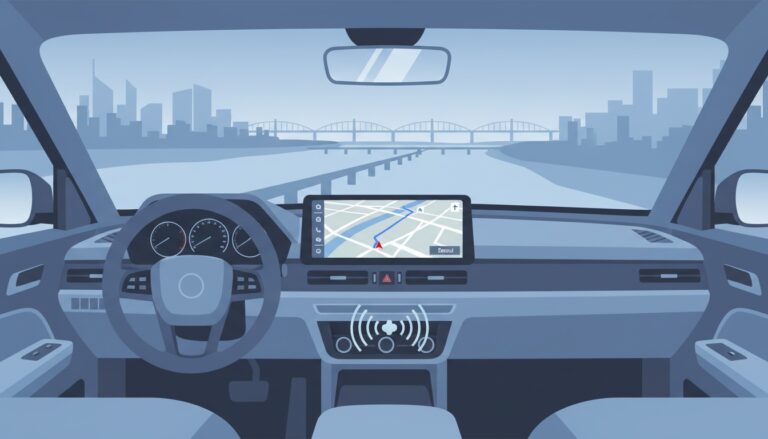
Picture this: You are driving a rental car on Jeju Island. The coastal road is beautiful, the wind is blowing, and K-Pop is blasting. Suddenly, you realize you’re hungry. You want to find that famous gogi-guksu (meat noodle) place, but typing on the navigation screen while driving is dangerous (and illegal).
So, you decide to channel your inner K-Drama CEO. You press the voice command button on the steering wheel with confidence, clearing your throat to speak perfectly.
“Go to Sister’s Noodles,” you say in Korean.
The car responds: “Calling Sister’s dry cleaners.”
Wait, what? No!
Voice technology in Korea is everywhere—from our phones to our fridges—but nowhere is it more critical than in the car. Korean navigation apps like Tmap and KakaoNavi are incredibly sophisticated, but they require a specific way of speaking. If you sound like a textbook, they might ignore you. If you mumble, they’ll misunderstand you.
Today, we aren’t just learning words; we are learning how to boss around a machine in Korean. Let’s get your car to actually listen to you.
Phase 2: The Commands That Actually Work (Deep Dive)
Since you are at a C1 level, we are skipping the basics. We are looking at commands that control the flow of your drive.
1. [장소]로 경유해 줘 ([Jangso]-ro gyeongyu-hae jwo)
- Pronunciation: [gyeong-yu-hae jwo] (The ‘gyeong’ sounds sharp, like a bell ringing)
- Meaning: “Add [Place] as a stopover.”
- Context: You are already navigating home, but you need to pick up a friend or grab coffee. Instead of canceling the trip, you add a via point.
- Editor’s Insight: The verb
경유하다(to pass through/stop over) is formal, but combining it with~해 줘(do it for me) creates the perfect human-to-AI command tone. It’s concise and clear.- Spectrum:
[Casual/Machine Friendly] ✅- 🤔 Think About It: Notice we use
~해 줘(casual request) with machines. In Korea, most people default to banmal (casual speech) with voice assistants like Bixby or Ariya. Why do you think we don’t use honorifics with AI? Does it feel rude, or practical?2. 최단 거리로 다시 찾아 줘 (Choedan georiro dasi chaja jwo)
- Pronunciation: [Choe-dan geo-ri-ro…]
- Meaning: “Find the shortest route again.”
- Context: The GPS suggests a main road, but it’s jammed. You want the shortest physical distance, even if it means winding through narrow alleyways (a classic Korean driving experience).
- Editor’s Insight:
최단 거리(shortest distance) vs.최소 시간(minimum time). Knowing this distinction saves you hours in Seoul traffic. Drivers often shout this when the ETA keeps increasing.- Spectrum:
[Command] ✅3. 안내 종료 (Annae jongnyo)
- Pronunciation: [An-nae jong-nyo]
- Meaning: “End guidance.”
- Context: You are almost home and the voice keeps chatting. Or you’ve given up and want silence.
- Editor’s Insight: This is a noun-ending phrase. It’s not a sentence. It’s efficient. You don’t say “Please stop the guidance.” You just say “Guidance termination.”
- Spectrum:
[Administrative] ✅
Phase 3: Textbook vs. Real Life (The Road Rage Edition)
| Situation | 📖 Textbook Korean | 🗣️ Real Korean (Driver Mode) | 💡 Why the difference? |
|---|---|---|---|
| Re-routing | 경로를 재탐색해 주세요. (Please research the route.) | 아, 딴 길! 다른 길 알려 줘. (Ah, other road! Tell me another way.) | Drivers are impatient. We drop particles and complex verbs for speed. |
| Too Loud | 볼륨을 줄여 주십시오. (Please lower the volume.) | 소리 좀 줄여봐. (Lower the sound a bit.) | “Audio volume” becomes just “sound” (소리). Simplicity wins. |
| Wrong Place | 목적지가 잘못 설정되었습니다. (The destination is set incorrectly.) | 아니 거기 말고! (No, not there!) | We talk to the machine like it’s a slow-witted friend. |
Phase 4: Cultural Context — The “Bali-Bali” GPS
4-1. The “Tmap” Culture
In Korea, Google Maps is essentially useless for driving navigation due to local data laws. The king is Tmap (followed by KakaoNavi). Why does this matter? Tmap is famous for its “real-time” rerouting. It is obsessed with saving you even 1 minute. If your voice command is slow, you might miss the reroute window. Koreans speak fast and percussively to these machines to match the speed of the service.
4-2. Non-verbal: The “Driver’s Glare”
When a passenger is issuing voice commands for the driver, there is a specific etiquette. The music must be paused manually first (don’t shout over NewJeans). The passenger should lean forward toward the dashboard. If the machine fails twice, the passenger must silently apologize and switch to typing. It’s the unwritten rule of nunchi in the car.
Phase 5: Roleplay — The Detour
Setting: Friday night, 8 PM. Crossing the Han River via Hannam Bridge. Traffic is heavy. You are driving; your Korean friend, Jisoo, is in the passenger seat handling the music.
Jisoo: 야, 차 너무 막힌다. 우리 그냥 한강 공원에서 라면이나 먹고 갈까?
(Ya, cha neomu makhinda. Uri geunyang Hangang gongwoneseo ramyeonina meokgo galka?)
(Hey, traffic is awful. Should we just eat ramyeon at Han River Park and go?)
YOU: 좋은 생각이야. 내비한테 말해볼게.
(Good idea. I’ll tell the navi.)
(You press the button on the steering wheel)
YOU: 아리아, 가까운 한강 공원으로 경유해 줘.
(Ariya, gakkaun Hangang gongwoneuro gyeongyu-hae jwo.)
(Ariya, add the nearest Han River Park as a stopover.)
Navigation AI: “죄송합니다. 다시 말씀해 주세요.” (Sorry, please say it again.)
🔀 Decision Point! How do you react?
A) Polite & Slow: “가. 까. 운. 한. 강. 공. 원…” (E-nun-ci-ate clearly)
B) Frustrated & Short: “한강 공원! 경유!” (Keywords only)
C) Give up: “아, 됐어.” (Ah, forget it.)
✅ Editor’s Choice: B.
Voice recognition systems often perform better with keywords than full, grammatically complex sentences when there is background noise. Dropping the particles and hitting the nouns hard usually works best.
Phase 6: 10-Second Shadowing Drill
Let’s practice the intonation. Don’t be flat. Imagine you are in a rush.
Emotion: slightly impatient, clear command.
Tmap, / mu-ryo do-ro-ro / an-nae-hae jwo!
(Tmap, guide me via toll-free roads!)
Note: Stress the ‘Mu-ryo’ (Free) part, or you might end up paying 2,000 won at a toll gate!
Phase 7: K-Culture Mini Glossary
| Korean | Romanization | Meaning | Context |
|---|---|---|---|
| 내비 | Naebi | Navigation | Short for Navigation system. Everyone uses this short form. |
| 방지턱 | Bangjiteok | Speed Bump | “Speed bump ahead” is the most common phrase you’ll hear. Korea has millions of them. |
| 정체 | Jeongche | Traffic Jam | More formal than ‘makinda’. You’ll see this red word on the screen. |
| 하이패스 | Hi-Pass | Toll System | The electronic toll collection lane. Crucial to know which line to drive in. |
Phase 8: Traveler’s Survival Kit (Driving Edition)
If you are renting a car in Jeju or driving in Seoul, these are non-negotiable.
🆘 Survival Command #1
– 🇰🇷 “주유소 찾아 줘” (Juyuso chaja jwo)
– 🗣️ Meaning: “Find a gas station.”
– 💡 Pro Tip: If you are running low on gas, say this immediately. The app will list stations by price and distance.📌 Editor’s Travel Note
– Phone Numbers are Magic: In Korean GPS, you don’t need the address. You can search by the destination’s phone number. It is much more accurate than typing English names.
– Bluetooth: Rental cars often have Korean UI. Learn the word블루투스 연결(Bluetooth Connection) before you leave the lot.
Phase 9: Think Deeper — Politeness & Machines
Language & Power:
Here is a fascinating contradiction. Korean society is strictly hierarchical, built on honorifics (jondaetmal). Yet, when talking to AI—Ariya, Bixby, Siri—most Koreans drop the honorifics instantly. We command them: “Do this,” “Find that.”
However, some older generations or very polite individuals still feel awkward using banmal to a voice. You might hear a taxi driver saying, “~hae juseyo” (Please do it) to his phone. It shows how deeply ingrained politeness is in the Korean psyche; it feels unnatural to be rude, even to a robot. Where do you draw the line in your language?
Phase 10: FAQ & Troubleshooting
Q: Can I set the navigation language to English?
A: Yes, Tmap and KakaoNavi have English settings! BUT, the voice input (speech recognition) works 10x better in Korean. If you say “Gyeongbokgung” with an American accent, it might fail. Using the Korean pronunciation we practiced is safer.
Q: The GPS keeps telling me to go, but the light is red. Why?
A: In Korea, you can usually turn right on red (unless marked otherwise). The GPS knows this and assumes you are moving. Don’t panic.
❌ Common Mistake: Saying the full address (Seoul-si, Gangnam-gu…).
✅ Fix: Just say the landmark name or the phone number. “COEX Mall” is enough. The machine gets confused by too much detail.
Phase 11: Wrap-up
Summary: To master Korean driving, you must master the “Navi.” Be short, be clear, and use keywords like ‘Gyeongyu’ (stopover) and ‘Juyuso’ (gas station).
Action Missions:
– 🥉 Bronze: Open Google Maps or Naver Map and practice saying “Starbucks” with Korean pronunciation (Seu-ta-beok-seu) into the voice search.
– 🥈 Silver: Watch a Korean car review on YouTube (channel like ‘Motline’ or ‘Boda’). Listen for when they talk to the car’s interface.
– 🥇 Gold: Next time you are in a taxi in Korea, listen to the driver’s navigation app. Can you catch the word “Jongnyo” (End) or “Jeongche” (Traffic)?
Phase 12: Interactive Quiz
Situation: You are driving and want to avoid paying toll fees because you have no cash and no Hi-Pass card. What is the correct command?
- “가장 빠른 길로 가 줘.” (Go the fastest way.)
- “고속도로로 안내해.” (Guide me to the highway.)
- “무료 도로로 안내해 줘.” (Guide me via free roads.)
- “편한 길로 가자.” (Let’s go the comfortable way.)
Correct Answer: 3.
Why? ‘무료’ (Muryo) means free. Option 1 will likely put you on a toll road because it’s faster. Option 2 is definitely a toll road. Option 4 is too vague for a machine.
Frequently Asked Questions (FAQ)
Q: What does "[장소]로 경유해 줘 ([Jangso]-ro gyeongyu-hae jwo)" mean in Korean and how do you pronounce it?
A: In Korean, "[장소]로 경유해 줘 ([Jangso]-ro gyeongyu-hae jwo)" is pronounced [gyeong-yu-hae jwo] and means: "Add [Place] as a stopover."
Q: What does "최단 거리로 다시 찾아 줘 (Choedan georiro dasi chaja jwo)" mean in Korean and how do you pronounce it?
A: In Korean, "최단 거리로 다시 찾아 줘 (Choedan georiro dasi chaja jwo)" is pronounced [Choe-dan geo-ri-ro...] and means: "Find the shortest route again."
Q: What does "안내 종료 (Annae jongnyo)" mean in Korean and how do you pronounce it?
A: In Korean, "안내 종료 (Annae jongnyo)" is pronounced [An-nae jong-nyo] and means: "End guidance."







