

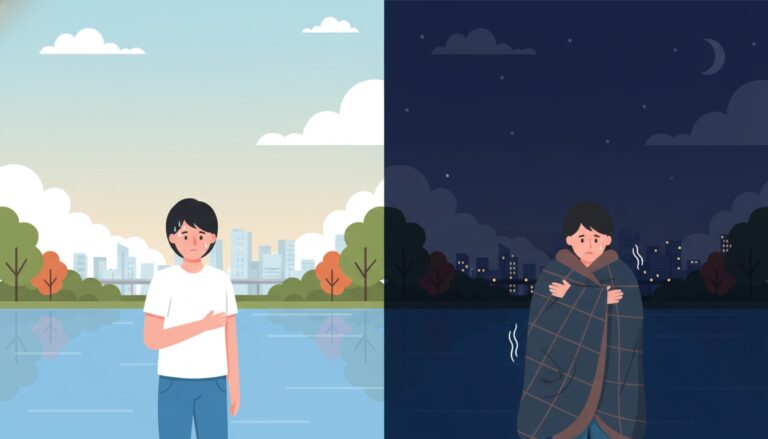
Phase 1: The Trap of the “Perfect” Autumn Day
Hello! This is your Daily Hangul editor.
Let me paint a picture for you. It’s 2 PM in Seoul. The sky is that famous, impossible blue called cheon-go-ma-bi (high sky, plump horses). You’re at the Han River park, wearing a T-shirt, thinking, “This weather is perfect.”
Cut to 7 PM.
The sun drops, and suddenly, it’s not autumn anymore. It feels like early winter. You are shivering, your teeth are chattering, and everyone around you has magically produced cardigans and trench coats out of thin air.
In K-Dramas, this is the precise moment the male lead takes off his coat and wraps it around the female lead’s shoulders. Slow motion. Romantic music.
But in real life? You just get a runny nose.
Today, we aren’t just learning weather vocabulary. We are learning how to survive the treacherous Korean autumn and how to use this weather to show jeong (affection) to your friends. Because in Korea, telling someone to “watch out for a cold” isn’t medical advice—it’s a love language.
Phase 2: Deep Dive into Key Expressions
Here are the three expressions that will save you from freezing and make you sound like a local.
1. 일교차가 커요 (Ilgyocha-ga keoyo)
- Pronunciation: [il-gyo-cha-ga keo-yo]
Tip: ‘gyo’ sounds like the start of ‘Kyoto’. ‘Keo’ sounds like ‘caw’ (like a crow) but shorter.- Meaning:
- Literal: The daily temperature range is big.
- Real Nuance: “The weather is bipolar today.” / “It’s hot now, but it will be freezing later.”
- K-Culture Moment: You’ll hear this on every news forecast and in elevators. It’s the ultimate small talk starter in October.
- Editor’s Insight: This is your excuse for carrying a heavy bag with extra clothes. If someone asks why you have a jacket in the afternoon heat, just say this phrase.
- Situation Spectrum:
[🚫 Formal Only] ———— [✅ Universal] ———— [🚫 Slang]
(You can use this with anyone, from taxi drivers to your boss.)- 🤔 Think About It: Why do Koreans have a specific, four-syllable Sino-Korean word (ilgyocha) for “daily temperature difference”? It shows how strictly the weather dictates daily life and agriculture here.
2. 감기 조심하세요 (Gamgi josimhaseyo)
- Pronunciation: [gam-gi jo-sim-ha-se-yo]
- Meaning:
- Literal: Please be careful of a cold.
- Real Nuance: “Take care of yourself,” “Goodbye,” or “I care about your health.”
- K-Culture Moment: At the end of a K-Pop idol’s live stream in autumn, they don’t just say “Bye.” They say, “The wind is cold, gamgi josimhaseyo!”
- Editor’s Insight: This replaces “Have a nice day” in October and November. If you say this to a cashier or a taxi driver, they will likely look surprised and then smile warmly. It shows you have Korean manners.
- Situation Spectrum:
[🚫 Friends Only] ———— [⚠️ Polite] ———— [✅ Standard]
(Use this with colleagues, elders, or strangers. With close friends, just say “감기 조심해”.)3. 따뜻하게 입으세요 (Ttatteuthage ibeuseyo)
- Pronunciation: [tta-tteut-ha-ge i-beu-se-yo]
Tip: The double ‘tt’ is a tense sound. Imagine holding your breath for a split second before exploding into the ‘t’.- Meaning: Dress warmly.
- Editor’s Insight: This is often a command disguised as a suggestion. In Korea, letting a friend walk around in thin clothes during autumn causes visible distress to others. It triggers the “Korean grandmother instinct” in everyone.
Phase 3: Textbook vs. Real Life
Let’s see how a textbook robot speaks versus a Hongdae hipster.
| Situation | 📖 Textbook Korean | 🗣️ Real Korean | 💡 Why different? |
|---|---|---|---|
| Commenting on the weather | 날씨가 추워졌어요. (The weather has become cold.) | 아, 쌀쌀하다! (Ah, it’s chilly!) | Ssalssalhada specifically describes that crisp, biting autumn chill. |
| Greeting a friend | 안녕히 계세요. (Goodbye.) | 감기 걸리지 마~ (Don’t catch a cold~) | Health warnings function as affectionate goodbyes among friends. |
| Warning about temperature | 일교차가 심합니다. (The daily range is severe.) | 낮에는 덥고 밤에는 추워. (Hot in day, cold at night.) | In casual speech, describing the feeling is more natural than using scientific terms. |
💡 Bottom Note: using “쌀쌀하다” (chilly) instead of just “춥다” (cold) instantly bumps your Korean level up to B1+. It’s a very sensory word.
Phase 4: Cultural Context — The “Onion” Strategy
4-1. The Art of Layering
Koreans often joke about “Onion Fashion” (양파 패션) in autumn. Because the ilgyocha is 10°C to 15°C, you peel off layers at lunch and put them back on at dinner. If you walk around in a thick sweater at 2 PM, people might stare—not because it looks bad, but because they are sweating just looking at you.
4-2. K-Food Remedy: Doraji-bae-cha
Connected to the “Watch out for colds” phrase is the food culture. If you actually start coughing, a Korean friend might drag you to a cafe and order “Doraji-bae-cha” (Bellflower root and pear tea).
- The Logic: Koreans believe pears and bellflower roots protect the throat and lungs.
- The Taste: It’s sweet, warm, and slightly bitter. It tastes like “health.”
Phase 5: Immersive Roleplay
Setting: It is 8 PM at Yeouido Han River Park. You are having Chimaek (Chicken & Beer) with your Korean friend, Min-su. You underestimated the cold and are rubbing your arms.
Characters:
* YOU: Wearing only a light hoodie.
* Min-su: Wearing a light down vest (prepared Korean).
(Dialogue Start)
Min-su: 와, 해 지니까 갑자기 확 추워지네.
(Wa, hae jinikka gapjagi hwak chuwojine.)
Wow, now that the sun’s down, it suddenly got really cold.
YOU: 그러게. 낮에는 진짜 더웠는데…
(Geureoge. Najeneun jinjja deowonneunde…)
I know. It was really hot during the day…
Min-su: 한국 가을은 일교차가 커서 위험해. 너 춥지?
(Hanguk gaeureun ilgyocha-ga keoseo wiheomhae. Neo chupji?)
Review: The temperature gap in Korean autumn is big, so it’s dangerous. You’re cold, right?
🔀 Decision Point: How do you respond?
Option A: “아니, 괜찮아! 난 튼튼해.” (No, I’m fine! I’m strong.)
Option B: “응, 좀 쌀쌀하네. 편의점 가서 따뜻한 거라도 마실까?” (Yeah, it’s a bit chilly. Should we go to the convenience store and drink something hot?)
Option C: (Shivering) “살려줘…” (Save me…)
✅ Best Choice: Option B.
This is the most social response. It acknowledges the situation (using the word ssalssalhada) and proposes a solution that extends the hangout (going to the ‘pyeon-ui-jeom’).
(Continuing with Option B)
YOU: 응, 좀 쌀쌀하네. 편의점 가서 따뜻한 거라도 마실까?
Min-su: 그래! 가서 따뜻한 베지밀(soymilk) 하나 사 줄게. 감기 걸리면 안 되니까.
(Geurae! Gaseo ttatteuthan bejimil hana sa julge. Gamgi geollimyeon an doenikka.)
Sure! I’ll buy you a warm soymilk. We can’t let you catch a cold.
Phase 6: 10-Second Shadowing Drill
Don’t just read it. Feel the shiver in your voice!
1. The Observation (Surprised/Complaining)
😢 요즘 / 일교차가 / 너무 커요.
(Yo-jeum / il-gyo-cha-ga / neo-mu keo-yo.)
These days / the temperature gap / is too big.
2. The Caring Friend (Warmly)
😊 밤에는 추우니까 / 따뜻하게 / 입으세요!
(Ba-me-neun chu-u-ni-kka / tta-tteut-ha-ge / i-beu-se-yo!)
Since it’s cold at night / warmly / please dress!
Phase 7: K-Culture Mini Glossary
| Korean | Romanization | Meaning | Context |
|---|---|---|---|
| 환절기 | Hwan-jeol-gi | Change of seasons | The period between seasons (usually implies sickness/allergies). |
| 겉옷 | Geot-ot | Outerwear | A jacket or coat you carry to survive the ilgyocha. |
| 몸살 | Mom-sal | Body ache/fatigue | A uniquely Korean illness from stress or weather change. Not quite the flu, but your whole body hurts. |
Phase 8: Traveler’s Survival Kit (Autumn Edition)
If you are visiting Korea in Oct-Nov, memorize this card.
🆘 Survival Phrase #1: Finding Medicine
* 🇰🇷 “감기약 있어요?” (Gamgi-yak isseoyo?)
* 🗣️ Pronunciation: [Gam-gi-yak i-sseo-yo?]
* 📍 Where: Yak-guk (Pharmacy) or Pyeon-ui-jeom (Convenience Store)
* 💡 Pro Tip: Korean convenience stores sell basic cold medicine (Panpyrin, etc.) 24/7. Look for the medicine cabinet near the counter.📌 Editor’s Travel Note
* Shopping: If you forgot a jacket, go to the underground shopping malls (Gangnam, Gototo) for cheap “Man-won” (10,000 KRW) cardigans. They are lifesavers.
* Heat Packs: Look for “Hot Packs” (핫팩) in convenience stores starting late October. Shake them, and they stay warm for hours.
Phase 9: Think Deeper — Language & Care
Why is everyone obsessed with my health?
In Western cultures, commenting on someone’s health (“You look tired,” “Watch out for a cold”) can sometimes feel intrusive or like a comment on one’s appearance. In Korea, this is a fundamental form of social glue known as Jeong (정).
Historically, surviving the harsh Korean winters and changing seasons was a communal effort. Asking “Have you eaten?” or saying “Don’t catch a cold” isn’t a question or a command—it’s a phatic expression confirming, “I acknowledge your existence and I want you to be safe.”
So, when a Korean acquaintance nags you to zip up your jacket, don’t be annoyed. Take it as a sign that you have successfully entered their circle of care.
💬 Your Turn: Does your culture have a greeting based on the weather or health? Tell us in the comments!
Phase 10: FAQ & Troubleshooting
- Q: Can I say “Gamgi josimhaseyo” to my boss?
- A: YES! In fact, you should. It shows you are a considerate employee. Use the polite ending “-haseyo.”
- Q: Is it rude to wear a mask if I’m not sick?
- A: No. In autumn, many people wear masks just to keep their face warm or to protect their throat from the dry air. It’s totally normal.
- ❌ Common Mistake:
- Saying “You look cold” as “너 추워 보여” (literal translation).
- Better: “추워 보인다” (You look cold – observation) or just ask “안 추워?” (Aren’t you cold?)
Phase 11: Wrap-up & Mission
One-Liner: Autumn in Korea is a battle between hot days and cold nights—arm yourself with layers and the phrase “Gamgi josimhaseyo.”
🍂 Your Mission:
* 🥉 Bronze: Look in the mirror, zip up an imaginary jacket, and say “Gamgi josimhaseyo.”
* 🥈 Silver: Check the weather app for Seoul. If the gap is over 10 degrees, post a screenshot on social media with the caption: “Ilgyocha is no joke!”
* 🥇 Gold: Text a Korean friend (or a friend interested in Korea): “날씨가 쌀쌀해요. 감기 조심하세요!” (The weather is chilly. Watch out for a cold!)
Phase 12: Quiz
- Situation: You are leaving a cafe to meet a friend. It’s windy. What is the best farewell to the barista?
- a) 사랑해요 (I love you)
- b) 감기 조심하세요 (Watch out for a cold)
- c) 깍아주세요 (Please give me a discount)
- True or False: Ilgyocha means “Traffic jam.”
- (True / False)
- Culture Check: Your friend offers you Doraji-bae-cha. What is it for?
- a) To keep you awake (Caffeine)
- b) To protect your throat/lungs
- c) To cool you down in summer
(Answers: 1-b, 2-False [it means temperature gap], 3-b)
Frequently Asked Questions (FAQ)
Q: What does "일교차가 커요 (Ilgyocha-ga keoyo)" mean in Korean and how do you pronounce it?
A: In Korean, "일교차가 커요 (Ilgyocha-ga keoyo)" is pronounced [il-gyo-cha-ga keo-yo] and means: Literal: The daily temperature range is big.
Q: What does "감기 조심하세요 (Gamgi josimhaseyo)" mean in Korean and how do you pronounce it?
A: In Korean, "감기 조심하세요 (Gamgi josimhaseyo)" is pronounced [gam-gi jo-sim-ha-se-yo] and means: Literal: Please be careful of a cold.
Q: What does "따뜻하게 입으세요 (Ttatteuthage ibeuseyo)" mean in Korean and how do you pronounce it?
A: In Korean, "따뜻하게 입으세요 (Ttatteuthage ibeuseyo)" is pronounced [tta-tteut-ha-ge i-beu-se-yo] and means: Dress warmly.







