

Phase 1: The Seoul Transformation
Greeting: Hello! Your Daily Hangul editor here.
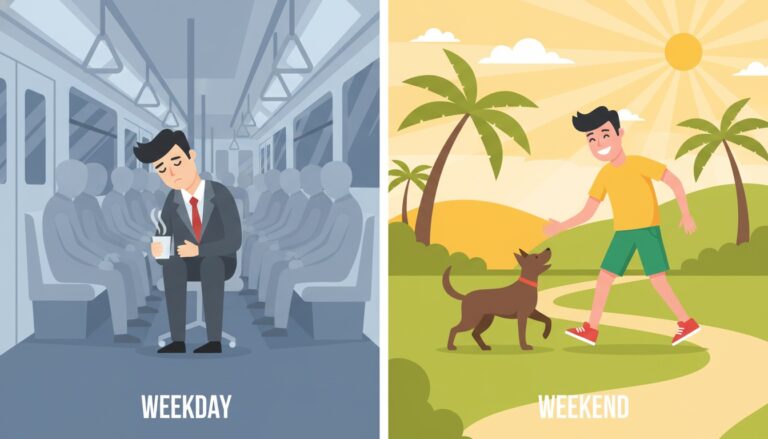
If you stand at Gangnam Station on a Tuesday morning at 8 AM, you’ll see a sea of black suits, tired eyes, and hands clutching iced Americanos like life-support systems. Fast forward to the same spot on a Saturday afternoon. The vibe? Completely different. Bright colors, couples holding hands, and long lines at trendy dessert cafes.
In Korea, the gap between 평일 (pyeong-il, weekdays) and 주말 (jumal, weekends) isn’t just a change in the calendar. It’s a personality shift. K-Dramas show this all the time: the main character is a stressed office worker with messy hair during the week, but transforms into a fashion icon on the weekend date.
To survive in Korea, you need to know how to switch modes. Today, we’re not just learning the days of the week; we’re learning the rhythm of Korean life.
Phase 2: Deep Dive into Key Expressions
1. 평일 (Pyeong-il) vs. 주말 (Jumal)
- Pronunciation: [pyeong-il] / [ju-mal]
- Meaning: Weekday / Weekend
- K-Culture Moment: You’ll see these words everywhere on store doors. “평일: 09:00 ~ 18:00 / 주말: Closed.” Mixing these up is why I once stood outside a locked bank for 10 minutes wondering why the lights were off.
- Editor’s Insight: Pyeong means ‘flat’ or ‘peaceful’ (ironic, given how busy weekdays are), and Il means ‘day’. Ju means ‘week’, Mal means ‘end’. Simple logic.
- Situation Spectrum:
[🚫 Formal] ———— [✅ Casual]
(Both are standard nouns, safe to use with everyone!) - 🤔 Think About It: In many Western cultures, Friday evening is effectively the weekend. In Korea, is Friday night considered pyeong-il or jumal? (Spoiler: It has its own name. See below.)
2. 불금 (Bul-geum)
- Pronunciation: [bul-geum] (Sounds like ‘Bull’ + ‘Gum’)
- Meaning: Literal: “Fire Friday” (Burning Friday). Real nuance: TGIF on steroids.
- K-Culture Moment: In K-Pop lyrics or variety shows, you’ll hear idols shouting “Bul-geum!” before eating late-night fried chicken. It’s the signal that the work week is officially dead.
- Editor’s Insight: You don’t just ‘have’ a Friday night in Korea; you ‘burn’ it. This implies energy, drinking, and staying out late. If you stay home, you are “wasting Bul-geum.”
- Situation Spectrum:
[🚫 Boss] ———— [⚠️ Colleague] ———— [✅ Friend]- Don’t say to your CEO: “Let’s have a Bul-geum!”
- Say to friends: “Oneul Bul-geum!” (It’s Fire Friday today!)
3. 쉬다 (Swida)
- Pronunciation: [swi-da]
- Meaning: To rest / To take a break / To have a day off.
- K-Culture Moment: When a K-Drama CEO asks an employee, “Jumal-e mwo haesseo?” (What did you do on the weekend?), the safest, most common answer is simply “Swieosseo-yo” (I rested).
- Editor’s Insight: In English, “I rested” sounds a bit like you were sick or recovering. In Korean, “resting” is an active hobby. It means recharging your battery.
Phase 3: Textbook vs. Real Life
| Situation | 📖 Textbook Korean | 🗣️ Real Korean | 💡 Why different? |
|---|---|---|---|
| Asking about plans | 주말에 계획이 있어요? (Do you have plans for the weekend?) |
주말에 뭐 해요? (What are you doing on the weekend?) |
“Plans” (gye-hoek) sounds too formal, like a business strategy. |
| Busy Weekdays | 저는 평일에 아주 바빠요. (I am very busy on weekdays.) |
평일엔 정신없어요. (On weekdays, I have “no mind.”) |
Jeongsin-eopseo captures the chaos of multitasking better than just “busy.” |
| Leaving work (Fri) | 안녕히 계세요. (Goodbye / Stay in peace.) |
저 먼저 들어갈게요! (I’m going in [home] first!) |
Implies checking out early/on time while others might still be working. |
Note: “Jeongsin-eopseo” is great for chatting with friends, but stick to “Bappayo” (Busy) with your boss.
Phase 4: Cultural Deep Dive — The “Ppalli-Ppalli” vs. “Healing” Paradox
4-1. Non-verbal Communication: The Monday Face
Koreans have a specific facial expression for Monday mornings on the subway. It’s a stoic, blank stare. If you are laughing or talking loudly on the phone during the Monday morning rush hour, you will get stares. Read the room (Nunchi)! Silence is the rule of the pyeong-il commute.
4-2. K-Food Connection: The Lunch Race vs. The Brunch Queue
Weekdays: Lunch is a race. You have 1 hour. You go to a place that serves Kimchi Stew (Kimchi-jjigae) or Cutlet (Donkatsu) fast. You eat, you grab a mega-sized low-cost coffee, you go back. Efficiency is flavor.
Weekends: It’s about aesthetics. People wait 40 minutes for a bagel place in Seongsu-dong or a cafe with a ocean view in Gangneung. On weekends, the food must be “Instagrammable.” If you didn’t take a picture, did you really eat it?
Food for Thought: Why is American-style brunch so popular in Korea on weekends? It represents the luxury of time—something people don’t have from Monday to Friday.
Phase 5: Immersive Roleplay
Setting: Friday, 5:50 PM. An office in Pangyo (Korea’s Silicon Valley). The air is buzzing. People are slowly packing their bags.
Characters:
– YOU: New employee from overseas.
– Minji: Your Korean coworker (28, friendly but tired).
Dialogue:
Minji: 와, 드디어 금요일이네요. 이번 주 진짜 길었어요.
(Wa, deudieo geum-yo-il-ineyo. Ibeon ju jinjja gireosseo-yo.)
Wow, finally it’s Friday. This week was really long.
(🎭 Stage Direction: She stretches her arms and sighs deeply)
YOU: 맞아요. 민지 씨, 주말에 뭐 해요?
(Majayo. Minji-ssi, jumal-e mwo haeyo?)
Right. Minji, what are you doing on the weekend?
Minji: 저는 그냥 집에서 쉴 거예요. 넷플릭스 보고… OO 씨는요?
(Jeoneun geunyang jib-eseo swil geoyeyo. Netflix bogo… OO-ssi-neun-yo?)
I’m just going to rest at home. Watch Netflix… How about you?
🔀 Your Turn! How do you answer?
- A) “저도요. 잠을 많이 잘 거예요.” (Me too. I will sleep a lot.)
- B) “저는 친구랑 홍대에 가요! 불금을 보내야죠!” (I’m going to Hongdae with a friend! Gotta spend a Fire Friday!)
- C) “우리 같이 놀러 갈까요?” (Shall we go play together?)
✅ Best Choice: A or B.
– A creates solidarity (“We are both tired workers”).
– B shows you know Korean slang (Bul-geum) and have an active life.
– ⚠️ Choice C Analysis: Too risky! In Korea, asking a coworker to hang out on the weekend can be pressure unless you are already very close. Weekends are sacred personal time.
Phase 6: 10-Second Shadowing Drill
Repeat this feeling the relief of Friday evening.
“Finally, it is the weekend! I’m going to sleep all day.”
😊 Brightly: 드디어 / 주말이에요! (Deudieo / jumal-ieyo!)
😴 Relaxed: 저는 / 하루 종일 / 잘 거예요. (Jeoneun / haru jongil / jal geoyeyo.)
Phase 7: K-Culture Mini Glossary
| Korean | Rom | Meaning | Context |
|---|---|---|---|
| 야근 | Yageun | Overtime work | The enemy of Pyeong-il. If you do this, you miss Bul-geum. |
| 호캉스 | Hocance | Hotel + Vacance | A popular weekend activity. Staying in a nice hotel in the city just to use the pool and do nothing. |
| 칼퇴 | Kaltoe | Knife Leave | Leaving work exactly at 6:00 PM (cutting time like a knife). Everybody wants to do this on Friday. |
Phase 8: Traveler’s Survival Kit
Visiting Korea? Don’t get caught by the calendar.
🆘 Survival Expression #1
– 🇰🇷 “주말에도 영업해요?” (Jumal-edo yeong-eop-haeyo?)
– 🗣️ Meaning: Are you open on weekends too?
– 📍 Use at: Pharmacies, small private cafes, local restaurants.
– 💡 Pro Tip: Many trendy cafes are closed on Mondays or Tuesdays (their “weekend” after working through the real weekend). Always check Naver Maps or Instagram.📌 Editor’s Travel Note
– Museums/Palaces: Usually closed on Mondays (or Tuesdays for some). Plan your Pyeong-il schedule carefully.
– Rush Hour: Avoid the subway (Line 2, especially) between 7:30-9:00 AM and 6:00-7:30 PM on weekdays. You will be crushed. Seriously. It’s not a metaphor.
Phase 9: Think Deeper — The “Active Rest” Phenomenon
Why do Koreans often say “I’m busy” even on weekends?
In many cultures, doing “nothing” is a valid weekend activity. In Korea, there is a subtle pressure to make the weekend count. Because weekdays are sacrificed for work/school, the weekend becomes a project to “reclaim” one’s life. This leads to “combat resting”—waking up early to hike, travel, or visit hot spots, returning home more tired than when you left.
💬 Your Turn: In your country, is a lazy weekend considered a “good” weekend or a “wasted” one?
Phase 10: FAQ & Troubleshooting
Q: Can I text my Korean colleague on the weekend?
A: Generally, NO. Unless it is a dire emergency or you are real friends (beyond work), sending a work-related KakaoTalk on Sunday is a major taboo. It causes “Sunday Scaries” (Wol-yo-ilbyeong). Respect the Jumal.
Q: Is ‘Bul-geum’ only for young people?
A: The slang is used mostly by younger generations, but the concept is universal. Older generations might just say “Han-jan ha-ja” (Let’s have a drink) instead of shouting “Bul-geum!”
❌ Common Mistake: Asking “How was your weekday?”
✅ Fix: People rarely ask about the weekday because the answer is boring (Work/School). Ask “How was your weekend?” (Jumal-e eottaesseo?) instead.
Phase 11: Wrap-up
One-Liner: Pyeong-il is for surviving, Jumal is for living, and Bul-geum is the bridge between them.
Action Missions:
– 🥉 Bronze: Look at your calendar and point to today. Say loud: “Oneul-eun [Pyeong-il/Jumal] ieyo.”
– 🥈 Silver: Search “#불금” on Instagram. See what Koreans are eating or doing.
– 🥇 Gold: Go to a Korean restaurant (or look at a menu online) and find their “Lunch Special” (Jeomsim teukseon). Note that it likely says “Pyeong-il only.”
K-Culture Mission: Watch a K-Drama scene where office workers go for a Hoesik (company dinner). It’s usually a Thursday or Friday. Feel the vibe!
Phase 12: Quiz — The Situation Check
1. It is Tuesday morning. Your boss asks, “Are you busy?”
– A) “Yes, it’s Bul-geum!”
– B) “Ne, bappayo.” (Yes, I’m busy.)
– C) “Ne, jumal-ieyo.” (Yes, it’s the weekend.)
2. You want to visit a famous museum on Monday. What should you ask first?
– A) “Jumal-edo yeong-eop-haeyo?” (Are you open on weekends?)
– B) “Oneul swieoyo?” (Are you resting/closed today?)
Answers:
1. B (A is wrong day, C is hallucinating). Even better if you ask “Why?” (Wae-yo?) cautiously!
2. B (Mondays are common rest days for museums).
Frequently Asked Questions (FAQ)
Q: What does "평일 (Pyeong-il) vs. 주말 (Jumal)" mean in Korean and how do you pronounce it?
A: In Korean, "평일 (Pyeong-il) vs. 주말 (Jumal)" is pronounced [pyeong-il] and means: Weekday / Weekend
Q: What does "불금 (Bul-geum)" mean in Korean and how do you pronounce it?
A: In Korean, "불금 (Bul-geum)" is pronounced [bul-geum] and means: Literal: "Fire Friday" (Burning Friday). Real nuance: TGIF on steroids.
Q: What does "쉬다 (Swida)" mean in Korean and how do you pronounce it?
A: In Korean, "쉬다 (Swida)" is pronounced [swi-da] and means: To rest / To take a break / To have a day off.







