

The Yellow Bag Mystery: Surviving Korea’s Food Waste Wars 🗑️
Phase 1: The Immersive Hook
Hello! This is your Daily Hangul Editor.
Picture this: You’ve just finished a glorious late-night delivery of Yangnyeom Chicken (spicy seasoned chicken) at your Airbnb or new apartment in Seoul. You are full, happy, and ready for bed. But wait. You have a pile of sticky chicken bones, some leftover radish cubes, and a few soggy tissues.
In your home country, maybe this all goes into one bin. But here? If you throw those chicken bones into the food waste bin, you are breaking the law. If you throw the radish into the general trash, you might get a side-eye from the landlord—or worse, a fine.
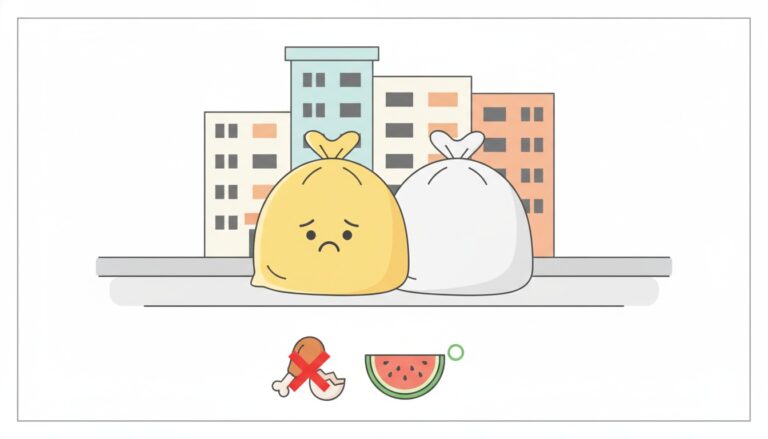
I’ve seen sophisticated expats freeze in front of the trash cans like deer in headlights. I’ve seen K-Drama heroines sigh deeply while holding a dripping yellow bag—it’s the great equalizer of Korean life. No matter how rich or famous you are, everyone has to deal with “Eum-sseu” (Food Waste).
Let’s decode the yellow bag before your room starts smelling like fermented regrets.
Phase 2: Deep Dive into Core Expressions
Here are the three phrases that stand between you and a recycling disaster.
1. 음식물 쓰레기 봉투 (Eumsikmul Sseuregi Bongtu)
- Pronunciation: [Eum-shing-mul Sseu-re-gi Bong-tu]
Sound Analogy: Eum (like clear throat ‘hmmm’) + Shing (shingle) + Mul (mull it over) + Sseu (snake hiss) + Re (red) + Gi (key) + Bong (bongo drum) + Tu (two).- Meaning: Food waste volume-rate disposal bag.
- Real Nuance: Usually just called “Eum-sseu-bong” (음쓰봉) by locals because the full name is a mouthful. This is the Yellow Bag.
- K-Culture Moment: In reality shows like I Live Alone, you’ll often see celebrities keeping these bags in their freezer to stop the smell. (Yes, people freeze their trash here. Welcome to Korea!)
- Situation Spectrum:
[🚫 Formal Speech] ———— [✅ Standard] ———— [✅ Casual]
(It’s a standard noun, safe to use everywhere)- 🤔 Think About It: Why does Korea charge for trash by the volume? It forces you to look at exactly how much you are wasting. It’s annoying, but it works.
2. 이거 일반 쓰레기예요? (Igeo ilban sseuregi-yeyo?)
- Pronunciation: [I-geo Il-ban Sseu-re-gi-ye-yo?]
- Meaning: Is this general trash?
- Real Nuance: You use this when holding something ambiguous—like an eggshell, a chicken bone, or a tea bag. The answer determines its fate.
- Editor’s Insight: This is the most important question you will ask your Korean roommate. Getting it wrong is a rite of passage, but let’s try to avoid it.
- Situation Spectrum:
[🚫 Boss] ———— [✅ Co-worker/Friend] ———— [✅ Convenience Store Staff]3. 2리터짜리 주세요 (Yi-liteo-jjari juseyo)
- Pronunciation: [Ee-lee-tuh-jja-ri Ju-se-yo]
- Meaning: Please give me the 2-liter one.
- Real Nuance: Use this at the convenience store checkout. Bags come in sizes like 1L, 2L, 5L, 10L. For a single person, 2L is usually the sweet spot before the smell becomes unbearable.
- Grammar Note: ~짜리 (jjari) is a counter suffix meaning “worth” or “value of.” It attaches to the number/unit.
Phase 3: Textbook vs. Real Life
| Situation | 📖 Textbook Korean | 🗣️ Real Korean | 💡 Why the difference? |
|---|---|---|---|
| Buying the bag | 음식물 쓰레기 봉투 있어요? (Do you have food waste bags?) | 음쓰봉 있어요? (Got ‘Eum-sseu-bongs’?) | Koreans love abbreviating long compound words for efficiency. |
| Asking about trash | 이것은 음식물 쓰레기입니까? (Is this food waste?) | 이거 음쓰예요? (Is this ‘Eum-sseu’?) | Same logic. ‘Eumsikmul Sseuregi’ is just too long to say 5 times a day. |
| Full trash can | 쓰레기통이 다 찼습니다. (The trash can is full.) | 꽉 찼어. (It’s packed tight.) | ‘Kkwak’ (꽉) provides the intense feeling of being stuffed to the brim. |
Phase 4: Cultural Deep Dive — The “Chicken Bone” Rule
4-1. The Golden Rule of Korean Recycling
If you remember nothing else from this article, remember this:
“If an animal can eat it, it is Food Waste. If an animal would choke on it, it is General Trash.”
Korea processes food waste into animal feed and fertilizer. This is why:
* Chicken Bones: General Trash (Animals choke on sharp bones).
* Egg Shells: General Trash (Not nutritious/bad texture).
* Onion/Garlic Skins: General Trash (Too fibrous for the machines).
* Leftover Rice/Kimchi: Food Waste (Standard food).
4-2. The “Nunchi” of Smells
In dense apartment complexes, Nunchi (reading the room) applies to trash, too. If you leave your food waste bag dripping in the hallway or elevator, you are violating the social contract. Modern luxury apartments now have RFID machines that weigh your trash and charge your credit card automatically—no bags needed. If you see a metal bin that talks, that’s the RFID machine!
Phase 5: Immersive Roleplay
Setting: A convenience store (CU or GS25) near your studio apartment. It is a humid Tuesday evening.
Characters:
* YOU: A foreigner holding a basket of snacks.
* Clerk: Part-time student, tired but helpful.
Dialogue:
YOU: (Approaching counter) 계산해 주세요.
(Gye-san-hae ju-se-yo.)
[I’d like to pay for this, please.]
Clerk: (Scans items) 봉투 필요하세요?
(Bong-tu piryo-haseyo?)
[Do you need a (plastic carrier) bag?]
YOU: 아, 아니요. 근데 음식물 쓰레기 봉투 있어요?
(Ah, aniyo. Geunde eumsikmul sseuregi bongtu isseoyo?)
[Ah, no. But do you have food waste bags?]
Clerk: 네, 몇 리터요?
(Ne, myeot liter-yo?)
[Yes, how many liters?]
🔀 Decision Point: What do you say?
* A) “제일 작은 거 주세요.” (Give me the smallest one.)
* B) “아무거나 주세요.” (Give me anything.)
* C) “이거 여기서 쓸 수 있어요?” (Can I use this here?)
✅ Best Choice: A. For a single person, you want the smallest (1L or 2L). Large bags take weeks to fill and will smell.
⚠️ Warning on C: This is actually a smart question! Trash bags are district-specific (Gu-specific). You cannot use a Mapo-gu bag in Gangnam-gu.
(Continuing with Choice A)
YOU: 제일 작은 거 주세요.
(Je-il ja-geun geo ju-se-yo.)
[The smallest one, please.]
Clerk: (Hands over a small yellow bag) 1리터짜리예요. 100원입니다.
[Here is the 1L one. That’s 100 won.]
Phase 6: 10-Second Shadowing Drill
Repeat after me. Pay attention to the emotion—you are slightly confused but trying to be a good citizen.
Context: Holding a dirty pizza box with cheese stuck to it.
“Cheezu-neun / eum-sseu-jimahn / box-neun / il-ban-iye-yo?”
(Cheese is / food waste but / the box is / general trash?)
🤨 Emotion: Confusion mixed with determination.
🗣️ Intonation: Raise the pitch at the end (iye-yo?) to emphasize the question.
Phase 7: K-Culture Mini Glossary
| Korean | Rom | Meaning | Context |
|---|---|---|---|
| 종량제 | Jongnyangje | Volume-rate System | The system where you pay for trash by buying specific bags. |
| 분리수거 | Bunli-sugeo | Recycling | Literally “Separate Collection.” The act of sorting your trash. |
| 음쓰 | Eum-sseu | Food Waste (Slang) | Short for Eumsikmul Sseuregi. Used commonly in chat/speech. |
| 일반쓰레기 | Ilban-sseuregi | General Trash | Anything that cannot be recycled or composted. Goes in the White bag. |
| 구청 | Gu-cheong | District Office | The local gov office that issues the bags (e.g., Gangnam-gu office). |
Phase 8: Traveler’s Survival Kit
Even if you are just traveling, you might rent an Airbnb. Here is how to survive the kitchen.
🆘 Survival Phrase #1
– 🇰🇷 “이거 어디에 버려요?” (Igeo eodi-e beoryeoyo?)
– 🗣️ Sounds like: E-go uh-dee-eh buh-ryuh-yo?
– 📍 Use: When asking your host or hotel staff where the bins are.
– 💡 Pro Tip: If you are in a hotel, just leave trash in the bin. But in an Airbnb, you must separate. If you don’t, the host gets fined, and you get a bad review.📌 Editor’s Travel Note
– Buying Bags: You can only buy trash bags in the district (Gu) where you are staying. If you buy a bag in Hongdae (Mapo-gu) and bring it to your hotel in Gangnam, the garbage collectors won’t take it.
– Colors:
– 🟡 Yellow: Food
– ⚪ White/Green: General Trash
– 🔵 Blue: Recyclables (sometimes just clear bags)
Phase 9: Think Deeper — “Why so strict?”
Environment & Identity:
Have you ever wondered why Korea is obsessed with this complex system? It’s not just about being clean. Korea has a small landmass with a high population density. Landfills are running out of space. By strictly enforcing food waste recycling (which is turned into fertilizer or animal feed), Korea recycles nearly 95% of its food waste—up from less than 2% in 1995.
Also, consider the communal nature of Korean housing. In an apartment block of 2,000 people, if everyone threw rotting food in general bins, the smell would affect the entire community. The strict rules are a form of consideration for your neighbors.
💬 Your Turn: How does your country handle leftover food? Do you have “compost guilt” if you throw an apple core in the trash? Tell us in the comments!
Phase 10: FAQ & Troubleshooting
Q: I have a chicken bone with a little meat left on it. Is it food waste?
A: No. If it has a hard bone, it goes in General Trash (White Bag). The machines that process food waste can break if hard bones get in. Strip the meat off if you can, but the bone is definitely trash.
Q: Can I put eggshells in the food waste bag?
A: No! Eggshells are rich in lime and cannot be processed into animal feed easily. General trash.
Q: My food waste bag smells terrible but it’s not full. What do I do?
A: Two hacks: 1) Keep the bag in your freezer (the “Korean Freezer Hack”). 2) Sprinkle baking soda inside. But honestly, just buy the smallest bags (1L) and take them out daily.
❌ Common Mistake: Throwing the whole plastic delivery container into the recycling bin with food sauce still on it.
✅ Fix: You must wash the container so it’s clean white plastic. If it’s stained red with Gochujang (chili paste), it often counts as general trash because it’s hard to recycle.
Phase 11: Wrap-up & Mission
One-Liner: If an animal can’t eat it, neither can the recycling machine—buy the yellow bag for the soft stuff, white bag for the rest.
Action Mission:
* 🥉 Bronze: Go to a convenience store and just look at the different bags behind the counter.
* 🥈 Silver: Buy a 1L Food Waste Bag and a 10L General Trash Bag. Post a photo on Instagram with #DailyHangulRecycling.
* 🥇 Gold: Successfully separate a full meal of delivery food (bones, leftovers, sauce containers) without cheating!
Phase 12: Interactive Quiz
1. Which of the following items goes into the YELLOW (Food Waste) bag?
A) Chicken bones
B) Onion skins
C) Watermelon rinds (soft skin)
D) Eggshells
2. You are at a store in Gangnam-gu. Can you use a trash bag you bought in Yongsan-gu?
A) Yes, it’s all Seoul.
B) No, bags are district-specific.
C) Only on weekends.
3. True or False: You should squeeze the water out of food waste before putting it in the bag.
(True / False)
⬇️ Click to see answers
Answers:
1. C) Watermelon rinds. (Soft skins are okay. Hard skins, bones, and dry onion skins are general trash).
2. B) No. You must buy bags for the specific district you live in.
3. True. Water increases weight (fees) and makes processing harder. There are usually strainers in sinks for this reason.
Frequently Asked Questions (FAQ)
Q: What does "음식물 쓰레기 봉투 (Eumsikmul Sseuregi Bongtu)" mean in Korean and how do you pronounce it?
A: In Korean, "음식물 쓰레기 봉투 (Eumsikmul Sseuregi Bongtu)" is pronounced [Eum-shing-mul Sseu-re-gi Bong-tu] and means: Food waste volume-rate disposal bag.
Q: What does "이거 일반 쓰레기예요? (Igeo ilban sseuregi-yeyo?)" mean in Korean and how do you pronounce it?
A: In Korean, "이거 일반 쓰레기예요? (Igeo ilban sseuregi-yeyo?)" is pronounced [I-geo Il-ban Sseu-re-gi-ye-yo?] and means: Is this general trash?
Q: What does "2리터짜리 주세요 (Yi-liteo-jjari juseyo)" mean in Korean and how do you pronounce it?
A: In Korean, "2리터짜리 주세요 (Yi-liteo-jjari juseyo)" is pronounced [Ee-lee-tuh-jja-ri Ju-se-yo] and means: Please give me the 2-liter one.







