

Phase 1: The ‘Read’ Receipt Anxiety
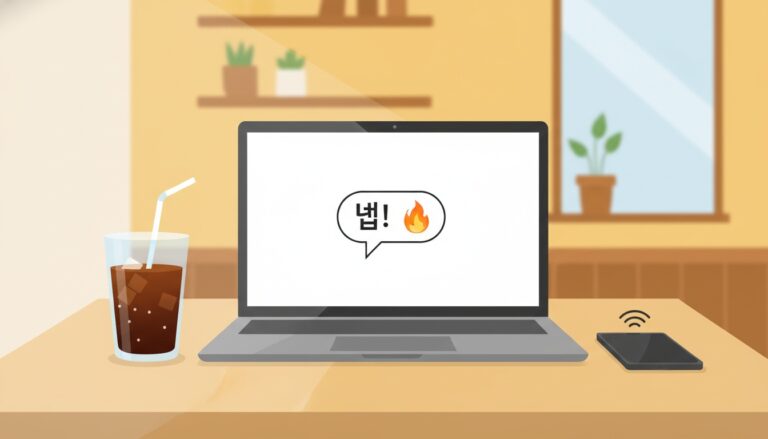
Greeting: 안녕하세요! This is your Daily Hangul editor, writing to you from a bustling cafe in Seongsu-dong, laptop open, iced americano in hand.
K-Culture Cold Open: Picture this: You’re watching a K-Drama like Start-Up or Misaeng. The protagonist sends a message to their team leader. The little yellow ‘1’ next to the message disappears (meaning they read it), but… silence. No reply. The tension is palpable. In the physical office, you could read their face. In the “Untact” (non-face-to-face) era, you’re left staring at a screen, sweating bullets.
The ‘Why’: Remote work in Korea isn’t just about translating “Zoom link please.” It’s about navigating a high-context culture through a low-context medium (text). Use the wrong tone in a work chat, and you might accidentally sound like a cold robot—or worse, rude. Let’s fix that.
Transparency: This guide is built on the real struggles of advanced learners who told me, “I know the grammar, but my Korean colleagues say my texts feel ‘cold’.”
Phase 2: Deep Dive into ‘Untact’ Nuances
1. 비대면 (Bidaemyeon) & 언택트 (Eontaekteu)
- Pronunciation: [Bi-dae-myeon] / [Eon-taek-teu]
- Meaning: Non-face-to-face (Formal) / Untact (Konglish for ‘Un-contact’)
- K-Culture Moment: You’ll see ‘비대면’ on banking apps, delivery instructions, and company announcements. ‘언택트’ was the buzzword of 2020-2022, often used in marketing trends.
- Editor’s Insight: While Untact is widely understood, in a formal business report or email to a client, 비대면 sounds much more professional and C1-level appropriate.
- Situation Spectrum:
[🚫 Casual Chat] ———— [✅ Business Email/News] ———— [✅ Formal Report]- 🤔 Think About It: “Untact” is a made-in-Korea English word. Why do you think Korea creates its own English words (Konglish) rather than using existing ones like ‘remote’ or ‘contactless’? What does this say about language adaptation?
2. 넵 (Nep)
- Pronunciation: [Nep] (Ends with a tight ‘p’ stop, sounding crisp)
- Meaning: Yes / Understood / I’m on it (The ‘Professional Yes’)
- K-Culture Moment: If you look at any Korean company’s group chat (KakaoWork, Slack), it is a waterfall of “넵!” “넵~” “넵!!”.
- Editor’s Insight: This is the MVP of Korean work life. ‘네’ (Ne) can feel too dry or indifferent. ‘예’ (Ye) can feel too old-fashioned. ‘넵’ implies energy, promptness, and military-like discipline but with a modern office vibe. It says, “I have received your command and am executing it immediately.”
- Situation Spectrum:
[🚫 To Elders/CEO] ———— [✅ Direct Superior] ———— [✅ Colleagues]- 🤔 Think About It: Why does a single syllable need so many variations to convey the right emotion? Does your language have a “work version” of “Yes”?
3. 확인 부탁드립니다 (Hwagin butak-deurimnida)
- Pronunciation: [Hwa-gin bu-tak-deu-rim-ni-da]
- Meaning: Please check this / Requesting your confirmation.
- K-Culture Moment: The standard closing line for sending a file, a draft, or a payment request. It puts the ball in their court politely.
- Editor’s Insight: In English, “Please check” can sometimes sound demanding. In Korean, the addition of “부탁드립니다” (I ask a favor of you) softens it entirely. It is humble yet firm.
- Situation Spectrum:
[🚫 Close Friends] ———— [✅ Client Email] ———— [✅ Boss]
Phase 3: Textbook vs. Real Life (The ‘Chat’ Edition)
| Situation | 📖 Textbook Korean | 🗣️ Real Office Chat (Messenger) | 💡 Why the difference? |
|---|---|---|---|
| Confirming a task | 알겠습니다. (Al-get-seum-ni-da) | 넵! / 넵 알겠습니다~ | ‘알겠습니다’ feels robotic. ‘넵’ + ‘!’ or ‘~’ adds “social lubrication.” |
| Apologizing for delay | 늦어서 죄송합니다. (Neujeoseo joesong-hamnida) | ㅠㅠ 죄송해요, 바로 보낼게요! | Using emoticons like ㅠㅠ (crying eyes) in semi-formal chats shows genuine regret and humanness. |
| Leaving work (remote) | 안녕히 계세요. (An-nyeong-hi gye-se-yo) | 저 먼저 퇴근하겠습니다! 🏃♂️ | Using a running emoji softens the awkwardness of logging off before others. |
Bottom Note: At C1 level, your goal is to manage the air of the conversation. Text is dry; punctuation and carefully chosen particles provide the moisture.
Phase 4: Cultural Deep Dive — Digital Nunchi (눈치)
4-1. The Emoji Dilemma
In Western business emails, emojis are often taboo. In Korean smart work culture (especially on messengers like KakaoTalk or Slack), emojis are a survival tool. They replace the smile you would have given in person.
– The Rule: Don’t use them in the first formal email. But once you move to instant messaging, a well-placed ‘Bow’ emoji (🙇♂️) or ‘Sparkles’ (✨) after a thank you can trigger a much warmer response than a period.
4-2. K-Drama Trope: The “Ghosting” Panic
In dramas like What’s Wrong with Secretary Kim, characters obsess over the ‘1’ disappearing on KakaoTalk. In a remote work setting, leaving a message on ‘Read’ without a ‘Like’ or a ‘Check’ reaction is considered stressful for the sender.
– Pro Tip: Even if you can’t reply fully, send a ‘Check’ emoji or a quick “확인했습니다” (Checked) to let them know you’re alive.
Phase 5: Roleplay — The Deadline Crisis
Setting: Friday, 4:00 PM. You are working from home (재택근무). Your team uses Slack. You receive a message from Manager Choi.
Characters:
– YOU: Foreign Specialist at a Korean tech firm.
– Manager Choi: Efficient, slightly stressed, favors speed over formality.
The Chat Stream:
Manager Choi: @Channel 이번 프로젝트 기획안, 오늘 6시까지 마무리 가능할까요? 급한 건이라서요. 🙏
(Ibeon project gihoegan, oneul 6si-kkaji mamuri ganeunghalkkayo? Geupan geoniraseoyo.)
Translation: Is it possible to finish the project proposal by 6 PM today? It’s an urgent matter.
🔀 Your Turn! How do you respond?
Option A: “아니요, 불가능합니다.” (No, it is impossible.)
Option B: “넵! 6시까지 공유드리겠습니다! 🔥” (Yep! I’ll share it by 6!)
Option C: “네.” (Yes.)✅ Best Choice: Option B.
Why: It starts with the magic word “넵”, confirms the time, and uses an emoji (🔥) to show you are working hard/passionately. It mirrors the manager’s urgency.
⚠️ Analysis of Option C: “네.” with a period is terrifying in Korea. It sounds like you are angry, annoyed, or passive-aggressive. Avoid the “Period of Doom.”
Phase 6: 10-Second Shadowing Drill
Let’s practice the tone of a professional “softener.”
Sentence: 혹시 / 통화 가능하신 시간 / 있으실까요? 📞
Pronunciation: Hok-si / tong-hwa ga-neung-ha-sin si-gan / i-sseu-sil-kka-yo?
Meaning: By any chance / is there a time you are available for a call?
Emotion: 😊 Polite & Cautious (Not demanding)
Key Tip: Raise your tone slightly at the end (~yo?) to sound inviting, not interrogating.
Phase 7: K-Culture Mini Glossary (Smart Work Edition)
| Korean | Romanization | English | Context |
|---|---|---|---|
| 재택근무 | Jaetaek-geunmu | Work From Home (WFH) | The standard term for working remotely from your house. |
| 화상회의 | Hwasang-hoeui | Video Conference | Zoom/Google Meet calls. Literally “Video Image Meeting.” |
| 칼답 | Kaldap | Instant Reply | Knife (Kal) + Answer (Dap). Replying instantly. Highly valued in urgent work chats. |
| 읽씹 | Ik-ssip | Left on Read | Reading a message and ignoring it. The ultimate sin in Korean communication. |
Phase 8: Digital Nomad Survival Kit
Since many of you work remotely from cafes in Seoul (or want to!), here is your survival pack.
🆘 Survival Phrases
– 🇰🇷 “혹시 콘센트 있는 자리 있나요?” (Hoksi consent inneun jari innayo?)
– “Do you have a seat with an outlet?”
– 🇰🇷 “와이파이 비밀번호가 어떻게 되나요?” (WiFi bimil-beonhoga eotteoke doenayo?)
– “What is the Wi-Fi password?”
– 💡 Pro Tip: In Korean cafes, you can leave your laptop on the table while you go to the bathroom. It won’t get stolen. This is the unwritten “CCTV Culture” trust!
Phase 9: Think Deeper — High Context vs. Text
🧠 The Paradox of ‘Nunchi’ in Slack
Korean culture relies heavily on Nunchi (reading the room). But how do you read the room when there is no room, only text on a screen? This has led to the hyper-inflation of digital cues. Punctuation (~, !, ^^), emojis, and response speed have become the new facial expressions. A period (.) is no longer just grammar; it’s an emotion.💬 Your Turn: In your native language, does using a period in a text message change the tone? How do you signal “politeness” in a digital workspace? Tell me in the comments!
Phase 10: Troubleshooting & FAQ
Q: My boss uses informal language (Banmal) in the chat. Can I use it back?
A: Absolutely NOT. Even if the platform feels casual (like KakaoTalk), the hierarchy remains. Stick to polite language (Haeyo-che) or formal language (Hapshio-che) until explicitly told otherwise.
Q: Is it rude to turn off my camera during a Zoom meeting?
A: In Korea, yes. Unless the host says “You can turn off cameras,” it is polite to keep it on to show you are paying attention (listening attitude). Showing your face is part of the “attendance.”
❌ Common Mistake #1: Saying “너” (You) to a colleague.
✅ Fix: Never use “You” in business. Use their Job Title (Manager Kim) or Name + Nim (Jimin-nim).
Phase 11: Wrap-up & Mission
One-Liner: In the untact era, your “tone” is determined by your punctuation and reaction speed—master the “Nep!” and conquer the chat.
Action Mission:
– 🥉 Bronze: Practice saying “Nep!” with a crisp, energetic tone.
– 🥈 Silver: Change your phone’s language setting to Korean for a day and navigate the interface vocabulary.
– 🥇 Gold: Go to a cafe (or library), find an outlet using the Korean phrase, and “work” for an hour!
K-Culture Mission: Watch an episode of a recent office drama (like Agency or Start-Up) and count how many times they say “Nep” vs “Ne.”
Phase 12: Quiz — The Tone Master
Situation: You need to decline a Zoom meeting because you are sick.
Which message is the most appropriate for your team leader?
1. “못 가요. 아파요.” (Can’t go. Sick.)
2. “팀장님, 죄송하지만 제가 몸살 기운이 있어서 화상회의 참석이 어려울 것 같습니다. ㅠㅠ” (Team leader, I’m sorry but I have body aches so it seems difficult to attend the video conference. crying face)
3. “회의 참석 불가합니다.” (Meeting attendance impossible.)
Answer: #2.
Explanation: #1 is too casual and rude. #3 is too robotic and cold. #2 explains the reason (body aches), apologizes, uses soft ending grammar (~ul geot gatseumnida), and adds a human touch (ㅠㅠ).
Frequently Asked Questions (FAQ)
Q: What does "비대면 (Bidaemyeon) & 언택트 (Eontaekteu)" mean in Korean and how do you pronounce it?
A: In Korean, "비대면 (Bidaemyeon) & 언택트 (Eontaekteu)" is pronounced [Bi-dae-myeon] and means: Non-face-to-face (Formal) / Untact (Konglish for 'Un-contact')
Q: What does "넵 (Nep)" mean in Korean and how do you pronounce it?
A: In Korean, "넵 (Nep)" is pronounced [Nep] and means: Yes / Understood / I'm on it (The 'Professional Yes')
Q: What does "확인 부탁드립니다 (Hwagin butak-deurimnida)" mean in Korean and how do you pronounce it?
A: In Korean, "확인 부탁드립니다 (Hwagin butak-deurimnida)" is pronounced [Hwa-gin bu-tak-deu-rim-ni-da] and means: Please check this / Requesting your confirmation.







