

Phase 1: The Immersive Hook
Greeting:
Hello, language enthusiasts. It’s your Daily Hangul editor here.
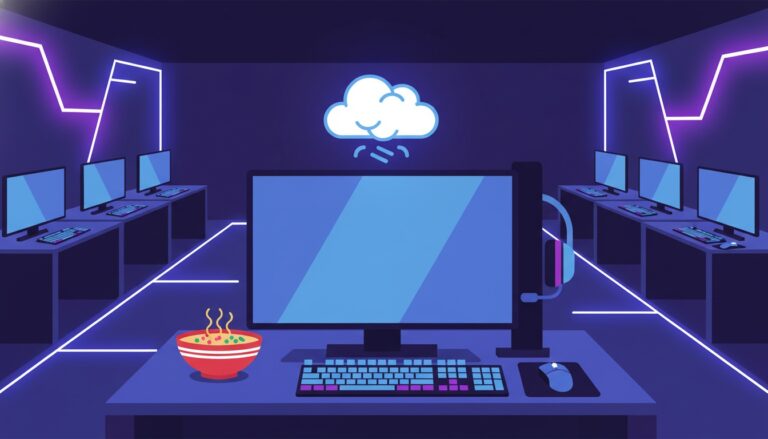
Picture this: It’s 11 PM on a rainy Tuesday in Seoul. You walk into a PC Bang (PC Cafe) in Hongdae. The air smells faintly of spicy ramen and energy drinks. All you hear is the intense tadak-tadak of mechanical keyboards and the occasional shout of frustration or victory.
You sit down, log in, and launch the latest high-graphic RPG. But wait—you aren’t running it on the heavy desktop tower next to your knees. You’re streaming it via the cloud. Suddenly, the screen stutters. Just for a microsecond.
In Korea, that microsecond is an eternity.
Today, we aren’t just talking about video games. We are dissecting the language of performance, patience, and specifications. Whether you are complaining about a lagging video call with your boss or debating the merits of cloud gaming vs. hardware with a tech-savvy friend, the vocabulary here is surprisingly high-stakes in Korean society.
This isn’t just about computers; it’s about the Korean obsession with speed and perfection.
Phase 2: Deep Dive into Core Expressions
We are looking at three C2-level terms that bridge the gap between digital hardware and social reality.
1. 사양 (Sayang)
- Pronunciation: [Sa-yang] + (Think of the ‘si’ in ‘sigh’ + ‘yang’ as in ‘yin and yang’)
- Meaning: Specifications / Specs.
- The Real Nuance: While it technically refers to hardware specs (CPU, GPU), in modern Korea, this word has aggressively migrated to the job market. People talk about their own “human specs” (degrees, certificates, looks) as sayang.
- K-Culture Moment: In almost every youth drama (like Misaeng), characters lament their “low specs” preventing them from getting a job.
- Editor’s Insight: If you ask about a computer’s sayang, you are asking how powerful it is. If you talk about a person’s sayang, you are evaluating their social competitiveness. It’s cynical, but essential to understand.
- Situation Spectrum:
[🚫 Boss (Personal)] ———— [⚠️ Colleague] ———— [✅ Electronics Store/Friends]- 🤔 Think About It: Why do you think a term for machine parts became the standard word for human qualifications in Korea?
2. 렉(이) 걸리다 / 버벅거리다 (Rek-i geollida / Beobeok-georida)
- Pronunciation: [Reg-ee goll-li-da] / [Buh-buk-guh-ri-da]
- Meaning: To lag / To stutter (video/movement).
- The Real Nuance: Rek comes from “Lag.” Beobeok-georida is onomatopoeic for stuttering or stumbling. While rek is purely technical, beobeok-georida can be used when a person is stuttering their words because they are nervous.
- K-Culture Moment: Watch any gaming streamer (BJ). If the game freezes, they scream “아, 렉!!” (Ah, Lag!!).
- Editor’s Insight: Beobeok-georida is the C2 gem here. Use it when your phone is slow, or when your friend is stammering while lying to you.
- Situation Spectrum:
[🚫 Formal Presentation] ———— [⚠️ IT Support] ———— [✅ Daily Life]3. 최적화 (Choejeokhwa)
- Pronunciation: [Choe-jeok-hwa]
- Meaning: Optimization.
- The Real Nuance: In the context of cloud gaming, it’s about whether the game runs smoothly on different devices. But Koreans love “optimizing” their lives. Optimized routes, optimized study schedules, optimized diets.
- Editor’s Insight: Calling someone “socially optimized” (사회생활에 최적화된 사람) means they are incredibly good at reading the room and handling office politics.
- Situation Spectrum:
[✅ Universal Usage]
Phase 3: Textbook vs. Real Life
| Situation | 📖 Textbook Korean | 🗣️ Real Korean | 💡 The “Why” |
|---|---|---|---|
| The game is slow/lagging. | 인터넷 연결이 원활하지 않습니다. (Internet connection is not smooth.) | 아, 렉 쩐다. / 렉 걸려. (Ah, the lag is dope/severe.) | “쩐다” is slang for extreme states. Textbook phrases are too clinical for frustration. |
| Asking about PC specs. | 이 컴퓨터의 사양이 어떻게 됩니까? (What are the specs of this computer?) | 이거 스펙이 어떻게 돼요? / 고사양이에요? (What are the specs? Is it high-spec?) | “Spec” (Konglish) is used interchangeably with sayang. Gosa-yang means high-end. |
| The screen froze. | 화면이 멈췄습니다. (The screen has stopped.) | 튕겼어. / 멈췄어. (It bounced/crashed. / It stopped.) | “튕기다” (To bounce off) is the specific verb for being disconnected from a server. |
Bottom Note: Use “버벅거려요” (It’s stuttering) when complaining to customer service about a slow service. It sounds more natural than “slow.”
Phase 4: Cultural Deep Dive
4-1. The “Ppalli-ppalli” vs. Cloud Latency Paradox
Korea has the fastest average internet speeds in the world. Consequently, Koreans have the lowest patience threshold for latency. Cloud gaming faces a unique hurdle here. Even a 50ms delay, which might be acceptable elsewhere, feels “broken” to a Korean gamer used to zero-latency PC Bang rigs. When you complain about lag in Korea, you aren’t just noting a technical issue; you are expressing a violation of the cultural expectation of immediacy.
4-2. The “Equipment Disease” (장비병)
There is a slang term called Jangbi-byeong (Equipment Disease). It refers to the belief that you play bad because your gear is bad. Even with cloud gaming rising, many Koreans prefer owning high-end hardware (PC본체) because it’s a status symbol. If you visit a Korean friend’s house and they have a glowing, water-cooled PC tower, complement it immediately: “와, 본체 간지나네요!” (Wow, the tower looks stylish/cool!).
Phase 5: Immersive Roleplay
Setting: A cafe in Gangnam. You are showing your Korean friend, Min-soo (an avid gamer), a new cloud gaming app on your tablet.
Characters:
* YOU: Tech-enthusiast, trying to convince Min-soo about cloud gaming.
* Min-soo: 28, Hardcore PC gamer, skeptical of streaming games.
Dialogue:
Min-soo: 야, 이걸로 고사양 게임이 돌아간다고? 말도 안 돼.
(Ya, igeollo gosa-yang geimi doragandago? Maldo an dwae.)
Hey, this runs high-spec games? No way.
YOU: 진짜야. 설치할 필요도 없어. 그냥 스트리밍하는 거야.
(Jinjja-ya. Seolchihal piryodo eopseo. Geunyang streaming-haneun geoya.)
It’s real. No need to install. Just streaming.
Min-soo: 에이, 그래도 렉 걸리겠지. 반응 속도가 중요하잖아.
(Ei, geuraedo rek geolligetji. Baneung sokdoga jungyohajana.)
Eh, but it’ll definitely lag. Response speed is important, you know.
🔀 Decision Point: How do you respond?
A) “아니야, 5G라서 끊김 없이 잘 돼.” (No, it’s 5G so it works well without cutting out.)
B) “너 ‘장비병’ 있어서 그래. 일단 한번 해봐.” (You’re just saying that because you have ‘Equipment Disease.’ Just try it.)
C) “한국 인터넷이 빠르니까 괜찮아.” (Korean internet is fast, so it’s fine.)
✅ Best Choice: B
Why? It playfully challenges his skepticism using a cultural slang (Jangbi-byeong). It shows you understand gaming culture. Choice A is too factual/boring. Choice C is okay, but less witty.
Min-soo: (Laughing) 장비병이라니! 야, 줘봐. 얼마나 최적화가 잘 됐는지 보자.
(Jangbi-byeong-irani! Ya, jwobwa. Eolmana choejeokhwa-ga jal dwaenneunji boja.)
Equipment disease?! Hey, give it here. Let’s see how well optimized it is.
Phase 6: 10-Second Shadowing Drill
Practice complaining about technology naturally. Focus on the annoyed intonation.
😤 Emotion: Frustrated & Impatient
“와… / 사양은 좋은데 / 왜 이렇게 / 버벅거리지?”
(Wa… / sa-yang-eun joeun-de / wae ireoke / beobeok-georiji?)
“Wow… the specs are good, but why is it stuttering like this?”
Phase 7: K-Culture Mini Glossary
| Korean | Romanization | Meaning | Context |
|---|---|---|---|
| PC방 | PC Bang | PC Cafe | A social hub for gaming and eating. Not just for those without PCs. |
| 고사양 | Gosa-yang | High-spec | Used for expensive electronics (or highly qualified people). |
| 핑이 튀다 | Ping-i twida | Ping spikes | When network latency suddenly jumps. |
| 현질 | Hyeon-jil | Pay-to-win/Buying items | Spending real cash (‘Hyeon-geum’) in a game. |
| 본체 | Bon-che | Desktop Tower | Lit. ‘Main Body’. The physical computer case/hardware. |
Phase 8: Traveler’s Survival Kit (Digital Nomad Edition)
Since this unit focuses on tech and connectivity, here is how to stay connected in Korea.
🆘 Survival Phrases
– 🇰🇷 “여기 와이파이 비번이 뭐예요?” (Yeogi wai-pai bi-beoni mwo-yeyo?)
– 🗣️ “What is the Wi-Fi password here?”
– 📍 Usage: Cafes, Hotels, some PC Bangs.
– 💡 Pro Tip: Look for the receipt! In Korea, the Wi-Fi password is almost always printed at the bottom of your receipt or on a small stand on the counter.📌 Editor’s Tech Note
– Public Wi-Fi: Seoul has excellent public Wi-Fi on subways and buses. Look for “Public WiFi Secure” networks.
– PC Bangs: If you need to print documents or edit a heavy video file while traveling, go to a PC Bang. For about $1-2 per hour, you get access to a supercomputer.
Phase 9: Critical Thinking — “Think Deeper”
Topic: Technology as a Status Symbol
In Korea, having the latest hardware (phones, GPUs, cars) is often tied to Chemyon (Social Face). Cloud gaming essentially makes hardware invisible—everyone streams the same rig.
🧠 Think Deeper:
Will the democratization of hardware via cloud gaming clash with the Korean desire for exclusive, high-end ownership? Or will the pragmatic desire for convenience (running high-end games on a subway ride) win over the status of owning a $3,000 PC?💬 Your Turn: In your country, is owning a powerful computer seen as “cool,” or just a tool?
Phase 10: FAQ & Troubleshooting
Q: Can I go to a PC Bang if I don’t play games?
A: Absolutely. Many students go there to register for university classes (because the internet is faster) or to buy concert tickets (ticketing war). You can also just watch YouTube and eat ramen. It’s a cheap, comfortable cafe.
Q: Is it rude to say “Game over”?
A: No, but in Korea, we often say “GG” (Good Game) or “수고하셨습니다” (You worked hard) to team members, even online. Leaving a game without saying anything is considered bad manners if you were playing as a team.
❌ Common Mistake:
Don’t confuse 인터넷(Internet) with 데이터(Data).
If you run out of mobile data, say “데이터가 없어요” (I have no data), not “인터넷이 없어요” (I have no internet). The latter sounds like the Wi-Fi router is broken.
Phase 11: Wrap-up & Missions
Summary: Today we mastered describing technical performance (sayang, rek, choejeokhwa) and learned how these words bleed into social status.
Action Missions:
– 🥉 Bronze: Look at your phone or laptop and say aloud: “사양이 어떻게 되지?” (What are the specs?)
– 🥈 Silver: Next time a video buffers on YouTube, sigh and say: “아, 왜 이렇게 버벅거려?” (Ah, why is it stuttering like this?)
– 🥇 Gold: Go to a Korean electronics store (or website like Danawa) and ask about a product’s sayang.
K-Culture Mission:
Watch a clip of a Korean e-sports tournament (LCK). Listen for the commentators. When a big fight happens, hear how fast they talk. That is the speed of Korean gaming culture.
Phase 12: Interactive Quiz
- Situation: Your friend is stuttering because they are nervous about a lie. What word fits best?
- A) 렉 걸려 (Rek geollyeo)
- B) 버벅거려 (Beobeok-georyeo)
- C) 최적화해 (Choejeokhwa-hae)
- True or False: In Korea, “Spec” (Seu-pek) is only used for computers.
- (True / False)
- Culture Check: You are at a PC Bang. You are hungry. What do you do?
- A) Go outside to a convenience store.
- B) Order food directly from the computer menu.
- C) You are not allowed to eat near computers.
Answers:
1. B (While Rek works metaphorically, Beobeok-georyeo is the specific onomatopoeia for verbal stuttering.)
2. False (It is heavily used for human qualifications like degrees and language scores.)
3. B (PC Bangs are famous for their food systems. You order on screen, and they bring it to you.)
Frequently Asked Questions (FAQ)
Q: What does "사양 (Sayang)" mean in Korean and how do you pronounce it?
A: In Korean, "사양 (Sayang)" is pronounced [Sa-yang] and means: Specifications / Specs.
Q: What does "렉(이) 걸리다 / 버벅거리다 (Rek-i geollida / Beobeok-georida)" mean in Korean and how do you pronounce it?
A: In Korean, "렉(이) 걸리다 / 버벅거리다 (Rek-i geollida / Beobeok-georida)" is pronounced [Reg-ee goll-li-da] and means: To lag / To stutter (video/movement).
Q: What does "최적화 (Choejeokhwa)" mean in Korean and how do you pronounce it?
A: In Korean, "최적화 (Choejeokhwa)" is pronounced [Choe-jeok-hwa] and means: Optimization.







