

Phase 1: The Alarm You Can’t Ignore
Hello, Daily Hangul family. It’s your editor here.
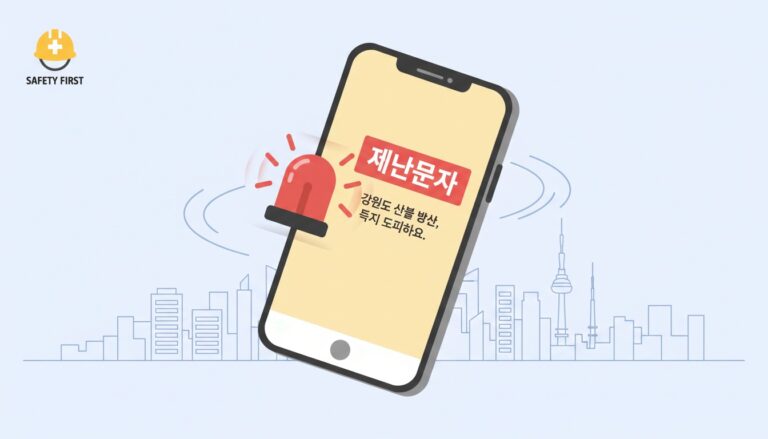
If you’ve spent more than a week in Seoul, you’ve heard it. That ear-piercing, dissonant screech from your smartphone that cuts through the silence of a library or the noise of a subway car. The Disaster Alert (재난문자).
In K-Dramas, this sound often signals a zombie outbreak (All of Us Are Dead) or a monster attack (Hellbound). But in reality? It’s usually heatwave warnings, missing person alerts, or—increasingly—earthquakes (지진).
Korea was long considered a “safe zone” from seismic activity, but the Gyeongju (2016) and Pohang (2017) earthquakes shattered that illusion. Suddenly, the vocabulary of survival wasn’t just for soldiers or civil defense drills; it became essential for everyone ordering a latte in Hongdae.
At a C2 level, we aren’t just learning how to say “Help.” We are looking at how to interpret high-context administrative orders during chaos, and how to command authority when seconds count. When the ground shakes, polite honorifics often crumble alongside the drywall. Let’s learn how to survive.
Phase 2: The Vocabulary of Survival (Deep Dive)
Here are the terms that flash on your screen or blare from loudspeakers. You need to process these instantly.
1. 행동 요령 (Haengdong Yoryeong)
- Pronunciation:
[haeng-dong yo-ryeong]— Think ‘Hang’ (hang glider) + ‘Dong’ (bell) + ‘Yo’ (yoyo) + ‘Ryeong’ (young). - Meaning: Action Guidelines / Code of Conduct
- Literal: Action (Haengdong) + Knack/Trick/Essentials (Yoryeong).
- K-Culture Moment: You’ll see this header on every safety poster in subway stations and apartment elevators. It’s the bureaucratic term for “What to do so you don’t die.”
- Editor’s Insight: This phrase embodies Korean administrative efficiency. It’s not just “rules”; yoryeong implies the smart, effective way to handle something. If someone says you have “no yoryeong” (요령이 없다), they mean you’re working hard but stupidly. In an emergency, you need yoryeong.
- Situation Spectrum:
[🚫 Casual Chat] ———— [✅ Official Notices] ———— [✅ News Reports]
2. 대피소 (Daepiso)
- Pronunciation:
[dae-pi-so] - Meaning: Evacuation Shelter
- K-Culture Moment: In the movie Exit, the protagonists frantically search for rooftop access. That rooftop is a form of daepiso. In reality, your local daepiso is likely a nearby elementary school or gym designated by a yellow sign.
- Editor’s Insight: Don’t confuse this with a bomb shelter (bunker). A daepiso for earthquakes is an open space. Knowing where your nearest one is located is a mark of a true Seoulite.
- 🤔 Think About It: Korea uses the same word, daepiso, for earthquake shelters and civil defense (air raid) shelters. Why might the context be confusing for foreigners, and how does the signage differ? (Hint: Look for the pictogram!)
3. 여진 (Yeojin)
- Pronunciation:
[yeo-jin] - Meaning: Aftershock
- Literal: Remaining (Yeo) + Shake/Tremor (Jin).
- Editor’s Insight: This is the word that causes the most psychological dread. The main event is scary, but the news anchors solemnly warning about yeojin is what keeps people sleeping in their tracksuits.
Phase 3: Textbook vs. Real Life
When the adrenaline hits, the grammar changes. Efficiency trumps etiquette.
| Situation | 📖 Textbook (News/Manuals) | 🗣️ Real Life (Survival Mode) | 💡 Why the shift? |
|---|---|---|---|
| Ordering Cover | 탁자 아래로 몸을 피하십시오. (Please take cover under the table.) | 머리 숙여! 들어가! (Head down! Get in!) | In emergencies, honorifics (Jondaetmal) are dropped for speed. It’s not rude; it’s urgent. |
| Checking Safety | 부상자는 없습니까? (Are there any injured persons?) | 다친 사람? 괜찮아? (Anyone hurt? You okay?) | Dropping the verb ending questions allows for faster scanning of the room. |
| Moving Out | 질서를 지켜 이동해 주십시오. (Please move in an orderly fashion.) | 밀지 마! 천천히! (Don’t push! Slowly!) | “Don’t push” (Milji-ma) is the most critical survival phrase in crowded Korea. |
Bottom Note: If you use the textbook versions in a real panic, you might sound like a robotic AI or a news anchor. Use the Real Life imperatives to be understood immediately.
Phase 4: Cultural Deep Dive
4-1. The “Palli-Palli” Paradox in Safety
Korea is famous for its Palli-Palli (Hurry-Hurry) culture. In business and service, this is great. In an evacuation, it can be dangerous. However, the collective “Nunchi” (reading the room) saves lives. When everyone moves, you move. Do not stand around asking “Is this real?” If the Koreans are running, you run.
4-2. The “Safety Stepping Stone” (안전디딤돌)
If you are tech-savvy in Korea, you don’t just wait for a text. You have the ‘Safety Stepping Stone’ (안전디딤돌) app installed. This is the government’s official disaster app. It has an English interface.
- K-Travel Tip: Even if you don’t speak Korean, having this app allows you to see the map of the nearest Daepiso. It works even when networks are jammed because it downloads the shelter database locally.
Phase 5: Immersive Roleplay
Setting: It’s 2:00 PM on a Tuesday. You are in a high-rise office building in Gangnam. Suddenly, the floor feels like it’s rolling on water. The blinds start slapping against the windows.
Characters:
* YOU: A foreign team lead.
* Min-jae: A younger Korean staff member, looking frozen in panic.
Dialogue:
Min-jae: (Eyes wide, gripping the desk) 어? 어? 땅이 왜 이래요?
(Eo? Eo? Ttang-i wae i-raeyo?)
(Uh? Uh? Why is the ground like this?)
YOU: (Realizing it’s an earthquake) 지진이야! 민재 씨, 얼른 책상 밑으로!
(Jijin-iya! Min-jae-ssi, eolleun chaeksang miteuro!)
(It’s an earthquake! Min-jae, get under the desk, quick!)
Min-jae: (Confused, trying to stand up) 나가야 되는 거 아니에요?
(Nagaya doeneun geo anieyo?)
(Shouldn’t we go outside?)
🔀 Decision Point: Min-jae is trying to run to the elevator. What do you yell?
- A) “엘리베이터는 위험합니다. 타지 마십시오.” (Polite, explaining the logic)
- B) “야! 가지 마! 엎드려!” (Banmal, shouting commands)
- C) “괜찮아요. 진정하세요.” (Calming him down)
✅ Best Choice: B
* Reasoning: In life-or-death moments, an authoritative command (even in Banmal or dropping honorifics) snaps people out of panic. Option A is too slow. Option C is dangerous because it’s not okay.
(Scenario Continues after shaking stops)
YOU: 흔들림 멈췄어. 계단으로 가자. 가방으로 머리 보호해!
(Heundeulrim meomchwosseo. Gyedan-euro gaja. Gabang-euro meori bohohae!)
(The shaking stopped. Let’s use the stairs. Protect your head with your bag!)
Phase 6: 10-Second Shadowing Drill
Practice these until they are muscle memory. The intonation should be sharp and falling (Imperative).
- 😤 Urgent Command:
머리 / 보호해! / 숙여!
(Meori / bohohae! / Sugyeo!)
Protect your head! Get down! -
🚫 Prohibition:
밀지 마세요! / 엘리베이터 / 안 돼요!
(Milji maseyo! / Ellibeiteo / an-dwaeyo!)
Don’t push! Elevator is a no-go!
Phase 7: K-Culture Mini Glossary
| Korean | Romanization | Meaning | Context |
|---|---|---|---|
| 재난 문자 | Jaenan Munja | Disaster Text | The loud alert sent to all phones in a radius. |
| 골든 타임 | Golden Time | Critical Window | Borrowed from medical terms; the crucial first few minutes to save lives. |
| 민방위 | Minbangwi | Civil Defense | The drill sirens you hear on certain Wednesdays. Often confused with earthquakes. |
| 내진 설계 | Naejin Seolgye | Seismic Design | You’ll see this in real estate ads boasting the building is earthquake-proof. |
Phase 8: Traveler’s Survival Kit
If you are traveling, you don’t have a home base. You need to know how to ask for safety on the street.
🆘 Survival Card
* 🇰🇷 “가장 가까운 대피소가 어디예요?”
(Gajang gakkaun daepiso-ga eodiyeyo?)
“Where is the nearest shelter?”
* 🇰🇷 “이 건물 내진 설계 되어 있나요?”
(I geonmul naejin seolgye doeeo innayo?)
“Is this building earthquake-proof?” (Advanced, but good for hotels/Airbnb)
* 💡 Pro Tip: Look for Yellow Signs on walls that say ‘지진 옥외 대피장소’ (Earthquake Outdoor Evacuation Area). Usually school playgrounds or parks.
Phase 9: Think Deeper — “The Boy Who Cried Wolf?”
The Alert Fatigue Phenomenon
In Korea, you receive Jaenan Munja for everything. COVID cases, icy roads, dry air, missing elderly people. At C2 level, we must discuss the social consequence: Desensitization.
When a real earthquake hits, many foreigners notice that locals check their phones with a sigh rather than immediately taking cover. The ubiquity of information has paradoxically lowered the sense of urgency. In your culture, are emergency alerts reserved for extreme danger, or used for general information? How does this affect your reaction time?
Phase 10: FAQ & Troubleshooting
Q: Can I wear my shoes into the shelter if it’s a school gym?
A: Normally, Koreans never wear shoes inside a gym/hall. However, Safety > Etiquette. In an earthquake evacuation, glass and debris are everywhere. Keep your shoes on. Nobody will scold you during a disaster.
Q: I saw a sign for “Chemical/Radioactive Shelter.” Is that for earthquakes too?
A: No. Those are usually underground (subways/basements). For earthquakes, you want Open Spaces (parks/playgrounds) to avoid falling glass. Beware: Going underground during an earthquake can be a trap.
❌ Common Mistake: Running outside immediately when the shaking starts.
✅ Correct Action: Wait for the shaking to stop (Golden Time), then move. Falling signage in Korean streets is a major hazard.
Phase 11: Wrap-up & Action Items
Summary: Today we mastered the urgent imperatives of earthquake survival, understood the difference between Haengdong Yoryeong and reality, and learned why you should keep your shoes on in a Korean gym during a crisis.
Your Mission:
* 🥉 Bronze: Practice yelling “머리 숙여!” (Head down!) convincingly.
* 🥈 Silver: Download the ‘Emergency Ready App’ (Safety Stepping Stone) and find the shelter nearest to your accommodation.
* 🥇 Gold: Next time you’re in a subway station, spot the locker with the gas masks and flashlights. Read the Korean instructions on the front.
K-Culture Mission: Watch the movie
Phase 12: Interactive Quiz
1. Situation Judgment:
Your phone blares the emergency alarm. Your Korean friend looks at it and goes back to sleep. The message says “[Web발신] 폭염 주의보” (Heatwave Advisory). What do you do?
* A) Dive under the table.
* B) Pack your emergency bag.
* C) Go back to sleep/work, but drink water.
2. Vocab Check:
Fill in the blank: “_______을/를 지켜 대피해 주십시오.”
* A) 눈치 (Nunchi)
* B) 질서 (Jilseo – Order/Discipline)
* C) 예의 (Ye-ui – Manners)
Answers:
1. C. Heatwave advisories are common. Don’t panic, just hydrate.
2. B. ‘Maintain order’ is the standard formal instruction.
Frequently Asked Questions (FAQ)
Q: What does "행동 요령 (Haengdong Yoryeong)" mean in Korean and how do you pronounce it?
A: In Korean, "행동 요령 (Haengdong Yoryeong)" is pronounced [haeng-dong yo-ryeong] and means: Action Guidelines / Code of Conduct
Q: What does "대피소 (Daepiso)" mean in Korean and how do you pronounce it?
A: In Korean, "대피소 (Daepiso)" is pronounced [dae-pi-so] and means: Evacuation Shelter
Q: What does "여진 (Yeojin)" mean in Korean and how do you pronounce it?
A: In Korean, "여진 (Yeojin)" is pronounced [yeo-jin] and means: Aftershock







