

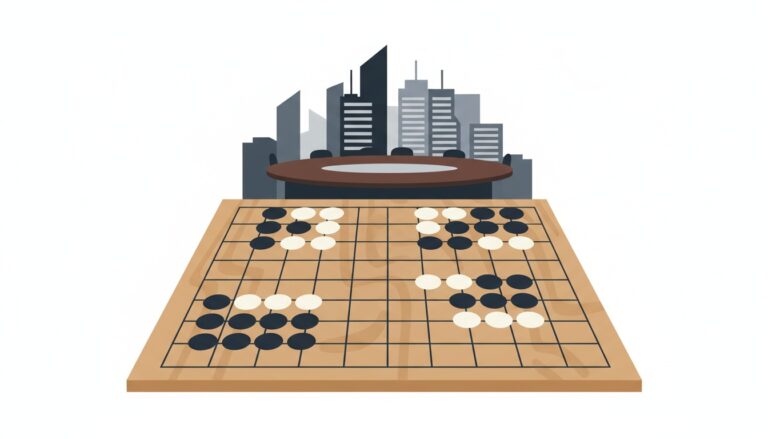
Phase 1: The Hook — More Than Just a Game
Hello! Daily Hangul Editor here.
Remember that scene in The Glory? Moon Dong-eun sits in the park, placing a black stone on the grid with a sharp, satisfying clack. She isn’t just playing a board game; she’s plotting revenge. She says, “I’m building a house where you will suffocate.”
That is the essence of Baduk (바둑). unlike Chess, where you kill the king, Baduk is about territory and survival. It is about building houses and suffocating opponents.
Here is the thing: You might never pick up a Baduk stone in your life, but if you work in a Korean company or watch the news, you are hearing Baduk terms every day. When a CEO talks about a “strategic opening,” they say Poseok. When a politician says they are “risking everything,” they talk about Sahwal.
If you don’t know these words, you are missing the subtext. You are playing checkers while everyone else is playing Go. Let’s upgrade your game.
Phase 2: Deep Dive into Strategy
These terms are high-level (C1). Using them correctly signals intellect and strategic thinking.
1. 포석 (Poseok)
- Pronunciation: [Po-seok] (Sounds like ‘Po’ in ‘Police’ + ‘Sock’)
- Meaning: (Literal) Opening moves in Baduk / (Real) Laying the groundwork; strategic preliminary steps.
- K-Culture Moment: In corporate dramas like Reborn Rich, when a character buys a small, seemingly useless company that turns out to be key to a merger later—that is Poseok.
- Editor’s Insight: This isn’t just “planning.” It implies a long-term vision where the current action might look vague but has a massive payoff later.
- Situation Spectrum:
[🚫 Casual Friends] ———— [⚠️ Colleagues] ———— [✅ Business/News]- 🤔 Think About It: Why does Korean culture value the “opening setup” (indirect preparation) more than the immediate attack? How does this reflect in Korean dating (some-tda) or business negotiations?
2. 사활 (Sahwal)
- Pronunciation: [Sa-hwal]
- Meaning: (Literal) Life and Death / (Real) A make-or-break situation; a matter of vital importance.
- K-Culture Moment: A news anchor reports on a semiconductor deal: “이번 계약에 삼성의 사활이 걸려 있습니다.” (Samsung’s life and death depends on this deal.)
- Editor’s Insight: Often used with the verb 걸다 (to hang/bet). “사활을 걸다” means to go all-in. It’s dramatic and heavy. Don’t use it for ordering lunch.
- Situation Spectrum:
[🚫 Ordering Coffee] ———— [⚠️ Sports] ———— [✅ Serious Discussions]- 🤔 Think About It: The concept of “Sahwal” comes from the idea that a group of stones must have two “eyes” (empty spaces) to live. Does your language have a metaphor that connects survival to spatial structure?
3. 훈수 (Hunsu)
- Pronunciation: [Hun-su]
- Meaning: (Literal) Advice given by a spectator / (Real) Unsolicited advice; backseat driving.
- K-Culture Moment: You are cooking ramyun, and your friend keeps telling you to add the egg now. You snap: “훈수 두지 마!” (Stop coaching me!)
- Editor’s Insight: Koreans have a communal culture where people love to intervene. Hunsu is often annoying, but sometimes necessary. The verb is 두다 (to place/play).
- Situation Spectrum:
[✅ Close Friends] ———— [⚠️ Colleagues] ———— [🚫 Elders]
Phase 3: Textbook vs. Real Life
Textbooks teach you to be polite. Real life teaches you to be strategic.
| Situation | 📖 Textbook Korean | 🗣️ Real Korean (Strategic) | 💡 Why different? |
|---|---|---|---|
| Preparing a project | 준비를 잘 하고 있어요. (We are preparing well.) |
포석을 깔고 있습니다. (We are laying the foundation stones.) |
Poseok implies a hidden, grander strategy rather than just gathering materials. |
| Trying really hard | 최선을 다하겠습니다. (I will do my best.) |
사활을 걸겠습니다. (I will stake my life on it.) |
In high-stakes Korean business, “doing your best” sounds weak. You need desperation. |
| Making a risky move | 위험한 선택이에요. (It’s a dangerous choice.) |
승부수를 띄웠네요. (They launched a ‘winning move’.) |
Seungbusu (승부수) is a gamble made to turn the tide of a losing game. It frames risk as courage. |
Bottom Note: Use “승부수” (Seungbusu) when you want to sound like an analyst or a savvy manager. It turns a reckless decision into a calculated risk.
Phase 4: Cultural Deep Dive — The Art of Nunchi and the Board
4-1. Reading the Board (Reading the Room)
In Baduk, you don’t look at just one stone; you look at the whole board. This is visually identical to Nunchi (눈치).
– Non-verbal Tip: When you drop a heavy word like Sahwal or Seungbusu, pause. Don’t rush the next sentence. Let the weight of the word sink in. In high-context cultures like Korea, the silence after a heavy word is part of the message.
4-2. The “Misaeng” (Incomplete Life) Phenomenon
If you haven’t seen the drama Misaeng, put it on your watchlist. The title comes from a Baduk term meaning “not yet alive” (a group of stones that can still be captured).
– The Connection: Many Korean office workers refer to themselves as Misaeng. They feel incomplete, vulnerable, and constantly fighting for their spot on the “board” of the corporate hierarchy.
– Critical View: Why is life viewed as a survival game? The hyper-competitive nature of Korean society mirrors the zero-sum nature of Baduk. If I gain territory, you lose it.
Phase 5: Immersive Roleplay — The Strategy Meeting
Setting: Monday morning, 10:00 AM. A glass-walled meeting room in Pangyo (Korea’s Silicon Valley). The atmosphere is tense. Sales are down.
Characters:
– YOU (Team Lead): Trying to propose a bold new marketing campaign.
– Director Choi (50s): Conservative, risk-averse, loves Baduk metaphors.
(Dialogue)
Director Choi: (Sighs, tapping his pen) 이번 분기 실적이 엉망이야. 대책 있어?
(Ibeon bungi siljeogi eongmang-iya. Daechaek isseo?)
(Results are a mess this quarter. Any countermeasures?)
YOU: 네, 이사님. 그래서 이번 신제품 런칭에 변화를 좀 주려고 합니다.
(Ne, isanim. Geuraeseo ibeon sinje pum reonching-e byeonhwa-reul jom juryeogo hamnida.)
(Yes, Director. So I’m planning to change the new product launch slightly.)
Director Choi: 변화? 지금 상황에서 위험하지 않겠어?
(Byeonhwa? Jigeum sanghwang-eseo wiheomhaji ankesseo?)
(Change? Isn’t that dangerous right now?)
YOU: 지금은 방어할 때가 아닙니다. 시장 점유율을 가져오기 위해 [ 1 ]를 띄워야 할 때입니다.
(It’s not time to defend. It’s time to launch a [ 1 ] to take market share.)
Director Choi: 허… 자네, 그거 실패하면 우리 팀 공중분해되는 거 알아?
(Huh… You know if that fails, our team disintegrates, right?)
🔀 Your Turn! How do you respond to the threat?
- A) “걱정 마세요. 제가 다 준비했습니다.” (Standard polite)
- B) “네, 알고 있습니다. 그래서 제 사활을 걸고 준비했습니다.” (High impact, risky)
- C) “한번 믿어주세요! 대박 날 거예요!” (Too casual, dangerous)
✅ Best Choice: B
Why? Director Choi is using serious language (
Frequently Asked Questions (FAQ)
Q: What does "포석 (Poseok)" mean in Korean and how do you pronounce it?
A: In Korean, "포석 (Poseok)" is pronounced [Po-seok] and means: (Literal) Opening moves in Baduk / (Real) Laying the groundwork; strategic preliminary steps.
Q: What does "사활 (Sahwal)" mean in Korean and how do you pronounce it?
A: In Korean, "사활 (Sahwal)" is pronounced [Sa-hwal] and means: (Literal) Life and Death / (Real) A make-or-break situation; a matter of vital importance.
Q: What does "훈수 (Hunsu)" mean in Korean and how do you pronounce it?
A: In Korean, "훈수 (Hunsu)" is pronounced [Hun-su] and means: (Literal) Advice given by a spectator / (Real) Unsolicited advice; backseat driving.






