

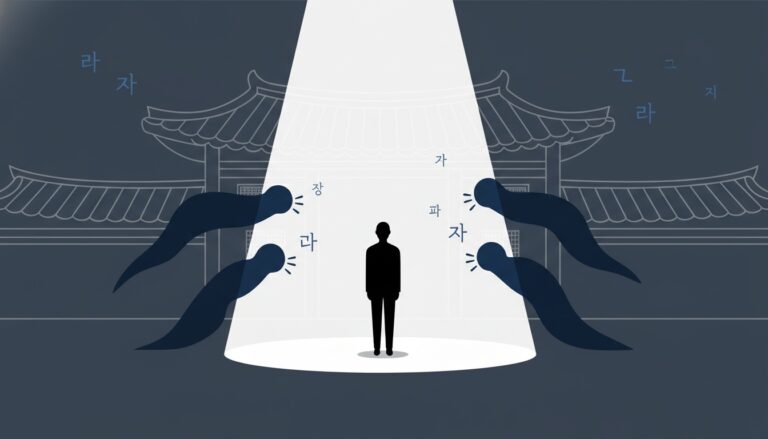
Phase 1: The Scene — “Am I the Crazy One?”
Hello, Daily Hangul readers. Let’s step away from the polished romance of K-Dramas for a moment and look at the script’s darker edges.
You’ve seen this scene a hundred times. A protagonist confronts their partner or boss about a lie. The music drops. The antagonist doesn’t shout. Instead, they sigh, look disappointed, and say softly, “You’re imagining things again.”
Suddenly, the protagonist apologizes.
In Korean, this psychological dismantling—gaslighting—is often wrapped in the velvet glove of hierarchy and affection (Jeong). As an advanced learner, you can order food or give a presentation. But can you detect when the language itself is being weaponized to make you doubt your reality?
Today, we aren’t just learning vocabulary; we are deconstructing the linguistic architecture of manipulation in Korea. Because understanding how someone dominates a conversation is the ultimate fluency.
Phase 2: The Vocabulary of Control
1. “너 예민해” (Neo yeminhae)
- Pronunciation: [Neo ye-min-hae] (Sound analogy: ‘Ye’ like ‘Yes’, ‘min’ like ‘mint’, ‘hae’ like ‘head’ without the ‘d’.)
- Meaning: “You are sensitive.” (Literal) → “Your reaction is irrational, and your feelings are invalid.” (Real Nuance)
- K-Culture Moment: Think of the “evil mother-in-law” trope. When the daughter-in-law politely points out an insult, the mother-in-law replies with this. It shifts the problem from the insult to the victim’s reaction.
- Editor’s Insight: The word 예민하다 (sensitive) is neutral in medical contexts (e.g., sensitive skin). But in relationships, it is the primary tool for reality distortion. It implies you lack “coolness” or social resilience.
- Situation Spectrum:
[🚫 Boss/Elder] ———— [⚠️ Colleague] ———— [✅ Close Friend (Jokingly)] - 🤔 Think About It: Why does Korean society often equate “enduring silently” with maturity? Is being “sensitive” actually a flaw, or is it a defense mechanism against rudeness?
2. “다 너 잘되라고 하는 소리야” (Da neo jal-dwe-ra-go ha-neun so-ri-ya)
- Pronunciation: [Da neo jal-dwe-ra-go ha-neun so-ri-ya]
- Meaning: “I’m saying this so you succeed.” (Literal) → “I am criticizing/controlling you, and you should be grateful for it.” (Real Nuance)
- K-Culture Moment: This is the anthem of the Kkondae (condescending elder). You’ll hear this in office dramas right after a manager destroys a junior’s self-esteem. It frames abuse as mentorship.
- Editor’s Insight: This phrase weaponizes Jeong (affection/bond). If you get angry at this, you aren’t just disagreeing; you are rejecting their “goodwill.” It traps you in a guilt cycle.
3. “나니까 너 받아주지” (Nanikka neo badajuji)
- Pronunciation: [Na-ni-kka neo ba-da-ju-ji]
- Meaning: “I put up with you because it’s me.” (Literal) → “You are unlovable/incompetent, and I am your only savior.” (Real Nuance)
- K-Culture Moment: The toxic boyfriend/girlfriend line. It isolates the victim, making them feel that leaving the relationship means total social abandonment.
- Editor’s Insight: Note the verb 받아주다 (to accept/take in). It implies the speaker is doing charity work by being with you.
Phase 3: Textbook vs. Real Life (The Battle for Reality)
| Situation | 📖 Textbook Response | 🗣️ Real Survival Korean | 💡 The Context |
|---|---|---|---|
| When someone denies what they said | “제 기억과는 다릅니다.” (That differs from my memory.) | “말씀하신 맥락은 그게 아니었잖아요.” (That wasn’t the context you spoke in.) | C2 Level: Don’t argue memory (subjective). Argue context (objective). |
| When called “sensitive” | “그렇게 느끼셨나요?” (Did you feel that way?) | “제 태도가 아니라 사실관계를 말씀드리는 거예요.” (I’m talking about facts, not my attitude.) | Reframes the conversation from emotion back to logic. |
| When told “it’s for your own good” | “감사합니다.” (Thank you.) | “저를 위하신다면 제 의견도 존중해 주세요.” (If it’s for me, please respect my opinion too.) | Uses their own logic (care) against them. |
Bottom Note: In a high-context culture like Korea, direct confrontation is rare. The “Real” examples above are polite but incredibly sharp. They signal, “I know what you are doing.”
Phase 4: Cultural Deep Dive — The Weaponization of Nunchi
In the West, gaslighting is often about lying. In Korea, it’s often about Nunchi (eye-measure/sensing the room).
A manipulator doesn’t have to lie; they just have to imply that you have “bad nunchi.”
- “Everyone else is fine with it, why are you the only one complaining?”
This invokes the fear of breaking group harmony (Inhwa). By framing your valid objection as a failure to read the room, the manipulator rallies the “silent majority” against you. In criminal psychology within Korea, this is distinct from Western gaslighting because it utilizes social shame rather than just memory distortion.
Phase 5: Immersive Roleplay — The Late Night “Hoesik”
Setting: It’s 11:30 PM. A mandatory team dinner (Hoesik). You want to leave. Your boss, Team Leader Park, is pouring another round.
Characters:
* YOU: A capable manager, exhausted but polite.
* Team Leader Park: Uses “loyalty” to control boundaries.
Park: (Laughing loud) 야, 김 매니저! 벌써 가게? 우리 팀워크가 이것밖에 안 돼? 🍺
(Ya, Kim Manager! Beolsseo gage? Uri tim-weo-keu-ga i-geot-ba-kke an dwe?)
(Translation: Hey, Manager Kim! Going already? Is our teamwork only worth this much?)
🔀 Your Turn! How do you escape this trap?
- A) “죄송합니다. 제가 좀 피곤해서요.” (Sorry, I’m a bit tired.)
- B) “팀워크는 내일 업무 성과로 보여드리겠습니다.” (I’ll show you teamwork with my work performance tomorrow.)
- C) “부장님, 저 먼저 갈게요. 안녕히 계세요!” (Manager, I’m leaving first. Bye!)
⚠️ Choice A Analysis: The trap snaps shut. He will reply, “You’re tired? Everyone else is tired too. You’re selfish.”
✅ Best Choice: B. You validate the concept (teamwork) but redefine how it’s measured (work vs. drinking). It cuts the emotional link.
⚠️ Choice C Analysis: Too abrupt for a hierarchical setting unless you plan to quit tomorrow.
Phase 6: 10-Second Shadowing Drill
Don’t just say it. Mean it. Set your boundaries.
- 😤 Firmly & Calmly:
제 감정은 / 제가 판단해요. / 강요하지 마세요.
(Je gam-jeong-eun / je-ga pan-dan-hae-yo. / Gang-yo-ha-ji ma-se-yo.)
I will judge / my own emotions. / Do not force yours on me.
Phase 7: K-Culture Mini Glossary (Psychology Edition)
| Korean | Romanization | English | Context |
|---|---|---|---|
| 가스라이팅 | Ga-seu-ra-i-ting | Gaslighting | A loanword, now widely used in Korea to describe manipulation in dating and workplaces. |
| 갑질 | Gapjil | Power Abuse | The structural foundation that makes gaslighting easy for bosses/elders. |
| 정치질 | Jeong-chi-jil | Office Politics | Literally “doing politics,” usually implies manipulating relationships to isolate someone. |
| 손절 | Son-jeol | Cutting Ties | Originally a stock market term (stop-loss), now used for cutting toxic people out of your life. |
Phase 9: Think Deeper — Language & Power
Language as a Prison:
Korean honorifics (Jondaetmal) create a physical distance. When a senior uses Banmal (casual speech) to a junior who must use Jondaetmal, a psychological dependency is already formed. The senior is the “parent/adult,” and the junior is the “child.”
Gaslighting thrives here because for the junior to point out the senior’s lie, they must often break the grammatical rules of politeness. To accuse a senior of lying is practically a linguistic taboop. This is why “passive-aggressive compliance” is so common in Korean corporate culture—it’s the only safe rebellion.
💬 Your Turn: Does your language have built-in hierarchies that make standing up to authority difficult? Or is everyone grammatically equal? Tell me in the comments.
Phase 10: Troubleshooting & FAQ
Q: My Korean partner says “You’re too sensitive” when I mention cultural differences. Is this gaslighting?
* Editor’s Take: It’s a yellow flag. Sometimes it’s a genuine cultural clash, but if it shuts down all discussion, it’s manipulation. Try saying: “문화 차이가 아니라 존중의 문제입니다” (It’s not about culture difference, it’s about respect).
Q: Can I use the word ‘가스라이팅’ to an elder?
* Answer: 🚫 NO. Saying “Are you gaslighting me?” to a boss/elder is a declaration of war. Use the “Textbook vs. Real Life” circumventions in Phase 3 instead.
Phase 11: Wrap-up & Action Mission
Summary: Korean gaslighting often hides behind “Jeong” (affection) and “Hierarchy.” Don’t let “Teamwork” or “Goodwill” be used to erase your boundaries.
Mission:
* 🥉 Bronze: Practice the Shadowing Drill until you can say it without stuttering.
* 🥈 Silver: Watch a K-Drama scene with a “toxic parent” (e.g., Sky Castle or The Glory) and identify the moment they use the phrase “It’s all for you.”
* 🥇 Gold: If someone pushes a boundary this week (even a small one), use the “Fact vs. Attitude” logic to stand your ground.
Stay sharp, stay sane.
Frequently Asked Questions (FAQ)
Q: What does ""너 예민해" (Neo yeminhae)" mean in Korean and how do you pronounce it?
A: In Korean, ""너 예민해" (Neo yeminhae)" is pronounced [Neo ye-min-hae] and means: "You are sensitive." (Literal) → "Your reaction is irrational, and your feelings are invalid." (Real Nuance)
Q: What does ""다 너 잘되라고 하는 소리야" (Da neo jal-dwe-ra-go ha-neun so-ri-ya)" mean in Korean and how do you pronounce it?
A: In Korean, ""다 너 잘되라고 하는 소리야" (Da neo jal-dwe-ra-go ha-neun so-ri-ya)" is pronounced [Da neo jal-dwe-ra-go ha-neun so-ri-ya] and means: "I'm saying this so you succeed." (Literal) → "I am criticizing/controlling you, and you should be grateful for it." (Real Nuance)
Q: What does ""나니까 너 받아주지" (Nanikka neo badajuji)" mean in Korean and how do you pronounce it?
A: In Korean, ""나니까 너 받아주지" (Nanikka neo badajuji)" is pronounced [Na-ni-kka neo ba-da-ju-ji] and means: "I put up with you because it's me." (Literal) → "You are unlovable/incompetent, and I am your only savior." (Real Nuance)







