

Phase 1: The “Glass Skin” Mission
Hello! I’m your editor at Daily Hangul.
Imagine this: You are walking down the streets of Gangnam. Every third building has a sign with a silhouette of a face. You’ve seen it in K-Dramas—the protagonist walks into a clinic looking tired and walks out glowing like a peeled hard-boiled egg. You want that — the famous Mul-gwang (Water Glow) skin.
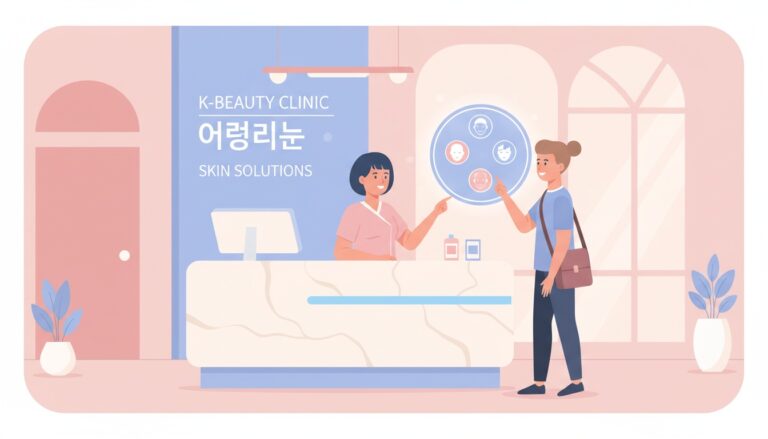
But when you walk up to the marble reception desk, panic sets in. The receptionist is looking at you, waiting. You want to ask for a treatment, but all you remember from your textbook is how to ask where the library is.
Don’t worry. I’ve helped dozens of students navigate this exact moment. Today, we aren’t learning complex grammar. We are learning how to survive the beauty capital of the world without accidentally booking a surgery you didn’t ask for.
Phase 2: The Only 3 Phrases You Need
Let’s keep this simple. You need to get in, say what you want, and ask the most important question of all: “Will this hurt?”
1. 예약했는데요 (Yeyak-haet-neun-de-yo)
- Pronunciation: [Yeh-yak-hen-neh-yo] — Imagine saying “Yeah-yak” like a yak agreeing with you.
- Meaning: I have a reservation / I made an appointment.
- K-Culture Moment: In dramas, the VIP client walks in and just nods. But for us regular folks, we need to announce our arrival. This phrase is the key that opens the door.
- Editor’s Insight: Notice the “-nunde-yo” ending? It’s softer than just saying “I reserved.” It implies, “I made a reservation… (so please check it for me).” It’s polite and expectant.
- Situation Spectrum:
[🚫 Boss] ———— [⚠️ Stranger] ———— [✅ Service Staff]
- Used specifically with staff at clinics, restaurants, or hair salons.
- 🤔 Think About It: Why do Koreans prefer soft endings like “…neundeyo” instead of direct statements? It leaves room for the listener to react.
2. 상담받고 싶어요 (Sangdam-bat-go si-peo-yo)
- Pronunciation: [Sang-dam-bat-go she-po-yo]
- Meaning: I want to get a consultation.
- K-Culture Moment: Before any laser touches your face, you sit in a small room with a “Manager” (Siljangnim). This is where the negotiation happens. This phrase gets you into that room.
- Editor’s Insight: “Sangdam” sounds serious, but in Korea, asking for advice is the first step of any service. You aren’t committing to buying; you are just asking.
- Situation Spectrum:
[🚫 Friends] ———— [✅ Clinics/Banks/Lawyers]
- Use this whenever you need professional advice.
3. 많이 아파요? (Mani a-pa-yo?)
- Pronunciation: [Ma-nee Ah-pa-yo?]
- Meaning: Does it hurt a lot?
- K-Culture Moment: You’re lying on the bed, looking at a scary machine. The nurse applies cooling gel. This is the question everyone asks, even tough guys in movies.
- Editor’s Insight: Be prepared for the answer “Ttakkeum-haeyo” (It stings a little). Spoiler: In Korean beauty standards, “little” is relative.
- 🤔 Think About It: Koreans often say “Siwon-hada” (It’s refreshing/cool) even when getting a painful massage. Why is pain sometimes equated with relief in Korean culture?
Phase 3: Textbook vs. Real Life
Textbooks are polite. Gangnam streets are fast.
| Situation | 📖 Textbook Korean | 🗣️ Real Korean | 💡 Why is it different? |
|---|---|---|---|
| Arriving | “저는 피부과 치료를 받고 싶습니다.” (I wish to receive dermatological treatment.) | “점 퉠러 왔어요.” (I came to pop out a mole.) | Koreans are specific. We state the exact purpose immediately. |
| Asking Price | “이 시술은 가격이 얼마입니까?” (What is the price of this procedure?) | “이거 얼마예요? 이벤트 해요?” (How much is this? Any events/promos?) | Clinics always have monthly “events” (discounts). asking shows you’re smart. |
| During Pain | “너무 아프므니다.” (It is too painful.) | “아! 잠깐만요!” (Ah! Wait a second!) | When it hurts, grammar goes out the window. Short and loud works best. |
Phase 4: Cultural Context — The “Factory” System
4-1. Nunchi (Eye-measure) at the Reception
In popular clinics, speed is everything. It might feel rushed compared to clinics in the West. This isn’t rude; it’s efficiency. Use your nunchi. Have your passport ready (for tax refunds!) and don’t tell your whole life story. Just the symptoms.
4-2. The K-Drama Connection: The Makeover
You know that scene where the main character gets a makeover after a breakup? It usually starts here. In Korea, taking care of your skin is seen as “managing yourself” (Jagi-gwalli). It’s less about vanity and more about showing diligence.
Phase 5: Roleplay — At “Gangnam Glow” Clinic
Setting: A bright, white clinic in Seoul. K-Pop ballads are playing softly. You approach the desk.
Receptionist: 어서 오세요. 예약하셨어요? (Welcome. Did you make a reservation?)
YOU: 네, 2시에 [예약했는데요].
(Ne, 2-si-e yeyak-haet-neun-de-yo.)
(Yes, I have a reservation at 2.)
Receptionist: 성함이 어떻게 되세요? (May I have your name?)
YOU: 제시카입니다. (It’s Jessica.)
Receptionist: 네, 제시카 님. 오늘 어떤 것 때문에 오셨어요? (Jessica-nim, what brings you here today?)
🔀 Decision Point! How do you reply?
- A) “피부가 나빠요.” (My skin is bad.)
- B) “상담받고 싶습니다.” (I want a consultation.)
- C) “예쉘어요?” (Are you pretty? – Wait, wrong word!)
✅ Best Choice: B. It’s the standard procedure. You talk to a consultant first, then the doctor.
⚠️ Choice A Analysis: Grammatically okay, but a bit vague. The receptionist needs to know if you want a laser, botox, or a facial.
(Selecting B)
Receptionist: 네, 잠시만 기다려 주세요. (Okay, please wait a moment.)
Phase 6: 10-Second Shadowing Drill
Practice this before you walk in. Emotion: Slightly nervous but polite.
🙂 저 / 상담 받고 싶은데요 / 많이 아프까요?
(Jeo / sang-dam bat-go si-peun-de-yo / ma-nee a-peu-kka-yo?)
“I’d like to get a consultation… will it hurt a lot?”
Phase 7: K-Culture Mini Glossary
| Korean | Romanization | Meaning | Context |
|---|---|---|---|
| 물광 | Mul-gwang | Water Glow | The shiny, dewy skin look famous in K-Beauty. |
| 실장님 | Sil-jang-nim | Manager | The person who consults on price and procedures before the doctor. |
| 이벤트 | Event | Promotion | Special discounts. Always ask, “Event haeyo?” |
| 재생 크림 | Jaesaeng Cream | Recovery Cream | Expensive cream they will tell you to buy after laser. |
Phase 8: Traveler’s Survival Kit — The Tax Refund Hack
Here is the pro tip that saves you money.
🆘 Survival Phrase #1
– 🇰🇷 “택스 리펀 되나요?” (Tax refund doenayo?)
– 🗣️ Pronunciation: [Tex-u re-fun dwae-na-yo]
– 📍 Where: Payment desk.
– 💡 Pro Tip: Many cosmetic procedures in Korea are eligible for a VAT refund (around 7-8% back). You must bring your physical passport to the clinic.
Phase 9: Think Deeper — The “Beauty” Pressure
Topic: Lookism & Competitiveness
Walking through Seoul, you will notice people dress well and take care of their skin aggressively. Why? In Korea, appearance is often considered a part of “competitiveness” (Gyeong-jaeng-ryeok). It’s not just about vanity; it’s about showing that you are diligent and self-disciplined. When you see a “men’s skin clinic,” remember that for many Korean men, clear skin helps in job interviews.
💬 Your Turn: In your culture, is skincare seen as “health” or “vanity”? Let me know in the comments!
Phase 10: FAQ & Troubleshooting
Q: Do I need to tip the doctor or nurse?
A: Absolutely not. Korea is a no-tipping culture. If you try to give money, they will look confused or even offended. A sincere “Thank you” (감사합니다) is enough.
Q: Can I negotiate the price?
A: At a hospital? Generally no. But at a cosmetic clinic (which is a business), you can ask about “Events” or package deals. “Discount jom haejuseyo” (Please give a discount) might work if you are doing multiple treatments.
❌ Common Mistake #1: Wearing full makeup to the appointment.
✅ Fix: Go with a bare face if possible. They will ask you to wash it off anyway.
Phase 11: Wrap-up & Mission
Summary: Today we learned how to book (예약), consult (상담), and check pain levels (아프까요) at a Korean clinic.
🏆 Action Mission:
– 🥉 Bronze: Say “예약했는데요” out loud 3 times while looking in the mirror.
– 🥈 Silver: Go to a Korean cosmetic brand website and find the word “이벤트” (Event).
– 🥇 Gold: Walk into a clinic in Korea (or a Korean spa in your country) and ask about a consultation!
🎭 K-Culture Mission: Watch a “Get Ready With Me” (GRWM) video by a Korean Youtuber. Count how many times they say “시원해요” (It’s cool/refreshing) when applying toner!
Phase 12: Quick Quiz
- Situation: The receptionist asks for your name. You say:
- A) 예약했어요.
- B) [Your Name]입니다.
- C) 아프까요?
- True or False: You should tip the nurse if the laser didn’t hurt.
- (T / F)
(Scroll down for answers)
.
.
.
Answers:
1. B (A is “I reserved”, C is “Does it hurt?”)
2. False (No tipping in Korea!)
Frequently Asked Questions (FAQ)
Q: What does "예약했는데요 (Yeyak-haet-neun-de-yo)" mean in Korean and how do you pronounce it?
A: In Korean, "예약했는데요 (Yeyak-haet-neun-de-yo)" is pronounced [Yeh-yak-hen-neh-yo] and means: I have a reservation / I made an appointment.
Q: What does "상담받고 싶어요 (Sangdam-bat-go si-peo-yo)" mean in Korean and how do you pronounce it?
A: In Korean, "상담받고 싶어요 (Sangdam-bat-go si-peo-yo)" is pronounced [Sang-dam-bat-go she-po-yo] and means: I want to get a consultation.
Q: What does "많이 아파요? (Mani a-pa-yo?)" mean in Korean and how do you pronounce it?
A: In Korean, "많이 아파요? (Mani a-pa-yo?)" is pronounced [Ma-nee Ah-pa-yo?] and means: Does it hurt a lot?







