

Hello! It’s your editor from Daily Hangul.
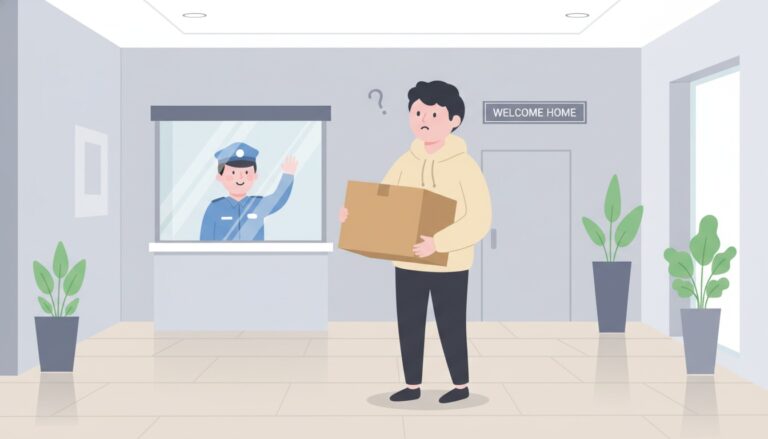
Imagine this: You’ve finally signed the papers for your new officetel or apartment in Seoul. The moving truck has left. You are standing in your new living room, surrounded by boxes. You have a mountain of cardboard and styrofoam to throw away, but you realize you have no idea where the recycling area is. Or maybe the digital door lock is beeping weirdly.
In K-Dramas, the protagonist usually runs into a grumpy but secretly warm-hearted security guard in a small booth who knows everything. In reality? You need to find that person immediately. If you don’t, you might get a stern note stuck to your door about “improper trash disposal.”
Today, let’s learn how to survive your first day in a Korean building by finding the Management Office.
1. 관리실이 어디예요? (Gwallisil-i eodiyeyo?)
Meaning: Where is the management office?
- Pronunciation: Gwal-li-sil-i / uh-dee-yay-yo? (The ‘ll’ in Gwallisil sounds a bit like the ‘l’ in ‘lily’.)
- The Vibe: This is your lifeline. The 관리실 (Gwallisil) is the control center of the building. They handle parking, trash complaints, maintenance, and package deliveries.
- K-Culture Moment: You know those scenes in thrillers like Sweet Home where the residents gather in the lobby or office? That’s the space we are talking about. In rom-coms, it’s where the lead character goes to complain about the noise from the upstairs neighbor.
- Situation Spectrum:
[🚫 Formal Boss] ———— [✅ Stranger/Neighbor] ———— [✅ Friend]
(This is a standard polite phrase. Safe to use with anyone.)
2. 경비 아저씨 (Gyeongbi-ajeossi)
Meaning: Security Guard (Mr. Security Guard)
- Pronunciation: Gyeong-bi / ah-juh-ssi
- Editor’s Insight: You don’t usually call them “Security Officer.” You call them “Ajeossi” (middle-aged man/uncle). While ajeossi can be rude if you yell it at a random guy in a suit in Gangnam, it is the standard, friendly title for the security guard in your building. Just say it with a smile.
- 🤔 Think About It: Why do Koreans use family titles like “Uncle” (Ajeossi) or “Aunt” (Imo) for strangers? It blurs the line between public and private, making the community feel tighter—even if you’ve never met before.
📖 Textbook vs. 🗣️ Real Life
| Situation | 📖 Textbook Korean | 🗣️ Real Korean | 💡 Why different? |
|---|---|---|---|
| Asking for help | 관리실이 어디에 있습니까? (Where is the office located?) | 저기요, 관리실 어딨어요? (Excuse me, where’s the office?) | “~습니까?” is too military/stiff. “~yo?” is polite enough. |
| Reason for visiting | 쓰레기봉투 때문에 왔습니다. (I came because of trash bags.) | 쓰레기… 어떻게 버려요? (Trash… how do I throw it away?) | Koreans often state the problem directly rather than the noun. |
🇰🇷 Cultural Context: The “Nunchi” of Trash
If you ask for the management office, 90% of the time it’s about parking or trash. Korea has one of the strictest recycling systems in the world.
- The Scenario: You can’t just throw things out. You need specific standard garbage bags (Jongnyangje) sold at convenience stores.
- Non-verbal Tip: When approaching the Gyeongbi-ajeossi, a slight bow is mandatory. If you hand him a small drink (like Vita500) while asking for help, you will instantly become his favorite resident. This is Jeong (affection/attachment) in action.
🎭 Roleplay: The First Day Panic
Setting: The first floor of your apartment building. You are holding a confused-looking bag of trash. You see a neighbor.
YOU: 저기요… 죄송한데요. (Excuse me… I’m sorry to bother you.)
(Jeo-gi-yo… joe-song-han-de-yo.)
Neighbor (Minji): 네? 무슨 일이세요? (Yes? What’s up?)
YOU: 제가 오늘 이사 왔어요. 관리실이 어디예요? (I moved in today. Where is the management office?)
(Je-ga o-neul i-sa wa-sseo-yo. Gwallisil-i eodiyeyo?)
Neighbor (Minji): 아! 지하 1층에 있어요. 엘리베이터 옆에요. (Ah! It’s on B1. Next to the elevator.)
🔀 Your Turn! The neighbor seems nice. What do you add?
* A) “감사합니다. 안녕히 계세요.” (Thank you. Goodbye.)
* B) “쓰레기는 어디에 버려요?” (Where do I throw the trash?)✅ Best Choice: B. You have the neighbor’s attention, and she lives here. She knows the rules better than anyone. Save yourself a trip to the basement!
🗣️ 10-Second Shadowing Drill
Let’s practice asking naturally. Don’t be a robot—sound a little confused!
- Emotion: 😥 Confused & Polite
- Line: 저기요 / 관리실이 / 어디예요? (Excuse me… / the management office / where is it?)
- Pronunciation: Jeo-gi-yo / Gwal-li-sil-i / eo-di-ye-yo?
🧳 Traveler’s Survival Kit
Even if you aren’t living in Korea, knowing how to ask “Where is X?” is crucial.
🆘 Survival Phrase #1
* 🇰🇷 “화장실이 어디예요?” (Hwajangsil-i eodiyeyo?)
* 🗣️ Meaning: Where is the bathroom?
* 📍 Where to use: Restaurants, subway stations, cafes.
* 💡 Pro Tip: In older buildings, the bathroom key is often hanging on the wall near the counter. You have to take it with you!
🧠 Think Deeper: The Power of “Ajeossi”
Let’s look at the word Ajeossi. In dictionaries, it means “middle-aged man.” In movies like The Man from Nowhere (Korean title: Ajeossi), it’s a title of protection. But in internet slang, Ggae-jeossi (Ajeossi who lacks manners) is an insult.
Why does this one word carry so much weight? It reflects Korea’s hierarchical society where age and gender dictate how we address each other. Calling a security guard Ajeossi is respectful of his age and role. But calling a young, fashionable man on the street Ajeossi? You might offend him. He wants to be called Oppa (older brother) or Haksaeng (student), regardless of his actual age.
🔧 Troubleshooting & FAQ
- Q: Can I use “Excuse me” (Silryehamnida) instead of “Jeogiyo”?
- A: You can, but Silryehamnida sounds very formal, like you are interrupting a CEO meeting. Jeogiyo is perfect for catching someone’s attention on the street or in a building.
- Q: The security guard is sleeping. Should I wake him up?
- A: Unless it’s an emergency (fire, water leak), wait. Korean security guards often work 24-hour shifts. Let the Ajeossi rest if it’s just about a recycling question!
📝 Your Mission
- Bronze: Say “Gwallisil-i eodiyeyo?” three times while imagining you are holding a heavy box.
- Silver: Open Naver Maps or Kakao Maps, search for an apartment complex in Seoul, and try to spot the small building at the entrance. That’s the Gyeongbisil (Security Office)!
- Gold: If you are in Korea, ask a staff member at your hotel or accommodation: “Gwallisil-i eodiyeyo?” just to see where they point.
Comment below: In your country, who do you call when you have a problem with your apartment? The landlord? The super? Tell me!
Frequently Asked Questions (FAQ)
Q: What does "관리실" mean in Korean and how do you pronounce it?
A: In Korean, "관리실" is pronounced [Gwallisil] and means: is the control center of the building. They handle parking, trash complaints, maintenance, and package deliveries.
Q: What does ""화장실이 어디예요?"" mean in Korean and how do you pronounce it?
A: In Korean, ""화장실이 어디예요?"" is pronounced [Hwajangsil-i eodiyeyo?] and means: * 🗣️







