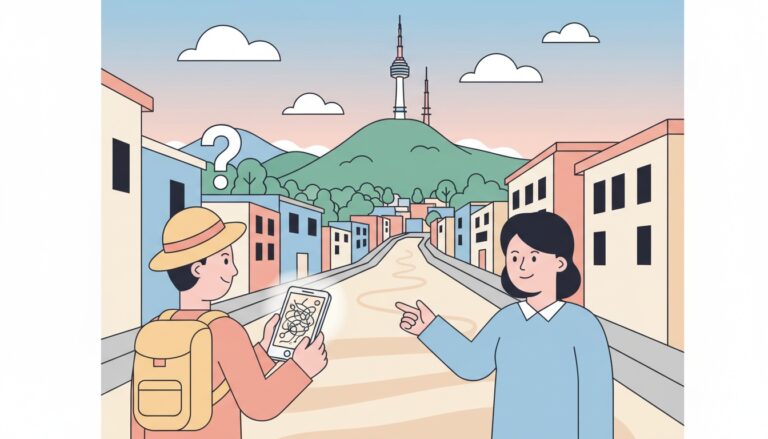
Phase 1: The “Is It Far?” Dilemma
Hello! This is your Daily Hangul Editor.
Let me paint a picture you’ve likely seen in a hundred K-Dramas. The protagonist just missed the bus. They are desperate. They grab a passing stranger’s arm (gently, please) and ask, “Where is Namsan Tower?” The stranger points vaguely and says, “It’s just over there.”
Cut to the next scene: The protagonist is sweating, climbing a 45-degree hill, gasping for air.
Here is the truth about traveling in Korea: Distance is relative, and Seoul is full of hills. When a Korean says “It’s near,” they might mean “It’s near for me, because I walk fast and hike mountains on weekends.”
Today, we aren’t just learning how to ask “How many minutes?” We are learning how to ask, “Is this walk actually going to kill me, or is it a nice stroll?” Let’s survive the streets of Seoul together.
Phase 2: The Core Expressions (Deep Dive)
Here are the three ways to ask about walking distance, ranked from “Textbook” to “Local Pro.”
1. 걸어서 얼마나 걸려요? (Georeoseo eolmana geollyeoyo?)
- Pronunciation: Guh-ruh-suh / ol-ma-na / gyul-lyuh-yo?
- Tip: “Geol” sounds a bit like “Gull” (as in seagull).
- Meaning: How long does it take by walking? (Literal)
- The Vibe: This is your standard, safe, polite question. You can use this with anyone—a convenience store clerk, a police officer, or a passerby.
- Situation Spectrum:
[🚫 Formal Boss] ———— [⚠️ Colleague] ———— [✅ Stranger/Friend](Safe for most!) - Editor’s Insight: The key word here is ‘Georeoseo’ (by walking). If you just ask “Eolmana geollyeoyo?” they might answer with the taxi time or subway time. Be specific!
- 🤔 Think About It: Korean verbs often change based on the method of transport. Why do you think specifying the method (walking) comes at the very beginning of the sentence?
2. 여기서 멀어요? (Yeogiseo meoreoyo?)
- Pronunciation: Yuh-ghi-suh / muh-ruh-yo?
- Meaning: Is it far from here?
- K-Culture Moment: Think of a variety show where the cast is dropped in the middle of nowhere. They look around, bewildered, and ask the PD (Producer), “Is the basecamp far?” (Spoiler: It’s always far).
- Editor’s Insight: This is a “feeling” question. You aren’t asking for minutes; you’re asking for the psychological distance. The answer will usually be “Not far” (An meoreoyo) or “A bit far” (Jom meoreoyo).
- Situation Spectrum:
[✅ Casual/Polite]
3. 걸어서 갈 만해요? (Georeoseo gal manhaeyo?)
- Pronunciation: Guh-ruh-suh / gal / man-hae-yo?
- Meaning: Is it walkable? (Is it worth walking?)
- The “Real” Nuance: This is the MVP expression. You are implicitly asking: “Are there steep hills?” “Is the road dangerous?” “Is it too hot to walk?”
- Editor’s Insight: If you use this, the local will look at you with respect. It shows you understand that just because something is 1km away doesn’t mean it’s an easy walk.
- Situation Spectrum:
[✅ Most Daily Situations]
Phase 3: Textbook vs. Real Life
| Situation | 📖 Textbook Korean | 🗣️ Real Korean | 💡 Why the difference? |
|---|---|---|---|
| Asking time | 도보로 몇 분 소요됩니까? (Dobo-ro myeot bun soyo-doemnikka?) | 걸어서 얼마나 걸려요? (Georeoseo eolmana geollyeoyo?) | “Dobo” and “Soyo” are written/news words. Nobody speaks like a news anchor on the street. |
| Checking possibility | 걸어갈 수 있어요? (Georeogal su isseoyo?) | 걸어서 갈 만해요? (Georeoseo gal manhaeyo?) | “Can I walk?” asks about physical ability. “Is it worth walking?” asks about the quality of the route. |
| Short distance | 가깝습니다. (Gakkapseumnida.) | 금방 가요. (Geumbang gayo.) | “Geumbang” suggests speed and ease, not just physical distance. |
Bottom Note: Unless you are writing a police report, avoid “Dobo” (on foot). Stick to “Georeoseo”.
Phase 4: Cultural Deep Dive — The “Korean 10 Minutes”
4-1. The “Palli-Palli” Pace
Koreans are fast walkers. Seoul was ranked as one of the cities with the fastest walking speeds in the world.
* The Trap: If a local tells you, “It takes about 10 minutes,” consider your own walking pace. If you are a leisurely walker, that’s a 15-20 minute walk for you.
* The Hill Factor: Seoul is 70% mountains. A “short walk” might involve a staircase that looks like it leads to heaven. This is why Expression #3 (Gal manhaeyo?) is crucial. It filters out the vertical hikes.
4-2. Non-verbal Pointing
When a Korean gives you directions:
* They will rarely point with a single index finger (it can feel accusing).
* They often use an open hand to gesture the direction.
* Watch the eyes: If they look hesitant while saying “It’s close,” check your map. They might just be trying to be polite and not disappoint you.
Phase 5: Immersive Roleplay
Setting: It is a humid summer afternoon in Hongdae. You are looking for a famous cafe that is hidden in an alleyway. You stop a university student.
Characters:
* YOU: Thirsty, slightly lost tourist.
* Student: A helpful local carrying an iced Americano.
Dialogue:
YOU: 저기요, 실례합니다. 혹시 이 카페 아세요?
(Jeogiyo, sillyehamnida. Hoksi i kape aseyo?)
(Excuse me. By any chance, do you know this cafe?)
Student: (Looking at your phone) 아, 여기요? 음… 알 것 같아요.
(Ah, yeogiyo? Eum… al geot gatayo.)
(Ah, here? Hmm… I think I know it.)
YOU: 여기서 걸어서 얼마나 걸려요?
(Yeogiseo georeoseo eolmana geollyeoyo?)
(How long does it take to walk from here?)
Student: 걸어서요? 음… 한 15분? 근데 좀 더울 텐데…
(Georeoseoyo? Eum… han sib-o-bun? Geunde jom deoul tende…)
(Walking? Hmm… about 15 minutes? But it might be a bit hot…)
🔀 Decision Point! The student hints it’s hot. How do you respond?
- Option A: “아, 괜찮아요. 감사합니다!” (Brave the heat)
- Option B: “아, 그래요? 그럼 택시 타는 게 나을까요?” (Ask for a better option)
- Option C: “뛰어가면 얼마나 걸려요?” (The “Running Man” approach)
✅ Best Choice: Option B.
(Ah, geuraeyo? Geureom taeksi taneun ge naeulkkayo?)
Why? When a Korean says “It might be hot/far,” it is a polite warning code for “Don’t walk, you will melt.” Option B shows you caught their nunchi (social cue).
Phase 6: 10-Second Shadowing Drill
Let’s practice the flow. Remember, raise your intonation at the end politely!
Emotion: 🤔 Curious & slightly worried (Don’t sound aggressive!)
- Expression: 여기서 / 걸어서 / 갈 만해요?
- Romanization: Yeogiseo / georeoseo / gal manhaeyo?
- Breakdown: From here / by walking / is it doable?
Phase 7: K-Culture Glossary
| Korean | Romanization | Meaning | Context |
|---|---|---|---|
| 언덕 | Eondeok | Hill | The archnemesis of travelers in Seoul. Gangnam and Itaewon are full of them. |
| 골목 | Golmok | Alleyway | Where the best restaurants are hidden. |
| 지름길 | Jireumgil | Shortcut | Locals know these. If someone says “Jireumgil-ro gaseyo,” follow them. |
| 역세권 | Yeoksegwon | Station Area | A real estate term meaning “close to the subway.” If a place is Yeoksegwon, it’s very walkable. |
Phase 8: Traveler’s Survival Kit
Walking in Korea? You need these tools.
🆘 Survival Phrases #1
* 🇰🇷 “이 근처에 지하철역 있어요?” (I geuncheo-e jihacheol-yeok isseoyo?)
* 🗣️ Meaning: Is there a subway station nearby?
* 📍 Use when: You gave up on walking and just want to leave.📌 Editor’s Travel Note: The Map App War
* Google Maps: Works poorly in Korea for walking directions due to government data regulations. It often doesn’t show walking paths correctly.
* Naver Map / Kakao Map: These are essential. They show accurate walking times, construction sites, and even the number of stairs at subway exits!
Phase 9: Think Deeper — Why “Walkable” is Subjective
Media vs. Reality: In K-Dramas, couples often have romantic walks along the Han River or the stonewall paths of Deoksugung. However, the reality of Korean city life is efficiency.
The phrase “Gal manhaeyo?” (Is it doable?)” perfectly encapsulates the modern Korean mindset. We calculate the “cost-benefit” of movement. Is the sweat and time worth the walk? Or should I pay 4,800 won for a taxi? It’s not just about distance; it’s about energy efficiency in a hyper-busy society.
💬 Your Turn: In your country, what is the maximum time you would walk before calling a taxi? 10 minutes? 30 minutes? Tell me in the comments!
Phase 10: FAQ & Troubleshooting
Q: Can I use “Georeoseo gal manhaeyo?” to an older person?
A: Yes! It uses the polite ending “-yo”. It sounds friendly but respectful. Just bow slightly when you ask.
Q: What if I don’t understand their answer?
A: If they talk too fast, just ask: “Meoreoyo?” (Far?). If they shake their head “No,” keep walking. If they nod and make a pained face, take a taxi.
❌ Common Mistake: Asking “How many meters/kilometers?”
✅ Correction: Most people don’t know the exact distance in meters. Stick to time (minutes) or effort (walkable).
Phase 11: Wrap-up & Action
Summary: Today we learned to ask not just about time (Eolmana geollyeoyo?) but about the quality of the walk (Gal manhaeyo?).
🚀 Action Missions:
* 🥉 Bronze: Look at your local grocery store on a map. Say out loud: “Georeoseo gal manhaeyo?”
* 🥈 Silver: Download Naver Map. Search for a location in Seoul (e.g., Gangnam Station to COEX) and check the walking route.
* 🥇 Gold: Next time you are out, ask a friend, “Yeogiseo [Destination] georeoseo eolmana geollyeoyo?” (Even if you speak English, mix it in!)
K-Culture Mission: Watch an episode of a Korean travel reality show (like Earth Arcade or Adventure by Accident). Watch how they ask locals for directions!
Phase 12: Quiz — Interactive Challenge
1. Situation: You are in Gangnam. A local tells you a cafe is “Right over there” but points toward a steep hill. What is the best question to ask to be safe?
* A) 지금 몇 시예요? (What time is it?)
* B) 걸어서 갈 만해요? (Is it walkable?)
* C) 이름이 뭐예요? (What is your name?)
2. True or False (K-Culture):
* “If a Korean says it takes 10 minutes to walk, it will probably take you 5 minutes because you are faster.”
* (True / False)
Answers:
1. B) You need to know if that hill is worth climbing!
2. False. Koreans usually walk very fast. If they say 10 minutes, expect 15!
Frequently Asked Questions (FAQ)
Q: What does "걸어서 얼마나 걸려요? (Georeoseo eolmana geollyeoyo?)" mean in Korean and how do you pronounce it?
A: In Korean, "걸어서 얼마나 걸려요? (Georeoseo eolmana geollyeoyo?)" is pronounced [Guh-ruh-suh / ol-ma-na / gyul-lyuh-yo?] and means: a key conversational Korean expression covered in this lesson.
Q: What does "여기서 멀어요? (Yeogiseo meoreoyo?)" mean in Korean and how do you pronounce it?
A: In Korean, "여기서 멀어요? (Yeogiseo meoreoyo?)" is pronounced [Yuh-ghi-suh / muh-ruh-yo?] and means: Is it far from here?
Q: What does "걸어서 갈 만해요? (Georeoseo gal manhaeyo?)" mean in Korean and how do you pronounce it?
A: In Korean, "걸어서 갈 만해요? (Georeoseo gal manhaeyo?)" is pronounced [Guh-ruh-suh / gal / man-hae-yo?] and means: Is it walkable? (Is it worth walking?)