

🚨 “WEE-WOO!” Why is my phone screaming? Surviving a Korean Typhoon
Phase 1: The Panic (and Calm)
Greeting: Hello! Your Daily Hangul Editor here.
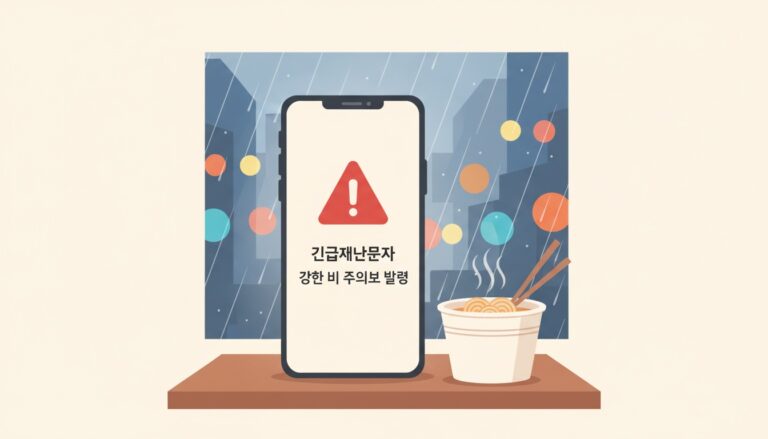
Picture this: You are sitting in a cozy cafe in Hongdae, sipping an iced Americano. Suddenly, a piercing siren sound goes off. It’s not just your phone—it’s everyone’s phone. The entire cafe starts buzzing at once. You look at your screen, but it’s a wall of Korean text with a [Emergency Alert] header.
Panic? Nope. Not on my watch.
This is the quintessential “Re-nan Moon-ja” (Disaster Text) experience. In Korea, summer and early autumn bring the Typhoon (Taepung) season. While K-Dramas might make rain look romantic (cue the slow-motion umbrella scene), real Korean typhoons are serious business. But here’s the secret: Koreans handle this with a mix of intense preparation and calm “Jip-kok” (staying home) vibes.
Don’t worry about the siren. Today, I’ll teach you how to understand what’s happening and how to stay safe—and polite—during the storm.
Phase 2: The “Save Your Life” Phrases
1. 태풍이 와요 (Taepung-i wayo)
- Pronunciation: [Tae-pung-i wa-yo] (Sounds like: Taekwondo + poong like a gust of wind + ee + wah-yo)
- Meaning: A typhoon is coming. (Literal: Typhoon comes.)
- Editor’s Insight: You will hear this everywhere—news, taxi drivers, convenience store owners. It’s the headline of the day.
- Situation Spectrum:
[🚫 Formal] ———— [✅ Casual/Polite] ———— [✅ Friendly] - 🤔 Think About It: Why is the verb “to come” (oda) used for weather? It treats the storm almost like a guest—an unwanted one, perhaps, but a guest nonetheless.
2. 나가지 마세요 (Nagaji maseyo)
- Pronunciation: [Na-ga-ji ma-se-yo] (Sounds like: Nah, don’t go + gee + ma + say-yo)
- Meaning: Please don’t go out.
- K-Culture Moment: In disaster movies (like Tunnel or Exit), there’s always that one character who ignores this warning and opens the door. Don’t be that character.
- Editor’s Insight: The
~ji maseyoending is the magic key for “Please don’t do X.” It’s firm but polite. You’ll see this on safety signs too. - Situation Spectrum:
[🚫 Boss to You] ———— [✅ You to Friend] ———— [✅ Safety Warning]
3. 조심하세요 (Josim-haseyo)
- Pronunciation: [Jo-sim-ha-se-yo] (Sounds like: Joe + shim + ha + say-yo)
- Meaning: Be careful / Watch out.
- K-Culture Moment: When K-Pop idols end a live stream during rainy season, they almost always say this to fans. “Car watch out! Rain watch out!”
- Editor’s Insight: This is the “God bless you” of Korean safety. It shows you care. If you say this to a cashier or taxi driver on a stormy day, they will look at you with warm, surprised eyes.
Phase 3: Textbook vs. Real Life
| Situation | 📖 Textbook Korean | 🗣️ Real Korean (Insa Style) | 💡 Why the difference? |
|---|---|---|---|
| Staying home | 집에 있을 거예요. (I will be at home.) | 오늘 집콕이야. (Today is Jip-kok.) | “Jip-kok” is a slang combining “House” + “Stuck in corner.” It implies cozying up safely. |
| Heavy rain | 비가 많이 옵니다. (Rain is coming a lot.) | 비 장난 아니야. (The rain is no joke.) | Koreans love using “Not a joke” (Jangnan aniya) to emphasize intensity. |
| Asking safety | 안전합니까? (Is it safe?) | 괜찮아요? (Are you okay?) | “Safe” sounds like a technical report. “Okay” checks on the person’s feelings and state. |
Phase 4: Cultural Deep Dive — The “Delivery” Dilemma
4-1. The Unspoken Rule of K-Delivery
In Korea, you can get anything delivered—Fried Chicken (Chimaek), Jjajangmyeon, Pizza—at any hour. BUT, during a typhoon, there is a massive cultural debate.
The Rule: If the weather is bad enough to make you scared to go out, do not order delivery.
Why? Because ordering food puts the delivery rider (usually on a motorbike) in danger. In K-Dramas, the hero risks it all for love. In real life, we don’t want riders risking it all for your fried chicken. If you order during a storm, you might get labeled as a “Gap-jil” (abusing power) customer. Stick to the ramyeon you bought yesterday!
4-2. The Sound of Safety
That loud siren sound on your phone? That’s the Emergency Disaster Text. It bypasses silent mode. Don’t be annoyed; be impressed. It’s a sign of how wired and responsive Korean infrastructure is. It usually tells you which districts to avoid or advises against entering mountainous areas.
Phase 5: Survival Roleplay — The Guesthouse Storm
Setting: A cozy guesthouse in Jeju Island. Wind is howling outside, rattling the windows. It’s 7 PM.
Characters:
– YOU: Hungry traveler who wants a snack.
– Minji: Guesthouse owner (30s, caring but firm).
Dialogue:
Minji: (Looking at the window) 와, 바람 소리 들려요? 태풍이 진짜 세네요.
(Wa, baram sori deullyeoyo? Taepung-i jinjja seneyo.)
Wow, do you hear the wind? The typhoon is really strong.
YOU: 네, 무서워요. 저… 편의점에 가고 싶어요.
(Ne, museowoyo. Jeo… pyeonuijeom-e gago sipeoyo.)
Yes, it’s scary. I… want to go to the convenience store.
Minji: (Eyes wide open, shaking hand) 지금요? 절대 안 돼요! 나가지 마세요.
(Jigeum-yo? Jeoldae an dwaeyo! Nagaji maseyo.)
Now? Absolutely not! Don’t go out.
YOU: 배가 너무 고파요…
(Baega neomu gopayo…)
I’m so hungry…
Minji: 제가 라면 드릴게요. 오늘은 여기서 먹어요.
(Jega ramyeon deuril-geyo. Oneureun yeogiseo meogeoyo.)
I’ll give you ramyeon. Let’s eat here today.
🔀 Decision Point: How do you respond to Minji?
- Option A: “아니요, 저는 치킨 시킬게요.” (No, I will order chicken.)
- Option B: “정말요? 감사합니다! 잘 먹겠습니다.” (Really? Thank you! I will eat well.)
✅ Best Choice: B — You stay safe, you get free ramyeon, and you build a bond (Jeong). Win-win-win.
⚠️ Choice A Analysis: Remember the Delivery Rule? Minji will judge you. Hard.
Phase 6: 10-Second Shadowing Drill
Let’s practice the most caring phrase you can say today.
Sentences:
- 😟 (Worried) 바람이 / 너무 / 세요!
(Ba-ra-mi / neo-mu / se-yo!)
The wind is too strong! -
🙅 (Firm) 밖에 / 나가지 / 마세요.
(Bakk-e / na-ga-ji / ma-se-yo.)
Don’t go outside. -
😊 (Warmly) 집에서 / 조심하세요.
(Jib-e-seo / jo-sim-ha-se-yo.)
Please stay safe at home.
Phase 7: K-Culture Mini Glossary
| Korean | Romanization | Meaning | Context |
|---|---|---|---|
| 장마 | Jangma | Rainy Season | The humid monsoon season (June-July) before the typhoons hit. |
| 재난 문자 | Jaenan Munja | Disaster Text | The loud alert that scares you on your phone. |
| 집콕 | Jip-kok | Staying Home | Slang. Staying stuck in your room/house (often happily). |
| 배달 | Baedal | Delivery | A huge part of culture, but paused during typhoons. |
Phase 8: Traveler’s Survival Kit (Typhoon Edition)
🆘 Survival Expression #1
– 🇰🇷 “비 많이 와요?” (Bi mani wayo?)
– 🗣️ Meaning: Is it raining a lot?
– 📍 Use: Asking the hostel staff before you head out for the day.
– 💡 Pro Tip: If they make a face and say “Ne!” (Yes!), go back to bed.📌 Editor’s Travel Note
– Apps: Download KakaoMetro or Naver Map. They often show if subway lines are delayed due to weather.
– Umbrellas: Korean convenience store umbrellas are cheap and great, but in a typhoon, they will flip inside out in 3 seconds. Buy a raincoat (U-bi) instead.
Phase 9: Think Deeper — Why so many alerts?
Collective Safety (Uri Culture):
You might find the constant phone buzzing annoying. But in Korea, safety is viewed as a collective responsibility. The government sends alerts for everything—missing persons, fires, storms, even excessive heat. It stems from a culture of “Uri” (Us/We). Knowing what’s happening to the community is considered vital, even if it disrupts your nap. It’s not just about your safety; it’s about everyone being on the same page.
💬 Your Turn: Does your country have a loud alarm system for weather? Or do you just look out the window? Tell me in the comments!
Phase 10: FAQ & Troubleshooting
- Q: Can I use “Annyeonghaseyo” when I enter a shop dripping wet?
- A: Yes! But adding “Big-a jinjja mani wayo” (It’s raining so much) is a great ice-breaker.
- Q: My flight is tomorrow. Will it be cancelled?
- A: Don’t ask me, ask the airline! But in Korean, you can ask staff: “Bihaeng-gi tteo-yo?” (Is the plane taking off?).
❌ Common Mistake: Thinking “Typhoon” is just “Wind.”
✅ Correction: In Korea, Typhoon = Wind + Flooding. Avoid basement areas (Banjiha) like the one in the movie Parasite.
Phase 11: Wrap-up & Mission
One-Liner: When the phone screams, stay inside (Jip-kok), eat Ramyeon, and don’t order chicken!
Action Missions:
– 🥉 Bronze: Say “Nagaji maseyo” to yourself in the mirror with a serious face.
– 🥈 Silver: Check your phone settings to see if “Emergency Alerts” are on.
– 🥇 Gold: Next time it rains, ask a Korean friend “Gwaenchana-yo?” (Are you okay?).
K-Culture Mission: Watch the movie “Parasite” (specifically the rain scene) or “Exit” (disaster theme) to feel the urgency of Korean emergencies!
Phase 12: Quick Quiz
- Situation: Your friend wants to go to the beach during a typhoon alert. What do you say?
- A) 재미있게 놀아! (Have fun!)
- B) 나가지 마세요! (Don’t go out!)
- Culture: True or False? It is polite to order delivery food during a dangerous storm to support local businesses.
- (Answer: False! It puts riders in danger.)
(Scroll down for answers)
.
.
.
Answers: 1-B, 2-False
Frequently Asked Questions (FAQ)
Q: What does "태풍이 와요 (Taepung-i wayo)" mean in Korean and how do you pronounce it?
A: In Korean, "태풍이 와요 (Taepung-i wayo)" is pronounced [Tae-pung-i wa-yo] and means: A typhoon is coming. (Literal: Typhoon comes.)
Q: What does "나가지 마세요 (Nagaji maseyo)" mean in Korean and how do you pronounce it?
A: In Korean, "나가지 마세요 (Nagaji maseyo)" is pronounced [Na-ga-ji ma-se-yo] and means: Please don't go out.
Q: What does "조심하세요 (Josim-haseyo)" mean in Korean and how do you pronounce it?
A: In Korean, "조심하세요 (Josim-haseyo)" is pronounced [Jo-sim-ha-se-yo] and means: Be careful / Watch out.







