

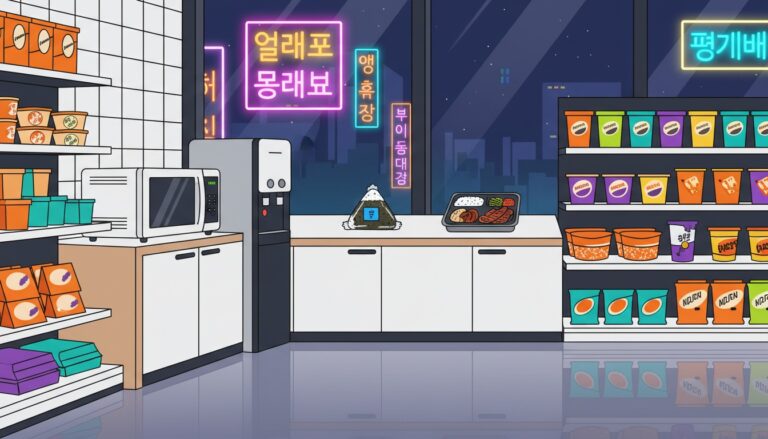
Phase 1: The “Cold Rice” Tragedy
Hello! Daily Hangul editor here.
Picture this: You’ve just finished watching a K-Pop concert in Seoul. You’re hungry, your throat hurts from screaming the fan chants, and it’s 11 PM. You walk into a brightly lit CU or GS25 (Korean convenience stores). You grab a Dosirak (Bento box) or a Samgak-gimbap (Triangular Kimbap) because you’ve seen your favorite K-Drama characters eat them.
You sit down, open the package, take a bite… and it’s ice cold. The rice is hard. The cheese isn’t melted. It’s tragic.
You look around. Everyone else is eating steaming hot food. They are all standing in front of a machine in the corner. That, my friend, is the Microwave Zone.
Today, I’m going to teach you how to survive this moment so you never have to eat hard, cold rice again. Let’s learn the magic word: “Dol-li-da.”
Phase 2: Deep Dive — The Magic Word
1. 데워 주세요 vs. 돌리세요
Wait, textbooks usually teach “De-wo-ju-se-yo” (Please heat it up). While correct, in a Korean convenience store, you do it yourself. So, you need to know the verb everyone actually uses.
🇰🇷 이거 전자레인지에 돌려요?
(Igeo jeon-ja-ren-ji-e dol-lyeo-yo?)
- Pronunciation:
Ee-geo(Like ‘Eagle’ without ‘l’) +Jeon-ja-ren-ji(Sounds like ‘Ginger’ + ‘Range’) +Dol-lyeo-yo(Doll-yuh-yo) - Meaning:
- Literal: Do I spin this in the microwave?
- Real Nuance: Do I need to microwave this?
- Editor’s Insight: Why “Spin” (돌리다)? Look inside a microwave. The plate spins, right? Koreans focus on the action of the machine. It’s much more casual and common than saying “heat up.”
- Situation Spectrum:
[🚫 Boss] ———— [⚠️ Stranger] ———— [✅ Store Clerk/Friend]
(Use polite ending ‘yo’ for clerks!)
🇰🇷 얼마나 돌려요?
(Eol-ma-na dol-lyeo-yo?)
- Pronunciation:
Ol-ma-na+Dol-lyeo-yo - Meaning: How long do I spin (microwave) it?
- K-Culture Moment: You’ll see this in variety shows like I Live Alone. A celebrity tries to cook a convenience store meal and stares blankly at the machine, muttering, “Eolmana dollyeoya doeji?” (How long should I spin this?)
- 🤔 Think About It: In English, we say “nuke it” or “zap it.” In Korean, we say “spin it.” Does your language focus on the sound, the action, or the result?
Phase 3: Textbook vs. Real Life
| Situation | 📖 Textbook Korean | 🗣️ Real Korean | 💡 Why different? |
|---|---|---|---|
| Asking to use it | 전자레인지를 사용해도 됩니까? (Can I use the microwave?) | 여기 돌려도 돼요? (Can I spin here?) | “Use” sounds too technical. “Spin” is the action. |
| Asking for time | 몇 분 동안 데워야 합니까? (For how many minutes must I heat it?) | 몇 분 돌려요? (How many minutes spin?) | Efficiency! We want to eat fast. |
Note: A2 Level learners often try to be too polite. In a busy convenience store, short and clear is actually more polite because it saves everyone’s time.
Phase 4: Cultural Context — The “Ding!” Culture
4-1. Nunchi (Eye-measure)
In Korea, most convenience stores are Self-Service. The clerk won’t ask if you want it heated; they assume you know where the microwave is. If you stand at the counter waiting for them to do it, that’s a lack of nunchi! Look for the counter in the corner with microwaves and hot water dispensers.
4-2. The “700W vs 1000W” Mystery
This is the most confusing part for foreigners, but it’s crucial for K-Food fans.
Look at the back of your Samgak-gimbap. You will see two numbers:
– 1000W (Store Standard): 20 sec
– 700W (Home Standard): 30 sec
Convenience store microwaves are industrial strength (1000W). If you use the home time (700W), your kimbap will explode or get too hot to hold. Always look for the smaller number when you are at the store.
Phase 5: Roleplay Scenario
Setting: A GS25 near the Han River Park. It’s Friday night. You bought a spicy pork bento box.
Characters:
– YOU: Hungry traveler.
– Clerk: Part-time student, looking at their phone, but polite.
Dialogue:
YOU: (Holding the bento) 저기요, 이거 전자레인지에 돌려요?
(Jeogiyo, igeo jeon-ja-ren-ji-e dol-lyeo-yo?)
(Excuse me, do I microwave this?)
Clerk: 네, 뒤에 있어요.
(Ne, dwi-e i-sseo-yo.)
(Yes, it’s behind you.)
YOU: 아, 감사합니다. 음… [ DECISION POINT ]
🔀 Your Turn! How do you ask for the time?
– A) 시간은요? (Time?)
– B) 얼마나 돌려요? (How long do I spin it?)
– C) 몇 시예요? (What time is it?)
✅ Best Choice (B): “How long do I spin it?” is the most natural fit.
⚠️ Choice A: A bit too abrupt.
❌ Choice C: You are asking the current time (e.g., 8:00 PM), not the cooking time!
(Selecting B)
Clerk: 2분만 돌리세요.
(I-bun-man dol-li-se-yo.)
(Just spin it for 2 minutes.)
Phase 6: 10-Second Shadowing
Let’s practice saying it naturally. Don’t be robotic!
- Thinking Face 🤔: 이거 / 얼마나 / 돌려요?
(Igeo / eolmana / dollyeoyo?)
“How long do I spin this?” -
Surprised Face 😲: 앗! / 너무 / 뜨거워요!
(At! / neomu / tteugeowoyo!)
“Ouch! It’s too hot!”
Phase 7: K-Culture Mini Glossary
| Korean | Romanization | Meaning | Context |
|---|---|---|---|
| 삼각김밥 | Samgak-gimbap | Triangle Kimbap | The soul food of students and busy workers. |
| 컵라면 | Cup-ramyeon | Cup Noodles | The classic partner for kimbap. Use the hot water dispenser! |
| 2+1 | Two-plus-one | Buy 2 Get 1 Free | The magic sale sign you must look for. |
Phase 8: Traveler’s Survival Kit
🆘 Survival Card: The Microwave
- 🇰🇷 “어떻게 해요?” (Eotteoke haeyo?)
- English: How do I do this?
- Use when: The microwave buttons are all in Korean and you are panicked.
- Pro Tip: Most Korean convenience store microwaves have a Green Button that says “조리 시작” (Start Cooking). Usually, pressing number “1” adds 10 seconds, and “2” adds 20 seconds. If confused, just press the green button multiple times!
📌 Editor’s Travel Note:
Be careful with eggs. Some smoked eggs (Hoon-je-ran) will explode if you microwave them. Check the package for the “Do Not Microwave” symbol (a microwave with a generic ‘X’ over it).
Phase 9: Think Deeper — “Palli-Palli” Culture
Have you noticed something? Korean convenience store food is designed to be cooked in under 2 minutes. The microwaves are high-powered (1000W). The language itself (“Spin it”) focuses on the action.
This reflects Korea’s “Palli-Palli” (Hurry-Hurry) culture. It’s not just about impatience; it’s about high efficiency and respecting other people’s time in a crowded society. When you quickly “spin” your food and move aside for the next person, you are participating in this silent social contract.
💬 Your Turn: In your country, is eating at a convenience store common? Or is food meant to be eaten slowly? Let me know in the comments!
Phase 10: FAQ & Troubleshooting
Q: Can I ask the clerk to do it for me?
A: Generally, No. Unless you have a disability or the store is completely empty and you look very confused, it’s expected that you do it yourself. It’s part of the experience!
Q: Can I eat outside food (like a burger from another shop) in the convenience store?
A: No. Only eat what you bought there. It’s considered rude to occupy a table without being a customer.
❌ Common Mistake: Putting the entire bento box in with the lid sealed tight.
✅ Fix: Slightly open the lid (pop the corner) before microwaving. Otherwise, the steam will make the container expand and pop!
Phase 11: Wrap-up
Today we learned that in Korea, we don’t just “use” the microwave, we “spin” (dol-li-da) it!
Action Missions:
– 🥉 Bronze: Say “Elemana dollyeoyo?” out loud 3 times right now.
– 🥈 Silver: Next time you use a microwave at home, say “Dollyeoyo!” as you press start.
– 🥇 Gold: Go to a Korean mart or convenience store, find a Samgak-gimbap, and find the “1000W” cooking time on the label.
Phase 12: Interactive Quiz
1. What is the most natural way to ask “How long do I microwave this?”
A) 시간 얼마예요? (How much is the time?)
B) 얼마나 돌려요? (How long do I spin it?)
C) 전자레인지 있어요? (Do you have a microwave?)
2. True or False?
You should keep the lid of your bento box completely closed and sealed when microwaving.
Answers:
1. B (A is asking price of time(?), C is asking existence).
2. False (You must open it slightly to let steam escape!).
Frequently Asked Questions (FAQ)
Q: What does ""조리 시작"" mean in Korean and how do you pronounce it?
A: In Korean, ""조리 시작"" is pronounced [Start Cooking] and means: . Usually, pressing number "1" adds 10 seconds, and "2" adds 20 seconds. If confused, just press the green button multiple times!







