

Hello! This is your Daily Hangul Editor.
Have you ever heard the sound “Dang-geun!” 🥕 ringing out on a subway in Seoul? If you have, you’ve witnessed the heartbeat of modern Korean recycling culture. It’s the notification sound for Karrot Market (Danggeun Market), the app that revolutionized how Koreans buy, sell, and—most importantly—give away used items.
In K-Dramas, you might see a protagonist moving into a rooftop apartment and receiving a plate of rice cakes from a neighbor. That’s the old school Jeong (affection). Today, that Jeong has moved digital. We don’t just throw things away; we do “Nanum” (Sharing). Whether you’re leaving Korea and emptying your room, or you just bought a new toaster and don’t need the old one, knowing how to give things away for free will make you popular in your neighborhood instantly.
Let’s learn how to turn your trash into someone else’s treasure, Korean style.
Phase 2: Deep Dive into Core Expressions
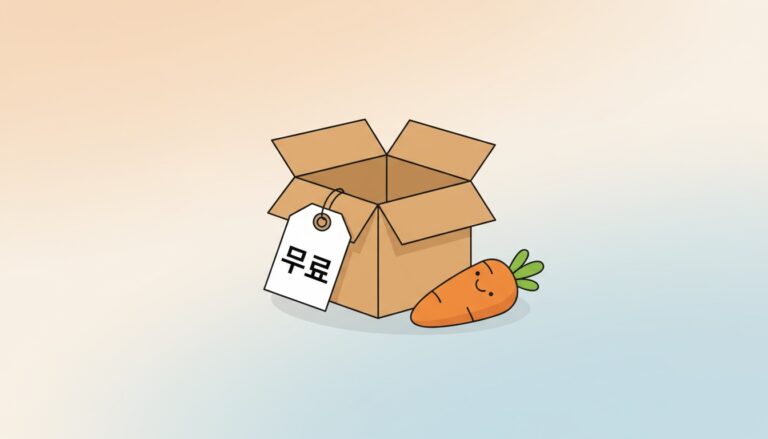
1. 무료 나눔해요 (Muryo nanum-haeyo)
- Pronunciation: [Muryo nanum-haeyo] + (Sounds like “Moo-ryo na-num hay-yo”)
- Meaning: I’m giving this away for free / Free sharing.
- Context: ‘무료’ means free (cost), and ‘나눔’ comes from the verb ‘나누다’ (to share/divide). This is the standard title you’ll see on apps or community boards.
- K-Culture Moment: You know those K-Pop birthday cafes where fans give away cup holders and stickers? That is also a form of ‘Nanum’. It’s a culture of spreading joy without expecting money.
- Editor’s Insight: Using just “Free” (공짜 – Gong-jja) can sound a bit cheap or like the item has zero value. “Nanum” implies you are doing a good deed. It sounds much warmer.
- Situation Spectrum:
[🚫 Boss] ———— [⚠️ Colleague] ———— [✅ Neighbors/Online] - 🤔 Think About It: Why does Korean distinguish between ‘free’ (no cost) and ‘sharing’ (act of kindness)? How does this reflect the community spirit?
2. 선착순이에요 (Seonchak-sun-ieyo)
- Pronunciation: [Seonchak-sun-ieyo] + (Sounds like “Sun-chak-soon ee-ae-yo”)
- Meaning: First come, first served.
- Context: When you post something free, your phone will explode with messages. You need to set boundaries. This phrase tells people, “The fastest person gets it.”
- K-Drama Vibe: Imagine a limited edition sale scene where the main character runs in slow motion. That urgency? That’s Seonchak-sun.
- Editor’s Insight: This is your shield. If someone messages you an hour later complaining, you just say, “Sorry, it was Seonchak-sun.”
- Situation Spectrum:
[🚫 Elders] ———— [✅ Everyone else]
3. 문고리 거래 가능해요? (Mungori geolae ganeunghaeyo?)
- Pronunciation: [Mungori geolae ganeung-haeyo?] + (Sounds like “Moon-go-ree guh-lay ga-neung-hay-yo?”)
- Meaning: Is a doorknob trade possible? / Can I leave it on the doorknob?
- Context: ‘문고리’ is a doorknob. This means leaving the item hanging on your front door so the taker can pick it up without meeting you face-to-face. Very popular post-pandemic.
- Editor’s Insight: This requires a high level of trust. In many countries, the item would be stolen by a stranger. In Korea, it usually stays there until the right person comes. It’s the ultimate “Introvert’s transaction.”
Phase 3: Textbook vs. Real Life
| Situation | 📖 Textbook Korean | 🗣️ Real Korean (Street/App) | 💡 Why the difference? |
|---|---|---|---|
| Posting the Title | 이 물건을 무료로 드립니다. (I give this item for free.) | 무나해요 / 나눔 (Sharing!) | Koreans love shortening words (Muk-bang, Chi-maek). ‘Muna’ is short for Muryo Nanum. |
| Closing the deal | 거래가 완료되었습니다. (The transaction is complete.) | 나눔 완료 / 나눔 완 (Sharing done.) | On mobile, brevity is king. ‘Wan’ implies ‘Wan-ryo’ (Complete). |
| Asking for condition | 상태가 어떻습니까? (How is the condition?) | 사용감 있나요? (Is there a feeling of use?) | Asking “Is it bad?” is rude. “Is there usage feeling?” is a polite, indirect way to check for scratches. |
Bottom Note: If you are B1 level, stick to “무료 나눔해요.” Slang like “무나” is cool, but make sure you know the full phrase first!
Phase 4: Cultural Deep Dive — The “Manner Temperature”
In the app Danggeun Market, every user has a “Manner Temperature” (매너온도). It starts at 36.5°C (body temperature). If you are polite, give free items, and reply fast, your temperature goes up. If you are rude or ghost people, it drops.
Non-verbal Tip: When handing over an item in person, even if it’s free, Koreans often put it in a clean paper bag. Handing over a naked toaster cord-dangling looks a bit careless. It’s about respecting the new owner.
K-Drama Connection: In Crash Landing on You, people in the village share food and items constantly. That village spirit is what modern Koreans are trying to recreate digitally through these apps.
Phase 5: Immersive Roleplay
Setting: You are moving out and giving away a decent table lamp on the app. It’s Saturday afternoon.
Characters:
– YOU: A generous expat cleaning your room.
– NEIGHBOR: A university student living nearby.
Scenario:
NEIGHBOR: 저기요, 이거 아직 있나요? 💡
(Jeogiyo, igeo ajik innayo?)
(Excuse me, is this still available?)
YOU: 네, 있어요! [ 1. Select your response ]
(Ne, isseoyo! …)
(Yes, it is! …)
🔀 Your Turn! How do you proceed?
– A) “언제 오실 수 있어요?” (When can you come?)
– B) “문고리 거래 하실래요?” (Do you want to do a doorknob trade?)
– C) “빨리 오세요.” (Come quickly.)
NEIGHBOR: (If you chose B) 아, 네! 편하고 좋네요. 몇 호로 가면 될까요?
(Ah, ne! Pyeonhago jonneyo. Myeot horo gamyeon doelkkayo?)
(Oh, yes! That’s comfortable and good. Which apartment number should I go to?)
YOU: 201호입니다. 문 앞에 둘게요!
(Ibaek-il-ho imnida. Mun ape dulgeyo!)
(It’s number 201. I’ll leave it in front of the door!)
✅ Editor’s Pick: Choice B is very common these days. It saves time for both parties and avoids awkward small talk. Choice A is also perfect. Choice C sounds a bit demanding unless you specified “Right now only” in the post.
Phase 6: 10-Second Shadowing Drill
Let’s practice describing the condition honestly. Honesty raises your Manner Temperature!
Emotion: 😊 Friendly but honest
“작동은 / 잘 되는데 / 생활 기스가 / 좀 있어요.”
(Jakdong-eun / jal doenunde / saenghwal giseu-ga / jom isseoyo.)
Translation: “It works / well, but / there are some / signs of daily use (scratches).”
Note: ‘Skinship’ and ‘Service’ are Konglish, and so is ‘Giseu’ (from Japanese ‘Kizu’). ‘생활 기스’ refers to those tiny scratches that happen naturally over time.
Phase 7: K-Culture Mini Glossary
| Korean | Romanization | Meaning | Context |
|---|---|---|---|
| 당근 | Danggeun | Karrot (Market) | The definitive app for local second-hand trade. Also means ‘Carrot’. |
| 쿨거래 | Kul-geolae | Cool Deal | A quick transaction with no haggling or fuss. “I’ll take it now.” |
| 네고 | Nego | Negotiation | Short for Negotiation. “Nego ganeung?” (Can you lower the price?) |
| 나눔 | Nanum | Sharing | Giving away for free. |
| 득템 | Deuk-tem | Item Get | Slang for getting a great item (usually cheap or free). From gaming ‘Item Get’. |
Phase 8: Traveler’s Survival Kit
Even if you aren’t living in Korea, you might need to dispose of things (like a broken suitcase) or give away leftover unopened food/supplies before leaving.
🆘 Survival Expression #1
– 🇰🇷 “이거 무료로 드려요.” (Igeo muryo-ro deuryeoyo.)
– 🗣️ Usage: Leaving a hostel/Airbnb and giving leftover ramyun to the host or other guests.
– 💡 Pro Tip: In Korea, you usually have to pay money (buy a sticker) to throw away large items like suitcases (Dae-hyeong pyegimul). Giving it away for free to someone who can fix it saves you money!📌 Editor’s Note:
Do not leave large trash on the street thinking “Someone will take it.” That is illegal dumping. If you leave it, attach a note: “필요하신 분 가져가세요 (Take it if you need it)”, but if no one takes it in 24 hours, you must dispose of it properly.
Phase 9: Think Deeper — Trust in Society
Why does “Doorknob Trading” work in Korea?
The fact that people can leave laptops, air fryers, and clothes outside their front doors for hours says a lot about Korean society. Is it the CCTV cameras everywhere? Or is it a cultural contract? Korea has a high level of social pressure to maintain a “good citizen” image. In the realm of Nanum, breaking that trust (stealing a free item intended for someone else) is seen as incredibly shameful.
💬 Your Turn: In your country, would you feel safe leaving a used iPhone box on your porch for a stranger to pick up? Why or why not?
Phase 10: FAQ & Troubleshooting
Q: Can I ask for a refund on a free item if it breaks immediately?
A: NO. 🚫 It’s free. The etiquette is to thank the giver and dispose of it yourself if it doesn’t work. Complaining about a free gift is considered very rude (Remember the proverb: “Don’t look a gift horse in the mouth”).
Q: Can I give away opened food?
A: Usually No. ⚠️ Unopened canned food or ramyun packs are okay. But half-eaten kimchi or opened milk? Absolutely not. That’s trash, not a gift.
❌ Common Mistake: Expecting the giver to deliver.
✅ The Rule: If it’s free, you go to them. Do not ask, “Can you bring it to my station?” unless they offered first.
Phase 11: Wrap-up & Action Mission
Summary: Today we learned how to share items using “무료 나눔”, manage expectations with “선착순”, and use the convenient “문고리 거래”.
🚀 Action Missions:
– 🥉 Bronze: Say “무료 나눔해요” aloud three times while imagining handing over an item.
– 🥈 Silver: Go to a Korean community app (or even Instagram) and search #무료나눔 to see what people are giving away.
– 🥇 Gold: Have something you don’t need? Offer it to a Korean friend or colleague saying, “이거 안 써서 그러는데, 무료 나눔해요!” (I’m not using this, so I’m sharing it for free!)
Phase 12: Interactive Quiz
1. Situation: You posted a free chair. 10 people messaged you. You want to give it to the first person. What do you add to your post?
– A) 네고 사절 (No negotiation)
– B) 선착순 (First come first served)
– C) 환불 불가 (No refunds)
2. True or False?
– “It is polite to ask a person giving away a free heavy desk to deliver it to your house because you don’t have a car.”
– (Answer: False. The receiver usually handles transportation.)
3. Decode the Slang:
– “쿨거래 하시면 덤 드려요.”
– (Hint: Cool deal + Bonus)
– Meaning: “If you make this transaction quick and easy, I’ll give you a free bonus item.”
(Scroll down for answers)
👇
👇
Answers: 1 (B), 2 (False), 3 (If we trade quickly, I give a bonus.)
Frequently Asked Questions (FAQ)
Q: What does "무료 나눔해요 (Muryo nanum-haeyo)" mean in Korean and how do you pronounce it?
A: In Korean, "무료 나눔해요 (Muryo nanum-haeyo)" is pronounced [Muryo nanum-haeyo] and means: I'm giving this away for free / Free sharing.
Q: What does "선착순이에요 (Seonchak-sun-ieyo)" mean in Korean and how do you pronounce it?
A: In Korean, "선착순이에요 (Seonchak-sun-ieyo)" is pronounced [Seonchak-sun-ieyo] and means: First come, first served.
Q: What does "문고리 거래 가능해요? (Mungori geolae ganeunghaeyo?)" mean in Korean and how do you pronounce it?
A: In Korean, "문고리 거래 가능해요? (Mungori geolae ganeunghaeyo?)" is pronounced [Mungori geolae ganeung-haeyo?] and means: Is a doorknob trade possible? / Can I leave it on the doorknob?







