

Fire & Ice: Why Koreans Eat Hot Sweet Potatoes with Icy Kimchi
Phase 1: The Immersive Hook
Hello! Your Daily Hangul editor here.
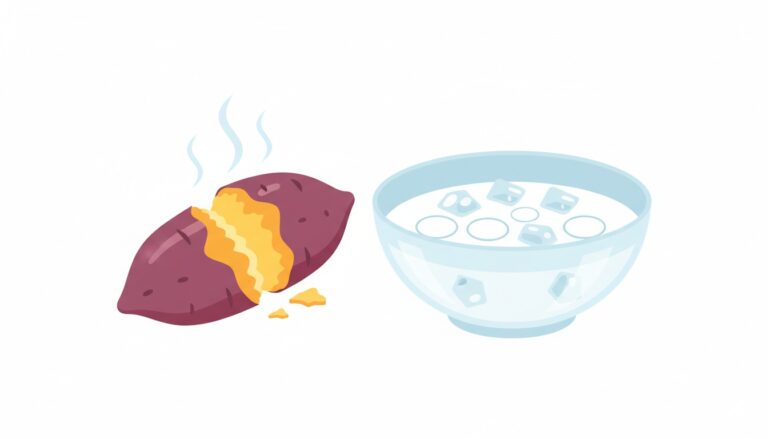
Imagine this scene: Outside, the Seoul wind is biting your face—it’s minus 10 degrees. You rush into a warm room with a heated floor (Ondol). Someone hands you a foil-wrapped, roasting hot sweet potato. You peel it, burning your fingertips slightly, and take a bite. It’s sweet, soft, and… suddenly, your throat feels dry. You can’t swallow.
Just then, a stainless steel bowl slides toward you. Inside is clear liquid with floating radish cubes and shards of ice. You take a sip. Whoosh. Everything goes down.
If you’ve watched Reply 1988, you know this moment. It’s the legendary combo of Gun-goguma (roasted sweet potato) and Dongchimi (radish water kimchi).
Today, we aren’t just eating; we are learning how to talk about texture, physical sensations, and the unique Korean love for temperature contrast.
Phase 2: Deep Dive — Key Expressions
Here are the three phrases that define this winter experience.
1. 호호 불다 (Ho-ho bulda)
- Pronunciation: [ho-ho bulda] (Sounds like Santa laughing + ‘bull’ + ‘da’)
- Meaning: To blow on hot food to cool it down.
- K-Culture Moment: In every K-Drama, when the male lead hands the female lead a hot fish cake or potato, he doesn’t just give it to her. He blows on it first—ho, ho. It’s a classic sign of affection.
- Editor’s Insight: ‘Ho-ho’ is an onomatopoeia for the sound of blowing air. You can also use it for blowing on frozen hands to warm them up!
- Situation Spectrum:
[🚫 Formal(Boss)] ———— [✅ Casual(Friends)]
(It’s an action verb, so usage depends on the sentence ending, but the action itself is universal.)- 🤔 Think About It: English doesn’t really have a specific verb for “blowing to cool food.” Why do you think Korean has specific words for these small physical actions?
2. 목이 메다 (Mogi meda)
- Pronunciation: [mogi meda]
- Meaning: To feel choked up; throat feels dry/blocked.
- K-Culture Moment: You eat a dry sweet potato, biscuit, or hard-boiled egg yolk without water. That stuck feeling? That is mogi meda.
- Editor’s Insight: This has a double meaning. Physically, it means food is stuck. Emotionally, it means you are “choked up” with sadness or emotion.
- Example: “그 영화를 보고 목이 메었어요.” (I got choked up watching that movie.)
- Situation Spectrum:
[✅ Casual] ———— [✅ Formal]- 🤔 Think About It: Why do Koreans associate the physical sensation of a dry throat with the emotional sensation of sadness?
3. 속이 뻥 뚫리다 (Sogi ppeong ttullida)
- Pronunciation: [sogi ppeong ttul-li-da]
- Meaning: To feel completely relieved / Digestion unblocked.
- K-Culture Moment: You drink the icy Dongchimi brine after the dry potato. The blockage is gone. You say this phrase.
- Editor’s Insight: ‘Ppeong’ is the sound of a cork popping or an explosion. This is used when indigestion is cured, OR when a frustrating problem is finally solved.
- Situation Spectrum:
[✅ Casual] ———— [⚠️ Semi-formal] ———— [🚫 Formal Meetings]
Phase 3: Textbook vs. Real Life
| Situation | 📖 Textbook Korean | 🗣️ Real Korean | 💡 Why is it different? |
|---|---|---|---|
| Evaluating the taste | 맛있어요 (Masisseoyo) | 꿀맛이야! (Kkul-mat-iya!) | Literally “Honey taste.” Koreans love comparing sweet things to honey. |
| Feeling refreshed | 시원해요 (Siwonhaeyo) | 캬~ 시원하다! (Kya~ Siwonhada!) | ‘Kya’ is the involuntary sound you make after a good drink. |
| Too hot to touch | 뜨거워요 (Tteugeowoyo) | 아 뜨, 아 뜨! (A-tteu, A-tteu!) | In real life, you don’t speak full sentences when you’re burning your fingers. |
Bottom Note: Siwonhada is tricky. It means “cool,” but we also say it when eating hot soup or sitting in a sauna to mean “relieving/refreshing.” Context is king!
Phase 4: Cultural Deep Dive
4-1. The “Goguma” vs. “Cider” Slang
Did you know these snacks are now personality types in Korea?
– Goguma (Sweet Potato): A situation (or person) that is frustrating, slow, and stuffy. Like a drama plot where the couple just won’t confess.
– Example: “Watching this drama is total goguma.”
– Cider (Sprite/7-Up): A situation that is refreshing, fast, and resolves the frustration. Like when the villain finally gets caught.
– Example: “That ending was total cider!”
Dongchimi plays the role of “Cider” in the traditional food pairing!
4-2. Non-verbal: The “Finger Dance”
When eating a hot roasted sweet potato, you never just hold it. You juggle it quickly between your left and right hands while making a “Hoo! Hoo!” sound. This “hot potato dance” is a universal body language in Korea during winter.
Phase 5: Immersive Roleplay
Setting: A snowy Saturday night at your friend Minji’s apartment. You are sitting on the floor (Ondol) watching Netflix. Minji brings out a tray.
Minji: 자, 군고구마 가져왔어. 엄청 뜨거우니까 조심해.
(Ja, gun-goguma gajyeowasseo. Eomcheong tteugeounikka josimhae.)
(Here, brought the roasted sweet potatoes. It’s super hot, so be careful.)
YOU (Select your reaction):
🔀 Decision Point:
– A) (Grab it firmly) “고마워!” (Gomawo!)
– B) (Juggle it between hands) “아 뜨, 아 뜨! 호호~” (A-tteu, A-tteu! Ho-ho~)
– C) “포크 있어요?” (Do you have a fork?)
✅ Best Choice: B
This is the most natural reaction. Choice A will burn your hand, and Choice C kills the vibe—sweet potatoes taste better when eaten with your hands!
Minji: (Laughing) 야, 천천히 먹어. 여기 동치미 국물도 마셔.
(Ya, cheoncheonhi meogeo. Yeogi dongchimi gukmuldo masyeo.)
(Hey, eat slowly. Drink this Dongchimi broth, too.)
YOU: (Takes a sip after a bite of dry potato)
“와… 진짜 [BLANK]!”
Fill in the blank:
– A) 목이 메다 (Mogi meda)
– B) 속이 뻥 뚫린다 (Sogi ppeong ttullinda)
✅ Answer: B. The liquid resolves the dryness. If you said A, it means the water made you choke!
Phase 6: 10-Second Shadowing Drill
Let’s practice the feeling of relief. Imagine drinking cold sparkling water after a long run.
😤 Emotion: Total satisfaction & relief
동치미를 마시니까 / 속이 / 뻥~ 뚫려요!
(Dongchimi-reul masinikka / sogi / ppeong~ ttul-lyeoyo!)
Drinking Dongchimi / makes my insides / completely clear up!
Phase 7: K-Culture Glossary
| Korean | Romanization | Meaning & Context |
|---|---|---|
| 군고구마 | Gun-goguma | Roasted sweet potato. ‘Gun’ comes from ‘Gupda’ (to roast). |
| 동치미 | Dongchimi | Radish water kimchi. It’s not spicy; it’s salty, tangy, and icy. |
| 온돌 | Ondol | Korean floor heating system. The reason we sit on the floor in winter. |
| 궁합 | Gunghap | Compatibility/Chemistry. Used for couples, but often used for food pairings (like potato & kimchi). |
Phase 8: Traveler’s Survival Kit
Finding sweet potatoes in modern Seoul isn’t hard, but finding the good ones takes skill.
🆘 Survival Expressions
– 🇰🇷 “현금 계좌이체 돼요?” (Hyeongeum gyejwa-iche dwaeyo?)
– Can I send a bank transfer? (Many street stalls don’t take cards, but they all take transfers!)
– 🇰🇷 “이거 꿀고구마예요, 밤고구마예요?” (Igeo kkul-goguma-yeyo, bam-goguma-yeyo?)
– Is this ‘honey’ potato (soft/wet) or ‘chestnut’ potato (firm/dry)?
– 💡 Pro Tip: Convenience stores (GS25, CU) now sell baked sweet potatoes near the counter in winter. They are surprisingly high quality!
Phase 9: Think Deeper — “Hot & Cold”
Why do Koreans love extreme temperature contrasts?
Notice the pattern: Boiling hot stew served with ice-cold water. A 90-degree sauna followed by chilled Sikhye (rice punch). And here, burning hot potatoes with icy Dongchimi.
This isn’t just about taste; it’s about balance—Korean “Yin and Yang” (Eum-Yang) in food therapy. The hot potato heats the body, but too much heat can cause stagnation. The cold, fermented radish aids digestion and cools the “fire.”
💬 Your Turn: Does your culture have a “Fire and Ice” food combination? Or is mixing temperatures a taboo?
Phase 10: FAQ & Troubleshooting
- Q: Can I eat the skin of the roasted sweet potato?
- A: Yes, it’s edible and healthy! However, most Koreans peel it because the texture can be tough, and the charred parts taste bitter. If it’s washed well and not burnt, go for it.
- Q: Is Dongchimi spicy?
- A: No! This is the biggest misconception. It is salty and sour (from fermentation). It’s perfectly safe for people who can’t handle spice.
- ❌ Common Mistake: Using “Hot” (Maepda) instead of “Hot” (Tteugeopda).
- If the potato burns your tongue, it is Tteugeowo (Temperature hot).
- If the kimchi burns your tongue, it is Maewo (Spicy hot).
- Don’t say the potato is Maewo!
Phase 11: Wrap-up & Mission
One-Liner: When life gives you dry sweet potatoes (frustration), find your Dongchimi (relief)!
Action Missions:
– 🥉 Bronze: Whisper “Ho-ho” next time you eat something hot.
– 🥈 Silver: Go to a Korean grocery store, buy Dongchimi broth (packaged), and try it.
– 🥇 Gold: Watch a Mukbang video of “Gun-goguma” and comment using the phrase “꿀맛이네요!” (It looks like honey taste!).
Phase 12: Quiz
1. Which phrase describes the feeling of a dry throat when eating a yolk or potato?
– A) Sogi ppeong ttullida
– B) Mogi meda
– C) Ho-ho bulda
2. True or False:
– “Goguma” is slang for a situation that is refreshing and fast-paced. (T/F)
3. Why is Dongchimi paired with sweet potatoes?
– A) To make it spicier.
– B) To aid digestion and clear the throat.
– C) To heat up the body.
(Answers: 1-B, 2-False [That’s ‘Cider’], 3-B)
Frequently Asked Questions (FAQ)
Q: What does "호호 불다 (Ho-ho bulda)" mean in Korean and how do you pronounce it?
A: In Korean, "호호 불다 (Ho-ho bulda)" is pronounced [ho-ho bulda] and means: To blow on hot food to cool it down.
Q: What does "목이 메다 (Mogi meda)" mean in Korean and how do you pronounce it?
A: In Korean, "목이 메다 (Mogi meda)" is pronounced [mogi meda] and means: To feel choked up; throat feels dry/blocked.
Q: What does "속이 뻥 뚫리다 (Sogi ppeong ttullida)" mean in Korean and how do you pronounce it?
A: In Korean, "속이 뻥 뚫리다 (Sogi ppeong ttullida)" is pronounced [sogi ppeong ttul-li-da] and means: To feel completely relieved / Digestion unblocked.







