

Phase 1: The “Leg Day” for Your Soul
Hello, Daily Hangul readers.
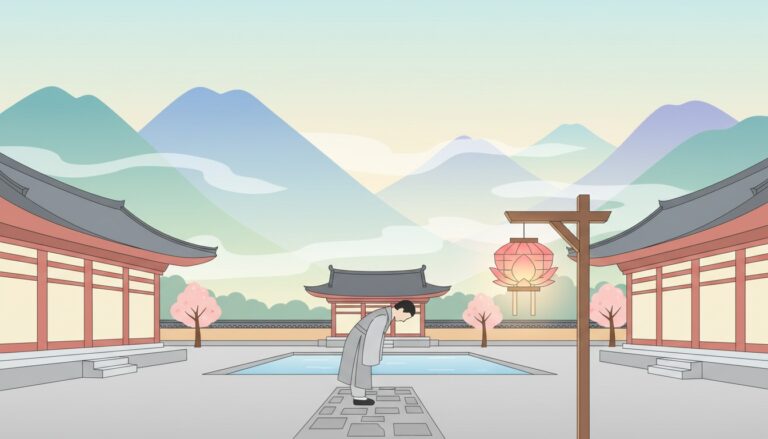
Imagine this: You are in a serene temple in the mountains of Gangwon-do. The air smells like pine needles and incense. It’s 4:00 AM. You should be sleeping, but instead, you are doing your 57th bow. Your thighs are burning, your knees are screaming, and you’ve lost count.
If you’ve watched Korean variety shows like 2 Days & 1 Night or I Live Alone, you’ve seen celebrities sent to temples for “mental training.” They sweat, they groan, and they struggle to finish 108 bows (108배). You might wonder: Is this torture or therapy?
In Korea, the Temple Stay isn’t just a tourist attraction; it’s a reset button. It’s where stressed office workers, students preparing for exams, and people going through breakups go to escape the “Hell Joseon” rat race. Today, we aren’t just learning words for “prayer.” We are learning the language of emptying your mind—C1 level Korean for describing your internal state, your struggles, and that weird sense of clarity that comes after physical exhaustion.
Phase 2: Deep Dive into Inner Peace (and Pain)
1. 번뇌 (Beonnoe)
- Pronunciation: [beon-noe] (Sounds like ‘burn’ + ‘no’ + ‘eh’ quickly combined)
- Meaning: Anguish / Worldly desires / Mental clutter
- Nuance: This is a Buddhist term that has bled into everyday high-level Korean. It refers to the 108 anxieties that plague humans—greed, anger, obsession, jealousy. In a secular context, it’s used when your head is full of complicated, stressful thoughts.
- K-Culture Moment: In a melodrama, when the protagonist stares blankly at the Han River, sighing heavily. A friend might ask, “Why is your face so dark?” The protagonist replies, “Just… too much beonnoe.”
- Situation Spectrum:
[🚫 Casual Slang] ———— [✅ Deep Conv.] ———— [✅ Formal/Literary] - 🤔 Think About It: Why does Korean distinguish between simple “worry” (걱정) and existential “anguish” (번뇌)? Does your language have a specific word for mental suffering caused by your own desires?
2. 마음을 비우다 (Maeum-eul biuda)
- Pronunciation: [ma-eum-eul bi-u-da]
- Meaning: To empty one’s mind / To let go of greed or obsession
- Editor’s Insight: Literally “to empty the heart/mind.” You use this when you stop obsessing over a promotion, a crush, or a result. It implies reaching a state of acceptance. It is the ultimate goal of the 108 bows.
- Real Life Example:
- “이번 프로젝트 결과는 그냥 마음 비웠어.” (I’ve just emptied my mind regarding the results of this project = I’m not stressing about the outcome anymore.)
3. 묵언 수행 (Mugeon suhaeng)
- Pronunciation: [mug-eon su-haeng]
- Meaning: Vow of silence / Practice of silence
- Nuance: Mugeon means silence, suhaeng means ascetic practice. While used in temples, Koreans use this metaphorically in the city. If a friend is unusually quiet or refusing to talk about a sensitive topic, they might jokingly say, “Don’t ask. I’m doing mugeon suhaeng right now.”
Phase 3: Textbook vs. Real Korean
Let’s see how a C1 learner sounds compared to a textbook beginner.
| Situation | 📖 Textbook Korean | 🗣️ Real C1 Korean | 💡 The Context |
|---|---|---|---|
| Going to a temple | 저는 절에 가서 기도할 거예요. (I will go to a temple and pray.) | 속세를 좀 떠나 있고 싶어서 템플 스테이 신청했어. (I wanted to leave the secular world for a bit, so I signed up for a temple stay.) | “Sok-se” (secular world) adds a dramatic, weary nuance perfectly suited for burnt-out adults. |
| During 108 bows | 다리가 너무 아파요. (My legs hurt too much.) | 무념무상으로 절하다 보니 다리 감각이 없어. (Bowing in a state of no thought, no desire, I’ve lost feeling in my legs.) | “Munyeom-musang” is a four-character idiom for a mind free of distracting thoughts. |
| Feeling better | 기분이 좋아졌어요. (I feel better.) | 머릿속이 한결 개운해졌어. (Inside my head feels much lighter/refreshed.) | “Gaeunhada” is the specific feeling after a sauna, a good sleep, or resolving a worry. |
Phase 4: Cultural Context — The Art of Not Trying
4-1. The “Half-Bow” (Banjol)
You don’t do a full prostration (knees to floor) when you meet a monk on the temple grounds. You stop, put your hands together in front of your chest (Hapjang), and bow your head slightly. Eye contact is soft—don’t stare them down, but don’t look at the floor in shame either.
4-2. K-Drama Connection: The “Exile” Trope
Have you noticed in dramas like The Glory or Secret Garden, wealthy characters or those seeking redemption retreat to a temple? It’s a visual shorthand for “I am disconnecting from society to reset.” In reality, the food is bland (temple food has no garlic or green onions/scallions because they are believed to stimulate libido and anger), and the wake-up call is 3 AM. It’s not a vacation; it’s discipline.
Phase 5: Immersive Roleplay
Setting: It is 6:00 AM. You have just finished the morning chanting and 108 bows. You are sitting on the wooden porch (maru) with a fellow participant, Min-su, drinking lotus leaf tea. Your legs are trembling.
Min-su: (Rubbing his knees) 와, 오랜만에 108배 하니까 죽겠네요. 번뇌가 사라지는 게 아니라 무릎 연골이 사라지는 기분인데요?
(Wa, doing 108 bows for the first time in a while is killing me. It feels like my knee cartilage is disappearing, not my anguish!)
YOU (Your turn):
- Option A: 저도요. 너무 힘들어서 포기하고 싶었어요. (Me too. It was so hard I wanted to give up.)
- Option B: 그러게요. 근데 마지막엔 진짜 아무 생각도 안 들더라고요. 몸은 힘든데 머리는 맑아진 것 같아요. (Right? But at the end, I really had zero thoughts. My body is tired, but my head feels cleared.)
- Option C: 스님은 어떻게 매일 하시죠? 대박이에요. (How does the monk do this every day? It’s daebak.)
✅ Best Choice: B
Why? This is the C1 answer. You acknowledge the physical pain (“Geureogeyo” – agreeing with his complaint) but pivot to the internal result (“Meori-neun malgajin” – head became clear). This shows you understand the purpose of the bows.
(Dialogue Continues)
Min-su: 맞아요, 그 맛에 하는 거죠. 혹시 공양(meal) 드시러 가실래요? 절밥이 맛은 슴슴해도 건강엔 최고잖아요.
(That’s right, that’s the taste [reason] we do it. Shall we go for Gongyang? Temple food is bland, but best for health.)
Phase 6: 10초 섀도잉 (10-Second Shadowing)
Let’s practice the rhythm of a person who has found peace (or is trying to).
Context: Explaining to a friend why you went to the temple.
😊 Emotion: Calm, slightly relieved, contemplative.
“복잡한 생각들을 / 좀 내려놓고 싶어서 / 템플 스테이를 다녀왔어.”
(Bokjapan saenggak-deureul / jom naeryeo-notgo sipeoseo / tempeul seutei-reul danyeo-wasseo.)
Translation: I went to a temple stay because I wanted to put down my complicated thoughts for a bit.
Phase 7: K-Culture Mini Dictionary
| Korean | Romanization | Meaning | Context |
|---|---|---|---|
| 스님 | Seunim | Monk | Never call a monk “Ahjussi.” Always “Seunim.” |
| 공양 | Gongyang | Meal (Buddhist term) | In a temple, eating is also practice. You must clear every grain of rice. No leftovers allowed (Balwoo Gongyang). |
| 합장 | Hapjang | Palms together | The gesture of greeting. |
| 속세 | Sok-se | Secular world | The world outside the temple (where work, money, and stress exist). |
Phase 8: Traveler’s Survival Kit (Temple Edition)
Going to a Temple Stay? Here is what you need to know to survive without awkwardness.
🆘 Survival Phrases
- “촬영 해도 되나요?” (Chwaryeong haedo doenayo?)
- Can I take photos? (Some shrines or Buddha statues are strictly no-photo zones. Always ask.)
- “묵언 중입니다.” (Mugeon jung-imnida.)
- I am practicing silence. (Use this badge or phrase if you want people to leave you alone.)
- “다리가 저려요.” (Dariga jeoryeoyo.)
- My legs are numb/asleep. (Useful after sitting cross-legged for 20 minutes.)
📌 Editor’s Note:
Most major temples (like Jingwansa or Bongeunsa in Seoul) provide comfortable pants and vests for participants. You don’t need to bring special clothes, but wear socks. Being barefoot in the main Buddha hall is considered rude (and in winter, your toes will freeze).
Phase 9: Think Deeper — Pain as Peace?
Why do Koreans equate physical suffering with mental clarity?
The concept of 108 bows is fascinating because it forces the body to take over the mind. In Korean culture, there is a strong belief that mental anguish (Beonnoe) cannot be solved by sitting on a sofa and thinking. You must sweat it out. This aligns with the cultural concept of “Han” (deep resentment/sorrow)—an emotion so thick it needs physical release to be resolved. By counting to 108, you stop thinking about your boss or your bank account because you are too busy trying not to fall over.
💬 Your Turn: Does your culture have a practice where you induce physical difficulty to find mental peace? (e.g., fasting, pilgrimage, ice baths?). Let me know in the comments!
Phase 10: FAQ & Troubleshooting
Q: I’m not Buddhist. Can I still do the 108 bows?
A: Absolutely. In the context of a Temple Stay program, 108 bows are often presented as physical and mental exercise rather than a strictly religious rite of submission. Many Christians and atheists participate for the meditative aspect. Just follow the physical motions respectfully.
Q: Can I stretch my legs if they hurt during meditation?
A: Yes, but do it quietly. Don’t make a scene. If you can’t sit cross-legged (Yangban-dari), it’s okay to sit with your legs to the side, but never point the soles of your feet directly at the Buddha statue. That is considered very disrespectful.
❌ Common Mistake: Walking into the main hall through the center door.
✅ Fix: The center door is for the monks. Visitors should enter through the side doors.
Phase 11: Wrap-up & Mission
Today we learned that in Korea, sometimes you have to hurt your body to heal your mind.
🚀 Your Action Mission:
- 🥉 Bronze: Practice saying “Mugeon suhaeng” (Vow of silence) next time you don’t want to talk to anyone.
- 🥈 Silver: Watch a YouTube video of “108 bows” and try doing just 10. See how your breathing changes.
- 🥇 Gold: If you are in Korea, visit a nearby temple, find a quiet spot (not the main hall if you are shy), and try sitting in silence for 10 minutes without checking your phone.
K-Culture Mission: Search for the scene in the drama My Mister (나의 아저씨) where the characters visit the temple. Listen closely to the ambient sounds—the wind chimes and the silence. That is the vibe we studied today.
See you in the next lesson, where we might explore the chaos of Korean nightlife to balance out today’s silence! 👋
Frequently Asked Questions (FAQ)
Q: What does "번뇌 (Beonnoe)" mean in Korean and how do you pronounce it?
A: In Korean, "번뇌 (Beonnoe)" is pronounced [beon-noe] and means: Anguish / Worldly desires / Mental clutter
Q: What does "마음을 비우다 (Maeum-eul biuda)" mean in Korean and how do you pronounce it?
A: In Korean, "마음을 비우다 (Maeum-eul biuda)" is pronounced [ma-eum-eul bi-u-da] and means: To empty one's mind / To let go of greed or obsession
Q: What does "묵언 수행 (Mugeon suhaeng)" mean in Korean and how do you pronounce it?
A: In Korean, "묵언 수행 (Mugeon suhaeng)" is pronounced [mug-eon su-haeng] and means: Vow of silence / Practice of silence







