

Fake Reviews, Real Regret: Navigating the “Trust Deficit” in Korean Consumer Culture
Phase 1: The Immersive Hook
Greeting: 안녕하세요! This is your Daily Hangul editor, writing to you from a cafe in Seongsu-dong that I thought was famous.
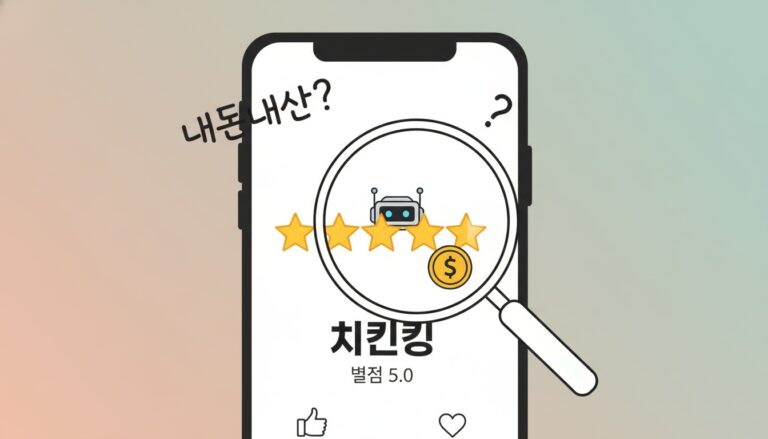
Picture this: You are scrolling through Naver Maps or Baedal Minjok (delivery app), starving. You find a fried chicken place with a perfect 5.0 rating and 2,000 reviews. The photos look like art. You order it. It arrives cold, the batter is soggy, and the portion is tiny.
What happened? You just fell into the trap of 리뷰 조작 (Review Manipulation).
In Korea, where trends move at the speed of light, the battle between savvy consumers and marketing algorithms is fierce. If you watch K-Dramas, you’ve seen the protagonist working part-time writing fake comments to boost a product’s image. This isn’t just fiction; it’s a real social issue known as “viral marketing part-timers” (바이럴 알바). Today, we aren’t just learning words; we are learning skepticism—a necessary survival skill in the hyper-connected Korean market.
Phase 2: Deep Dive into Core Expressions
1. 내돈내산 [Nae-don-nae-san]
- Pronunciation: [Nae-don-nae-san] Sounds like “Nay-don-nay-san”
- Meaning: Literally “My money, my purchase.” (I bought this with my own money).
- K-Culture Moment: This is the golden shield of Korean influencers. After the huge “Backdoor Advertising” (뒷광고) scandal where YouTubers pretended sponsored items were personal favorites, this hashtag became mandatory for survival. If a review doesn’t say this, Koreans assume it’s an ad.
- Editor’s Insight: This is a C2-level cultural marker. It represents a demand for transparency. Use this when you recommend something to a Korean friend to prove you aren’t just hyping it up for no reason.
- Situation Spectrum:
[🚫 Formal Report] ———— [⚠️ Semi-formal] ———— [✅ Casual/Internet]
(Mostly used in blogs, social media, and casual conversation. In a formal business meeting, use “자비로 구매했습니다” instead.) - 🤔 Think About It: Why does Korean society require a specific four-character idiom just to prove we actually paid for something? What does that say about the baseline level of trust in online information?
2. 걸러듣다 [Geol-leo-deut-da]
- Pronunciation: [Geol-leo-deut-da] Sounds like “Gull-luh-dute-da”
- Meaning: To listen with a filter; to take with a grain of salt.
- K-Culture Moment: In office dramas like Misaeng, when a boss makes a vague promise about a promotion, the experienced colleague tells the rookie: “Just filter that out” (그냥 걸러들어).
- Editor’s Insight: Georeuda means to filter or sift (like flour). This verb suggests active critical thinking. You aren’t ignoring them (ignoring is 무시하다); you are processing the information but discarding the fake parts.
- Situation Spectrum:
[🚫 To Elders] ———— [⚠️ Colleagues] ———— [✅ Friends]
( telling a superior to “filter” something is rude. Use it to advise peers.) - 🤔 Think About It: Is “filtering” considered cynical in your culture, or is it seen as being street-smart?
3. 알바 풀다 [Alba pul-da]
- Pronunciation: [Al-ba pul-da]
- Meaning: To deploy part-timers (fake reviewers).
- K-Culture Moment: You see a sudden spike in compliments for a mediocre idol singer or a terrible restaurant? A Netizen detective might comment: “야, 여기 알바 풀었네” (Hey, they deployed the part-timers here).
- Editor’s Insight: Pulda means to untie or release (like releasing dogs). It implies a deliberate, strategic release of a “swarm” of fake accounts to manipulate public opinion.
Phase 3: Textbook vs. Real Life
| Situation | 📖 Textbook Korean | 🗣️ Real Korean | 💡 The “Why” |
|---|---|---|---|
| Suspecting an Ad | 이 리뷰는 거짓말 같습니다. (This review seems like a lie.) | 이거 완전 광고 냄새 나는데? (This smells totally like an ad.) | Koreans use olfactory metaphors (“smell”) to describe suspicion. |
| Checking Credibility | 영수증이 있습니까? (Do you have a receipt?) | 영수증 인증 된 거야? (Is the receipt verified?) | “Verification” (인증) is the currency of trust in the Korean internet age. |
| Bad Experience | 저는 추천하지 않습니다. (I do not recommend it.) | 비추예요. / 거르세요. (Not rec / Filter this place.) | Efficiency rules online. Shortened slang conveys the warning faster. |
Phase 4: Cultural Deep Dive — The Art of “Nunchi” in Reading Reviews
Reading the Silence:
In Korean culture, direct confrontation is often avoided. This extends to reviews. If a review for a restaurant talks endlessly about the “kind owner” (사장님이 친절해요) or the “pretty interior” (인테리어가 예뻐요) but never mentions the taste, your Nunchi radar should scream: The food is terrible.
The “Blogji” Phenomenon:
A portmanteau of Blog + Beggar (Geoji). It refers to bloggers who demand free food in exchange for positive reviews. Restaurant owners despise them. Understanding this dynamic helps you understand why some owners are sensitive about photography.
K-Drama Trope:
The “Viral Marketing Team” scene. A room full of people with multiple phones, clicking “Like” and writing comments like “Woah, Daebak!” This is a satire of reality. In Korea, public opinion (Yeoron) is powerful, and manufacturing it is a business.
Phase 5: Immersive Roleplay Scenario
Setting: A trendy cafe district in Seoul (Yeonnam-dong). You and your Korean friend, Min-ji, are looking for a place to eat. Min-ji is glued to her smartphone.
Characters:
* YOU: A skeptical foodie who has been tricked before.
* Min-ji: Easily swayed by pretty Instagram photos.
Dialogue:
Min-ji: 와, 여기 봐! 별점 4.9점이야. 사진도 대박인데? 여기서 먹자! ✨
(Wa, yeogi bwa! Byeoljeom 4.9-jeomiya. Sajindo daebaginde? Yeogiseo meokja!)
(Wow, look here! 4.9 stars. The photos are epic too. Let’s eat here!)
YOU: 잠깐만. 리뷰 개수가 몇 개야? 너무 갑자기 많아진 거 아니야?
(Jamkkanman. Ribyu gaesuga myeot gaeya? Neomu gapjagi manajin geo aniya?)
(Hold on. How many reviews are there? Didn’t they increase too suddenly?)
Min-ji: 음… 3,000개? 오픈한 지 한 달밖에 안 됐다는데…
(Eum… 3,000-gae? Opeunhan ji han dalbakke an dwaetdaneunde…)
(Um… 3,000? They say it’s only been open for a month…)
🔀 Decision Point: How do you warn her?
- Option A: “그건 불가능해요. 가지 맙시다.” (Too dry, textbook style)
- Option B: “야, 그거 100% 알바 푼 거야. 거르자.” (Native-level skepticism)
- Option C: “사장님이 돈이 많으신가 봐.” (High-level sarcasm)
✅ Best Choice: Option B. It shows you understand the mechanics of review manipulation.
⚠️ Choice C Analysis: This is very witty and implies “They spent a lot on marketing,” but Min-ji might miss the sarcasm if she’s distracted.
YOU (Option B): 야, 한 달 만에 3,000개? 그거 100% 알바 푼 거야. 그냥 거르자.
(Ya, han dal mane 3,000-gae? Geugeo 100% alba pun geoya. Geunyang georeuja.)
(Hey, 3,000 in a month? That’s 100% fake reviewers. Let’s just skip/filter it.)
Min-ji: 헐, 진짜네? 자세히 보니까 멘트가 다 똑같아. 소름 돋아… 😱
(Heol, jinjjane? Jasehi bonikka menteuga da ttokgata. Soreum doda…)
(Whoa, you’re right? Looking closely, the comments are all identical. Goosebumps…)
Phase 6: 10-Second Shadowing Drill
Let’s practice the tone of a skeptical detective. Don’t sound angry; sound sharp.
Passage:
🤔 이 리뷰는 / 너무 / 광고 냄새가 / 나는데요? (I ribyu-neun / neomu / gwang-go naem-sae-ga / naneundeyo?)
Emotion Guide:
* 이 리뷰는 (Neutral tone)
* 너무 (Stress this word, elongate slightly)
* 광고 냄새가 (Lower pitch, suspicious tone)
* 나는데요? (Rising intonation, like you caught someone in the act)
Phase 7: K-Culture Mini Glossary
| Korean | Romanization | English | Context |
|---|---|---|---|
| 뒷광고 | Dwit-gwang-go | Backdoor Ad | Paid promotion disguised as organic content. A massive taboo in Korea now. |
| 별점 테러 | Byeol-jeom te-reo | Star Rating Terror | Maliciously bombing a business with 1-star reviews. |
| 인생샷 | In-saeng-shot | Life Shot | A photo so good it’s the best of your life. Often the only reason people visit “fake” cafes. |
| 주작 | Ju-jak | Fabrication | Slang for manipulation/fake. “이거 주작 아냐?” (Isn’t this staged?) |
Phase 8: Traveler’s Survival Kit (Review Edition)
Don’t let Naver Maps fool you. Here is how to survive the algorithm.
🆘 Survival Expression #1
* 🇰🇷 “여기 현지인 맛집 맞나요?” (Yeogi hyeon-ji-in mat-jip man-nayo?)
* 🗣️ Meaning: “Is this place actually popular with locals?”
* 💡 Pro Tip: Ask a taxi driver or hotel concierge this. Don’t ask the guy standing in front of the restaurant handing out flyers.📌 Editor’s Tech Tip: The “Yeongsujeung” Filter
When using Naver Maps, look for the “영수증 리뷰” (Receipt Review) tab. These are reviews from people who verified their payment. They are 90% more trustworthy than general blog posts.
Phase 9: Think Deeper — The Trust Economy
Media vs. Reality:
Korea is a high-context, high-trust society that transitioned rapidly into a digital, low-trust environment. The term “Nae-don-nae-san” is fascinating because it implies that the default assumption of online content is dishonesty. In a culture that values “Face” (Chemyon), being exposed for lying (like the Backdoor Advertising scandal) is social suicide. Yet, the pressure to succeed drives businesses to manipulate the system.
🧠 Think Deeper:
In your country, how do you spot fake reviews? Do you have specific slang like “Backdoor Ad” or “Nae-don-nae-san”? If not, does that mean your marketing is more honest, or just less scrutinized?
Phase 10: FAQ & Troubleshooting
Q: Can I use “Nae-don-nae-san” even if it was cheap?
A: Yes! It’s about the source of the money, not the amount. Even for a 1,000 won snack review, using it adds credibility.
Q: Is it rude to look up reviews while standing in front of the owner?
A: It’s a bit awkward. Korean Nunchi suggests you do it discretely before entering, or step aside. Doing it right in their face might imply you don’t trust them (which is true, but we don’t show it!).
❌ Common Mistake: Believing blogs with overly professional photos.
✅ The Fix: Look for shaky, badly lit photos. Those are usually real. If the kimchi looks messy, the review is honest.
Phase 11: Wrap-up & Action Mission
One-Liner: Authentic reviews are rare; use your “Nunchi” and look for the “Nae-don-nae-san” badge.
Action Mission:
* 🥉 Bronze: Say “이거 광고 냄새 나는데?” while scrolling through your own social media feed today.
* 🥈 Silver: Go to a Korean restaurant’s Google Maps page and try to identify which reviews look like “Alba” (fake) and which are real.
* 🥇 Gold: Next time you buy something good, post a story with the hashtag #내돈내산 (even if it’s in English/your language context, explain it to your friends!).
K-Culture Mission: Watch a Mukbang YouTuber’s apology video (search “뒷광고 사과” on YouTube). Observe the solemn atmosphere and black suit. It shows how serious this violation of trust is in Korea.
Phase 12: Quiz — The “Detective” Challenge
1. Situation Judgment: You see a new cafe with 500 reviews. All of them were written in the last 3 days. What is the most appropriate reaction?
* A) 와, 정말 인기가 많구나! (Wow, so popular!)
* B) 사장님이 인맥이 넓으신가 봐요. (The owner must have a wide network.)
* C) 이거 냄새가 나는데… 알바 푼 거 아냐? (This smells fishy… did they deploy part-timers?)
2. True or False:
* “Receipt Reviews” (영수증 리뷰) on Naver are generally less trustworthy than Blog reviews. (True/False)
Answers:
1. C (This is the classic sign of manipulation.)
2. False (Receipt reviews are verified purchases and are much more trusted.)
Frequently Asked Questions (FAQ)
Q: What does "내돈내산 [Nae-don-nae-san]" mean in Korean and how do you pronounce it?
A: In Korean, "내돈내산 [Nae-don-nae-san]" is pronounced [Nae-don-nae-san] and means: Literally "My money, my purchase." (I bought this with my own money).
Q: What does "걸러듣다 [Geol-leo-deut-da]" mean in Korean and how do you pronounce it?
A: In Korean, "걸러듣다 [Geol-leo-deut-da]" is pronounced [Geol-leo-deut-da] and means: To listen with a filter; to take with a grain of salt.
Q: What does "알바 풀다 [Alba pul-da]" mean in Korean and how do you pronounce it?
A: In Korean, "알바 풀다 [Alba pul-da]" is pronounced [Al-ba pul-da] and means: To deploy part-timers (fake reviewers).







