

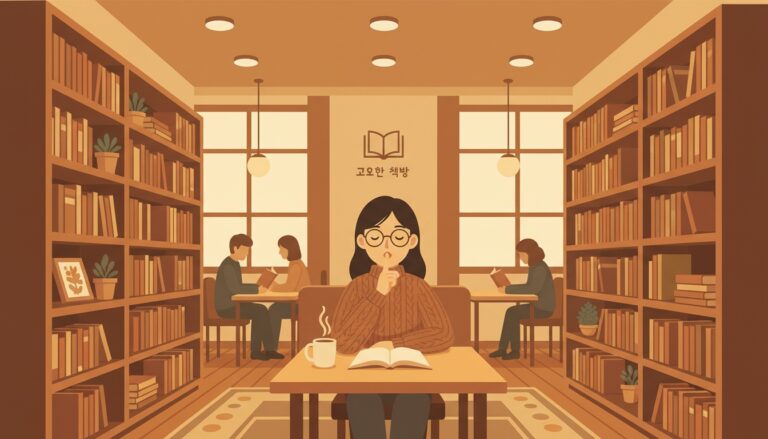
Phase 1: The “Shh” Factor — An Immersive Opening
안녕하세요! Hello! I’m your editor at Daily Hangul.
Let’s set the scene. You are at a trendy Book Cafe in Seoul—maybe the famous Starfield Library in Coex involving those towering bookshelves you’ve seen on Instagram. You’re trying to read, but the guy next to you is on the phone. Loudly. He’s practically shouting about his stock investments.
In a K-Drama, the main character might dramatically slam a book shut and glare. But in real life? You need the magic words.
Learning how to ask for silence isn’t just about libraries. It’s for the movie theater, the subway, or when your Korean friends get a little too excited at a late-night study session. Today, we aren’t just learning “Shut up” (please don’t say that). We are learning the art of the “Polite Shh.”
I’ve seen students freeze in this exact situation because they didn’t want to be rude. But trust me, in Korea, disturbing the peace is the rude part. You are doing everyone a favor.
Phase 2: Deep Dive — The Magic Words
1. 조용히 해 주세요 (Joyonghi hae juseyo)
- Pronunciation: [Jo-yong-hee hae ju-se-yo]
- Sound Analogy: Jo (like ‘Joe’) + yong (like ‘young’) + hee (like ‘he’) + hae (like ‘hair’ without ‘r’) + ju-se-yo.
- Meaning: Please be quiet (Polite standard).
- K-Culture Moment: Think of the strict head student in a high school K-Drama (like Sky Castle) scolding the class. It’s firm but uses polite grammar.
- Editor’s Insight: This is your shield. It’s direct but respectful. You aren’t angry; you are just requesting a change in volume.
- Situation Spectrum:
[🚫 To Boss] ———— [✅ Strangers/Peers] ———— [✅ Kids]
🤔 Think About It: In English, we might say “Could you keep it down?” It’s a question. In Korean, it’s often a direct request (“Please do quietness”). Why do you think Korean prefers a direct request here rather than a roundabout question?
2. 쉿! (Shit!)
- Pronunciation: [Shit]
- Sound Analogy: Okay, don’t panic. It sounds exactly like the English curse word, but shorter and sharper. It’s just the sound “Shh” with a ‘t’ stop at the end.
- Meaning: Shh! / Hush!
- K-Culture Moment: Used by idols in variety shows when they are playing a “silence game” or hiding from a “zombie.”
- Editor’s Insight: Use this only with close friends or if you are being playful. Do not say this to the scary man on the subway. I repeat: Do not.
- Situation Spectrum:
[🚫 Strangers] ———— [⚠️ Close Friends] ———— [✅ Playful Situations]
3. 조금만… (Jogeum-man…)
- Pronunciation: [Jo-geum-man]
- Meaning: Just a little bit… (Implied: Please lower your voice a little bit).
- Editor’s Insight: Koreans love softer, incomplete sentences. Instead of commanding silence, you say “Just a little bit…” while making a lowering hand gesture. It’s the most “local” way to handle it.
Phase 3: Textbook vs. Real Life
| Context | 📖 Textbook Korean | 🗣️ Real Korean | 💡 Why the difference? |
|---|---|---|---|
| In a Library | 정숙해 주십시오. (Please maintain silence.) | 저기요, 조금만 조용히… (Excuse me, just a little quiet…) | “Textbook” sounds like a robot or a sign on the wall. “Real” focuses on not hurting feelings. |
| To a Friend | 조용히 해. (Be quiet.) | 아, 시끄러! (Ah, noisy!) | Friends complain about the noise rather than giving a command. It’s more intimate. |
Bottom Note: If you see the sign “정숙 (Jeongsuk)” in a library, that means “Silence.” It’s a written word, not a spoken one.
Phase 4: Cultural Deep Dive — The Art of ‘Nunchi’
4-1. The Silent Glare (Non-verbal)
Before you even speak, you must use your eyes. In a Korean library or subway, if someone is loud, people will give them “The Look.” This is a test of their Nunchi (the ability to read the room).
- Step 1: Stop what you are doing.
- Step 2: Look directly at the noisy person.
- Step 3: Hold the gaze for 2 seconds.
- Step 4: Return to your book.
Usually, this is enough. Using words is actually the “Level 2” escalation.
4-2. K-Drama Trope: The Library Whisper
You’ve seen it. The leads are in a university library. One whispers something cute, the other says “Joyonghi hae!” (Be quiet!) but smiles. In Korea, libraries and bookstores (like Kyobo Bookstore) are surprisingly popular date spots. The enforced silence actually creates intimacy because you have to whisper. It’s romantic tension 101.
Phase 5: Roleplay — The Loud Neighbor
Setting: A cozy corner of a franchise cafe (like Ediya Coffee). You are studying. A man (Min-su) sits next to you and starts watching YouTube without headphones.
Characters:
* YOU: A foreign student trying to focus.
* Min-su: A guy who forgot his headphones.
Dialogue:
(Sound of loud YouTube video echoing)
YOU: (Make eye contact first, then clear throat) Hmm…
Min-su: (Doesn’t notice, keeps laughing at the video) 🤣
🔀 Decision Point: He didn’t catch your Nunchi signal. What do you say?
- A) “저기요, 조용히 해 주세요.” (Excuse me, please be quiet.)
- B) “쉿!” (Shh!)
- C) “이어폰 없으세요?” (Do you not have earphones?)
✅ Best Choice: A. It is polite, direct, and standard. He will likely apologize immediately.
⚠️ Choice C Analysis: This is passive-aggressive. Effective? Yes. Friendly? No. You might start an argument.
🚫 Choice B Analysis: Rude. Unless Min-su is your little brother, don’t do it.
Let’s go with A:
YOU: 저기요… 조용히 좀 해 주세요.
(Jeogiyo… joyonghi jom hae juseyo.)
(English) Excuse me… please be a little quiet.
Min-su: 아! 죄송합니다! 몰랐어요.
(Ah! Joesong-hamnida! Mollasseoyo.)
(English) Ah! I’m sorry! I didn’t know.
(Stage Direction: Min-su frantically turns down the volume and bows slightly while sitting.)
Phase 6: 10-Second Shadowing Drill
Don’t just read it. Say it. Feel the rhythm.
- Emotion: Polite but firm. slightly lowered voice.
- Sentence: 저기요 / 조용히 / 해 주세요.
- Pronunciation: Jeo-gi-yo / jo-yong-hi / hae ju-se-yo.
🗣️ Trainer’s Tip: Put a little hesitation after “Jeo-gi-yo.” It softens the blow. “Jeo-gi-yo… (pause)… joyonghi hae juseyo.”
Phase 7: K-Culture Mini Glossary
| Korean | Romanization | English | Context |
|---|---|---|---|
| 독서실 | Dokseo-sil | Study Room | A super-quiet, cubicle-style study space. Talking here is a crime. |
| 눈치 | Nunchi | Eye-measure | Reading the vibe. “He has no nunchi” means he’s clueless. |
| 정숙 | Jeongsuk | Silence | Usually seen written on signs in libraries or museums. |
| 백색소음 | Baeksaek-soeum | White Noise | Many Korean students prefer cafes because they need this background noise to focus. |
Phase 8: Traveler’s Survival Kit (Bookstore Edition)
You are at Kyobo Bookstore in Gwanghwamun. It’s huge. Here is what you need.
🆘 Survival Expression #1
* 🇰🇷 “이 책 어디에 있어요?” (I chaek eodi-e isseoyo?)
* 🗣️ English: Where is this book?
* 💡 Pro Tip: Show them the photo of the book cover on your phone. It works 100% of the time.📌 Editor’s Travel Note
* Sitting on the floor: In big Korean bookstores, you will see people sitting on the floor or steps reading. It’s culturally accepted! Join them if you want.
* Best Souvenir: Korean stationery (Design Moon具) sections in bookstores are legendary. Buy the stickers.
Phase 9: Think Deeper — Silence & Collectivism
Why is silence so heavy in Korea?
In Western cultures, public space is often viewed as a place for expression. In Korea (and much of East Asia), public space is viewed as a shared responsibility. Being quiet isn’t just about “following rules”; it’s about not infringing on someone else’s space. This is why the subway is eerily quiet even during rush hour. Your noise is considered a physical invasion of my personal bubble.
💬 Your Turn: Does your country value silence in public transport, or is it a place for conversation? Tell me in the comments!
Phase 10: FAQ & Troubleshooting
- Q: Can I say “Shut up” to a rude person?
- A: The phrase is “닥쳐 (Dak-chyeo).” But seriously, don’t use it. It’s extremely aggressive, like starting a fistfight. Stick to Joyonghi hae juseyo.
- Q: Is it okay to answer a phone call in a bookstore?
- A: No. You should run (literally, walk fast) to the exit or the stairwell. Answering at your seat is a major Nunchi fail.
- Q: I saw a sign saying “No Kids Zone.” What is that?
- A: Some cafes and book-cafes in Korea ban children to ensure absolute quiet. It’s controversial, but it exists. Check the door before you enter with family!
❌ Common Mistake: Using the “Shh” finger gesture without saying anything to an older person.
✅ Fix: Always accompany the gesture with a slight bow or a verbal “Joesong-handeyo…” (I’m sorry, but…).
Phase 11: Wrap-up & Mission
Summary: Today we learned how to protect our peace using “Joyonghi hae juseyo” and the importance of Nunchi in Korean libraries.
🚀 Action Mission:
* 🥉 Bronze: Whisper “Joyonghi hae juseyo” to yourself in the mirror 3 times.
* 🥈 Silver: Watch a YouTube video of a “Korean Study with Me” vlog and see how quiet it is.
* 🥇 Gold: Go to a library or cafe. If you hear a loud noise, mentally practice the “Nunchi Glare” (don’t actually scare anyone!).
K-Culture Mission: Search for “Starfield Library Seoul” on Google Images. It’s breathtaking. Imagine yourself there—what book are you grabbing?
Phase 12: Quiz — Do You Have Nunchi?
1. You are in a strict ‘Dokseo-sil’ (Study Room). You drop your pen. It makes a loud CLANG.
* A) Say “Oops!” loudly.
* B) Ignore it.
* C) Quickly bow your head slightly to the people around you as a silent apology.
2. Which is the rude way to say “Be quiet”?
* A) Joyonghi hae juseyo.
* B) Dak-chyeo.
* C) Jogeum-man joyonghi…
3. True or False:
* “Shit!” in Korean sounds like a bad English word, but it just means “Hush!”
Answers: 1: (C), 2: (B), 3: (True)
See you in the next lesson! Stay quiet and study hard! 🤫
Frequently Asked Questions (FAQ)
Q: What does "조용히 해 주세요 (Joyonghi hae juseyo)" mean in Korean and how do you pronounce it?
A: In Korean, "조용히 해 주세요 (Joyonghi hae juseyo)" is pronounced [Jo-yong-hee hae ju-se-yo] and means: a key conversational Korean expression covered in this lesson.
Q: What does "쉿! (Shit!)" mean in Korean and how do you pronounce it?
A: In Korean, "쉿! (Shit!)" is pronounced [Shit] and means: a key conversational Korean expression covered in this lesson.
Q: What does "조금만... (Jogeum-man...)" mean in Korean and how do you pronounce it?
A: In Korean, "조금만... (Jogeum-man...)" is pronounced [Jo-geum-man] and means: Just a little bit... (Implied: Please lower your voice a little bit).







