

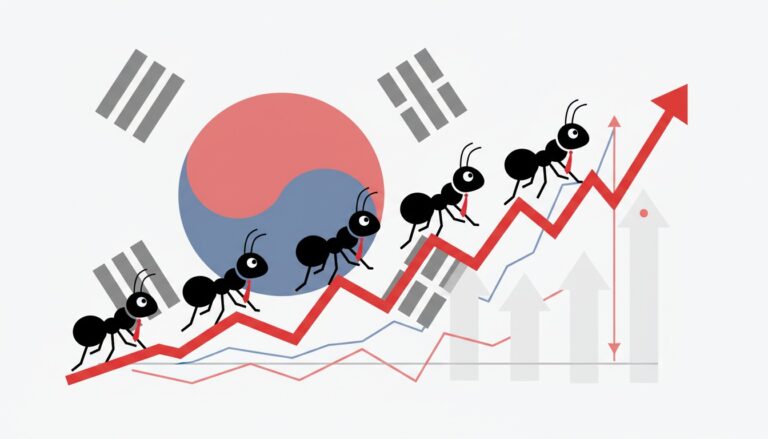
The “Ants” Are Marching: Inside Korea’s Stock Market Revolution
Phase 1: The Immersive Hook
Hello, Daily Hangul readers. It’s your editor here.
Picture this: It’s March 2020. The world is locking down. Panic is everywhere. But in Korea, something strange is happening. Instead of hoarding toilet paper, millions of people—students, housewives, office workers—are opening brokerage accounts. They are buying stocks as fast as foreign investors are selling them.
If you were in a taxi in Seoul during that time, the driver wasn’t talking about the weather. He was asking, “Samsung Electronics… is it the bottom yet?”
Welcome to the Donghak Ant Movement (동학 개미 운동). If you want to understand modern Korea, you have to look past K-Pop and look at K-Stocks. Why? Because for many Koreans, the stock market isn’t just about money—it’s viewed as the only ladder left to climb in a rigid society.
Today, we aren’t just learning vocabulary; we are decoding the desperation, the hope, and the fierce energy of Korea’s retail investors.
Phase 2: Deep Dive into Core Expressions
These are C2-level terms. They carry historical weight and raw emotion.
1. 동학 개미 운동 (Donghak Gaemi Undong)
- Pronunciation: [Dong-hak Gae-mi Un-dong] + Think “Dong-hak” (East Learning), “Gae-mi” (Ant), “Un-dong” (Movement).
- Meaning: Literal: Donghak Ant Movement. Real Nuance: A massive buying campaign by retail investors (Ants) defending domestic stocks against foreign sell-offs.
- K-Culture Moment: The name references the Donghak Peasant Revolution of 1894, a historical anti-foreign/anti-feudal uprising. By using this name, the media framed stock buying as a form of economic patriotism.
- Editor’s Insight: Using this term shows you understand Korean history. It elevates a conversation about money into a conversation about national identity.
- Situation Spectrum:
[🚫 Formal Biz Report] ———— [✅ News/Debate/Casual]- 🤔 Think About It: Why use a “war” metaphor for investing? Does this reflect a “Us vs. Them” (Common people vs. Wall Street) mentality unique to Korea?
2. 존버 (Jonber)
- Pronunciation: [Jon-beo] + Rhymes with “John” + “Burr” (cold).
- Meaning: Literal: Acronym for vulgar slang (Jonna Beotigi). Real Nuance: HODL (Holding On for Dear Life). Enduring a crash without selling, painfully waiting for a rebound.
- K-Culture Moment: You’ll hear this in every pocha (tent bar) when the market is red. “Samsung is down 30%? Just Jonber.”
- Editor’s Insight: It originated as slang, but it’s so widespread that even major news outlets use sanitized versions like “Jongang Beotigi” (Holding on with all might) to explain it. It captures the Korean spirit of grit through suffering.
- Situation Spectrum:
[🚫 Elders/Boss] ———— [⚠️ Close Colleagues] ———— [✅ Friends]- 🤔 Think About It: Is “Jonber” distinct from long-term investing? It often implies a lack of choice—you have to hold because selling now means total ruin.
3. 성투 (Seongtu)
- Pronunciation: [Seong-tu]
- Meaning: Literal: Successful Investment. Real Nuance: “Good luck!” or “May your portfolio go green.”
- K-Culture Moment: The standard closing greeting in online investment forums (like DC Inside or Naver Cafe). “Everyone, Seongtu today!”
- Editor’s Insight: Just as hikers say “An-san” (Safe hiking), investors say “Seongtu.” It reflects a communal wish for survival in a volatile market.
- Situation Spectrum:
[✅ Online/Text] ———— [✅ Casual Speech] ———— [⚠️ Formal Writing]
Phase 3: Textbook vs. Real Life
| Context | 📖 Textbook Korean | 🗣️ Real Korean (The “Ant” Language) | 💡 Why the difference? |
|---|---|---|---|
| Buying | 매수하다 (Maesu-hada) | 줍줍하다 (Jupjup-hada) | From “Jupgo Jupda” (pick up and pick up). Implies scavenging for cheap deals. |
| Market Crash | 주가가 폭락했다 (Stock prices crashed) | 떡락했다 (Tteokrak-haetda) | “Tteok” emphasizes the heavy, sudden nature of the fall. (Opposite: Tteoksang). |
| Trapped | 손해를 보고 있다 (Seeing a loss) | 물렸다 (Mullyeotda) | Lit: “Bitten.” You are bitten by the stock and can’t escape. Passive victimhood. |
💡 Editor’s Note: Using “Mullyeotda” (I’m bitten) instantly builds camaraderie. It says, “I made a mistake, and now I’m suffering,” which makes you relatable.
Phase 4: Cultural Context — The “Why” Behind the Ants
4-1. The Nunchi of Trading at Work
In Korean offices, everyone has dual monitors. One is for Excel, the other—often a tiny, minimized window—is the MTS (Mobile Trading System) or HTS (Home Trading System). The Nunchi game here is intense. You must react to a market crash without changing your facial expression during a meeting. If a colleague sighs deeply at 9:05 AM, don’t ask “What’s wrong?” Just nod. They probably just checked their portfolio.
4-2. Hell Joseon & The Ladder
Why is everyone an “Ant”? Connect this to the concept of “Hell Joseon” (a satirical term for socio-economic struggle). For the younger generation (MZ gen), relying on a salary alone feels insufficient for buying an apartment in Seoul. The stock market (and crypto) is viewed not as a gamble, but as the only remaining fast track to class mobility. This adds a layer of desperation to the vocabulary.
Phase 5: Immersive Roleplay — The Post-Work Soju
Setting: A noisy Samgyeopsal place in Yeouido (Korea’s Wall Street). It’s Friday night. Burnt meat smell mixes with cigarette smoke.
Characters:
– YOU: An expat who bought Korean stocks because of the hype.
– Min-su: Your Korean colleague, a self-proclaimed “Stock Expert” who is actually down 40%.
Min-su: (Pouring Soju) Ha… did you see the KOSPI today? The foreigners are selling everything again. My Samsung Electronics is crying.
(Romanization) Ha… oneul KOSPI bwasseo? Oegugin-deuri da palgo isseo. Nae Samjeon-eun ulgo itda.
🔀 Your Turn! How do you respond?
Option A: “Yes, the market volatility is high.” (Too formal, kills the vibe)
Option B: “Just Jonber! It will go up eventually!” (Optimistic, supportive)
Option C: “I’m bitten (mullyeotda) too… Let’s just drink.” (Empathetic, creates a bond)
If you choose Option C:
YOU: Don’t talk about it… I’m deeply bitten (mullyeotda) on Kakao right now. Let’s just drink.
(Romanization) Mal-do ma… Na jigeum Kakao-e gipge mullyeosseo. Sul-ina masija.
Min-su: (Clinking glasses loudly) Aigoo! Comrade! Let’s pray for Tteoksang (skyrocketing) next week! Jjan!
Phase 6: 10-Second Shadowing Drill
Let’s practice the ultimate mantra of the Korean Ant.
Emotion: Resigned but hopeful (Bittersweet)
“Even if I’m bitten now / I will Jonber / until the rescue team arrives!”
🗣️ Korean: 지-금-은 / 물-렸-지-만 / 구-조-대-가 / 올-때-까-지 / 존-버-한-다!
🔊 Guide: Ji-geumeun / mul-lyeot-ji-man / gu-jo-dae-ga / ol-ttae-kka-ji / jon-beo-han-da!
Note: “Rescue Team” (Gujodae) refers to the price rising back to your purchase price, allowing you to exit without loss.
Phase 7: K-Culture Mini Glossary
| Korean | Rom | Meaning | Context |
|---|---|---|---|
| 따상 | Ttasang | Double Price + Upper Limit | The jackpot. When an IPO stock doubles on day 1 and hits the daily limit (+30%). |
| 성지순례 | Seongji-sullye | Pilgrimage | Visiting an old post that correctly predicted the future to comment “grant my wish.” |
| 한강 가즈아 | Hangang Gajua | Let’s go to Han River | Dark Humor. Implies suicide due to bankruptcy, or sometimes just cooling off. Use with extreme caution. |
Phase 8: Business Traveler’s Survival Kit
You aren’t just a tourist; you are an investor.
🆘 Survival Expression #1
– 🇰🇷 “요즘 장이 어때요?” (Yojeum jang-i eottaeyo?)
– Meaning: “How is the market these days?”
– Where to use: Taxi drivers, business partners (during small talk).
– Pro Tip: This is a magic key. Ask this to a taxi driver, and you will get a 20-minute lecture on the Korean economy, politics, and which CEO is scandalous.📌 Editor’s Note: Red vs. Blue
Be careful! In the West, Red means loss and Blue/Green means gain. In Korea (and China/Japan), Red (🔴) is UP/Good and Blue (🔵) is DOWN/Bad. Don’t panic if you see red arrows!
Phase 9: Think Deeper — Language & Collective Identity
The Militarization of Finance
Notice the language: “Donghak Movement,” “Ants,” “Rescue Team,” “Bullet (Cash).” Korean financial slang is heavily militarized. This reflects a collective psychology where the market is a battlefield against powerful external forces (Institutions/Foreigners). Unlike the Western focus on individual “alpha,” Korean retail investors often move in swarms (the “Ant” metaphor), driven by online community consensus.
💬 Your Turn: Does your language have specific slang for retail investors? Is it derogatory (like “dumb money”) or empowering (like “Ants”)?
Phase 10: FAQ & Troubleshooting
Q: Can I use “Jonber” with my boss?
A: NO. It has vulgar roots. Even if you are close, it’s risky. Stick to “Janggi tuja” (Long-term investment) with superiors.
Q: Is it rude to ask how much someone made in stocks?
A: Yes, asking for specific amounts is rude. But asking “Is your atmosphere good?” (Are you red or blue?) is a very common casual conversation starter among friends.
❌ Common Mistake: Thinking “Gaemi” (Ant) is an insult.
✅ Correction: It is a self-deprecating but proud identity. You can call yourself an Ant.
Phase 11: Wrap-up & Action Mission
One-Liner: To speak Korean business, you must understand the heart of the “Ant.”
🏆 Action Missions:
– Bronze: Look at a Korean stock chart (Naver Finance). Identify if it is Red (Up) or Blue (Down).
– Silver: Find a Korean news article about stocks and look for the word “개미” (Gaemi) in the comments.
– Gold: Ask a Korean friend, “Hoksi… stocks haseyo?” (Do you do stocks?) and watch their reaction.
K-Culture Mission: Watch the movie “Money” (돈) starring Ryu Jun-yeol to see the dramatic visualization of this world.
See you in the next lesson, and may you all Seongtu! 👋
Frequently Asked Questions (FAQ)
Q: What does "동학 개미 운동 (Donghak Gaemi Undong)" mean in Korean and how do you pronounce it?
A: In Korean, "동학 개미 운동 (Donghak Gaemi Undong)" is pronounced [Dong-hak Gae-mi Un-dong] and means: Literal: Donghak Ant Movement. Real Nuance: A massive buying campaign by retail investors (Ants) defending domestic stocks against foreign sell-offs.
Q: What does "존버 (Jonber)" mean in Korean and how do you pronounce it?
A: In Korean, "존버 (Jonber)" is pronounced [Jon-beo] and means: Literal: Acronym for vulgar slang (Jonna Beotigi). Real Nuance: HODL (Holding On for Dear Life). Enduring a crash without selling, painfully waiting for a rebound.
Q: What does "성투 (Seongtu)" mean in Korean and how do you pronounce it?
A: In Korean, "성투 (Seongtu)" is pronounced [Seong-tu] and means: Literal: Successful Investment. Real Nuance: "Good luck!" or "May your portfolio go green."







